Table of Contents
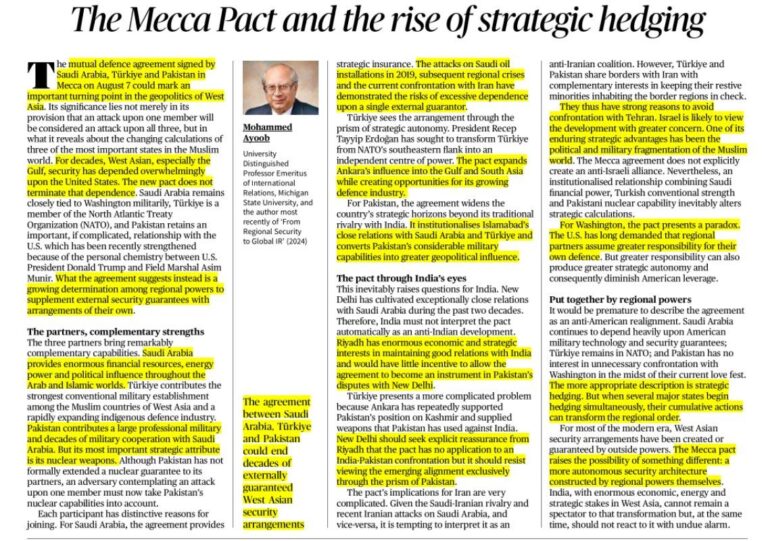
ToggleMecca Pact and Strategic Hedging: Changing Dynamics of West Asian Security
The Mecca Pact between Saudi Arabia, Türkiye, and Pakistan represents a significant shift in the geopolitics of West Asia. The agreement reflects a growing trend of strategic hedging, where regional powers seek to strengthen their own security arrangements rather than relying completely on external guarantors.
The pact highlights changing security calculations among major Muslim countries amid regional conflicts, uncertainty, and evolving global power dynamics.
Understanding the Mecca Pact
A New Regional Security Arrangement
The agreement brings together three influential countries with complementary strengths:
- Saudi Arabia contributes financial resources, energy influence, and political importance in the Arab world.
- Türkiye provides strong conventional military capabilities and defence-industrial expertise.
- Pakistan contributes professional military experience and nuclear capability.
Together, these countries aim to enhance their strategic cooperation and regional influence.
Rise of Strategic Hedging in West Asia
Moving Beyond External Security Dependence
For decades, several West Asian countries depended heavily on external powers, especially the United States, for security guarantees.
However, recent developments such as:
- Regional conflicts
- Attacks on critical infrastructure
- Rivalries among major powers
- Uncertainty in global alliances
have encouraged countries to build independent security mechanisms.
The Mecca Pact reflects this broader movement towards regional self-reliance in security affairs.
Implications for India
Balancing Strategic Interests
The agreement raises important questions for India due to its close relations with Saudi Arabia and growing engagement with West Asia.
India’s approach should focus on:
- Maintaining strong economic ties with Saudi Arabia
- Expanding strategic cooperation with West Asian countries
- Avoiding unnecessary alarm over regional realignments
The pact does not automatically indicate an anti-India alignment, as Saudi Arabia continues to have significant economic and strategic interests with New Delhi.
Impact on Regional Geopolitics
Towards a More Multipolar West Asia
The pact indicates a shift from a security model dominated by external powers towards greater involvement of regional actors.
However, challenges remain:
- Historical differences among partner countries
- Complex relations with Iran
- Internal political and strategic differences
The arrangement is better understood as strategic hedging rather than a formal military alliance.
Way Forward
India must carefully engage with emerging regional security frameworks while strengthening partnerships across West Asia.
Key priorities include:
- Energy security
- Trade and investment cooperation
- Defence diplomacy
- Connectivity initiatives
- Balanced relations with competing regional powers
Conclusion
The Mecca Pact and the rise of strategic hedging represent a changing security landscape in West Asia. Regional powers are increasingly seeking greater autonomy by creating their own partnerships. For India, the development highlights the importance of maintaining strategic flexibility and engaging proactively in a multipolar world order.
Vocabulary
1. Strategic Hedging – Balancing multiple partnerships
2. Mutual Defence – Collective response to attack
3. Strategic Autonomy – Independent security choices
4. Regional Order – Distribution of power in a region
5. Security Architecture – Framework of defence relationships
Frequently Asked Questions (FAQs)
What is the Mecca Pact?
The Mecca Pact is a strategic defence agreement between Saudi Arabia, Türkiye, and Pakistan aimed at enhancing regional security cooperation. It reflects growing efforts by regional powers to strengthen their own security arrangements.
What does strategic hedging mean in international relations?
Strategic hedging refers to a policy where countries maintain multiple partnerships and avoid excessive dependence on a single power. It helps states protect their interests in an uncertain geopolitical environment.
Why is the Mecca Pact important for West Asia?
The pact indicates a shift towards regional security mechanisms as countries seek greater autonomy amid conflicts, power rivalries, and changing global alliances.
How does the Mecca Pact impact India?
India needs to closely observe the development while maintaining its strong relations with Saudi Arabia and other West Asian countries. The pact highlights the importance of India’s strategic flexibility and diplomatic engagement.
Does the Mecca Pact represent an anti-India or anti-West alliance?
The pact is better understood as strategic hedging rather than an anti-West or anti-India alliance. Its primary objective is strengthening regional capabilities and reducing dependence on external security guarantees.
Source From : The Hindu
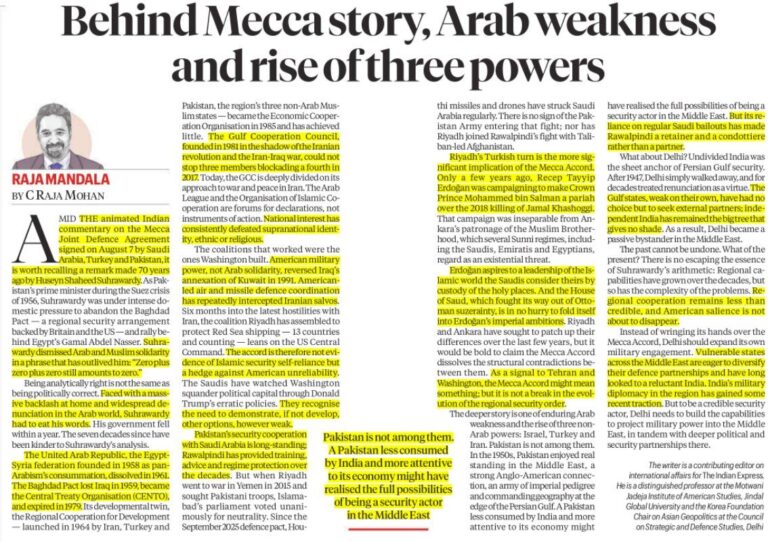
Behind the Mecca Pact: Arab Weakness and the Rise of Three Regional Powers
The Mecca Pact between Saudi Arabia, Türkiye, and Pakistan reflects the changing geopolitical landscape of West Asia. The agreement highlights the growing role of regional powers in shaping security arrangements amid declining Arab unity, internal divisions, and uncertainty over external security guarantees.
The pact represents a shift towards strategic autonomy and regional balancing rather than complete dependence on traditional global powers.
Declining Arab Unity and Regional Fragmentation
Weakness of Traditional Arab Institutions
Arab regional organisations have struggled to respond effectively to major crises due to differences among member states.
Key challenges include:
- Divergent national interests
- Political divisions among Arab countries
- Limited collective security mechanisms
- Dependence on external powers for defence
The weakening of Arab collective action has created space for non-Arab regional powers to expand their influence.
Rise of Saudi Arabia, Türkiye and Pakistan
Three Emerging Security Actors
The Mecca Pact brings together three countries with different but complementary strengths.
Saudi Arabia
- Financial resources and energy influence
- Strategic importance in the Islamic world
- Growing focus on independent security capabilities
Türkiye
- Strong conventional military
- Expanding defence industry
- Regional ambitions under strategic autonomy
Pakistan
- Professional military experience
- Nuclear capability
- Long-standing security cooperation with Gulf countries
Strategic Hedging in West Asia
Moving Beyond External Security Dependence
For decades, many West Asian states relied heavily on external powers, particularly the United States, for security.
However, recent developments have encouraged countries to diversify partnerships due to:
- Regional conflicts
- Security uncertainties
- Changing global power balances
The Mecca Pact reflects this trend of strategic hedging, where countries maintain multiple partnerships to protect national interests.
Implications for India
Need for Balanced Engagement
The changing West Asian order has important implications for India due to its:
- Energy dependence on the Gulf region
- Large Indian diaspora
- Trade and investment relations
- Strategic interests in the Indian Ocean region
India should continue engaging with Saudi Arabia, Türkiye, Iran, and other regional actors while maintaining strategic autonomy.
Towards a New West Asian Order
The emergence of regional security arrangements indicates that West Asia is moving towards a more multipolar framework. However, challenges such as rivalries, political differences, and regional conflicts may limit the effectiveness of such partnerships.
Conclusion
The Mecca Pact represents the rise of regional powers and the decline of traditional Arab collective influence. It reflects a broader transformation in West Asian geopolitics where countries are seeking greater security independence. For India, the evolving landscape highlights the importance of flexible diplomacy and proactive engagement.
Vocabulary
1. Strategic Hedging – Diversifying security partnerships
2. Regional Order – Distribution of power in a region
3. Security Guarantor – State providing external protection
4. Military Diplomacy – Defence engagement to build influence
5. Geopolitical Influence – Ability to shape regional outcomes
Frequently Asked Questions (FAQs)
What is the significance of the Mecca Pact?
The Mecca Pact between Saudi Arabia, Türkiye, and Pakistan represents a shift towards regional security cooperation. It reflects efforts by regional powers to build independent strategic capabilities.
Why is Arab unity considered weak in West Asia?
Arab unity has faced challenges due to diverging national interests, political divisions, and limited collective security mechanisms, reducing the effectiveness of regional organisations.
What does the rise of Saudi Arabia, Türkiye, and Pakistan indicate?
The growing role of these three countries highlights the emergence of non-Arab regional powers influencing West Asian security and geopolitics.
What is strategic hedging in international relations?
Strategic hedging refers to maintaining multiple partnerships to protect national interests and reduce excessive dependence on any single external power.
How does the changing West Asian order impact India?
India needs to maintain balanced relations with West Asian countries due to its interests in energy security, trade, diaspora, and regional stability while preserving strategic autonomy.