Table of Contents
ToggleRevisiting India’s Nuclear Doctrine Without Revising It
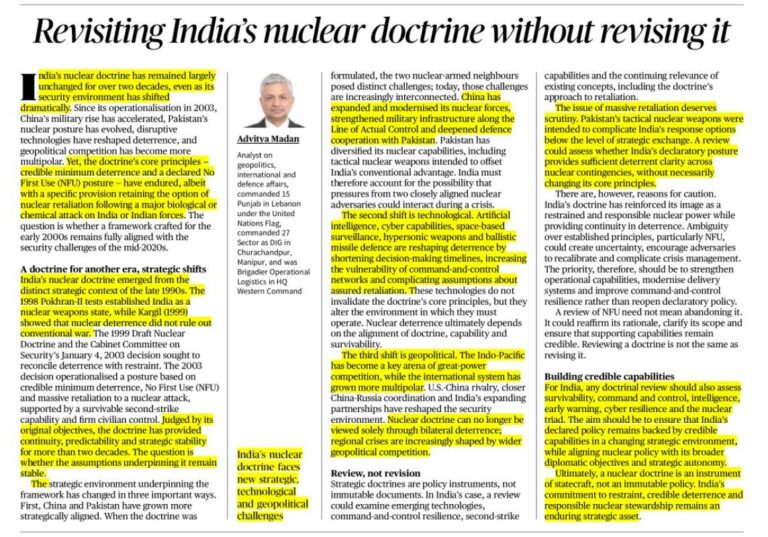
India’s nuclear doctrine has remained broadly consistent since its operationalisation in 2003, even as the strategic environment around India has changed significantly. The core framework is based on credible minimum deterrence, No First Use (NFU), civilian political control and assured retaliation. The 2003 Cabinet Committee on Security explicitly outlined these principles.
Evolution of India’s Nuclear Doctrine
India’s nuclear doctrine emerged from the strategic environment of the late 1990s. Following the 1998 Pokhran-II nuclear tests, India moved towards a declared nuclear deterrence framework.
The 2003 doctrine emphasised:
- Credible Minimum Deterrence
- No First Use
- Massive retaliation following a nuclear first strike
- Civilian political control over nuclear retaliation
- Non-use of nuclear weapons against non-nuclear-weapon states, subject to the stated doctrine
- Continued commitment to nuclear disarmament.
Why Revisit the Doctrine?
The strategic environment has changed considerably. China has expanded its nuclear and military capabilities, while Pakistan has developed a diverse nuclear arsenal. At the same time, emerging technologies are transforming the character of warfare.
Artificial intelligence, hypersonic weapons, cyber capabilities, advanced surveillance and space-based systems can reduce decision-making timelines and create new challenges for command, control and communication systems.
The Chief of Defence Staff noted in 2024 that changing warfare requires deeper consideration of nuclear strategy, deterrence and protection of nuclear C4I2SR infrastructure.
Review Does Not Necessarily Mean Revision
The central argument is that India can review the assumptions supporting its nuclear doctrine without necessarily abandoning its core principles.
A review could examine:
- Survivability of nuclear forces
- Second-strike capability
- Early-warning systems
- Command-and-control resilience
- Cybersecurity
- Technological developments
- Changing regional security dynamics
India has continued to officially describe its nuclear policy in terms of credible minimum deterrence and No First Use.
India’s Maritime Role
India’s geographical position gives it an important role in securing the wider Indian Ocean region.
India can contribute through:
- Maritime domain awareness
- Naval cooperation
- Intelligence sharing
- Anti-piracy operations
- Protection of sea lanes
- Defence logistics and infrastructure
Greater cooperation with Gulf countries can therefore strengthen security across the Arabian Sea and Indian Ocean.
Building Credible Deterrence
For a deterrence doctrine to remain credible, the ability to survive a first strike and retain retaliatory capability is important. India’s nuclear triad and SSBN capability contribute to survivability and assured retaliation. The successful INS Arihant SLBM launch was described by the Ministry of Defence as significant for India’s credible minimum deterrence.
Conclusion
India’s nuclear doctrine operates within a changing technological and geopolitical environment. The policy question is therefore not necessarily whether to abandon established principles, but whether existing capabilities, command systems and deterrence arrangements remain sufficiently credible.
A periodic assessment can help India strengthen nuclear safety, survivability and command-and-control resilience while retaining the declared principles of credible minimum deterrence and No First Use.
Vocabulary
1. Credible Minimum Deterrence – Minimum capability to prevent nuclear threats.
2. No First Use (NFU) – Not using nuclear weapons first.
3. Second Strike Capability – Ability to retaliate after a nuclear attack.
Prelims MCQs
MCQ 1
Consider the following statements:
1. India’s nuclear doctrine includes a No First Use policy.
2. Credible Minimum Deterrence requires maintaining unlimited nuclear weapons.
3. Second-strike capability strengthens deterrence.
Which are correct?
A) 1 and 3 only
B) 2 and 3 only
C) 1 and 2 only
D) 1, 2 and 3
Answer: A
UPSC Mains Question
“India’s nuclear doctrine must adapt to changing security challenges while maintaining strategic restraint.” Discuss.
(10 Marks)
Frequently Asked Questions (FAQs)
What are the key principles of India’s nuclear doctrine?
The key principles include credible minimum deterrence, No First Use, assured retaliation and civilian political control.
What does No First Use mean?
India’s declared NFU posture means nuclear weapons would be used in retaliation following a nuclear attack, subject to the doctrine’s stated provisions.
Why is India discussing a review of its nuclear doctrine?
Changes in China’s and Pakistan’s capabilities, along with emerging technologies such as AI, hypersonic systems, cyber capabilities and advanced surveillance, create new strategic challenges.
Does reviewing the nuclear doctrine mean abandoning NFU?
Not necessarily. A review can examine whether existing capabilities and supporting systems remain adequate without automatically changing the doctrine’s core principles.
Why is second-strike capability important?
A survivable second-strike capability strengthens deterrence by ensuring that a country retains the ability to respond even after suffering an initial attack.
Source From : The Hindu
Conflict and Consensus in the Election Commission of India
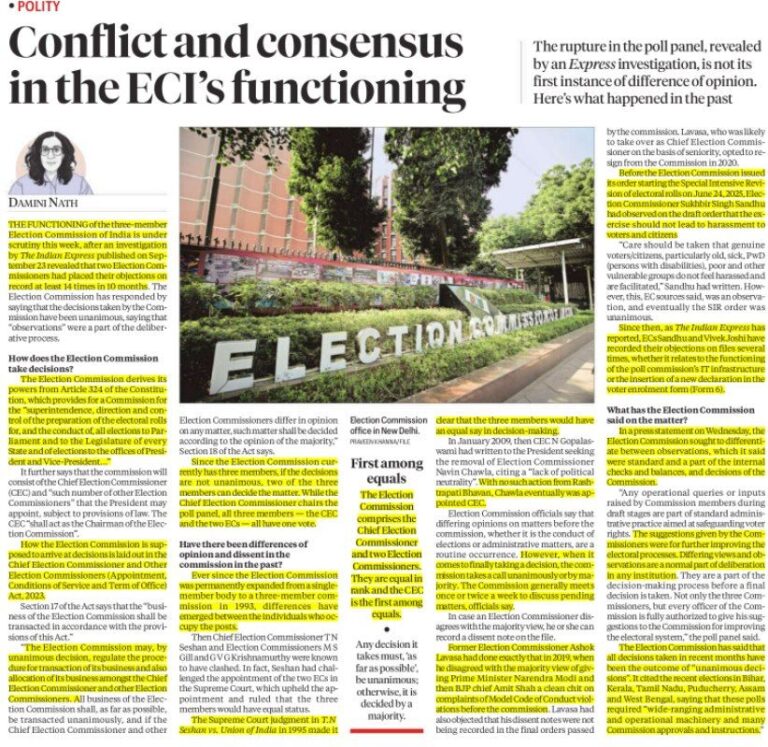
The Election Commission of India (ECI) is a constitutional body entrusted with the superintendence, direction and control of elections under Article 324 of the Constitution. Recent reports of differences among members of the three-member Commission have renewed attention on how the ECI functions, how dissent is handled and how decisions are ultimately taken.
The ECI has stated that differences and observations during internal deliberations are a normal part of institutional decision-making and that decisions taken by the full Commission in the recent period were unanimous.
Constitutional Framework of the ECI
Article 324 provides the constitutional foundation for the Election Commission. Since 1993, the ECI has functioned as a three-member body comprising the Chief Election Commissioner and two Election Commissioners. The Election Commissioners have an equal say in the Commission’s decision-making.
The CEC chairs the Commission, but the other Election Commissioners are not subordinate members when decisions are taken collectively.
Consensus and Majority Decision
The legal framework provides for consensus as far as possible. Under the applicable rules governing the transaction of ECI business, matters are generally expected to be dealt with unanimously. However, when the members differ, the matter can be decided according to the majority view.
Thus, disagreement among Commissioners does not by itself prevent the Commission from functioning.
A Commissioner who disagrees with the majority may record a dissenting note on the file. Historical instances, including differences involving former Election Commissioner Ashok Lavasa, demonstrate that disagreement within a multi-member ECI is not unprecedented.
Why Institutional Transparency Matters
The recent controversy is significant because the reported objections concern aspects of the electoral process, including electoral-roll management and technological systems. The Indian Express reported that two Election Commissioners had recorded objections on several occasions, while the ECI maintained that these were part of normal internal deliberation.
This raises broader questions about:
- Transparency in institutional decision-making
- Recording of dissenting views
- Internal checks and balances
- Independence of constitutional institutions
- Accountability in electoral administration
Balancing Consensus and Dissent
Consensus can promote institutional coherence, but structured disagreement can also function as an internal check. The legal framework therefore accommodates both unanimous decisions and majority decision-making.
The objective is not necessarily to eliminate disagreement but to ensure that disagreements are handled through established procedures and that final decisions remain legally reasoned and institutionally accountable.
Why High-Frequency Indicators Matter
High-frequency indicators provide additional evidence about the strength of economic activity. These include:
- Industrial production
- Capital goods output
- Vehicle registrations
- Electricity demand
- Investment activity
- Consumption indicators
A broad improvement across such indicators strengthens confidence that headline GDP growth reflects underlying economic momentum.
Conclusion
The functioning of a multi-member Election Commission requires both institutional consensus and space for independent deliberation. Article 324 provides the constitutional foundation, while the statutory framework provides mechanisms for collective decision-making when members differ.
The ongoing discussion highlights the importance of transparent procedures, effective internal checks and public confidence in the ECI as an institution responsible for administering India’s electoral process.
Vocabulary
1. Dissent Note – Written record of disagreement by a member in a decision-making body.
2. Article 324 – Constitutional provision establishing ECI’s powers.
3. Electoral Integrity – Ensuring free, fair and transparent elections.
Prelims MCQs
MCQ 1
Consider the following statements:
1. Article 324 of the Constitution provides for the Election Commission of India.
2. The Chief Election Commissioner has overriding powers over other Election Commissioners.
3. Election Commissioners can record dissent on decisions of the Commission.
Which are correct?
A) 1 and 3 only
B) 2 and 3 only
C) 1 and 2 only
D) 1, 2 and 3
Answer: A
UPSC Mains Question
“Institutional independence and internal transparency are essential for maintaining the credibility of the Election Commission of India.” Discuss. (10 Marks)
Frequently Asked Questions (FAQs)
What is the constitutional basis of the Election Commission of India?
Article 324 provides the constitutional foundation for the ECI and vests it with superintendence, direction and control over elections.
Is the Election Commission a three-member body?
Yes. Since 1993, it has functioned as a three-member body consisting of the CEC and two Election Commissioners.
What happens if Election Commissioners disagree?
The framework provides for matters to be decided by the majority view when the Commissioners differ.
Can an Election Commissioner record a dissent?
Yes. A Commissioner who disagrees with the majority can record a dissenting note on the file. Historical cases demonstrate that such dissent has occurred within the ECI.
Why is dissent important in a constitutional institution?
Dissent can form part of internal deliberation and institutional checks and balances, while the final decision continues to follow the legally prescribed decision-making process.