
Table of Contents
Togglendian Grey Hornbill in Gir Forest
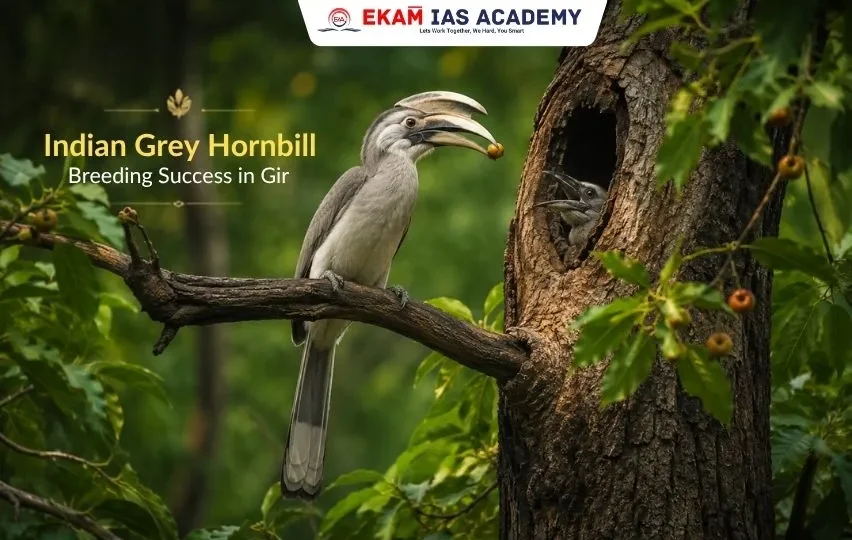
The Indian Grey Hornbill (Ocyceros birostris) has achieved a major conservation milestone with four consecutive years of successful breeding in Gujarat’s Gir Forest after its reintroduction in 2021. The species had disappeared from the region more than six decades ago, making its successful return a remarkable example of wildlife restoration and habitat conservation.
A study published in the journal Birds confirms that the reintroduced hornbill population has successfully adapted to its new habitat, established breeding territories, and begun natural reproduction. This achievement highlights the effectiveness of the Gujarat Forest Department’s conservation programme and underscores the importance of scientific wildlife management.
For UPSC aspirants, this topic is important under Environment & Ecology, Biodiversity, Wildlife Conservation, Protected Areas, and Species Conservation.
Why is the Indian Grey Hornbill in the News?
The Indian Grey Hornbill has been in the news after recording four successive years of successful breeding in Gir Forest, Gujarat, following its reintroduction in 2021.
The successful establishment of a self-sustaining population demonstrates the success of habitat restoration and species recovery efforts, marking an important achievement in wildlife conservation.
About the Indian Grey Hornbill
The Indian Grey Hornbill is a medium-sized hornbill species native to the Indian subcontinent and is commonly found in forests as well as urban landscapes
Scientific Name
Ocyceros birostris
IUCN Conservation Status
Least Concern (LC)
Although listed as Least Concern globally, the species faces local threats due to habitat loss and fragmentation.
Natural Habitat
The Indian Grey Hornbill inhabits a wide range of ecosystems, including:
- Dry deciduous forests
- Open woodlands
- Riverine forests
- Scrub forests
- Agricultural landscapes
- Urban parks and gardens
Its distribution extends across:
- India
- Nepal
- Parts of Pakistan
The species adapts well to human-modified landscapes provided adequate nesting trees and food resources are available.
Ecological Importance
The Indian Grey Hornbill plays a vital ecological role in maintaining healthy forest ecosystems.
Seed Dispersal
It acts as an efficient long-distance seed disperser, transporting seeds of fruit-bearing trees across large distances.
Forest Regeneration
By dispersing seeds, the bird supports:
- Natural forest regeneration
- Expansion of native vegetation
- Restoration of degraded habitats
Biodiversity Conservation
The hornbill contributes to maintaining ecological balance by promoting plant diversity and supporting healthy forest ecosystems.
Protection Status in India
The Indian Grey Hornbill receives legal protection under:
Wild Life (Protection) Act, 1972 (as amended in 2022)
Schedule
Schedule II
This provides protection against:
- Hunting
- Illegal trade
- Capture
The legislation helps ensure long-term conservation of the species.
Gir National Park & Wildlife Sanctuary
The successful breeding programme has taken place in the renowned Gir National Park and Wildlife Sanctuary, the only natural habitat of the Asiatic Lion.
Location
Gir is situated in the Kathiawar (Saurashtra) Peninsula of Gujarat and spans the districts of:
- Junagadh
- Gir Somnath
- Amreli
- Bhavnagar
Establishment
- Wildlife Sanctuary: 1965
- National Park: 1975
Major Rivers
Several rivers flow through Gir, providing water and supporting biodiversity:
- Hiran
- Shetrunji
- Datardi
- Shingoda
- Machhundri
- Raval
Important Flora
Gir primarily consists of dry deciduous forests interspersed with thorn scrub vegetation.
Major tree species include:
- Teak (Tectona grandis)
- Acacia (Babul)
- Flame of the Forest (Palash)
- Zizyphus (Ber)
- Jamun
- Banyan
- Prosopis
- Various grasses and thorny shrubs
These forests provide ideal nesting and feeding habitats for hornbills and many other species.
Important Fauna
Gir supports rich biodiversity, including:
- Asiatic Lion (only wild population in the world)
- Leopard
- Striped Hyena
- Golden Jackal
- Jungle Cat
- Chinkara
- Four-horned Antelope (Chousingha)
- Mugger Crocodile
Important Birds of Gir
The park is home to numerous bird species, including:
- Indian Grey Hornbill
- Crested Serpent Eagle
- Bonelli’s Eagle
- White-backed Vulture
- Painted Sandgrouse
- Paradise Flycatcher
- Indian Peafowl
Significance of Successful Breeding in Gir
The successful breeding of the Indian Grey Hornbill demonstrates:
- Successful species reintroduction
- Effective habitat restoration
- Improved ecosystem health
- Enhanced biodiversity conservation
- Scientific wildlife management
- Long-term conservation planning
It also highlights the importance of restoring locally extinct species to suitable habitats.
Conservation Challenges
Despite the success, several challenges remain:
- Habitat fragmentation
- Loss of mature nesting trees
- Urban expansion
- Climate change impacts
- Human-wildlife interactions
Continued habitat protection and monitoring are essential to sustain the growing hornbill population.
UPSC Prelims Quick Facts
| Topic | Fact |
|---|---|
| Species | Indian Grey Hornbill |
| Scientific Name | Ocyceros birostris |
| IUCN Status | Least Concern (LC) |
| Protection | Wild Life (Protection) Act, 1972 (Amended 2022) |
| Schedule | Schedule II |
| Reintroduction | Gir Forest (2021) |
| Successful Breeding | Four consecutive years |
| Key Role | Long-distance seed disperser |
| State | Gujarat |
UPSC Mains Perspective
GS Paper III
- Biodiversity Conservation
- Wildlife Protection
- Protected Areas
- Ecosystem Restoration
- Species Recovery Programmes
Environment & Ecology
- Conservation Biology
- Habitat Restoration
- Forest Ecosystems
- Wildlife Management
Conclusion
The successful breeding of the Indian Grey Hornbill in Gir National Park after more than six decades represents a landmark achievement in India’s wildlife conservation efforts. The species’ successful adaptation and natural reproduction highlight the effectiveness of scientific reintroduction programmes and habitat restoration initiatives undertaken by the Gujarat Forest Department. As an important seed disperser, the hornbill contributes significantly to forest regeneration and biodiversity conservation. For UPSC aspirants, this topic is highly relevant under Environment & Ecology, Wildlife Conservation, Biodiversity, Protected Areas, and Species Recovery Programmes, making it valuable for both Prelims and Mains.



Frequently Asked Questions (FAQs) About the Indian Grey Hornbill
What is the Indian Grey Hornbill?
The Indian Grey Hornbill (Ocyceros birostris) is a medium-sized hornbill native to the Indian subcontinent. It is commonly found in dry deciduous forests, open woodlands, riverine forests, agricultural landscapes, and urban parks across India, Nepal, and parts of Pakistan.
Why is the Indian Grey Hornbill in the news?
The Indian Grey Hornbill is in the news because it has recorded four consecutive years of successful breeding in Gujarat’s Gir Forest following its reintroduction in 2021. This marks a significant achievement in species recovery and habitat restoration after the bird had disappeared from the region for over 60 years.
What is the ecological importance of the Indian Grey Hornbill?
The Indian Grey Hornbill is an important seed disperser that helps regenerate forests by spreading the seeds of fruit-bearing trees over long distances. This supports forest regeneration, biodiversity conservation, and the maintenance of healthy ecosystems.
What is the conservation status of the Indian Grey Hornbill?
The Indian Grey Hornbill is classified as Least Concern (LC) on the IUCN Red List. In India, it is protected under Schedule II of the Wild Life (Protection) Act, 1972 (as amended in 2022), which prohibits hunting and illegal trade.
Why is Gir National Park important for wildlife conservation?
Gir National Park and Wildlife Sanctuary in Gujarat is the only natural habitat of the Asiatic Lion in the world. It also supports diverse wildlife, including leopards, striped hyenas, mugger crocodiles, and numerous bird species such as the Indian Grey Hornbill, making it one of India’s most significant protected areas for biodiversity conservation.