

Table of Contents
ToggleThe Union Public Service Commission (UPSC) fixes a minimum age of 21 years and a category-wise upper age ceiling for the Civil Services Examination (CSE). The precise “born not earlier than / not later than” dates change every year in the official notice, but the framework remains the same. Use this guide to understand age rules, attempts, and quick self-checks—clearly and without copied text.
Core Age Rules
Minimum age
- You must be 21 years on the reference date mentioned in that year’s notification (usually 1 August of the exam year).
Upper age by category
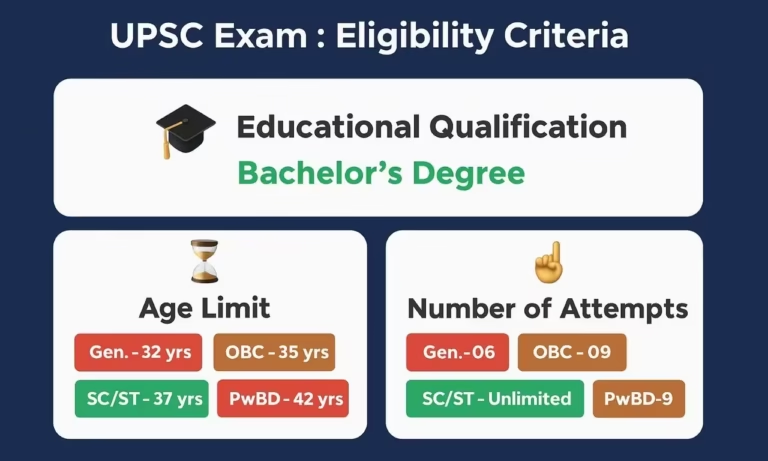
- General / Unreserved (UR) & EWS: up to 32 years
- OBC (Non-Creamy Layer): up to 35 years (UR limit +3)
- SC/ST: up to 37 years (UR limit +5)
- PwBD (Persons with Benchmark Disability): generally UR limit +10 years (applies within each category)
- Ex-Servicemen/ECOs/SSCOs: additional relaxation as per government rules (commonly up to +5 years, subject to conditions)
- Specified J&K domicile window: relaxation as per the current year’s notice
Attempts Policy (Works Alongside Age)
Attempt counts
- UR/EWS: 6 attempts
- OBC: 9 attempts
- SC/ST: attempts not capped (within the 37-year age window)
- PwBD: generally 9 for UR/OBC; SC/ST PwBD follow SC/ST rule within their age window
When does an attempt count?
- Filling the form but not appearing in Prelims does not count.
- An attempt is counted only when you sit for Prelims.
How to Self-Check Eligibility
Step 1: Age window
- Calculate your age on the reference date. If you are 21+ and within your category’s upper limit, you pass Step 1.
Step 2: Attempts left
- Count the number of times you have actually appeared in Prelims. If you have attempts remaining for your category, you pass Step 2.
Practical Examples
- Example A (UR): Age 30 years 6 months on the reference date; attempts used = 3.
→ Eligible (under 32 and attempts left = 3). - Example B (OBC): You turn 35 just before the reference date.
→ Crosses the OBC ceiling → Not eligible that year. - Example C (UR-PwBD): Age 41 on the reference date; attempts used = 6.
→ Eligible if PwBD cap (UR +10) covers you and your attempt limit (often 9) isn’t exhausted.
Edge Cases & Notes
Cut-off dates move every year
- UPSC publishes exact birth-date ranges annually. Always align your calculation with that year’s PDF.
Boundary birthdays
- If your birthday falls exactly on the boundary date, double-check—but remember, notification text prevails over any calculator.
Working professionals
- Plan attempts backward from your last eligible year. Keep at least one buffer attempt for contingencies.
Documents You’ll Need
Identity & category proofs
- Date of Birth: Matriculation/Secondary certificate
- Community: OBC (NCL)/SC/ST in the specified format and validity period
- PwBD: Certificate from a notified medical authority with the disability category/sub-category
- Service-based relaxations: Relevant service/tenure documents as instructed
UPSC CSE Age & Attempts – FAQ's
What is the minimum and maximum age for a General candidate?
Minimum 21; maximum 32 on the reference date of that exam year.
How many attempts do OBC and SC/ST candidates get?
- OBC: 9 attempts
- SC/ST: attempts not capped within the 37-year age window.
Is there relaxation for PwBD candidates?
Generally +10 years over the base limit, with attempt rules by category; sub-category specifics are in the year’s notice.
If I apply but do not appear, does it count as an attempt?
No. An attempt is counted only if you sit for Prelims.
Why doesn’t this guide show exact “born not earlier than” dates?
Because those change every year. Use this framework to pre-check, then confirm exact dates in the current UPSC notification.