Table of Contents
ToggleNational Afforestation Programme (NAP): Green India Mission
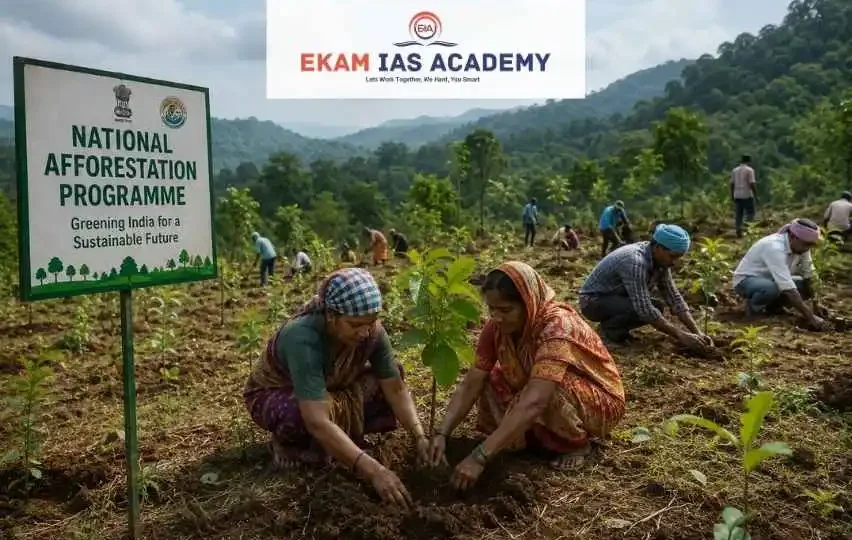
The National Afforestation Programme was formulated by the Ministry of Environment, Forest and Climate Change (MoEFCC) by merging four legacy 9th Five-Year Plan afforestation initiatives.
The Institutional Architecture:
National Afforestation and Eco-Development Board (NAEB)
│
▼
State Forest Development Agency
│
▼
Forest Development Agency (FDA)
│
▼
Joint Forest Management Committees (JFMCs)
The scheme operates on a decentralized, three-tier institutional matrix. At the forest division level, it functions through the Forest Development Agency (FDA), which coordinates with grassroot societies known as Joint Forest Management Committees (JFMCs). This structural alignment ensures that local fringe communities hold a direct administrative stake in the preservation of adjacent natural resources.
Core Objectives and Key Features of NAP
The National Afforestation Programme functions are built upon ecological revival and rural poverty alleviation:
- Ecological Regeneration: Restoring degraded forest lands and adjoining community resource spaces.
- Livelihood Security: Providing sustainable employment opportunities for forest-dependent, marginalized, and tribal populations.
- Democratic Decentralization: Empowering village institutions to independently plan, execute, and monitor local plantation cycles.
Funding Pattern Matrix:
As a Centrally Sponsored Scheme, the funding operates under an explicit split architecture:
| Region Category | Central Government Share | State Government Share |
| General Category States | 60% | 40% |
| Northeastern & Himalayan States | 90% | 10% |
The Central Role of Joint Forest Management (JFM)
The success of NAP relies heavily on the Role of Joint Forest Management (JFM). This institutional model treats local tribal and rural groups as active co-protectors rather than administrative intruders. By offering non-timber forest produce (NTFP) collection rights and a share in timber harvesting dividends, it aligns community survival with long-term conservation goals, transforming protection efforts from an enforcement problem into a community priority.
Modern Reforms: Transition and Strategic Integration
- To maximize efficiency, the central government executed a major policy shift by merging the National Afforestation Programme into the National Mission for a Green India (GIM).
This integration ensures that financial resource deployment, scientific monitoring via GIS-satellite platforms (like Bhuvan, VEDAS, and Yuktdhara), and field-level actions are consolidated under a single budgetary head. This allows India to work more effectively toward its global climate commitments, such as the Bonn Challenge and its Nationally Determined Contributions (NDCs) under the Paris Agreement.
| Phase | Components |
|---|---|
| Pre-Merger | NAP (Degraded Forest Lands) + GIM (Landscape Green Cover) |
| Integrated Landscape Paradigm | Unified Budget, Remote Sensing Monitoring, Public Participation Campaigns |
Challenges
The execution of the National Afforestation Programme has faced structural issues over the years, including delayed fund releases to grassroot JFMCs, a lack of high-quality saplings, and conflicts between local communities and state authorities over forest land rights.
Way Forward
To resolve these bottlenecks, the policy framework must adopt digital surveillance systems and automated fund transfers to local committees. Merging forestry targets with rural welfare schemes like MGNREGS, backing civic-led initiatives such as the “Ek Ped Maa Ke Naam” campaign, and expanding agroforestry outside official boundaries will help secure India’s ecological resilience and meet its climate goals.
Conclusion
Evaluating the National Afforestation Programme UPSC requires recognizing that true conservation cannot be achieved through top-down enforcement alone. Eco-restoration succeeds when it protects both ecosystems and the livelihoods of forest-dependent peoples. By resolving institutional delays, adopting geospatial monitoring, and strengthening community-led governance, India can ensure its afforestation programs drive sustainable development and help secure a resilient environment for the future.
UPSC Prelims: PYQs & Practice Questions
Previous Year Questions (Prelims)
UPSC CSE Prelims 2014
Q: With reference to the National Mission for a Green India, which of the following statements is/are correct?
1. It aims at protecting, restoring, and enhancing India's diminishing forest cover.
2. It responds to climate change by a combination of adaptation and mitigation measures.
3. It places a strong emphasis on decentralized governance by involving local bodies like the Gram Sabha and Joint Forest Management Committees.
Select the correct answer using the code given below:
(a) 1 only
(b) 2 and 3 only
(c) 1 and 2 only
(d) 1, 2 and 3
Answer: (d) 1, 2 and 3
Explanation:
All statements are correct. The National Mission for a Green India (GIM) is one of the eight missions under the National Action Plan on Climate Change (NAPCC). It focuses on protecting, restoring, and enhancing forest cover while addressing climate change through both adaptation and mitigation. The merger of the National Afforestation Programme (NAP) into GIM helped avoid overlapping budgets and strengthened decentralized governance through JFMCs and Gram Sabhas.
UPSC CSE Prelims 2011
Q: Under the framework of Joint Forest Management (JFM) practiced widely across India, the primary role of the local village community is to:
(a) Independently harvest timber and auction it to international markets.
(b) Partner with the State Forest Department to protect forest lands in exchange for non-timber forest produce and a share in harvesting dividends.
(c) Legally declare any adjacent revenue land as a Protected Sanctuary.
(d) Conduct independent Environmental Impact Assessments for major dam projects.
Answer: (b) Partner with the State Forest Department to protect forest lands in exchange for non-timber forest produce and a share in harvesting dividends.
Explanation:
The core philosophy of Joint Forest Management (JFM) is based on a reciprocal partnership between local communities and the State Forest Department. Village communities help protect and regenerate degraded forest lands. In return, they receive sustainable access to non-timber forest products (NTFPs) such as grasses, fruits, honey, and a share in harvesting benefits.
Practice Questions
Q: In the context of the institutional framework governing the National Afforestation Programme (NAP), consider the following statements:
1. The scheme is entirely implemented by a centralized top-down bureaucratic model directly from the National Afforestation and Eco-Development Board (NAEB) without state-level intermediate agencies.
2. The operational funding pattern follows a 60:40 ratio for general category states and a 90:10 ratio for Northeastern and Himalayan states.
Which of the statements given above is/are correct?
A. 1 only
B. 2 only
C. Both 1 and 2
D. Neither 1 nor 2
Answer: B. 2 only
Explanation:
Statement 1 is incorrect because the NAP relies on a
decentralized, three-tier institutional matrix:
State Forest Development Agencies (SFDAs) at the state level,
Forest Development Agencies (FDAs) at the division level, and
Joint Forest Management Committees (JFMCs) at the village level.
Statement 2 is correct as it accurately reflects the financial allocation pattern of this
Centrally Sponsored Scheme.
Q: Which specialized body under the Ministry of Environment, Forest and Climate Change (MoEFCC) is specifically tasked with promoting afforestation, tree planting, and ecological restoration activities across degraded lands in India?
A. National Biodiversity Authority (NBA)
B. National Afforestation and Eco-Development Board (NAEB)
C. Animal Welfare Board of India (AWBI)
D. Wildlife Crime Control Bureau (WCCB)
Answer: B. National Afforestation and Eco-Development Board (NAEB)
Explanation:
The National Afforestation and Eco-Development Board (NAEB) was set up in
August 1992. It is the nodal agency responsible for promoting
afforestation, ecological restoration, and eco-development activities across the country,
with a special focus on degraded forest areas and lands adjoining national parks.
UPSC Mains – Previous Year & Practice Questions
Mains Previous Year Questions
Mains 2023
Question: The frequency of severe forest fires in India is increasing significantly. Discuss the ecological impacts and outline preventive strategies.
(Can connect to how NAP/GIM funds are utilized by local JFMCs to create fire lines and restore burnt patches)
Mains 2021
Question: Explain the purpose of the Green Grid Initiative launched at world climate summits.
(Can link to how India’s internal carbon sequestration through afforestation feeds global climate targets)
Mains 2019
Question: Coastal regions of India are prone to cyclones. Discuss the role of mangroves in reducing the impact of such disasters.
(Requires referencing coastal eco-restoration drives funded under national afforestation programmes)
Mains 2016
Question: Environmental degradation cannot be tackled by state regulations alone; it requires active corporate accountability and community-led green initiatives. Elaborate.
(Directly tests the core democratic intent of Joint Forest Management models)
Mains 2013
Question: Critically analyze the role of traditional local communities in forest conservation versus command-and-control state forestry policies in India.
Mains Practice Questions
[15 Marks | 250 Words]
Question: The convergence of the National Afforestation Programme (NAP) into the National Mission for a Green India (GIM) marks a shift from a simple target-driven plantation focus to an integrated landscape approach. Analyze the institutional and environmental advantages of this policy merger.
[15 Marks | 250 Words]
Question: Joint Forest Management Committees (JFMCs) are vital for democratic decentralization in forest conservation in India. However, they frequently suffer from financial delays and bureaucratic friction with state forest departments. Critically evaluate the hurdles faced by JFMCs.
[10 Marks | 150 Words]
Question: Achieving the National Forest Policy target of 33% green cover is impossible through state-owned forest lands alone. Discuss how promoting agroforestry outside recorded forest areas can complement the goals of national afforestation programmes.



National Afforestation Programme-FAQs
What is the National Afforestation Programme?
The National Afforestation Programme is a government scheme aimed at restoring degraded forest lands, improving green cover, supporting ecological regeneration, and providing livelihood opportunities to forest-dependent communities.
Which ministry implements the National Afforestation Programme?
The National Afforestation Programme was implemented by the Ministry of Environment, Forest and Climate Change through institutions like Forest Development Agencies and Joint Forest Management Committees.
What is the role of Joint Forest Management in afforestation?
Joint Forest Management involves local communities in forest protection, plantation activities, monitoring, and sustainable use of forest resources. It helps combine conservation with livelihood security.
How is the National Afforestation Programme linked with Green India Mission?
The National Afforestation Programme has been integrated with the National Mission for a Green India to improve coordination, funding, satellite-based monitoring, and landscape-level forest restoration.
Why is the National Afforestation Programme important for UPSC?
The National Afforestation Programme is important for UPSC because it connects with environment, forest conservation, climate change, Joint Forest Management, Green India Mission, biodiversity, carbon sequestration, and sustainable development.