Table of Contents
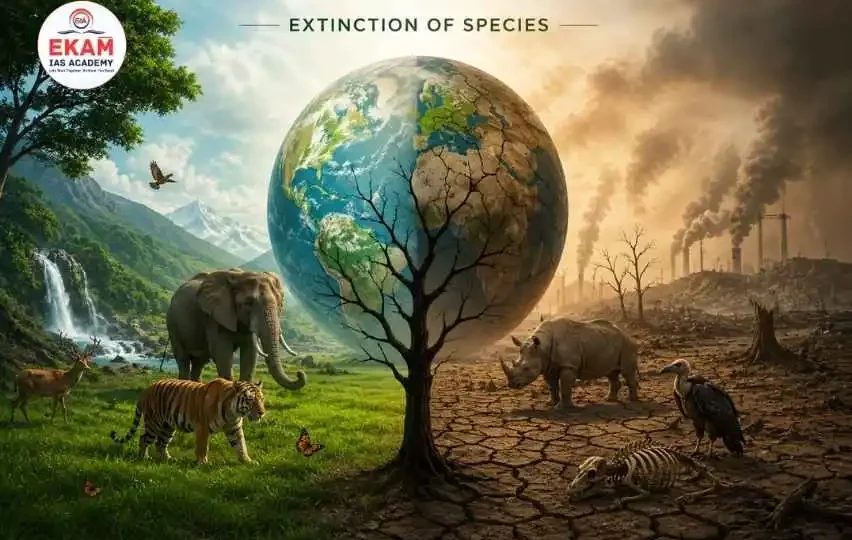
ToggleExtinction is a natural evolutionary feature of the biosphere. However, human industrial expansion, habitat destruction, and climate change have accelerated natural background extinction rates to an alarming degree. Understanding the drivers and classifications of this decline is essential for analyzing modern environmental governance.
Defining Species Extinction
Species extinction occurs when the very last individual of a specific biological organism dies, resulting in the permanent erasure of that unique genetic lineage from Earth. It represents an irreversible loss to global evolutionary potential.
Types of Extinction
Ecologists categorize the disappearance of species into three distinct structural types:
- Natural or Background Extinction: The slow, continuous loss of species over geological time due to natural shifts in climate, competition, or evolutionary succession.
- Mass Extinction: The catastrophic, rapid elimination of a massive percentage of global biotas (usually over 50-75% of all living species) within a short geological timeframe.
- Anthropogenic Extinction: The accelerated loss of species directly caused by human activities, completely bypassing natural evolutionary timelines.
The Five Historic Mass Extinctions
Earth’s geological history has recorded five major mass extinction events, primarily caused by massive planetary physical disruptions:
Ordovician-Silurian Extinction (~440 million years ago): Driven by intense glaciation and falling sea levels.
Late Devonian Extinction (~365 million years ago): Triggered by marine anoxia and global cooling.
Permian-Triassic Extinction (~250 million years ago): Known as the “Great Dying,” it wiped out 96% of marine species due to massive volcanic activity in the Siberian Traps and extreme global warming.
Triassic-Jurassic Extinction (~210 million years ago): Caused by massive volcanic eruptions and rising carbon dioxide levels.
Cretaceous-Paleogene Extinction (~66 million years ago): Triggered by an asteroid impact in present-day Mexico, wiping out the non-avian dinosaurs.
The Current State: The Sixth Mass Extinction
Scientists warn that we are currently undergoing the Sixth Mass Extinction, also known as the Anthropocene Extinction. Unlike its five prehistoric predecessors, this modern crisis is driven entirely by a single biological species—humans. Current extinction rates are estimated to be 100 to 1,000 times higher than natural background rates.
Major Causes of Species Extinction
The direct causes of species extinction are driven by heavy human activity, summarized by the primary “HIPPO” framework:
- Habitat Fragmentation and Destruction: Slicing contiguous wildlife zones with linear infrastructure like highways, dams, and railways, directly reducing breeding territories.
- Invasive Alien Species: Introducing exotic organisms (like Lantana camara or Water Hyacinth) that aggressively outcompete and displace native wildlife.
- Pollution: Biomagnification of pesticides, heavy metal contamination of water tables, and global microplastic accumulation.
- Population and Overexploitation: Illegal wildlife trafficking, commercial overfishing, and targeted poaching of apex predators.
- Anthropogenic Climate Change: Rapid warming forcing species out of their narrow thermal tolerance ranges, especially in montane and polar eco-zones.
The IUCN Red List Classification Framework
The IUCN Red List UPSC modules emphasize is the world’s most comprehensive inventory of the global conservation status of biological species. The International Union for Conservation of Nature (IUCN) divides species into nine precise categories based on specific population decline rates and geographic ranges:
- Extinct (EX): No reasonable doubt that the last individual has died.
- Extinct in the Wild (EW): Survives only in captivity or as a naturalized population well outside its historic range.
- Critically Endangered (CR): Faces an extremely high risk of extinction in the wild (e.g., meeting criteria such as a population reduction of $>90\%$ over 10 years).
- Endangered (EN): Faces a very high risk of extinction in the wild.
- Vulnerable (VU): Faces a high risk of extinction in the wild.
- Near Threatened (NT) / Least Concern (LC): Lower risk categories.
- Data Deficient (DD) / Not Evaluated (NE).
Extinct and Endangered Species in India
India’s rich, megadiverse habitats face intense environmental pressures, leading to notable species declines:
- Extinct in India: The Asiatic Cheetah (declared extinct in India in 1952, recently reintroduced via transcontinental relocation from Africa) and the Pink-headed Duck.
- Critically Endangered (CR): The Great Indian Bustard (facing severe threat from power-line collisions), the Gharial (impacted by river sand mining), and the White-rumped Vulture (decimated by diclofenac poisoning).
- Endangered (EN): The Bengal Tiger, Asiatic Lion, Lion-tailed Macaque, and the Snow Leopard.
Ecological and Economic Impacts of Extinction
- Trophic Cascades: Eliminating an apex keystone predator (like wolves or tigers) causes an explosion of lower-level herbivores, leading to overgrazing and the collapse of entire forest canopies.
- Loss of Ecosystem Services: Declining insect pollinator populations directly compromises global agricultural crop production and food security.
- Economic Costs: Wiping out natural wetlands increases the financial burden of managing artificial flood mitigation and water purification networks.
India’s Conservation Initiatives
India employs a comprehensive combination of policy and targeted wildlife initiatives:
- Statutory Laws: The Wildlife (Protection) Act, 1972 (comprehensively rationalized to align with CITES Appendices) provides strict legal penalties against poaching.
- Species Recovery Programmes: The Ministry of Environment, Forest and Climate Change (MoEFCC) runs dedicated recovery programmes for critically endangered species, including the Great Indian Bustard and the Dugong.
- Ex-situ Conservation: Establishing safe gene banks, captive breeding centers (e.g., Vulture Conservation Breeding Centres), and zoological reserves to revive populations before reintroducing them into the wild.
Conclusion
For a high-scoring baseline in the extinction of species UPSC section, candidates must frame the crisis as an existential threat to planetary stability. Halting this downward trend requires moving away from isolated, small-scale protected reserves. Conservation must be integrated into national economic planning, infrastructure layout, and transboundary wildlife frameworks, ensuring that human development does not come at the permanent cost of Earth’s evolutionary heritage.
UPSC Prelims: PYQs & Practice Questions
Previous Year Questions (Prelims)
UPSC CSE Prelims 2012
Q: Vultures which used to be very common in the Indian countryside some years ago are rarely seen nowadays. This is attributed to:
(a) The destruction of their nesting sites by new invasive species.
(b) A drug used by cattle owners for treating their diseased cattle.
(c) Scarcity of food available to them.
(d) A widespread, persistent and fatal disease among them.
Answer: (b) A drug used by cattle owners for treating their diseased cattle.
Explanation:
During the 1990s and 2000s, India witnessed an unprecedented population crash of major
Gyps vulture species. Scientific studies found that the collapse was caused by the veterinary use of
Diclofenac, a non-steroidal anti-inflammatory drug given to cattle.
Vultures feeding on livestock carcasses containing drug residues suffered from visceral gout and fatal kidney failure. This localized anthropogenic crisis pushed these birds close to extinction.
UPSC CSE Prelims 2018
Q: The term “Anthropocene Extinction”, frequently appearing in global climate change assessments and conservation journals, refers directly to which of the following?
(a) The prehistoric mass extinction of marine trilobites during the Ordovician period.
(b) The sudden annihilation of avian dinosaurs via an asteroid impact in the Cretaceous period.
(c) The ongoing, accelerated loss of biodiversity and species extinctions driven by human activities.
(d) The localized collapse of plant populations caused by the natural evolution of toxic volcanic gases.
Answer: (c) The ongoing, accelerated loss of biodiversity and species extinctions driven by human activities.
Explanation:
The Sixth Mass Extinction is also known as the
Anthropocene Extinction or Holocene Extinction. Unlike earlier mass extinctions caused by natural planetary events such as volcanic activity, glaciation, or asteroid impacts, the present extinction crisis is driven primarily by humans.
Major causes include habitat fragmentation, overhunting, industrial pollution, invasive species, and climate change. These pressures have accelerated species loss far beyond the natural background extinction rate.
Practice Questions
Q: With reference to the IUCN Red List, consider the following statements regarding the quantitative criteria for a species to be classified as Critically Endangered (CR):
1. The species must have experienced a documented population reduction of greater than or equal to 90% over the last 10 years or three generations.
2. The total number of mature individuals in the wild must have dropped below 250, alongside an observed continuous decline.
3. The geographic extent of its occurrence must be estimated to be less than 100 square kilometers.
Which of the statements given above are correct?
(a) 1 and 2 only
(b) 2 and 3 only
(c) 1 and 3 only
(d) 1, 2 and 3
Answer: (d) 1, 2 and 3
Explanation:
All three statements represent important quantitative thresholds used by the
International Union for Conservation of Nature (IUCN) for classifying a species as
Critically Endangered (CR).
These include severe population reduction, extremely low number of mature individuals, and highly restricted geographic range. These criteria help distinguish Critically Endangered species from those classified as Endangered (EN) or Vulnerable (VU).
Q: The "Great Dying", recognized as the most catastrophic mass extinction event in Earth's geological history where nearly 96% of marine species were wiped out, corresponds to which period?
(a) Cretaceous-Paleogene boundary
(b) Permian-Triassic boundary
(c) Ordovician-Silurian boundary
(d) Late Devonian epoch
Answer: (b) Permian-Triassic boundary
Explanation:
The Permian-Triassic mass extinction, which occurred roughly
250 million years ago, is known as the
"Great Dying". It was the most severe mass extinction event in Earth’s history.
It was likely triggered by massive volcanic eruptions in the Siberian Traps, which released enormous quantities of greenhouse gases. This caused runaway global warming, ocean acidification, and widespread marine anoxia. The Cretaceous-Paleogene extinction, by contrast, occurred much later and is associated with the extinction of non-avian dinosaurs.
UPSC Mains – Previous Year & Practice Questions
Mains Previous Year Questions
Mains 2023
Question: Identify the main causes of the loss of
biodiversity in India.
(Requires analyzing direct drivers of extinction like habitat loss, forest fragmentation, and hunting.)
Mains 2018
Question: How does biodiversity vary in India?
How is the Biological Diversity Act, 2002 helpful in conservation of flora and fauna?
(Tests legal and institutional tools designed to halt species loss.)
Mains 2021
Question: Differentiate the causes of landslides in the
Himalayan region and Western Ghats.
(Important because these disruptions destroy fragile ecosystems, driving endemic species to extinction.)
Mains 2019
Question: Coastal regions of India are prone to cyclones.
Discuss the role of mangroves in reducing the impact of such disasters.
(Can discuss how the extinction of local mangrove species undermines coastal climate defense networks.)
Mains 2014
Question: Enumerate the
indirect services provided by an ecosystem.
(Can highlight how preventing species extinction preserves evolutionary repositories and pollination networks.)
Mains Practice Questions
[10 Marks | 150 Words]
Question: Explain the phenomenon of a “Trophic Cascade”. Discuss how the anthropogenic extinction of an apex keystone predator can cause the collapse of an entire ecosystem canopy.
[15 Marks | 250 Words]
Question: Evaluate the effectiveness of Ex-situ conservation strategies, such as captive breeding and gene banks, versus In-situ landscape protection in preventing the terminal extinction of species highlighted in UPSC modules.
[15 Marks | 250 Words]
Question: The Great Indian Bustard (GIB) is currently on the verge of extinction primarily due to linear infrastructure intrusions. Suggest structural and policy modifications required to balance clean-energy infrastructure with avian conservation.



Species Extinction-FAQs
Difference between Extinct and Extinct in the Wild?
Extinct (EX) means no individual of the species is alive anywhere. Extinct in the Wild (EW) means the species has disappeared from natural habitats but survives in zoos, captive breeding centres, or botanical gardens.
What is Background Extinction Rate?
It is the natural rate at which species disappear over geological time. It matters because today’s extinction rate is far higher, showing a human-driven biodiversity crisis.
How did vulture decline cause a public health crisis in India?
Diclofenac poisoning caused a sharp decline in vultures. This left cattle carcasses exposed, increased feral dog populations, and led to more dog bites and rabies cases.
What is Functional Extinction?
Functional extinction occurs when a species survives in very low numbers but can no longer perform its ecological role. It may also be unable to reproduce enough for long-term survival.
How does India’s Species Recovery Programme work?
Under the IDWH scheme, MoEFCC supports recovery of critically endangered species It funds habitat protection, captive breeding, invasive species removal, and anti-poaching measures.