Table of Contents
ToggleEcosystems balance over millennia through complex predator-prey dynamics and resource competition. When a non-native organism bypasses natural geographical barriers and enters a new habitat without its natural predators, this balance shatters. Understanding the mechanics of invasive alien species in India is crucial for managing contemporary biodiversity threats UPSC modules.
Definition of Invasive Species
An invasive species (or invasive alien species) is an organism that is not native to a specific location, spreads aggressively, and causes ecological, environmental, or economic harm to the new environment.
Characteristics of Invasive Species
Successful invasive species possess specific biological traits that allow them to outcompete native flora and fauna:
- High Reproductive Rate: Fast maturation and high seed or offspring production.
- Phenotypic Plasticity: The capacity to adapt rapidly to varying environmental conditions (temperature, moisture, soil quality).
- Generalist Diet/Habitat: Ability to feed on diverse food sources and survive in disturbed habitats.
- Lack of Natural Predators: Absence of local herbivores, carnivores, or diseases to check their population growth.
- Allelopathy: Certain invasive plants secrete toxic chemicals from their roots to inhibit the growth of surrounding native plants.
Causes of Invasive Species Introduction
- Global Trade and Shipping: Marine bio-fouling and species transported in the ballast water of large ships (e.g., Zebra mussels).
- Agriculture and Forestry: Intentional introduction of fast-growing species for commercial timber, cattle forage, or ornamental gardens.
- Canal Construction: Connecting isolated water basins creates corridors for aquatic invasions.
- Climate Change: Altered temperature patterns allow tropical invasive organisms to expand into previously inhospitable regions.
Ecological, Environmental, and Economic Impacts
Ecological Impact
- Biodiversity Reduction: Direct predation or aggressive resource monopolization drives native species toward local extinction.
- Disruption of Food Webs: Altering nutrient cycling and eliminating critical structural components of food webs.
Environmental Impact
- Altered Hydrology: Deep-rooted invasive plants can deplete local groundwater reserves and accelerate soil erosion.
- Wildfire Intensification: Certain invasive grasses dry out quickly, creating fuel loads that increase the frequency and severity of forest fires.
Economic Impact
- Agricultural Losses: Weeds choke cash crops, degrade pasture quality for livestock, and increase management costs.
- Infrastructure Damage: Aquatic weeds clog hydroelectric dams, irrigation canals, and water treatment systems.
Invasive Alien Species in India
India’s diverse bioclimatic zones suffer heavily from multiple biological invasions:
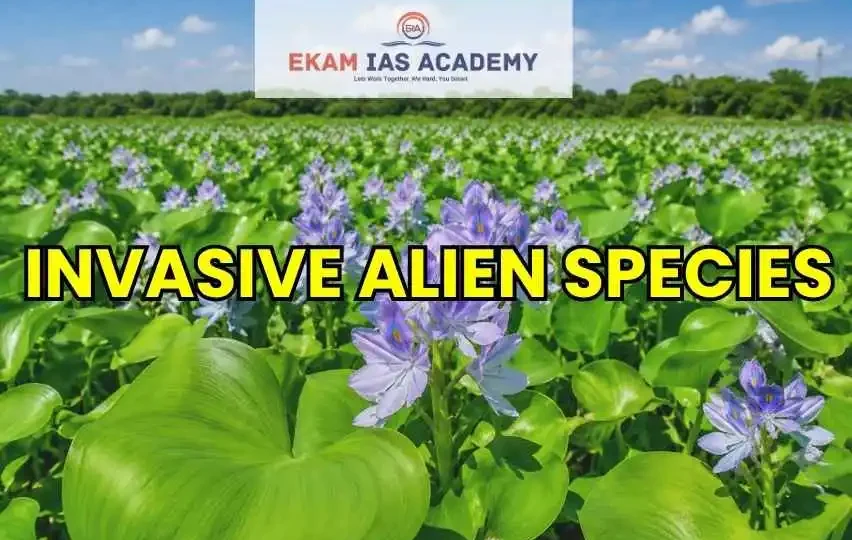
- Water Hyacinth (Eichhornia crassipes): Known as the “Terror of Bengal,” this fast-growing aquatic plant carpets lakes and rivers, blocking sunlight, depleting dissolved oxygen, and suffocating native aquatic life.
- Lantana camara: An ornamental shrub that has invaded more than 40% of India’s tiger reserves. It forms impenetrable thickets, chokes native forage plants, and starves local herbivores like chital and sambar.
- Prosopis juliflora (Vilayati Kikar): Introduced to green arid zones, it has invaded grasslands and sanctuary areas (e.g., Keoladeo National Park), depleting water tables and wiping out indigenous vegetation.
- African Apple Snail: An agricultural pest in southern India that damages paddy crops and acts as a vector for human pathogens.
Types of Invasive Species
- Terrestrial Flora: Aggressive weeds and woody shrubs (Lantana, Parthenium).
- Aquatic Flora: Floating or submerged freshwater plants (Water Hyacinth, Salvinia).
- Terrestrial Fauna: Invasive insects, rodents, and feral animals.
- Marine/Aquatic Fauna: Exotic fish and mollusks introduced via aquaculture or ballast water (Tilapia, African Catfish).
Management and Control Measures
- Mechanical Control: Physical removal by uprooting, cutting, or burning. This requires continuous effort to prevent seed banks from regenerating.
- Chemical Control: Application of targeted herbicides or pesticides. This approach carries risks of environmental bioaccumulation and damage to non-target native species.
- Biological Control: Introducing a natural predator or disease from the invasive species’ native range (e.g., using specific weevils to consume water hyacinth). This requires strict quarantine testing to ensure the biocontrol agent does not become invasive itself.
Government and International Initiatives
- Convention on Biological Diversity (CBD): Aichi Target 9 and the Kunming-Montreal Global Biodiversity Framework (Target 6) focus heavily on identifying, prioritizing, and controlling invasive alien species.
- Ramsar Convention: Mandates the monitoring and removal of invasive vegetation from listed wetlands of international importance.
- Directorate of Plant Protection, Quarantine & Storage: India’s apex nodal agency regulating imports to prevent exotic biosecurity threats.
- National Biodiversity Authority (NBA): Formulates statutory guidelines to check bio-invasions under the Biological Diversity Act, 2002.
Invasive Species vs. Exotic Species
| Parameters | Exotic (Alien) Species | Invasive Species |
| Core Definition | Any species living outside its native historical range. | An exotic species that causes documented ecological or economic harm. |
| Impact | Can be benign, beneficial, or controlled (e.g., potato, tomato). | Always destructive, self-sustaining, and expanding. |
| Control Need | Does not require eradication if balanced within human systems. | Demands active containment and eradication measures. |
Conclusion
For the invasive species UPSC core module, these organisms represent a profound biosecurity challenge. Managing invasive alien species in India requires robust early-detection systems, strict ballast-water management at ports, and ecological restoration models that replace cleared invasives with native vegetation. Protecting indigenous biodiversity is fundamental to building climate resilience and securing rural livelihoods across the country.
UPSC Prelims: PYQs & Practice Questions
Previous Year Questions (Prelims)
Q: Why is a plant called Prosopis juliflora often mentioned in news? (UPSC CSE Prelims 2018)
(a) Its extract is widely used in cosmetics.
(b) It tends to reduce the biodiversity in the area in which it grows.
(c) Its juice is used in the synthesis of pesticides.
(d) None of the above
Answer: (b) It tends to reduce the biodiversity in the area in which it grows
Explanation:
Prosopis juliflora (commonly called
Vilayati Kikar) is an invasive exotic shrub native to
South and Central America. Introduced into India for fuelwood and afforestation in arid regions, it spread aggressively due to its high drought resistance and rapid growth. It consumes large amounts of groundwater, suppresses native grasses and shrubs, and severely reduces local biodiversity in grasslands and dry ecosystems.
Q: Consider the following statements: (UPSC CSE Prelims 2023)
1. Invasive Species Specialist Group (which develops the Global Invasive Species Database) belongs to the International Union for Conservation of Nature (IUCN).
2. The Convention on Biological Diversity (CBD) mandates countries to prevent the introduction of, control or eradicate those alien species which threaten ecosystems, habitats or species.
Select the correct answer using the code given below:
(a) 1 only
(b) 2 only
(c) Both 1 and 2
(d) Neither 1 nor 2
Answer: (c) Both 1 and 2
Explanation:
Both statements are correct. The
Invasive Species Specialist Group (ISSG) functions under the
Species Survival Commission (SSC) of the
IUCN. Further,
Article 8(h) of the
Convention on Biological Diversity (CBD) directs member nations to adopt measures for preventing, controlling, or eradicating invasive alien species that threaten ecosystems, habitats, and native biodiversity.
Practice Questions
Q: In the context of botanical bio-invasions in India, the biological strategy known as "Allelopathy" is best described by which of the following statements?
(a) The ability of a plant to alter its reproductive cycle based on unpredictable monsoon patterns.
(b) The secretion of biochemicals by an invasive plant into the soil that inhibits the germination, growth, and survival of native vegetation.
(c) A mutualistic relationship where an exotic weed feeds local insect vectors to accelerate pollination.
(d) The mechanism by which a plant hyper-accumulates heavy metals to survive in industrial dump yards.
Answer: (b) The secretion of biochemicals by an invasive plant into the soil
Explanation:
Allelopathy is a chemical warfare strategy adopted by several invasive alien plants such as
Lantana camara and
Parthenium hysterophorus (Carrot grass). These plants release toxic
allelochemicals through roots, stems, or decaying leaves that alter soil chemistry and suppress the growth of native vegetation. This allows invasive species to establish dense monocultures and outcompete indigenous flora.
Q: The environmental phenomenon known as the "Terror of Bengal" refers to which of the following invasive alien species in India?
(a) African Apple Snail
(b) Water Hyacinth (Eichhornia crassipes)
(c) Eucalyptus globulus
(d) Nile Perch
Answer: (b) Water Hyacinth (Eichhornia crassipes)
Explanation:
Water Hyacinth, native to the
Amazon Basin, was introduced into India as an ornamental aquatic plant. It spread rapidly across freshwater bodies, especially in
West Bengal, earning the title
"Terror of Bengal". The plant forms thick floating mats that block sunlight, increase sedimentation, reduce dissolved oxygen, and ultimately suffocate aquatic biodiversity, including fish populations.
UPSC Mains – Previous Year & Practice Questions
Mains Previous Year Questions
Question: Identify the main causes of the
loss of biodiversity in India.
(Mains 2023)
(Essential to highlight invasive species as the second greatest driver of global extinctions after direct habitat destruction)
Question: What is a
wetland? Explain the Ramsar concept of
'wise use' in the context of wetland conservation in India.
(Mains 2018)
(Can incorporate how the unmonitored spread of aquatic weeds like
Salvinia and
Water Hyacinth violates ‘wise use’ criteria)
Question: How does the draft
Environment Impact Assessment (EIA) Notification, 2020
differ from the existing
EIA Notification, 2006?
(Mains 2020)
(Large infrastructure clearances often lead to forest canopy fragmentation, creating light-gaps where invasive weeds like
Lantana thrive)
Question: Enumerate the
indirect services provided by an ecosystem.
(Mains 2014)
(The displacement of native plants by invasive species degrades ecosystem services such as
soil stabilization and
groundwater recharge)
Question: Coastal regions of India are prone to
cyclones. Discuss the role of
mangroves in reducing the impact of such disasters.
(Mains 2019)
(Can discuss how invasive marine bio-foulers threaten the root networks and ecological resilience of coastal mangrove ecosystems)
Mains Practice Questions
[10 Marks | 150 Words]
Question: Invasive alien species are not merely an environmental crisis; they are a severe socio-economic threat to India's rural economy. Discuss.
[15 Marks | 250 Words]
Question: The biological invasion of Lantana camara across India's protected forest reserves has triggered a cascading crisis for native herbivores and apex predators alike. Analyze this statement.
[15 Marks | 250 Words]
Question: Critically evaluate India's existing legal and institutional mechanisms for preventing biological invasions. Suggest structural reforms necessary to match global biosecurity standards.



Invasive Species-FAQs
Why are invasive species dangerous even if they add green cover?
Green cover is not always ecological health. Invasive plants like Lantana or Prosopis replace native grasses, reduce food for herbivores, increase human-wildlife conflict, and indirectly threaten predators like tigers.
What is Ballast Water and how does it cause marine invasions?
Ballast water is seawater carried by ships for balance. It can transport larvae, algae, and small marine organisms from one region to another, releasing them into new ecosystems where they may become invasive.
Why is biological control a double-edged sword?
Biological control uses natural predators or diseases to control invasive species. But if the introduced organism attacks native plants, crops, or species, it can become a new ecological threat.
How does climate change spread invasive species?
Climate change weakens native ecosystems through heat, droughts, and erratic rainfall. Invasive species adapt faster and colonize disturbed areas, including higher altitudes and degraded habitats.
Which statutory body manages invasive species threats in India?
The National Biodiversity Authority, under the Biological Diversity Act, 2002, advises the government on biodiversity conservation. It works with State Biodiversity Boards to regulate invasive and exotic species.