Table of Contents
ToggleIn any ecological community, species interact in complex webs of predation, symbiosis, and competition. While all organisms contribute to the ecosystem, certain species hold a critical position where their removal would trigger a catastrophic, cascading collapse of the entire community structure. This biological dependency makes them a core focus for modern wildlife management and environmental governance.
Definition of Keystone Species
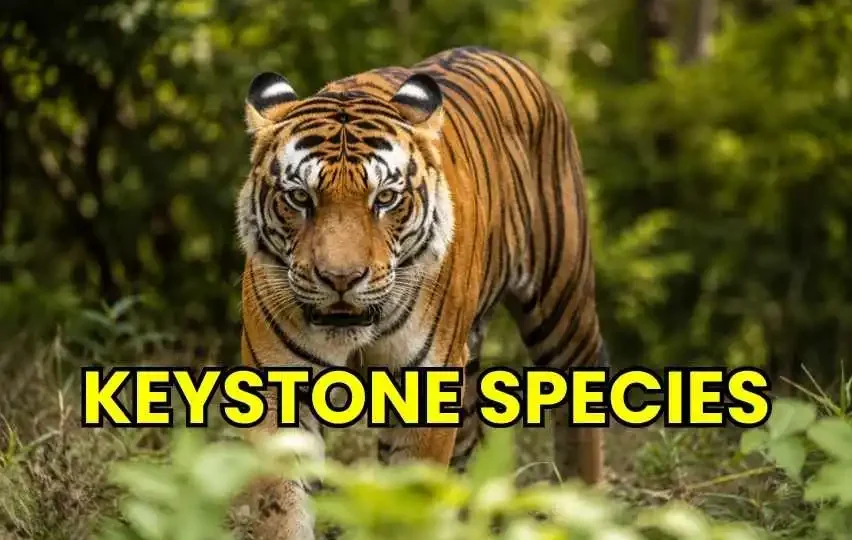
A keystone species is an organism that helps define an entire ecosystem. Without its presence, the ecosystem would be dramatically different or cease to exist altogether. The term was coined by American zoologist Robert T. Paine in 1969, who used the analogy of a wedge-shaped “keystone” at the top of a stone arch, which locks all other stones in place and prevents the structure from collapsing.
Characteristics of Keystone Species
- Disproportionate Impact: Their ecological influence is significantly greater than what would be predicted based solely on their low abundance or biomass within the community.
- Functional Unique Role: They perform specific ecological tasks (like apex predation or habitat modification) that cannot be replicated by any other species in that ecosystem.
- Trophic Cascades: Their removal triggers a top-down or bottom-up trophic cascade, fundamentally altering food webs and physical landscapes.
Ecological Role and Types of Keystone Species
The importance of keystone species is best understood through their functional classification:
Keystone Predators
They control the populations of lower trophic level herbivores and smaller carnivores, preventing any single species from monopolizing resources and wiping out local biodiversity.
Ecosystem Engineers (Modifiers)
These species physically manipulate or create habitats, modifying the landscape to generate niches that support numerous other organisms.
Mutualists
Organisms that engage in mutually beneficial interactions where the survival of multiple other species depends directly on that link (e.g., critical pollinators).
Keystone Hosts
Plants or trees that provide essential food and shelter resources during critical periods of environmental stress (like dry seasons) to a vast array of animal life.
Landmark Keystone Species Examples
Understanding keystone species examples globally and domestically clarifies their structural impact:
- Sea Otters (Predator): They feed on sea urchins in kelp forests. Without sea otters, sea urchins overgraze and completely decimate the kelp forests, destroying the breeding grounds of countless marine species.
- African Elephants (Engineers): By knocking down trees and eating shrubs, they prevent savannas from converting into dense forests, maintaining open grasslands for grazing herbivores.
- Beavers (Engineers): They build dams that turn fast-flowing streams into calm wetland ponds, creating entire habitats for fish, amphibians, and waterfowl.
Keystone Species vs. Dominant Species
It is structurally vital to distinguish these two ecological terms for the examination:
| Parameters | Keystone Species | Dominant Species |
| Biomass / Abundance | Low abundance and small cumulative biomass in the ecosystem. | High abundance and forms a massive share of the ecosystem’s biomass. |
| Nature of Impact | Disproportionate; huge impact despite low numbers. | Proportional; large impact simply due to sheer numbers or size. |
| Example | Tigers or Sea Otters. | Mangrove trees in a swamp; Pine trees in a coniferous forest. |
Threats to Keystone Species
Because of their position at the apex of food chains or as specialized modifiers, they are highly vulnerable to:
- Habitat Fragmentation: Apex predators like tigers require massive, contiguous territories to hunt and breed.
- Anthropogenic Poaching: Commercial illegal trade targeting keystone predators or elephants for fur, bones, and ivory.
- Bioaccumulation: Top-down predators accumulate high concentrations of toxins (like heavy metals and pesticides) through the food chain.
Keystone Species in India's Conservation Policies
India’s environmental framework places immense strategic focus on protecting keystone species to ensure wider ecosystem survival:
- Project Tiger & Project Elephant: These flagship initiatives utilize the Umbrella Species concept. By protecting the vast habitats required by these keystone animals, entire sub-ecosystems and co-dependent species are automatically conserved.
- Snow Leopard Population Assessment: Focused protection of the Snow Leopard as a keystone predator of the high-altitude Himalayan ecosystem to preserve fragile alpine grasslands.
- Legal Status: Most identified keystone animals are granted the highest protection under Schedule I of the Wildlife Protection Act, 1972.
Conservation Measures
- Corridor Protection: Creating safe eco-passages to connect fragmented habitats, allowing keystone animals to migrate safely.
- Community-Based Protection: Compensating and involving local pastoralists and indigenous communities to minimize human-wildlife conflict.
- Reintroduction Programs: Reintroducing apex species (such as the Cheetah translocation project) to restore long-lost ecological balances in degraded grasslands.
Conclusion
For an effective grasp of the keystone species UPSC segment, these organisms must be recognized as nature’s ultimate safety nets. Protecting a keystone species is a highly cost-effective conservation strategy; instead of managing hundreds of individual species, preserving the keystone organism ensures the self-regulation and structural permanence of the entire biome. Modern environmental policy must prioritize these biological anchors to build long-term climate and ecological resilience.
UPSC Prelims: PYQs & Practice Questions
Previous Year Questions (Prelims)
Q: With reference to the food chains in ecosystems, which of the following kinds of organism, is/are known as decomposer organism/organisms? (UPSC CSE Prelims 2020)
1. Virus
2. Fungi
3. Bacteria
Select the correct answer using the code given below:
(a) 1 only
(b) 2 and 3 only
(c) 1 and 3 only
(d) 1, 2 and 3
Answer: (b) 2 and 3 only
Explanation:
Fungi and bacteria are structural decomposers (saprotrophs) that break down organic matter and recycle nutrients back into ecosystems. Viruses are non-living entities outside a host and do not function as decomposers. In several ecosystems, decomposers and detritivores can also act as keystone species because nutrient recycling sustains the entire food web.
Q: Consider the following animals: (UPSC CSE Prelims 2021)
1. Hedgehog
2. Marmot
3. Pangolin
To reduce the chance of being captured by predators, which of the above organisms rolls up/roll up and protects/protect its/their vulnerable parts?
(a) 1 and 2 only
(b) 2 only
(c) 3 only
(d) 1 and 3 only
Answer: (d) 1 and 3 only
Explanation:
Both Hedgehogs and Pangolins curl into defensive balls to protect themselves from predators. The Pangolin is also considered an important ecosystem engineer because its burrowing activities aerate soil and help regulate insect populations such as termites and ants.
Practice Questions
Q: Consider the following statements regarding the concept of "Trophic Cascades":
1. It is an ecological phenomenon triggered by the addition or removal of top predators, involving reciprocal changes in the relative populations of predator and prey through a food chain.
2. The presence of a keystone predator typically dampens biodiversity by monopolizing the food web at the apex level.
Which of the statements given above is/are correct?
(a) 1 only
(b) 2 only
(c) Both 1 and 2
(d) Neither 1 nor 2
Answer: (a) 1 only
Explanation:
Statement 1 is correct; a trophic cascade is a top-down ecological chain reaction caused by manipulating apex predators. Statement 2 is incorrect because keystone predators generally enhance biodiversity. By regulating dominant herbivores or meso-predators, they prevent ecological monopolization and maintain species balance. For example, sea otters control sea urchin populations, thereby protecting kelp forests.
Q: Which of the following best describes the ecological function of a "Keystone Modifier" (Ecosystem Engineer)?
(a) An organism that establishes mutualistic pollen-transfer networks across fragmented forest canopies.
(b) A species that physically alters the structural architecture of the landscape, creating novel ecological niches for other organisms.
(c) A high-abundance plant species that contributes to the majority of the community's biomass.
(d) An indicator species whose population decline signals micro-climatic stress.
Answer: (b) A species that physically alters the structural architecture of the landscape
Explanation:
Keystone modifiers, also known as ecosystem engineers, physically transform their environment and create habitats for other species. Examples include the Beaver, which constructs dams that generate wetland ecosystems, and the African Elephant, which modifies vegetation patterns and maintains grassland habitats.
UPSC Mains – Previous Year & Practice Questions
Mains Previous Year Questions
Question: Identify the main causes of the loss of biodiversity in India.
(Mains 2023)
(Directly ties into how targeted poaching of apex keystone species like tigers triggers a collapse of lower food webs)
Question: Coastal regions of India are prone to cyclones. Discuss the role of
mangroves in reducing the impact of such disasters.
(Mains 2019)
(Mangroves act as a dominant species that doubles as a keystone structural host for coastal fauna)
Question: How does the draft Environment Impact Assessment (EIA) Notification, 2020 differ from the existing EIA Notification, 2006?
(Mains 2020)
(Crucial for evaluating how mega-projects impact the core habitats of keystone ecosystem engineers like elephants)
Question: Enumerate the indirect services provided by an ecosystem.
How do these help in sustainable development?
(Mains 2014)
(The self-regulating maintenance provided by keystone animals is a foundational indirect ecosystem service)
Question: What is the economic importance of the marine ecosystem in India?
Discuss the Blue Economy's potential.
(Mains 2015)
(Can be linked to how marine keystone species like sharks and otters sustain commercially viable fish and kelp ecosystems)
Mains Practice Questions
[10 Marks | 150 Words]
Question: Differentiate between a Keystone species, an Umbrella species, and an Indicator species. How does Indian environmental law incorporate these concepts into conservation planning?
[15 Marks | 250 Words]
Question: Examine the ecological consequences of eliminating apex keystone predators from grassland ecosystems. Use the context of India's recent carnivore reintroduction projects to support your answer.
[15 Marks | 250 Words]
Question: The African elephant and the Indian elephant are classic ecosystem engineers. Discuss how the fragmentation of elephant corridors compromises the climate resilience of forest landscapes.



Keystone Species-FAQs
Can a species be a keystone species in one ecosystem but not in another?
Yes. The “keystone” status is not a permanent biological trait of a species; it is entirely context-dependent. For example, a particular predator may be a keystone species in a resource-scarce desert ecosystem because it regulates the entire small-rodent population. However, if that same predator is introduced into a hyper-diverse tropical rainforest with multiple overlapping generalist predators, its functional uniqueness diminishes, and it loses its keystone role.
What is the difference between a Keystone Species and an Umbrella Species?
A Keystone Species is defined strictly by its disproportionate ecological impact relative to its low biomass or abundance. An Umbrella Species is chosen because its protection automatically safeguards a vast array of other co-existing species, typically because it requires a massive geographic home range (e.g., Tigers or Elephants). Many large mammals function as both.
Why are certain trees considered "Keystone Hosts"?
Trees like the Ficus (Fig tree) are classic keystone hosts in tropical rainforests. During seasons of extreme drought or food scarcity, when most other plants stop fruiting, Ficus trees continue to produce fruit. This makes them the sole lifelines supporting the entire canopy community of birds, primates, and bats during critical bottleneck periods.
How did the removal of wolves from Yellowstone National Park prove the keystone concept?
This is the most famous global example of a trophic cascade. When wolves were eradicated, the elk (deer) population exploded. They overgrazed the river valleys, wiping out young willow and aspen trees. This lack of vegetation caused severe soil erosion, altered the path of rivers, and drove away beavers and songbirds. When wolves were reintroduced in 1995, they regulated the elk, the vegetation returned, and the entire physical landscape stabilized.
How does the Wildlife Protection Act (WPA), 1972 protect keystone species in India?
India’s conservation strategy protects the ecosystem by heavily guarding the keystone elements. Most apex keystone animals—such as the Bengal Tiger, Asiatic Lion, Snow Leopard, Indian Elephant, and the Great Indian Bustard—are listed under Schedule I of the WPA, 1972, making any hunting, poaching, or habitat encroachment subject to the highest possible legal penalties.