Table of Contents
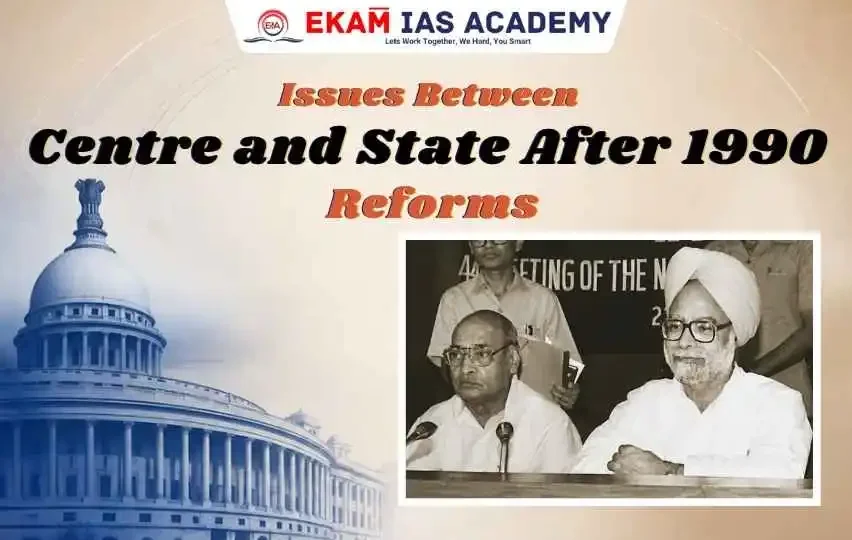
ToggleIssues Between Centre and State After 1990 Reforms
The 1991 Liberalisation, Privatisation, and Globalisation (LPG) economic reforms fundamentally altered Centre State Relations After 1991. Transitioning India from a command economy to a market-driven system reshaped the balance of power between the Union and regional governments. Studying Economic Reforms and Federalism, recurring Centre State Issues UPSC
Centre-State Relations Before vs. After 1991 Reforms
Centre-State Relations Before 1991
- Centrally Planned Economy: Driven by the Planning Commission through rigid top-down central allocation of developmental funds.
- License-Permit Raj: Central control over industrial licensing, public sector monopolies, and capital market approvals dictated state industrial trajectories.
- Political Hegemony: Frequent invocation of Article 356 (President’s Rule) centralising political power at the expense of regional autonomy.
How 1991 Reforms Changed the Dynamics
- De-licensing & Market Forces: Market forces replaced central allocation, prompting private and foreign direct investment (FDI) to seek business-friendly states.
- Rise of Coalition Politics: The era of coalition governments empowered regional political parties in federal decision-making.
Major Issues Between Centre and States After 1991
Political & Administrative Issues
- Misuse of Constitutional Offices: Governor’s role in reserved bills, delayed assent, and appointment of Vice-Chancellors remains a key flashpoint in Centre State Conflicts in India.
- Central Agency Overreach: Tensions surrounding central investigative agencies operating within state jurisdictions without local concurrence.
Legislative & Fiscal Issues
- GST and Centre State Relations: The introduction of the Goods and Services Tax restricted state indirect taxation autonomy, making states heavily reliant on central compensation transfers.
- Encroachment via Centrally Sponsored Schemes: Increased discretionary spending under Article 282 conditions state budgets and limits local priority spending.
Shift in Federal Architecture
Role of Liberalisation in Competitive Federalism
Liberalisation triggered “Competitive Federalism,” forcing states to compete directly for private capital, foreign investment, and infrastructure projects by improving ease of doing business.
Planning Commission to NITI Aayog
The replacement of the Planning Commission with NITI Aayog in 2015 shifted the paradigm toward Cooperative Federalism UPSC mandates, operating as a policy think-tank rather than a discretionary fund-allocating body.
Finance Commission & Key Commissions
- Finance Commission: Recommended higher untied tax devolution (increasing to 42% under the 14th FC and 41% under the 15th FC) to restore fiscal space to states.
- Sarkaria Commission & Punchhi Commission: Emphasised constitutional safeguards against the arbitrary invocation of Article 356, mandatory consultation with Chief Ministers regarding Governor appointments, and cooperative governance via the Inter-State Council.
- Supreme Court Benchmark: The landmark S.R. Bommai v. Union of India (1994) judgment established strict judicial review over President’s Rule, protecting state legislative autonomy.
Impact of Post-1991 Reforms on Federalism
Positive Impacts
- Empowered states as active economic actors driving regional infrastructure and local industrial policy.
- Enhanced state participation in international economic forums and investor summits.
Negative Impacts & Concerns
- Widening Regional Disparities: Industrially developed coastal states attracted the bulk of FDI, leaving landlocked and underdeveloped states further behind.
- Fiscal Fragility: Reduced tax autonomy under structural tax reforms created persistent state revenue dependencies on Union transfers.
Way Forward
- Standardize Consultative Mechanisms: Activate the Inter-State Council as a permanent platform for consensus-building prior to major economic policies.
- Fiscal Rationalisation: Reduce tied grants, streamline CSS, and ensure timely release of state GST compensation shares.
- Strengthen NITI Aayog: Enhance state representation in policy formulation to foster genuine cooperative federalism.
Conclusion
The post-1991 economic era transformed Indian federalism from centralized planning into a dynamic matrix of competitive and cooperative federalism. Resolving structural Centre State Relations After Liberalisation issues ensures national integration while sustaining state-led developmental momentum.
UPSC Prelims: PYQs & Practice Questions
Previous Year Questions (Prelims)
Q: Which of the following statements is/are correct regarding the Goods and Services Tax (GST) introduced in India?
1. It subsumed indirect taxes levied by both the Union and the States into a single unified tax structure.
2. The GST Council is a constitutional body established under Article 279A of the Constitution to foster cooperative federalism.
3. Post-GST implementation, State governments retained independent legislative powers to unilaterally change SGST rates on manufactured goods.
Select the correct answer using the code given below:
(A) 1 and 2 only
(B) 2 only
(C) 1 and 3 only
(D) 1, 2, and 3
Answer: (A) 1 and 2 only
Explanation:
Statement 1 is correct: The 101st Constitutional Amendment Act, 2016 introduced GST,
subsuming several central and state indirect taxes such as Excise Duty, Service Tax, VAT, Octroi and
Entertainment Tax into a harmonized indirect tax regime.
Statement 2 is correct: Article 279A created the GST Council as a joint forum of the Centre and States, reflecting the principle of cooperative federalism.
Statement 3 is incorrect: Under GST, States do not have complete unilateral autonomy over tax rates. Major GST rate decisions are taken through the GST Council, limiting independent rate-setting powers of individual States.
Q: With reference to the structural transition from the Planning Commission to NITI Aayog in 2015, consider the following statements:
1. NITI Aayog possesses statutory authority under Article 282 to directly disburse developmental grants to States.
2. Unlike the Planning Commission, NITI Aayog functions primarily as an advisory think-tank with no powers to allocate central financial resources.
Which of the statements given above is/are correct?
(A) 1 only
(B) 2 only
(C) Both 1 and 2
(D) Neither 1 nor 2
Answer: (B) 2 only
Explanation:
Statement 1 is incorrect: NITI Aayog is neither a constitutional nor a statutory body
and does not possess independent fund-allocation powers under Article 282. The allocation of central
financial resources is handled through the appropriate financial and budgetary mechanisms of the Union Government.
Statement 2 is correct: Unlike the Planning Commission, which played a major role in central plan allocation, NITI Aayog functions primarily as a policy think-tank. It promotes cooperative and competitive federalism through consultation, policy advice and bottom-up planning.
Practice Questions (Prelims)
Q: In the context of post-1991 economic reforms and federal dynamics in India, consider the following statements:
1. The de-licensing of industries in 1991 catalyzed Competitive Federalism,
allowing states to directly compete for private investments and Foreign Direct Investment (FDI).
2. The Supreme Court's ruling in S.R. Bommai v. Union of India (1994)
strengthened state political stability by subjecting President's Rule (Article 356) to strict judicial review.
3. The proportion of cesses and surcharges collected by the Centre is automatically added to the
divisible pool for vertical devolution under Finance Commission recommendations.
How many of the statements given above are correct?
(A) Only one
(B) Only two
(C) All three
(D) None
Answer: (B) Only two (Statements 1 and 2 are correct)
Explanation:
Statement 1 is correct: Economic liberalisation dismantled the
License-Permit Raj, shifting investment decisions from central controls
towards market forces and encouraging states to compete for private capital and FDI.
Statement 2 is correct: The 1994 S.R. Bommai judgment recognised federalism as part of the basic structure of the Constitution and made proclamations under Article 356 subject to judicial review, thereby limiting arbitrary dismissal of elected state governments.
Statement 3 is incorrect: Under Article 270, cesses and surcharges levied by the Central Government are excluded from the divisible tax pool shared with the States. This has remained an important issue in Centre-State fiscal relations.
Q: Which of the following commissions/committees recommended that the Governor of a State should be an eminent person from outside the State and not actively affiliated with local politics, to prevent central political friction?
1. Sarkaria Commission (1983)
2. Punchhi Commission (2007)
3. Venkatachaliah Commission (NCRWC 2002)
Select the correct answer using the code given below:
(A) 1 only
(B) 1 and 2 only
(C) 2 and 3 only
(D) 1, 2, and 3
Answer: (D) 1, 2, and 3
Explanation:
All three landmark commissions—the Sarkaria Commission,
Punchhi Commission, and the
National Commission to Review the Working of the Constitution (NCRWC)—
emphasised that the Governor should be a detached and eminent person from outside the State,
preferably without active political affiliations.
These recommendations were aimed at ensuring the political neutrality of the Governor and reducing friction in Centre-State relations. They also stressed the importance of consultation with the State leadership in the appointment process.
UPSC Mains – Previous Year & Practice Questions
Mains Previous Year Questions
Question: "The 1991 economic reforms shifted the federal balance in India from centralized planning to competitive federalism, leading to wider regional economic disparities." Critically examine. (UPSC GS Paper II – 2023, 15 Marks)
Question: How far has the transition from the Planning Commission to NITI Aayog helped in strengthening cooperative federalism in India? Analyze the key differences in their operational principles. (UPSC GS Paper III/II – 2018, 15 Marks)
Question: "GST has introduced a system of 'pooled sovereignty' in Indian fiscal federalism, but friction points regarding state revenue autonomy persist." Discuss in light of post-1991 fiscal relations. (UPSC GS Paper II – 2021, 15 Marks)
Question: The role of the Governor has often emerged as a major flashpoint between the Centre and States. Discuss the major recommendations of the Punchhi Commission to restore administrative harmony. (UPSC GS Paper II – 2020, 15 Marks)
Question: Analyze the impact of growing central dependence on cesses and surcharges on the overall divisible pool of taxes and Centre-State financial relations. (UPSC GS Paper II – 2019, 10 Marks)
Mains Practice Questions
[15 Marks | 250 Words]
Question: "Post-1991 economic liberalisation empowered states as primary economic agents, yet fiscal centralisation has restricted their developmental flexibility." Critically evaluate.
[10 Marks | 150 Words]
Question: Examine how the proliferation of Centrally Sponsored Schemes (CSS) under Article 282 collides with the fiscal space granted through Finance Commission tax devolutions.
[15 Marks | 250 Words]
Question: "Cooperative federalism cannot function in an institutional vacuum." Suggest structural reforms in the Inter-State Council and GST Council to resolve administrative and fiscal deadlocks.
Issues Between Centre and State After 1990 Reforms-FAQs
How did the 1991 economic reforms affect Centre-State relations?
The 1991 LPG reforms reduced centralised economic controls and increased the role of states in attracting private investment, FDI and infrastructure projects. This contributed to the growth of competitive federalism.
What are the major Centre-State issues after economic liberalisation?
Major issues include the role of Governors, use of central investigative agencies, GST-related fiscal concerns, Centrally Sponsored Schemes, and disagreements over the distribution of financial resources.
How did GST affect the fiscal autonomy of states?
GST created a unified indirect tax system but reduced states’ independent taxation powers over several major indirect taxes. Consequently, states became more dependent on tax devolution and Union transfers.
What is the role of NITI Aayog in India's federal structure?
NITI Aayog replaced the Planning Commission in 2015 and focuses on policy coordination, cooperative federalism and encouraging states to participate in development strategies rather than functioning as a centralised fund-allocation body.
Why is S.R. Bommai v. Union of India important for Centre-State relations?
The 1994 S.R. Bommai judgment strengthened federalism by placing the imposition of President’s Rule under judicial review and establishing safeguards against arbitrary use of Article 356.