Table of Contents
ToggleEmergency Provisions
Designed to safeguard national integrity, sovereignty, and democratic stability, Emergency Provisions form an exceptional chapter in Part XVIII of the Indian Constitution (Articles 352 to 360). However, the historical Misuse of Article 356 has triggered intense debate over central overreach versus state autonomy. Mastering Emergency Provisions UPSC topics is essential for civil services candidates seeking a deep understanding of President’s Rule in India, federal balances, and Emergency Provisions Indian Constitution jurisprudence.
What are Emergency Provisions
The Emergency Provisions in India enable the Union government to temporarily convert the federal structure into a unitary framework to handle extraordinary crises without formal constitutional amendments.
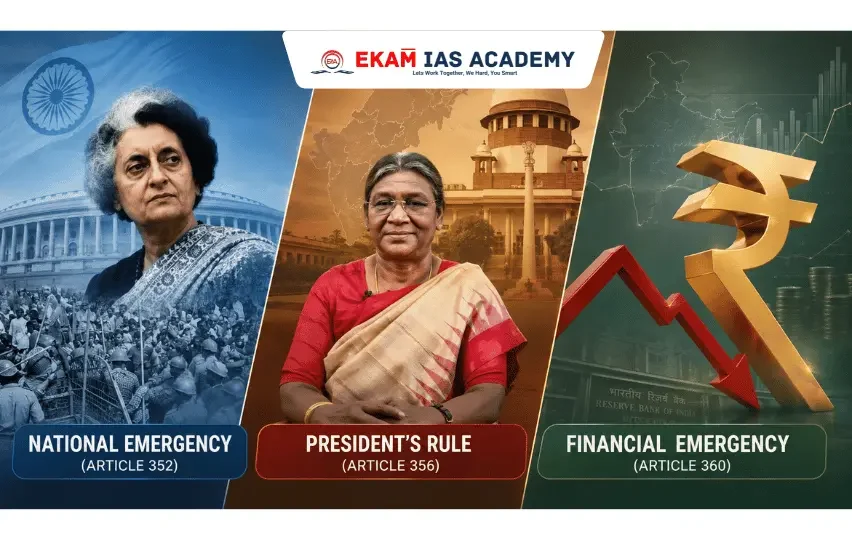
The Three Types of Emergencies
National Emergency (Article 352)
Declared on grounds of war, external aggression, or armed rebellion (substituted for “internal disturbance” by the 44th Constitutional Amendment Act, 1978).
President's Rule (Article 356)
Imposed on the grounds of Failure of Constitutional Machinery in a state, or under Article 365 when a state fails to comply with central directions.
Financial Emergency (Article 360)
Proclaimed if the financial stability or credit of India or any part of its territory is threatened (Financial Emergency in India has never been declared to date).
President's Rule – Article 356, Article 355, and Its Effects
Under Article 356 Indian Constitution, the President can assume state executive powers based on a report by the Governor’s Role in Article 356 or suo motu.
Article 355 and Article 356
Article 355 UPSC mandates the Union to protect every state against external aggression and internal disturbance while ensuring governance aligns with constitutional provisions. Article 356 serves as the enforcement mechanism when state governance fails.
Effects of President's Rule:
The state council of ministers is dismissed, and the state legislature is either suspended or dissolved. Parliament assumes power to pass laws and budgets for the state.
Misuse of Article 356 & Historical Context
Historically, Article 356 Misuse became a frequent political instrument for dismissing opposition-led state governments, severely damaging Article 356 and Centre State Relations. Over 120 invocations occurred before judicial intervention, altering state mandates arbitrarily.
Landmark Judgments: S.R. Bommai Judgment and Safeguards
The S R Bommai Case (1994) transformed Article 356 Judicial Review jurisprudence:
- Floor Test Mandatory: Majority must be tested on the floor of the Legislative Assembly, not in the Governor’s office.
- Subject to Judicial Review: The satisfaction of the President is subject to judicial scrutiny; courts can restore dismissed governments if the action is malicious.
- Secularism and Basic Structure: Actions violating the basic structure authorize Article 356 imposition.
Sarkaria and Punchhi Commission Recommendations
| Commission | Recommendation on Article 356 |
| Sarkaria Commission Article 356 | Should be used as a matter of last resort after issuing warnings under Article 355. State Assembly must not be dissolved before parliamentary approval. |
| Punchhi Commission Article 356 | Recommended “Local Emergency” provisions to isolate specific districts rather than taking over the entire state machinery. |
Conclusion
Understanding Article 356 UPSC and National Emergency Article 352 frameworks reveals the fine line between constitutional preservation and federal overreach. Thorough preparation on S R Bommai Judgment UPSC guidelines equips aspirants to critically analyze federal governance, civil liberties, and the legal limits of executive authority.
UPSC Prelims: PYQs & Practice Questions
Previous Year Questions
Q: Which of the following are not necessarily the consequences of the proclamation of President’s Rule in a State?
1. Dissolution of the State Legislative Assembly
2. Removal of the Council of Ministers in the State
3. Dissolution of the Local Bodies
Select the correct answer using the code given below:
(a) 1 and 2 only
(b) 1 and 3 only
(c) 2 and 3 only
(d) 1, 2 and 3
Answer: (b) 1 and 3 only
Explanation:
Statement 2 is a necessary consequence. When
President’s Rule under Article 356 is imposed, the State Council of Ministers headed by the Chief Minister is removed and the executive authority of the State is assumed by the President.
Statement 1 is not necessarily a consequence. The
State Legislative Assembly may either be
suspended or dissolved. In
S.R. Bommai v. Union of India (1994), the Supreme Court emphasized that the Assembly should not ordinarily be dissolved before Parliamentary approval of the proclamation.
Statement 3 is not necessarily a consequence.
Panchayats and Municipalities are governed under
Parts IX and IXA of the Constitution and are not automatically dissolved when President’s Rule is imposed in a State.
Q: If the President of India exercises his power under
Article 356 of the Constitution in respect of a particular State, then:
(a) The Right to Freedom under Article 19 is automatically suspended in that State.
(b) Parliament assumes the power to make laws for that State.
(c) Article 358 becomes applicable to that State.
(d) The President can make laws only on subjects mentioned in the Concurrent List for that State.
Answer: (b) Parliament assumes the power to make laws for that State
Explanation:
Under Article 356, the President may declare that the powers of the
State Legislature shall be exercisable by or under the authority of
Parliament.
Options (a) and (c) are incorrect. The suspension of freedoms under
Article 19 and the operation of
Article 358 relate to a
National Emergency under Article 352, not President’s Rule under Article 356.
Option (d) is incorrect. Parliament can make laws for that State on subjects in the
State List during President’s Rule.
Practice Questions
Q: With reference to the Emergency Provisions in the Constitution of India, consider the following statements:
1. A proclamation of National Emergency under Article 352 must be approved by both Houses of Parliament within one month from the date of its issue, whereas President's Rule under Article 356 allows two months for parliamentary approval.
2. The 44th Constitutional Amendment Act, 1978 substituted the phrase “internal disturbance” with “armed rebellion” for invoking Article 352.
3. Every resolution approving the proclamation or continuation of President's Rule under Article 356 must be passed by a special majority in both Houses of Parliament.
How many of the above statements are correct?
(a) Only one
(b) Only two
(c) All three
(d) None
Answer: (b) Only two
Explanation:
Statement 1 is correct. A proclamation of
National Emergency under Article 352 must be approved by both Houses of Parliament within
one month from the date of its issue. In contrast,
President's Rule under Article 356 must be approved within
two months.
Statement 2 is correct. The
44th Constitutional Amendment Act, 1978 replaced the expression
“internal disturbance” with
“armed rebellion” as one of the grounds for proclaiming a National Emergency under Article 352.
Statement 3 is incorrect. Parliamentary approval and continuation of
President's Rule under Article 356 require a
simple majority of members present and voting.
A special majority is required for the approval or continuation of a
National Emergency under Article 352.
Q: Which of the following guidelines were laid down by the Supreme Court in the landmark S.R. Bommai v. Union of India (1994) case regarding Article 356?
1. The proclamation of President's Rule is subject to judicial review.
2. The material on the basis of which the President forms his satisfaction can be scrutinized by the court.
3. The State Legislative Assembly cannot be dissolved until Parliament approves the proclamation under Article 356.
Select the correct answer using the code given below:
(a) 1 and 2 only
(b) 2 and 3 only
(c) 1 and 3 only
(d) 1, 2 and 3
Answer: (d) 1, 2 and 3
Explanation:
Statement 1 is correct. In
S.R. Bommai v. Union of India (1994), the Supreme Court held that a proclamation issued under
Article 356 is subject to judicial review.
Statement 2 is correct. The courts can examine whether the
material relied upon for the President's satisfaction was relevant and whether the proclamation was based on valid constitutional grounds.
Statement 3 is correct. The Court emphasized that the
State Legislative Assembly should not be dissolved before Parliament approves the proclamation. Until such approval, the Assembly may be kept under
suspended animation.
UPSC Mains – Previous Year & Practice Questions
Mains Previous Year Questions
[15 Marks]
Question: “The S.R. Bommai judgment fundamentally reshaped Indian federalism by curbing the arbitrary exercise of power under Article 356.” Analyse the constitutional safeguards introduced by this judgment. (UPSC GS Paper II – 2022)
[15 Marks]
Question: Under what circumstances can President's Rule be proclaimed under Article 356 of the Constitution? Critically examine the efficacy of the remedies available to aggrieved States. (UPSC GS Paper II – 2018)
[10 Marks]
Question: Examine the constitutional relationship between Article 355 and Article 356. Is Article 355 a prerequisite duty before Article 356 can be legitimately invoked? (UPSC GS Paper II – 2017)
[12.5 Marks]
Question: “ Emergency provisions in the Indian Constitution are a double-edged sword designed to protect State integrity, yet prone to centralization.” Discuss with special reference to Article 352 and Article 356. (UPSC GS Paper II – 2015)
[10 Marks]
Question: Critically evaluate the recommendations of the Sarkaria Commission and the Punchhi Commission regarding the role of the Governor and the imposition of Article 356. (UPSC GS Paper II – 2013)
Mains Practice Questions
[15 Marks | 250 Words]
Question: “ Article 356 was envisaged by Dr. B.R. Ambedkar as a ‘dead letter’ of the Constitution, but it has frequently functioned as a ‘deadly weapon’.” Discuss the historical trajectory and judicial constraints governing Article 356.
[10 Marks | 150 Words]
Question: Analyse how the 44th Constitutional Amendment Act, 1978 introduced institutional checks and balances to prevent the misuse of National Emergency under Article 352.
[15 Marks | 250 Words]
Question: Evaluate the Punchhi Commission’s recommendation on “Local Emergency” under Articles 355 and 356. How can localized interventions preserve federal equilibrium without replacing State governance?
Emergency Provisions-FAQs
What are Emergency Provisions in India?
Emergency Provisions are special constitutional powers under Part XVIII that allow the Union to respond to war, external aggression, armed rebellion, state constitutional failure or financial instability.
Which Articles deal with Emergency Provisions?
Articles 352 to 360 deal with National Emergency, President’s Rule and Financial Emergency.
What is Article 356?
Article 356 allows the President to impose President’s Rule when the government of a State cannot be carried on according to the Constitution.
What did the S.R. Bommai judgment decide?
The S.R. Bommai judgment held that Article 356 proclamations are subject to judicial review and that majority should normally be tested on the floor of the Assembly.
Why is Article 356 important for UPSC?
Article 356 is important because it connects President’s Rule, Centre-State relations, federalism, Governor’s role, judicial review and misuse of emergency powers.