

Table of Contents
ToggleMAHANADI WATER DISPUTE AND COOPERATIVE RIVER MANAGEMENT
TOPIC: (GS2) POLITY: THE HINDU
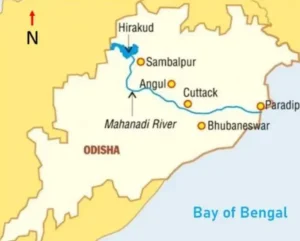
Odisha’s Chief Minister says water-sharing talks with Chhattisgarh are progressing with Central Water Commission support.
Understanding the Dispute
- Odisha fears that upstream dams and barrages in Chhattisgarh reduce downstream water availability, particularly during summer.
- The issue involves competing demands for irrigation, drinking water, industries and river ecosystems.
Key Prelims Facts
- Mahanadi: An east-flowing peninsular river originating in Chhattisgarh’s Sihawa hills and draining into the Bay of Bengal.
- Hirakud Dam: Located in Odisha; supports irrigation, electricity generation and flood control.
- Tribunal: The Union government constituted the Mahanadi Water Disputes Tribunal on March 12, 2018.
Constitutional and Institutional Framework
- Article 262: Enables Parliament to provide for adjudication of interstate river water disputes.
- Inter-State River Water Disputes Act, 1956: Provides for tribunals when negotiations fail.
- CWC: Supplies technical expertise and hydrological information for informed negotiations.
Wider Significance
- Federalism: Shared rivers require cooperation between upstream and downstream States.
- Livelihoods: Uncertain supplies affect farmers, fisheries and water-dependent communities.
- Environment: Adequate river flows sustain wetlands, biodiversity and the delta.
Way Forward
- Publish agreed decisions and share reliable flow data.
- Coordinate reservoir operations, seasonal allocations and drought responses.
- Establish joint monitoring with clear responsibilities and protect minimum ecological flows.
CENTRAL WATER COMMISSION (CWC)
- Established: In 1945 as the Central Waterways, Irrigation and Navigation Commission; headquartered in New Delhi.
- Administrative position: An attached office of the Department of Water Resources, River Development and Ganga Rejuvenation, Ministry of Jal Shakti.
- Main role: Coordinates water conservation and development with States for irrigation, drinking water, hydropower, navigation and flood control.
- Organisation: Has three technical wings—Designs and Research, Water Planning and Projects, and River Management.
Conclusion:
A transparent, science-based agreement can secure equitable water access while strengthening cooperative federalism.
GANDHI’S TALENT AND MORAL RESPONSIBILITY
TOPIC: (GS2) GOVERNANCE: THE HINDU
On Gandhi Jayanti, a recent article revisits how Gandhi recognised exceptional talent in engineering, politics, literature and spirituality.
Meaning and Central Idea
- Gandhi used “genius” for exceptional ability, creative achievement and the distinctive qualities of people or institutions.
- His examples suggest that intelligence alone does not guarantee goodness; its purpose and effects also matter.
- These observations appear across the Collected Works of Mahatma Gandhi, available through the government-supported Gandhi Heritage Portal.
Appreciation of Constructive Talent
- Engineering: During his 1888 journey to England, Gandhi admired the remarkable planning behind the Suez Canal.
- Political leadership: He recognised Bal Gangadhar Tilak’s outstanding contribution to the demand for swaraj.
- Culture and education: He valued Rabindranath Tagore’s poetry and institution-building through Santiniketan, Sriniketan and Visva-Bharati.
- Spiritual insight: He admired Rajchandra’s learning despite limited formal schooling. Gandhi’s autobiography also identifies him as a major personal influence.
Intelligence Used for Harm
- Gandhi criticised discriminatory administration in South Africa, showing how organised ability could sustain injustice.
- His comments on the Jallianwala Bagh massacre exposed the moral failure behind colonial authority.
- He condemned policies that encouraged Hindu-Muslim divisions to preserve British rule.
Ethics
- Competence and integrity: Skilled officials must combine administrative ability with honesty, empathy and fairness.
- Means and ends: Efficient methods cannot justify discrimination, violence or violations of human dignity.
- Education: Qualifications should be considered alongside judgment, character and practical understanding.
- Innovation: Artificial intelligence can improve healthcare but can also enable surveillance and misinformation.
- Leadership: Evaluate achievement through public welfare, inclusion and accountability.
Wider Lesson
- These reflections support a balanced assessment of progress: celebrate creativity while examining who benefits, who suffers and whether power serves society.
- Public institutions should reward ethical conduct alongside measurable performance.
Conclusion:
Genius becomes socially valuable when exceptional ability serves truth, justice and human dignity.
PM-DHARA
TOPIC: (GS3) ECONOMY: THE HINDU
The Union Cabinet approved the ₹1.86 lakh crore PM-DHARA Scheme to strengthen State-level transmission networks and integrate large-scale renewable energy grid congestion and intermittency.
What is PM-DHARA?
- PM-DHARA stands for PM-Developing Harmonized and Accelerated Renewable-energy Access.
- It aims to modernise the Intra-State Transmission System (InSTS) across States/UTs by FY 2032-33.
- It will support evacuation of up to 135 GW of renewable power and deployment of 50 GWh Battery Energy Storage Systems (BESS).
Implementation Framework
- State Transmission Utilities (STUs) will coordinate implementation.
- New or greenfield projects will follow Tariff-Based Competitive Bidding (TBCB).
- Existing-network upgrades will use the Cost-Plus Basis.
- Private Transmission Service Providers can participate through the Build-Own-Operate-Maintain (BOOM) model.
Why is it Important?
- Grid stability: BESS can store surplus solar/wind electricity and supply it during peak or non-solar hours.
- Green transition: Supports India’s target of 900 GW non-fossil capacity by 2035.
- Future readiness: CEA estimates India may require about 411 GWh of energy storage by 2031-32, showing the growing importance of storage infrastructure.
- Economic dimension: Transmission, battery manufacturing, construction and grid management can generate skilled employment.
Conclusion
PM-DHARA can bridge the gap between rapid renewable-energy creation and reliable electricity delivery, making storage and transmission the backbone of India’s clean-energy transition.
NATIONAL COASTAL MISSION (NCM) 2.0
TOPIC: (GS3) ECONOMY: THE HINDU
The Union Environment Minister has launched the implementation guidelines for National Coastal Mission (NCM) 2.0 in New Delhi.
About NCM 2.0
- It is a Central Sector Scheme under the Ministry of Environment, Forest and Climate Change (MoEFCC).
- Outlay: ₹767 crore; implementation extends up to 2030-31.
- Coverage: Nine coastal States—Gujarat, Maharashtra, Goa, Karnataka, Kerala, Tamil Nadu, Andhra Pradesh, Odisha and West Bengal—and four coastal UTs.
- It builds upon the earlier National Coastal Mission and promotes Centre-State-stakeholder coordination.
Key Focus Areas
- Climate resilience: Undertake vulnerability assessments and adaptation measures against sea-level rise, erosion and extreme weather.
- Ecosystem conservation: Restore and protect mangroves, coral reefs, wetlands and other marine habitats.
- Scientific planning: Develop Integrated Coastal Zone Management Plans (ICZMPs) and Coastal Marine Spatial Plans for balanced use of coastal resources.
- Pollution control: Prevent and reduce pollution entering coastal and territorial waters.
- Livelihood security: Promote diversified, climate-resilient livelihoods, sustainable tourism and community participation.
- Blue Economy: Facilitate environmentally sustainable coastal infrastructure and economic activities.
- Governance: Strengthen research, capacity-building, monitoring and convergence with existing government programmes.
Significance
- The Mission links ecological security with economic development, particularly for climate-vulnerable coastal communities.
- The National Centre for Sustainable Coastal Management (NCSCM) will be a major implementation partner, supporting science-based coastal management.
Conclusion
NCM 2.0 can make India’s coastline a model where ecosystem conservation, climate resilience and the Blue Economy advance together.
GREEN ENERGY CORRIDOR
TOPIC: (GS3) ENVIRONMENT: THE HINDU
The Union Cabinet has approved Green Energy Corridor Phase-III (GEC-III) to strengthen the Intra-State Transmission System and evacuate up to 135 GW of renewable energy.
About Green Energy Corridor
- The Green Energy Corridor was conceptualised after a 2012 POWERGRID study identified inadequate transmission infrastructure near renewable-energy zones; implementation began in 2015.
- GEC aims to connect renewable-rich regions with the electricity grid through new transmission lines and substations.
- Earlier, GEC-I covered eight renewable-rich States, while GEC-II is being implemented by seven States.
Key Features of GEC-III
- Target: Evacuation and integration of up to 135 GW renewable power across States/UTs.
- Timeline: Targeted for completion by FY 2032-33.
- Total outlay: ₹1,86,405 crore—₹1,36,378 crore for InSTS infrastructure and ₹50,000 crore for 50 GWh BESS.
- Central Financial Support: ₹54,082 crore, aimed at limiting transmission charges and reducing the burden on consumers.
- Implementation: State Transmission Utilities will be the overall implementing agencies.
- Greenfield transmission projects will follow Tariff-Based Competitive Bidding (TBCB) under the Build-Own-Operate-Maintain (BOOM) model, while brownfield strengthening will use the Cost-Plus route.
Why is GEC-III Important?
- Renewable integration: Helps transmit electricity from solar and wind-rich areas to consumption centres.
- Grid stability: BESS can absorb surplus renewable power and supply electricity during peak and non-solar hours, reducing intermittency and curtailment.
- Energy security: Reduces dependence on fossil fuels and supports India’s expanding non-fossil electricity capacity.
- Affordable power: Central support can lower the capital burden on State transmission utilities.
- Private participation: Competitive bidding can encourage investment, innovation and cost efficiency.
- Green economy: Expansion of transmission, substations and storage can generate employment and strengthen India’s clean-energy ecosystem.
Key Challenges
- Land and Right-of-Way: Transmission lines may face delays due to land, forest and local-clearance issues.
- Financial stress: Weak finances of power-sector utilities can affect timely investments.
- Import dependence: Batteries require critical minerals such as lithium, exposing projects to global supply-chain risks.
- Technical challenges: Large-scale variable renewable power requires accurate forecasting, smart grids and flexible power markets.
- Implementation delays: GEC-I itself required timeline extensions, underlining the importance of stronger project monitoring.
Way Forward
- India should combine timely transmission construction, domestic battery manufacturing, smart-grid technologies, storage, DISCOM reforms and Centre-State coordination.
- Planning transmission simultaneously with new renewable projects can prevent clean-energy capacity from being stranded.
Conclusion
GEC-III can transform India’s renewable-energy ambition into reliable electricity by ensuring that green power is not merely generated, but efficiently stored, transmitted and delivered.
FIRST-EVER UN DECLARATION ON SEA LEVEL RISE, AND INDIA’S COASTAL VULNERABILITY
TOPIC: (GS3) ENVIRONMENT: THE HINDU
On 24 September 2026, the UN General Assembly adopted its first political declaration specifically addressing the threats posed by sea-level rise.
What is Sea-Level Rise?
- It refers to a long-term increase in the average height of oceans.
- Major causes include melting glaciers and ice sheets, thermal expansion of warming seawater and changes in terrestrial water storage.
- According to WMO, the global mean sea-level rise accelerated from 2.1 mm/year during 1993-2002 to 4.7 mm/year during 2015-2024.
Key Features of UN Declaration
- Recognises sea-level rise as a serious threat to people, ecosystems, economies and low-lying island countries.
- Calls for stronger adaptation, climate finance, scientific cooperation and disaster resilience.
- Supports stability of maritime zones already established under UNCLOS, despite physical changes in coastlines.
- Underscores the continuity of statehood and sovereignty of countries affected by sea-level rise.
- Gives greater attention to human mobility, cultural heritage and rights of displaced populations.
Why India is Vulnerable
- Coastal erosion and flooding: threaten ports, roads, settlements and industrial infrastructure.
- Salinity intrusion: can affect groundwater and agriculture, particularly in low-lying deltas.
- Ecosystem loss: Sundarbans, mangroves, wetlands and coral systems face increasing stress.
- Human security: repeated flooding, cyclones and erosion can trigger livelihood loss and displacement.
- Strategic dimension: Andaman & Nicobar and Lakshadweep are important for India’s maritime presence and Exclusive Economic Zone.
India’s Response
- CRZ Notification, 2019 regulates development along vulnerable coastlines.
- Coastal Zone Management Plans support risk-sensitive development.
- India promotes resilient infrastructure internationally through the Infrastructure for Resilient Island States (IRIS) initiative.
- Going forward, India needs ecosystem-based adaptation, mangrove restoration, resilient urban planning, early-warning systems and clear policies for climate-induced displacement.
Conclusion
The UN Declaration shifts sea-level rise from merely an environmental concern to an issue of climate justice, human security, sovereignty and long-term coastal resilience.