Table of Contents
ToggleRise of Marathas UPSC
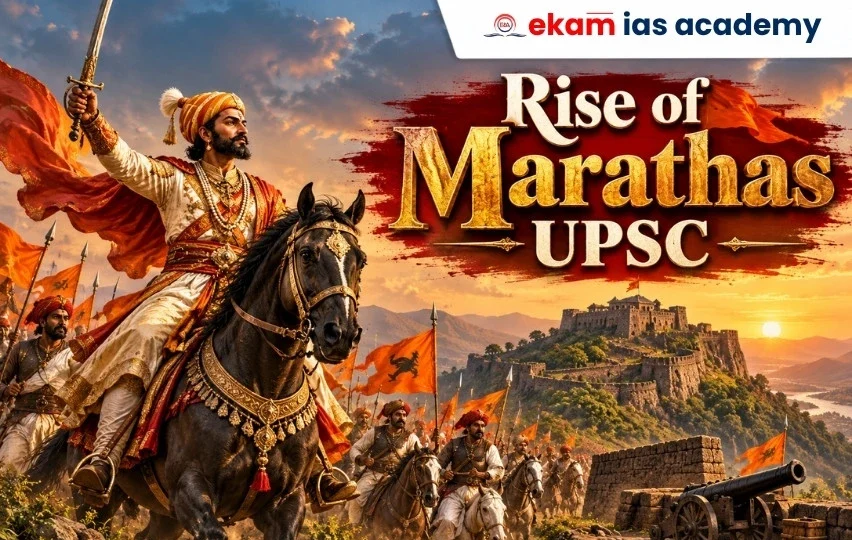
The political landscape of 17th-century South Asia witnessed a massive shift with the Rise of Marathas under the dynamic leadership of Chhatrapati Shivaji Maharaj. Transitioning from local hill landholders into a formidable sovereign power, this movement reshaped imperial dynamics across the Deccan. For civil services candidates covering Medieval Indian History UPSC, mastering the Early Career of Shivaji provides foundational insights into state-building, guerrilla warfare, and regional autonomy.
Background to the Rise of the Marathas
- The rugged, defensive geography of the Sahyadri mountain range provided a natural military stronghold for local populations.
- Decades of administrative and military service under regional Islamic kingdoms fostered a seasoned class of Maratha military commanders (Sardars).
The Bhakti cultural movement (led by saints like Tukaram and Ramdas) fostered a shared regional consciousness and social cohesion among the masses.
Social and Economic Background of the Maratha Rise
- Agrarian working groups and peasant-warriors (Mavalas) formed the core socio-economic base of the early Maratha army.
- Dissatisfaction with revenue extractions by corrupt local intermediaries created strong popular support for a fair, direct administration.
- Shared linguistic and cultural traditions broke down rigid caste barriers, enabling broad socio-political mobilization under Shivaji Maharaj Rise of Marathas.
Role of the Deccan Sultanates
- Deccani states like Ahmadnagar and Bijapur routinely recruited Maratha warriors to defend their frontiers against Mughal expansion.
- Revenue grants (Jagirs) and military titles bestowed upon Maratha elites allowed them to accumulate administrative expertise and local influence.
- Continuous factional wars among the Deccani kingdoms created political vacuums that accelerated the Rise of Maratha Power.
Shahji Bhonsle and the Early Background of Shivaji
- Shahji Bhonsle, an influential military commander, served both Ahmadnagar and Bijapur, securing the strategic Jagir of Pune and Supe.
- Young Shivaji was raised at Pune under the guardianship of his mother, Jijabai, and tutor, Dadaji Kondadev, who instilled strong governance ideals during Shivaji Early Life.
- Shahji’s political maneuvers provided the territorial nucleus and military network necessary for his son’s political ambitions.
Shivaji's Early Political Career
- Initiated his military campaigns in the mid-1640s by capturing strategic forts in the Western Ghats while still in his teens.
- Focused on unifying the local Maval hill peasantry to build a fiercely loyal, mobile military force.
- Challenged local revenue collectors (Deshmukhs) to establish direct state control and administrative justice across the Pune region.
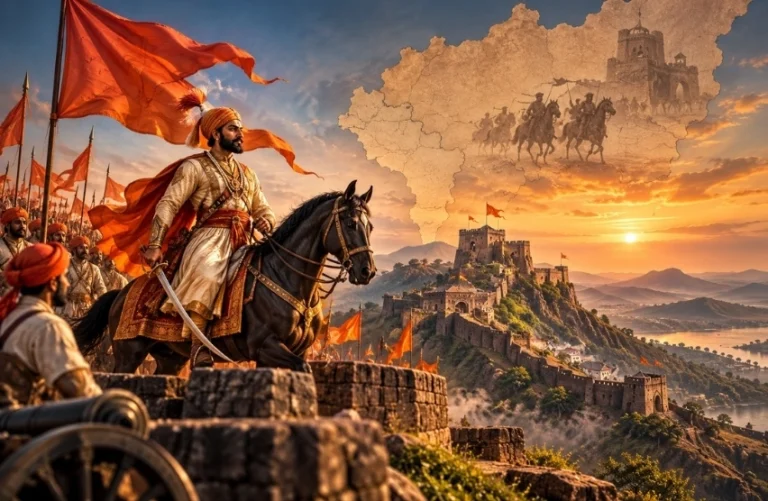
Shivaji's Fort Policy
- Formulated a comprehensive strategic doctrine where hill forts functioned as the primary anchors of political sovereignty.
- Captured, renovated, and constructed key strongholds like Torna, Rajgad, Kondhana (Sinhagad), and Raigad during Shivaji Forts and Expansion.
- Ensured every fort was garrisoned with balanced appointments of different social groups to prevent internal betrayal.
Expansion of Shivaji's Power
- Extended control across the fertile Konkan coastal strip, securing valuable maritime trade outlets and ports.
- Laid the foundations of a sovereign naval fleet to protect coastal trade against European traders and the Siddis of Janjira.
- Systematically expanded his territorial base, transitioning from a local chieftain to an independent regional sovereign in Maratha History UPSC.
Conflict with Bijapur
- Alarmed by his growing influence, the Bijapur court dispatched elite general Afzal Khan in 1659 to crush the Maratha movement.
- Shivaji lured the larger Bijapuri army into the dense, hilly terrain of Javli to eliminate their heavy cavalry advantage.
- Resulted in the decisive defeat of the imperial Bijapur forces, establishing Shivaji as an unassailable military leader.
Battle of Pratapgad
- Fought in November 1659, featuring the legendary personal encounter between Shivaji and Afzal Khan at the base of Pratapgad fort.
- Demonstrated superior tactical planning, intelligence gathering, and concealment within the rugged Sahyadri forests.
- Marked a major turning point in the Shivaji and Bijapur Sultanate conflict, yielding vast military plunder and artillery.
Shivaji's Military Strategy
- Mastered light, highly mobile cavalry and infantry tactics known as Ganimi Kava (guerrilla warfare).
- Avoided open pitch battles against larger imperial armies, relying instead on surprise night raids, ambushes, and rapid retreats.
- Maintained an efficient intelligence network (Spies) led by leaders like Bahirji Naik to execute precise military maneuvers.
Shivaji and the Deccan Powers
- Exploited ongoing rivalries between the imperial Mughals, Bijapur, and Golconda to safeguard his territorial interests.
- Conducted strategic diplomatic negotiations while simultaneously capturing border fortresses from neighboring kingdoms.
- Positioned the Maratha state as a major political broker capable of checking both Northern and Southern powers.
Shivaji's Relations with the Mughals in the Early Phase
- Initiated raids into Mughal territories in Ahmednagar and Junnar in 1657 during the imperial war of succession.
- Prompted Aurangzeb to dispatch Shaista Khan in 1660 to suppress the rising Maratha state, leading to the famous daring night raid on Pune.
- Highlighted the initial clashes between Shivaji and Mughal Empire forces that would eventually dominate late 17th-century politics.
Factors Behind the Rise of the Marathas
- Geographical Advantage: Impregnable mountain terrain ideal for defensive warfare and guerrilla maneuvers.
- Socio-Religious Union: Mass mobilization fostered by the egalitarian teachings of the Deccani Bhakti movement.
- Leadership Excellence: The exceptional military genius, administrative vision, and charismatic character of Shivaji.
Shivaji's Leadership
- Instituted a discipline-focused army structure where soldiers were paid directly in cash from the state treasury.
- Championed religious tolerance, strictly forbidding the desecration of places of worship or the mistreatment of non-combatants.
- Created an efficient administrative framework centered around public welfare, paving the way for the Shivaji and Maratha Empire legacy.
Rise of the Marathas – Timeline
- 1630: Birth of Shivaji Maharaj at the Shivneri hill fort.
- 1646: Capture of Torna fort, marking the start of Shivaji’s Early Conquests.
- 1659: Historic Battle of Pratapgad and elimination of Afzal Khan.
- 1663: Daring night raid on Shaista Khan at Lal Mahal in Pune.
- 1674: Formal coronation (Chhatrapati) at Raigad Fort, establishing sovereign Maratha rule.
Conclusion
The Rise of Maratha Power under the stellar leadership of Shivaji Maharaj transformed South Asian history. By combining tactical innovation, fort-based defense, and inclusive governance, the Shivaji Maharaj UPSC module highlights how a regional uprising grew into a major imperial power. A deep study of Rise of Maratha Power UPSC and Maratha Empire UPSC remains vital for civil services aspirants analyzing the decline of centralized Mughal authority.
UPSC Prelims: PYQs & Practice Questions
Previous Year Questions (Prelims)
Q: With reference to the military and administrative policies during the early career of Shivaji, consider the following statements:
1. Shivaji's military tactics relied heavily on light, highly mobile cavalry and infantry trained in guerrilla warfare (Ganimi Kava).
2. To maintain army discipline and reduce corruption, soldiers were primarily paid through direct land revenue assignments (Jagirs) rather than cash salaries.
Which of the statements given above is/are correct?
(a) 1 only
(b) 2 only
(c) Both 1 and 2
(d) Neither 1 nor 2
Answer: (a) 1 only
Explanation:
Statement 1 is correct: Shivaji pioneered Ganimi Kava (guerrilla tactics), leveraging the dense forests and hill passes of the Western Ghats to launch swift surprise attacks and ambushes against heavy, slow-moving Bijapuri and Mughal armies.
Statement 2 is incorrect: Unlike many contemporary medieval rulers who relied on the Jagirdari system, Shivaji strictly avoided granting land assignments (Jagirs) to his military officers. Soldiers were paid regularly in cash directly from the central state treasury (Kosh) to prevent local officers from building autonomous power bases.
Q2: The strategic significance of the Battle of Pratapgad (1659) in the early career of Shivaji lies in the fact that:
(a) It resulted in the complete annexation of Golconda by Maratha forces.
(b) It led to the decisive defeat of the elite Bijapuri army led by Afzal Khan and established Shivaji as a premier sovereign power in the Deccan.
(c) It marked the first naval victory of the Maratha fleet over European traders off the Konkan coast.
(d) It forced Emperor Aurangzeb to sign a treaty abdicating all imperial claims over the Western Ghats.
Answer: (b) It led to the decisive defeat of the elite Bijapuri army led by Afzal Khan and established Shivaji as a premier sovereign power in the Deccan.
Explanation:
In November 1659, Shivaji lured the larger Bijapuri invasion force commanded by Afzal Khan into the narrow, forested terrain around Pratapgad Fort. Following the dramatic personal encounter where Afzal Khan was killed, the Maratha forces launched a coordinated ambush that defeated the Bijapuri army, yielding vast artillery, horses, and treasure, and strengthening Maratha power in the region.
Practice Questions
Q: Regarding the early territorial expansion and fort policy of Shivaji, consider the following statements:
1. Torna was among the earliest major hill forts captured by young Shivaji in the mid-1640s from the Adil Shahi Sultanate of Bijapur.
2. Shivaji implemented a policy of appointing officers from different caste backgrounds to every major fort garrison to prevent internal treachery.
Which of the statements given above is/are correct?
(a) 1 only
(b) 2 only
(c) Both 1 and 2
(d) Neither 1 nor 2
Answer: (c) Both 1 and 2
Explanation:
Statement 1 is correct: In 1646, at the age of 16, Shivaji captured Torna Fort from Bijapur. The hidden treasure discovered there was used to strengthen Rajgad.
Statement 2 is correct: Shivaji instituted a balanced administrative arrangement within major forts consisting of a Havildar (military commander), a Sabnis (civil administrator/accounts officer), and a Karkhanis (commissariat inspector). Their functions provided mutual checks within the garrison.
Q2: What role did the Bhakti movement in Maharashtra play in facilitating the rise of Maratha power under Shivaji?
(a) It converted the local population into a uniform monastic order dedicated solely to asceticism.
(b) It fostered a sense of regional linguistic unity and egalitarian social consciousness across different caste groups.
(c) It established formal diplomatic channels between Maratha chieftains and European merchant trading bases.
(d) It mandated the direct administrative integration of temple trusts into imperial tax collectors.
Answer: (b) It fostered a sense of regional linguistic unity and egalitarian social consciousness across different caste groups.
Explanation:
Saint-poets such as Jnaneshwar, Namdev, Eknath, Tukaram, and Samarth Ramdas preached in Marathi rather than Sanskrit, contributing to regional identity and social cohesion. This helped create a wider sense of Maharashtra Dharma and provided a social foundation for Shivaji's mobilization of peasants (Mavalas), artisans, and landholders.
UPSC Mains – Previous Year & Practice Questions
Mains Previous Year Questions
Question: The rise of Maratha power under Shivaji was not a mere historical accident, but the culmination of long-term socio-economic, religious, and geographic factors in the Deccan. Elucidate. (UPSC CSE Mains 2021)
Question: Analyze the strategic role played by hill forts (Durgs) in Shivaji’s military doctrine and territorial expansion. (UPSC CSE Mains 2016)
Question: Discuss the early conflict between Shivaji and the Bijapur Sultanate, with special reference to the campaigns of Afzal Khan and Shaista Khan. (UPSC CSE Mains 2011)
Question: Examine how the teachings of the Deccani Bhakti saints provided the socio-cultural bedrock for the Maratha state-building process. (UPSC CSE Mains 2005)
Question: “Shivaji’s military organization combined innovative guerrilla tactics with strict financial discipline.” Comment. (UPSC CSE Mains 1999)
Mains Practice Questions
[15 Marks | 250 Words]
Question: The early career of Shivaji demonstrates a masterclass in asymmetric warfare and diplomatic maneuvering amidst the rivalries of the Deccan Sultanates and the Mughal Empire. Discuss.
[15 Marks | 250 Words]
Question: How did Shivaji transform the localized Mavali peasant resistance into a sovereign, institutionalized regional state during the mid-17th century?
[15 Marks | 250 Words]
Question: Shivaji’s fort administration and revenue policies laid the foundation for an efficient state apparatus that survived despite intense Mughal military pressure. Critically evaluate.
Rise of Marathas UPSC-FAQs
What were the major factors behind the Rise of the Marathas?
The rise was supported by the Sahyadri geography, experienced Maratha military groups, Deccan political rivalries, Bhakti traditions, and Shivaji Maharaj’s leadership.
What was the importance of Shivaji’s fort policy?
Forts such as Torna, Rajgad, Kondhana and Raigad served as strategic centres of defence and administration. They helped Shivaji consolidate and expand his territorial control.
What was the significance of the Battle of Pratapgad?
The Battle of Pratapgad in 1659 was a major victory for Shivaji against Afzal Khan and the Bijapur forces. It strengthened Shivaji’s military position and expanded his influence in the Deccan.
What was Ganimi Kava used for by Shivaji?
Ganimi Kava involved mobility, surprise attacks, ambushes, intelligence and rapid withdrawal. It allowed Shivaji’s forces to exploit difficult terrain against larger armies.
When did Shivaji Maharaj establish sovereign Maratha rule?
Shivaji Maharaj was formally crowned Chhatrapati at Raigad in 1674, marking the establishment of sovereign Maratha rule.