Table of Contents
ToggleNational and State Human Rights Commissions
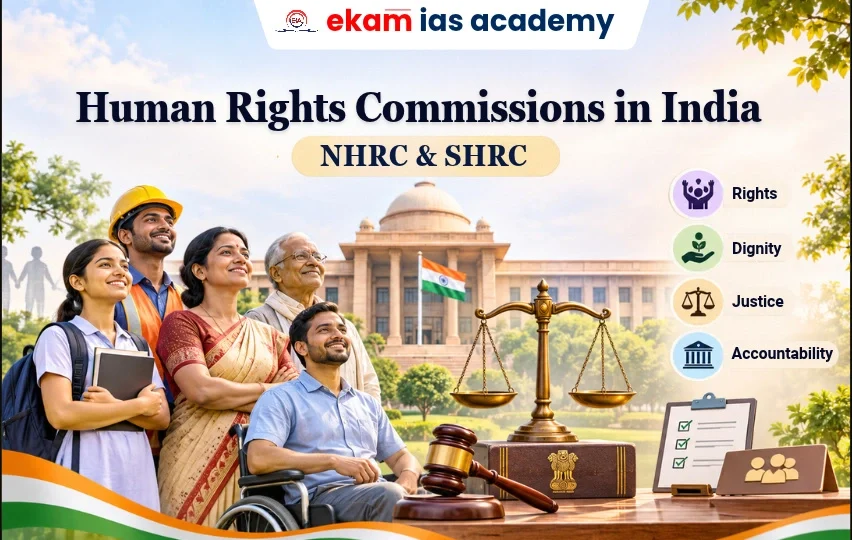
- Human Rights Commissions in India serve as specialized statutory watchdogs tasked with promoting and safeguarding Human Rights Protection in India across central and state spheres.
- Together, the National Human Rights Commission of India and State Human Rights Commission bodies bridge constitutional ideals with accessible institutional grievance redressal.
- For Indian Polity and Governance UPSC preparation, mastering NHRC UPSC and SHRC UPSC concepts is essential because these bodies operate at the intersection of Human Rights and Fundamental Rights and public accountability.
Historical Background
- Global momentum following the Universal Declaration of Human Rights (1948) and the Paris Principles (1991, endorsed by the UN General Assembly in 1993) shaped domestic institutional standards for Human Rights Commissions in India.
- In response to evolving human rights concerns and international commitments, Parliament enacted the Protection of Human Rights Act 1993, establishing the National Human Rights Commission of India and enabling states to set up a State Human Rights Commission.
- This institutional framework expanded Human Rights Protection Mechanisms beyond traditional courts by creating dedicated inquiry, review, and awareness bodies at both levels of governance.
Constitutional and Legal Framework
- Rather than being named directly in a single constitutional article, NHRC UPSC and SHRC UPSC institutions are Constitutional and Statutory Bodies in the broader sense that they are statutory bodies created under the Protection of Human Rights Act 1993 to operationalize Human Rights and Fundamental Rights such as Article 21 (protection of life and personal liberty).
- Under the Act, human rights encompass rights relating to life, liberty, equality, and dignity guaranteed by the Constitution or embodied in international covenants and enforceable by Indian courts.
- The Act also provides for Human Rights Courts and defines Human Rights Commission Composition, appointment procedures, and reporting channels for Human Rights Protection in India.
National Human Rights Commission (NHRC)
- Human Rights Commission Composition at the National Human Rights Commission of India includes a Chairperson (who has been a Chief Justice of India or a Supreme Court Judge), one member who is or has been a Supreme Court Judge, one member who is or has been a High Court Chief Justice, and three members with human rights knowledge/practical experience (at least one woman), alongside designated national commission chairpersons/chief commissioner as deemed members.
- The Chairperson and members are appointed by the President on the recommendation of a six-member committee comprising the Prime Minister (chair), Speaker of the Lok Sabha, Union Home Minister, Deputy Chairman of the Rajya Sabha, and Leaders of the Opposition in both Houses of Parliament.
- Under NHRC UPSC provisions, members serve for three years or until attaining 70 years of age, whichever is earlier, and the National Human Rights Commission of India submits annual/special reports to be laid before Parliament.
State Human Rights Commission (SHRC)
- A State Human Rights Commission is constituted by a state government under the Protection of Human Rights Act 1993 to address Human Rights Violations in India within subjects falling under List II (State List) and List III (Concurrent List) of the Seventh Schedule.
- Human Rights Commission Composition for an SHRC includes a Chairperson who has been a Chief Justice or a Judge of a High Court, one member who is or has been a High Court Judge or a District Judge in the state (with at least seven years’ experience as a District Judge), and one member with human rights knowledge or practical experience.
- Members of a State Human Rights Commission are appointed by the Governor on a state-level committee’s recommendation, but can be removed only by the President of India, serving for three years or up to 70 years of age.
NHRC vs SHRC
← Swipe left or right to view the full comparison →
| Comparison Feature | National Human Rights Commission (NHRC) | State Human Rights Commission (SHRC) |
|---|---|---|
| Territorial Scope | Addresses human rights matters nationwide, subject to its statutory jurisdiction. | Operates within its respective state, subject to its statutory jurisdiction. |
| Union Territories | Handles human rights functions relating to the Union Territory of Delhi. | May be conferred human rights functions for specified Union Territories other than Delhi. |
| Subject Jurisdiction | Can take up human rights matters involving Union authorities, alongside its broader statutory mandate. | Inquires into matters relating to subjects in the State List and Concurrent List. |
| Court Intervention | May intervene in court proceedings involving allegations of human rights violations with the court's approval. | May also intervene in such proceedings with the court's approval, within its statutory remit. |

Powers and Limitations
- NHRC Powers and Functions (and parallel State Human Rights Commission Powers within state jurisdiction) include inquiring suo motu or on petitions into human rights violations or public-servant negligence, visiting jails/detention centers, reviewing safeguards, and recommending interim relief.
- Both commissions exercise powers of a civil court while conducting inquiries—such as summoning witnesses, examining on oath, and requisitioning public records—and can promote human rights literacy and NGO efforts.
- Key limitations include the recommendatory nature of their orders rather than binding enforcement, a one-year bar on entertaining complaints after the incident occurs, and restricted scope regarding armed forces personnel under Human Rights Protection Mechanisms.
Important Amendments and Developments
- Amendments to the Protection of Human Rights Act 1993—notably the 2006 and 2019 amendment acts—updated Human Rights Commission Composition, tenure norms, and institutional alignment across Human Rights Commissions in India.
- Key changes expanded eligibility for the NHRC Chairperson to include former Supreme Court Judges alongside former Chief Justices of India, increased human-rights expert members to three (with at least one woman), added deemed members such as NCBC, NCPCR, and the Chief Commissioner for Persons with Disabilities, and set tenure at three years or up to 70 years of age.
- Ongoing digital complaint portals, custodial death reporting protocols, and state-level SHRC operationalization continue to shape Human Rights Protection in India.
Challenges and Issues
- Non-binding recommendations and uneven follow-up action by executive authorities can dilute the practical impact of NHRC Powers and Functions and State Human Rights Commission Powers when addressing Human Rights Violations in India.
- Heavy complaint backlogs, reliance on deputed or external investigative personnel rather than a dedicated permanent investigation wing, and vacancies or delays in filling posts in some SHRCs constrain responsiveness.
- Balancing state autonomy, armed-forces accountability debates, and grassroots awareness remains an ongoing test for Human Rights Protection Mechanisms.
Way Forward
- Ensuring timely follow-up and transparent compliance tracking on recommendations will strengthen Human Rights Protection in India without undermining institutional independence.
- Building specialized investigative capacity, filling vacancies promptly in every State Human Rights Commission, and expanding digital outreach for marginalized groups will bolster SHRC UPSC and NHRC UPSC effectiveness.
- Closer coordination between the National Human Rights Commission of India, SHRCs, civil society, and Human Rights Courts can make Human Rights and Fundamental Rights more meaningful at the grassroots.
Conclusion
- The National Human Rights Commission of India and State Human Rights Commission bodies form vital Human Rights Protection Mechanisms grounded in the Protection of Human Rights Act 1993.
- By linking Human Rights and Fundamental Rights with investigative inquiry, jail inspections, and public awareness, they advance Human Rights Protection in India across federal and state tiers.
- A clear grasp of NHRC UPSC, SHRC UPSC, NHRC Powers and Functions, and State Human Rights Commission Powers equips aspirants to analyze institutional accountability in Indian Polity and Governance UPSC.
UPSC Prelims: PYQs & Practice Questions
Previous Year Questions (Prelims)
Q: Which of the following statements regarding the National Human Rights Commission (NHRC) of India is/are correct?
1. It is a statutory body established under the Protection of Human Rights Act, 1993.
2. Following the 2019 amendment, the Chairperson and members hold office for a term of three years or until they attain the age of 70 years, whichever is earlier.
Select the correct answer using the code given below:
(a) 1 only
(b) 2 only
(c) Both 1 and 2
(d) Neither 1 nor 2
Answer: (c) Both 1 and 2
Explanation:
The National Human Rights Commission (NHRC) was established under the
Protection of Human Rights Act, 1993. Under the
Protection of Human Rights (Amendment) Act, 2019, the term of office
for the Chairperson and members of the NHRC and State Human Rights Commissions was
modified to three years or until they attain the age of 70 years, whichever is earlier.
Q: Consider the following changes brought by the Protection of Human Rights (Amendment) Act, 2019:
1. A person who has been a Judge of the Supreme Court, in addition to a former Chief Justice of India, can be appointed as Chairperson of the NHRC.
2. The number of members having knowledge of or practical experience in matters relating to human rights in the NHRC was increased to three, including at least one woman.
Which of the statements given above is/are correct?
(a) 1 only
(b) 2 only
(c) Both 1 and 2
(d) Neither 1 nor 2
Answer: (c) Both 1 and 2
Explanation:
Both statements are correct. The 2019 amendment broadened eligibility for the
NHRC Chairperson to include a person who has been a Judge of the Supreme Court,
in addition to a former Chief Justice of India. It also increased the number of members with
knowledge of or practical experience in human rights matters from two to three,
with at least one woman member.
Practice Questions
Q: With reference to the State Human Rights Commission (SHRC), consider the following statements:
1. An SHRC can inquire into human rights violations relating to matters in List II (State List) and List III (Concurrent List) of the Seventh Schedule.
2. Members of an SHRC are appointed by the Governor and can also be removed by the Governor alone.
3. Under the 2019 amendment, a person who has been a Judge of a High Court, alongside a former Chief Justice of a High Court, can be Chairperson of an SHRC.
Which of the statements given above is/are correct?
(a) 1 and 2 only
(b) 1 and 3 only
(c) 2 and 3 only
(d) 1, 2 and 3
Answer: (b) 1 and 3 only
Explanation:
Statement 1 is correct: An SHRC inquires into human rights violations in respect of subjects covered under the State List and Concurrent List.
Statement 2 is incorrect: Although the Governor appoints the Chairperson and members of an SHRC on the recommendation of a state committee, only the President of India can remove them, following the statutory inquiry procedure.
Statement 3 is correct: Under the Protection of Human Rights (Amendment) Act, 2019, a person who has been a Judge of a High Court can also be appointed as Chairperson of an SHRC, alongside a former Chief Justice of a High Court.
Q: Consider the following statements regarding the powers and jurisdiction of the National Human Rights Commission (NHRC):
1. While conducting inquiries, the NHRC exercises powers of a civil court under the Code of Civil Procedure, 1908.
2. The NHRC has binding punitive powers to punish public servants directly for human rights violations without approaching a court.
3. Human rights functions relating to the Union Territory of Delhi are dealt with by the NHRC.
Which of the statements given above is/are correct?
(a) 1 and 2 only
(b) 1 and 3 only
(c) 2 and 3 only
(d) 1, 2 and 3
Answer: (b) 1 and 3 only
Explanation:
Statement 1 is correct: The NHRC has civil court powers during inquiries, including summoning witnesses, examining persons on oath, and requisitioning public records.
Statement 2 is incorrect: The NHRC's findings and awards are recommendatory in nature. It may recommend compensation, interim relief, initiation of legal proceedings, or approach courts for appropriate directions or writs.
Statement 3 is correct: Human rights functions relating to the Union Territory of Delhi are dealt with by the NHRC.
UPSC Mains – Previous Year & Practice Questions
Mains Previous Year Questions
Question: Though the Human Rights Commissions have contributed immensely to the protection of human rights in India, yet they have failed to assert themselves against the mighty and powerful. Analyzing their structural and practical limitations, suggest remedial measures. (Mains 2021 – GS Paper II)
Question: National Human Rights Commission (NHRC) in India can be most effective when its tasks are adequately supported by other mechanisms that ensure the accountability of a government in a modern welfare State. Assess the role of NHRC as a watchdog of human rights in India. (Mains – GS Paper II)
Question: The Indian Constitution has provisions for holding a just society by harmonizing Fundamental Rights and Directive Principles of State Policy. Discuss how statutory institutions complement constitutional rights protection. (Mains – GS Paper II)
Question: Discuss the role of statutory bodies and regulatory mechanisms in ensuring accountability and citizen-centric governance. (Mains – GS Paper II)
Question: Judicial activism and quasi-judicial/statutory commissions have expanded the horizons of Article 21 in India. Examine. (Mains – GS Paper II)
Mains Practice Questions
[10 Marks | 150 Words]
Question: Examine how the Protection of Human Rights (Amendment) Act, 2019 reshaped the composition, tenure, and administrative functioning of the National Human Rights Commission and State Human Rights Commissions.
[15 Marks | 250 Words]
Question: Analyze the jurisdictional relationship and division of work between the National Human Rights Commission and State Human Rights Commissions. Why do functional gaps or vacancies at the state level affect grassroots human rights protection?
[10 Marks | 150 Words]
Question: Why are the recommendations of the NHRC and SHRCs non-binding in nature, and how does this limitation shape their effectiveness when dealing with state agencies and powerful actors?


National and State Human Rights Commissions-FAQs
What are NHRC and SHRC?
The NHRC and State Human Rights Commissions (SHRCs) are statutory bodies established under the Protection of Human Rights Act, 1993 to protect and promote human rights in India.
What are the major powers of NHRC and SHRC?
They can inquire into human rights violations, act suo motu, visit prisons and detention centres, summon witnesses, examine evidence and recommend relief or corrective measures.
What is the major limitation of NHRC and SHRC?
Their recommendations are generally recommendatory rather than binding, and they normally cannot entertain a complaint more than one year after the alleged violation.
What is the difference between NHRC and SHRC?
The NHRC has a nationwide jurisdiction, while an SHRC deals primarily with human rights matters relating to subjects under the State and Concurrent Lists within its respective state.
Under which law were NHRC and SHRC established?
Both institutions derive their statutory basis from the Protection of Human Rights Act, 1993, which was amended in 2006 and 2019 to modify their composition and institutional framework.