Table of Contents
TogglePoona Pact
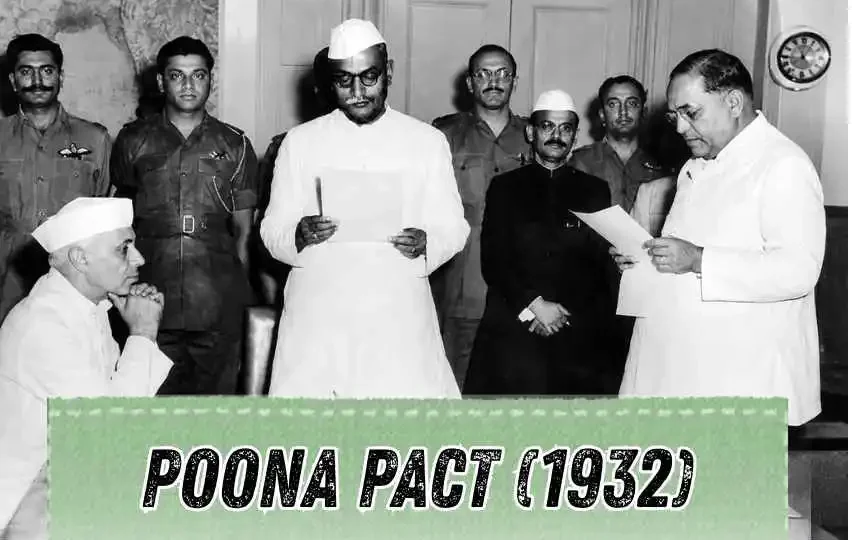
The Poona Pact 1932 is a landmark agreement in Modern Indian History UPSC preparation. Signed on September 24, 1932, at Yerwada Central Jail in Pune, this historic compromise resolved a critical impasse between Gandhi and Ambedkar over the political representation of the Depressed Classes within the Indian National Movement.
Historical Background of the Poona Pact
Following the breakdown of discussions on minority rights at the Second Round Table Conference, British Prime Minister Ramsay MacDonald Communal Award was declared in August 1932. This created deep political ripples across the nationalist struggle.
Communal Award of 1932
The Communal Award 1932 extended Separate Electorates to Muslims, Sikhs, Europeans, and crucially, treating the Depressed Classes as a distinct minority community separate from caste Hindus.
Gandhi's Fast unto Death
Viewing separate electorates as a British attempt to fracture Hindu society permanently, Mahatma Gandhi undertook a fast unto death at Yerwada Jail to protest the proposal and demand Joint Electorates.
Poona Pact of 1932
To save Gandhi’s life and resolve the political deadlock, leaders like Madan Mohan Malaviya and C. Rajagopalachari facilitated negotiations between Dr B R Ambedkar and Gandhi, culminating in the Gandhi Ambedkar Poona Pact.
Major Provisions of the Poona Pact
Key Poona Pact provisions included:
- Abandonment of Separate Electorates for the Depressed Classes in favor of Joint Electorates.
- Increasing legislative seats for Depressed Classes from 71 (under the Communal Award) to 148 in provincial legislatures.
- Allocating 18% of Central Legislature seats to the Depressed Classes.
- Provisions for Reservation for Scheduled Castes in public services and educational institutions.
Poona Pact vs Communal Award
Analyzing Poona Pact and Communal Award:
- Communal Award: Granted Separate Electorates with fewer reserved seats (71).
- Poona Pact: Guaranteed Joint Electorates with substantially increased reserved seats (148).
Role of Mahatma Gandhi
Gandhi sought to preserve the social unity of the nation while committing to removing untouchability through constructive social work.
Role of Dr. B.R. Ambedkar
Dr. Ambedkar demonstrated pragmatic statesmanship by accepting political safeguards and electoral reservations to ensure political representation for marginalized communities.
Significance of the Poona Pact
The Poona Pact significance lies in establishing affirmative action and structural representation for marginalized communities within mainstream political systems.
Criticism of the Poona Pact
Critics argue that under joint electorates, candidates supported by the majority community were often elected over true representatives of the Depressed Classes.
Poona Pact and the Indian Constitution
The agreement laid the constitutional groundwork for Poona Pact and Indian Constitution provisions, directly influencing Articles 330 and 332 regarding electoral reservations for Scheduled Castes.
Limitations of the Poona Pact
While it secured political reservation, it could not immediately eliminate social discrimination and caste prejudices.
Timeline of Important Events
- August 16, 1932: Ramsay MacDonald announces the Communal Award.
- September 20, 1932: Gandhi begins his fast unto death.
- September 24, 1932: Signing of the Poona Pact 1932.
Conclusion
In conclusion, mastering the Poona Pact UPSC module is essential for revising UPSC History Notes. It fundamentally shaped modern India’s social justice framework and constitutional polity.
UPSC Prelims: PYQs & Practice Questions
Previous Year Questions
Q: Which of the following was/were the feature(s) of the Poona Pact?
1. It abandoned the principle of separate electorates for the Depressed Classes.
2. It provided for reserved seats for the Depressed Classes within the general electorate.
3. It increased the representation of the Depressed Classes in the provincial legislatures compared to the Communal Award.
Select the correct answer using the code given below:
(a) 1 and 2 only
(b) 2 and 3 only
(c) 1 and 3 only
(d) 1, 2 and 3
Answer: (d) 1, 2 and 3
Explanation:
Statement 1 is correct. The
Poona Pact replaced the system of
separate electorates for the Depressed Classes, proposed under the Communal Award, with joint electorates.
Statement 2 is correct. Seats were reserved for the
Depressed Classes within the general electorate, where voters of all communities participated in the election.
Statement 3 is correct. The Communal Award had provided
71 seats for the Depressed Classes in provincial legislatures. The Poona Pact increased this representation to
148 reserved seats and provided representation in the Central Legislature.
Q: The Poona Pact was signed between:
(a) Gandhiji and Lord Irwin
(b) Gandhiji and Jinnah
(c) Gandhiji and Dr. B.R. Ambedkar
(d) Subhash Chandra Bose and Dr. B.R. Ambedkar
Answer: (c) Gandhiji and Dr. B.R. Ambedkar
Explanation:
The Poona Pact was reached in
September 1932 following negotiations over political representation for the
Depressed Classes.
Dr. B.R. Ambedkar represented the interests of the Depressed Classes, while the agreement was reached with leaders representing caste Hindus in the context of
Mahatma Gandhi's opposition to separate electorates.
Gandhi had begun an
indefinite fast in Yerwada Jail against the provision of separate electorates for the Depressed Classes under the
Communal Award, leading to negotiations that culminated in the Poona Pact.
Practice Questions
Q: With reference to the electoral mechanism agreed upon under the Poona Pact (1932), consider the following statements:
1. It introduced a two-tier election system involving primary and secondary elections for reserved seats of the Depressed Classes.
2. The primary election involved only voters from the Depressed Classes choosing a panel of candidates.
3. The Pact fixed a period of 10 years for the continuation of reserved seats unless terminated by mutual agreement.
Which of the statements given above is/are correct?
(a) 1 and 2 only
(b) 2 and 3 only
(c) 1 and 3 only
(d) 1, 2 and 3
Answer: (a) 1 and 2 only
Explanation:
Statement 1 is correct. The
Poona Pact provided for a
two-stage electoral process. In the primary stage, members of the Depressed Classes selected a panel of candidates, while the final election was conducted through the joint electorate.
Statement 2 is correct. The
primary election was conducted exclusively among voters belonging to the Depressed Classes, who selected a panel of
four candidates for each reserved seat.
Statement 3 is incorrect. The Poona Pact did not prescribe a fixed
10-year duration for reservation of seats. The arrangement was to continue until terminated by
mutual agreement between the communities concerned. The 10-year constitutional provision was later introduced under
Article 334 of the Constitution.
Q: Consider the following historical developments during the Indian National Movement:
1. Announcement of the Communal Award by Ramsay MacDonald
2. Gandhi-Irwin Pact
3. Third Round Table Conference
4. Signing of the Poona Pact
What is the correct chronological sequence of the above events?
(a) 2 - 1 - 4 - 3
(b) 1 - 2 - 3 - 4
(c) 2 - 4 - 1 - 3
(d) 1 - 3 - 2 - 4
Answer: (a) 2 - 1 - 4 - 3
Explanation:
The correct chronological sequence is:
1. Gandhi-Irwin Pact – 5 March 1931
2. Communal Award – 16 August 1932
3. Poona Pact – 24 September 1932
4. Third Round Table Conference – November–December 1932
Therefore, the correct sequence is
2 - 1 - 4 - 3.
UPSC Mains – Previous Year & Practice Questions
Mains Previous Year Questions
[UPSC Mains 2021 | GS Paper I]
Question: “The Poona Pact defeated the purpose of separate electorates but established a system of political reservation that continues to shape Indian democracy.” Discuss.
[UPSC Mains 2015 | GS Paper I]
Question: Bring out the ideological differences between Mahatma Gandhi and Dr. B.R. Ambedkar regarding the upliftment of the Depressed Classes.
[UPSC Mains 2012 | Modern History]
Question: Critically examine the historical circumstances leading to the Communal Award of 1932 and its aftermath on the Indian National Movement.
[UPSC Mains 2008 | Modern History]
Question: “ Dr. B.R. Ambedkar’s approach to the freedom struggle was distinct from that of the mainstream Congress movement.” In the light of this statement, analyse his role during the Round Table Conferences and the signing of the Poona Pact.
[UPSC Mains 2003 | Modern History]
Question: How far is it correct to say that the Poona Pact was a turning point in the socio-political movement of the Depressed Classes in pre-independent India?
Mains Practice Questions
[15 Marks | 250 Words]
Question: While Mahatma Gandhi viewed untouchability as a moral blot on Hindu society requiring internal reform, Dr. B.R. Ambedkar approached it as a political and structural issue requiring statutory rights. Analyse how these contrasting visions manifested during the Poona Pact negotiations and their lasting legacy on social reform in India.
[15 Marks | 250 Words]
Question: The Poona Pact was a compromise born out of political compulsion rather than complete ideological consensus. Evaluate its short-term political gains and long-term sociological consequences for the Scheduled Castes in India.
[15 Marks | 250 Words]
Question: Trace the evolution of electoral safeguards for minority and disadvantaged groups from the Morley-Minto Reforms, 1909 to the Poona Pact, 1932. How did these constitutional arrangements influence the framing of the Indian Constitution?
Poona Pact-FAQs
What was the Poona Pact 1932?
The Poona Pact was an agreement reached in September 1932 between Dr. B. R. Ambedkar and caste Hindu leaders to replace separate electorates for Depressed Classes with joint electorates and reserved seats.
Why was the Poona Pact signed?
It was signed to resolve the deadlock created by the Communal Award of 1932 and Gandhi’s fast against separate electorates for the Depressed Classes.
What were the major provisions of the Poona Pact?
It provided joint electorates, increased reserved seats for Depressed Classes in provincial legislatures, representation in the Central Legislature, and safeguards in education and public services.
How was the Poona Pact different from the Communal Award?
The Communal Award gave separate electorates with fewer reserved seats, while the Poona Pact accepted joint electorates with increased reserved representation.
Why is the Poona Pact important for UPSC?
It is important because it connects Gandhi, Ambedkar, Communal Award, depressed classes, electoral reservation, social justice and the evolution of constitutional safeguards in India.