
Table of Contents
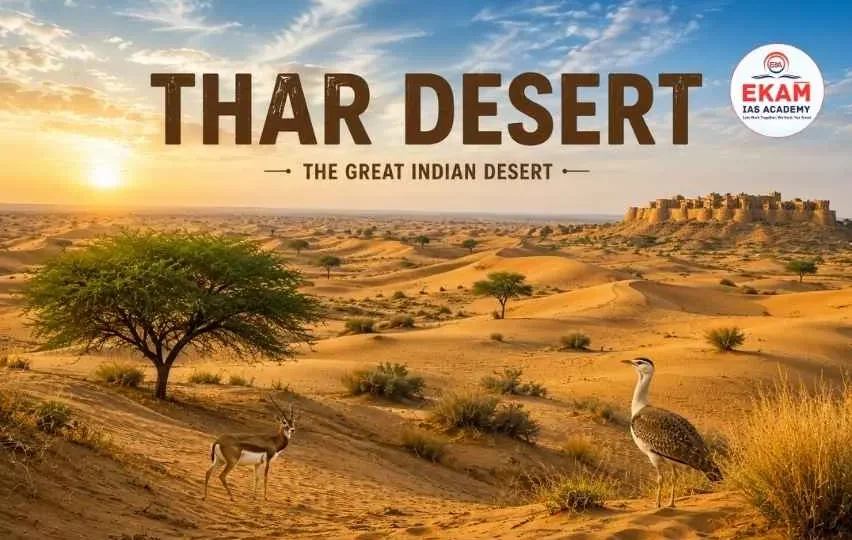
ToggleThe Thar Desert serves as a natural boundary between India and Pakistan. In the environment ecology notes UPSC curriculum, it is studied as a critical subtropical desert that plays a significant role in the Indian monsoon system and regional biodiversity.
Definition and Classification
The Thar Desert is a large, arid region characterized by aeolian (wind-blown) sand dunes, sparse vegetation, and extreme temperature variations. It is classified as a hot subtropical desert and represents the easternmost extension of the Saharo-Arabian desert belt.
Location and Extent
- Geographic Reach: It covers an area of approximately 200,000 sq. km.
- Political Boundaries: About 85% of the desert lies in India (primarily in Rajasthan, with extensions into Gujarat, Punjab, and Haryana) and 15% in Pakistan.
- Physical Boundaries: It is bordered by the Aravalli Hills to the southeast, the Rann of Kachchh to the south, and the Indus River alluvial plains to the west and northwest.
Characteristics of the Thar Desert
- Sand Dunes: The desert features various types of dunes, including shifting barchans and longitudinal dunes.
- Hydrology: The Luni River is the only significant river integrated into the desert, which eventually disappears into the Rann of Kachchh.
- Rocky Outcrops: Large areas of the desert consist of regolith and rocky pavements, particularly near Jaisalmer.
Climate of the Thar Desert
The thar desert geography UPSC notes emphasize its extreme “Continental” climate:
- Temperature: Summer temperatures can soar above 50°C, while winter nights can drop below 0°C (high diurnal temperature range).
- Precipitation: Extremely low and erratic rainfall, ranging from 100 mm in the west to 500 mm near the Aravallis.
- Wind: Strong, dust-laden winds known as ‘Loo’ are common during the summer months.
Flora and Fauna: Biodiversity of the Great Indian Desert
Despite the aridity, the Great Indian desert notes highlight a surprising diversity of life:
- Flora (Xerophytes): Dominated by thorny shrubs and stunted trees like Khejri (Prosopis cineraria), Rohida, and Ber. These plants have deep roots and small leaves to minimize water loss.
- Fauna: Home to the critically endangered Great Indian Bustard (GIB). Other notable species include the Blackbuck, Chinkara (Indian Gazelle), Desert Fox, and the Caracal.
Economic and Environmental Significance
- Mineral Wealth: Rich in gypsum, feldspar, phosphorite, and high-quality limestone. It also holds significant reserves of oil and natural gas (Barmer basin).
- Renewable Energy: A global hub for solar and wind energy generation due to high insolation and wind speeds.
- Monsoon Link: The intense low pressure created over the Thar during summer is a primary driver for the Indian Summer Monsoon winds.
Problems and Challenges
- Desertification: The eastward shift of the desert due to overgrazing and deforestation.
- Water Scarcity: Heavy reliance on the Indira Gandhi Canal, which has led to issues like soil salinization and waterlogging in some areas.
- Invasive Species: The spread of Prosopis juliflora (Vilayati Kikar) is choking native biodiversity.
Conservation Measures
- Desert National Park: A key conservation area for the Great Indian Bustard.
- Green Belts: Massive plantation drives to check the expansion of the desert.
- Water Harvesting: Traditional methods like Taankas, Khadins, and Johads are being revitalized for sustainable water management.
Conclusion
The Thar Desert is a testament to life’s resilience under extreme conditions. For UPSC aspirants, understanding the Thar is crucial for topics ranging from climatology to wildlife conservation. Balancing industrial growth, such as solar parks, with the preservation of its fragile ecology is the way forward for the sustainable development of this unique Indian landscape.
UPSC Prelims: PYQs & Practice Questions
Previous Year Questions (Prelims)
UPSC CSE Prelims 2020
Q: With reference to India’s Desert National Park, which of the following statements are correct?
1. It is spread over two districts.
2. There is no human habitation inside the Park.
3. It is one of the natural habitats of the Great Indian Bustard.
Select the correct answer using the code given below:
(a) 1 and 2 only
(b) 2 and 3 only
(c) 1 and 3 only
(d) 1, 2 and 3
Answer: (c) 1 and 3 only
Explanation:
The Desert National Park (DNP) is spread across the Jaisalmer and Barmer districts of Rajasthan. Statement 2 is incorrect because several villages and human settlements exist inside the park boundaries. Statement 3 is correct since the park is a major habitat of the critically endangered Great Indian Bustard.
UPSC CSE Prelims 2018
Q: Which of the following leaf modifications occur(s) in the Thar Desert to inhibit water loss?
1. Hard and waxy leaves
2. Tiny leaves or no leaves
3. Thorns instead of leaves
Select the correct answer:
(a) 2 and 3 only
(b) 2 only
(c) 1, 2 and 3
(d) 1 and 3 only
Answer: (c) 1, 2 and 3
Explanation:
These are classic xerophytic adaptations found in desert vegetation. Waxy leaves reduce transpiration, while tiny leaves and thorns minimize water loss by reducing surface area exposed to sunlight and dry winds. Such adaptations are common in plants like Khejri and Cacti.
Practice Questions
Q: The "Luni River", the only significant river in the Thar Desert, is characterized by which of the following?
1. It originates in the Pushkar Valley of the Aravalli Range.
2. It is an endorheic river that drains into the Arabian Sea.
3. Its water becomes saline after reaching Balotra.
Select the correct answer:
(a) 1 and 2 only
(b) 1 and 3 only
(c) 3 only
(d) 1, 2 and 3
Answer: (b) 1 and 3 only
Explanation:
Statement 2 is incorrect because although the Luni River is an endorheic river, it drains into the Rann of Kachchh rather than the open Arabian Sea. Statement 3 is correct because the river acquires a high salt content after flowing through the saline desert soils near Balotra.
Q: Which of the following states in India do NOT share a portion of the Thar Desert?
(a) Gujarat
(b) Punjab
(c) Madhya Pradesh
(d) Haryana
Answer: (c) Madhya Pradesh
Explanation:
The Thar Desert primarily covers Rajasthan and extends into parts of Gujarat, Punjab, and Haryana. It does not extend into Madhya Pradesh.
UPSC Mains – Previous Year & Practice Questions
Mains Previous Year Questions
Question: Explain the causes and effects of desertification. How is it related to the loss of biodiversity in the context of Western India? (Mains 2021)
Question: How can the mountain ecosystem of the Aravallis act as a barrier to the eastward expansion of the Thar Desert? (Mains 2019)
Question: What are the environmental implications of the Indira Gandhi Canal Project on the ecology of the Great Indian Desert? (Mains 2018)
Question: Identify the main causes of the loss of biodiversity in India. (Mains 2023)
(Overgrazing and habitat degradation in the Thar Desert are major examples)
Question: Discuss the potential of renewable energy in the arid regions of India. (Mains 2020)
(Focus on the solar and wind energy potential of the Thar Desert)
Mains Practice Questions
[10 Marks | 150 Words]
Question: The Great Indian Bustard is on the brink of extinction. Analyze the specific threats it faces within the Thar Desert ecosystem.
[15 Marks | 250 Words]
Question: Discuss the role of the Thar Desert in the mechanics of the Indian Summer Monsoon.
[15 Marks | 250 Words]
Question: Traditional water harvesting systems like Khadins and Taankas are more sustainable than large-scale canal irrigation in the Thar Desert. Critically evaluate.



Thar Desert-FAQs
Why is the Thar Desert the most 'populated' desert in the world?
Unlike the Sahara, the Thar has relatively higher groundwater accessibility in certain pockets and a long history of human adaptation through pastoralism and traditional water harvesting, allowing it to support a higher density of people and livestock.
What is the 'Khejri' tree and why is it important?
Prosopis cineraria or Khejri is the state tree of Rajasthan. It is a nitrogen-fixing tree that provides fodder, fuel, and stabilizes sand dunes. It is central to the Bishnoi community’s conservation ethics.
How does the 'Aravalli Range' affect the Thar?
The Aravallis act as a physical barrier that checks the eastward spread of the desert. However, mining and deforestation in the Aravallis have created “gaps” through which sand is now migrating into the fertile plains of Delhi and Haryana.
What are 'Barchans'?
They are crescent-shaped sand dunes produced by the action of wind predominately from one direction. They are very common in the Thar desert geography UPSC studies.
What is the impact of the Indira Gandhi Canal (IGNP)?
While it brought “Green Revolution” to the desert, it also caused waterlogging and soil salinization, and led to the decline of native desert flora as farmers switched to water-intensive crops like wheat and cotton.