
Table of Contents
ToggleEarth’s biological wealth is concentrated in specific geographic pockets. As human expansion accelerates habitat destruction, scientists rely on macro-ecological frameworks to identify areas where extinctions are most imminent. Biodiversity hotspots represent these critical battlegrounds for global conservation.
Defining Biodiversity Hotspots
A biodiversity hotspot is a biogeographic region that possesses an extraordinary density of unique species but is simultaneously facing a severe crisis of habitat destruction. These areas are nature’s most valuable yet highly vulnerable biomes.
Origin of the Concept
- The Pioneer: The concept was first introduced by British ecologist Norman Myers in two landmark papers published in 1988 and 1990.
- The Principle: Norman Myers biodiversity hotspots framework shifted the conservation narrative from protecting single charismatic species (like the panda or tiger) to safeguarding entire threatened ecosystems that harbor immense quantities of endemic flora and fauna.
- Institutional Adoption: Conservation International (CI) adopted Myers’ concept in 1989, making it the bedrock of its global environmental funding and monitoring strategy.
Criteria for Identification
To qualify as a global biodiversity hotspot under the Conservation International and Myers framework, a region must strictly satisfy two stringent criteria:
Species Endemism (Irreplaceability): It must contain at least 1,500 species of vascular plants as endemics (accounting for roughly 0.5% of the world’s total). Endemic species are those found strictly in that specific locality and nowhere else on Earth.
Degree of Threat (Vulnerability): It must have lost at least 70% of its original primary vegetation. In other words, it must be operating on 30% or less of its pristine, natural habitat footprint.
Characteristics of Biodiversity Hotspots
- High Endemism: They hold species with highly localized distributions that cannot survive if their specific micro-climate is altered.
- Tropical and Mediterranean Bias: The vast majority of hotspots are located in tropical rainforests, island ecosystems, and Mediterranean-climate zones.
- High Human Density: They often overlap with areas experiencing rapid human population growth, intense agricultural expansion, and heavy urbanization.
Global Distribution of Hotspots
Currently, there are 36 recognized biodiversity hotspots across the globe. While they collectively cover just 2.4% of Earth’s land surface, they support more than 50% of the world’s endemic plant species and nearly 43% of all bird, mammal, reptile, and amphibian endemics.
Major global examples include the Tropical Andes (the most diverse hotspot on Earth), Madagascar, the Mediterranean Basin, and Mesoamerica.
Biodiversity Hotspots in India
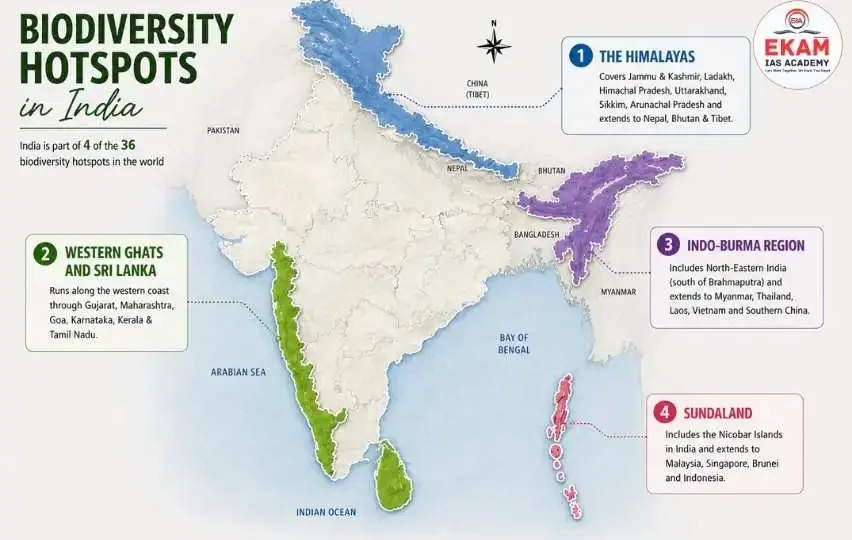
Understanding the specific hotspots in india UPSC modules outline is vital for both Prelims mapping and Mains analysis. Four out of the world’s 36 biodiversity hotspots extend directly into Indian territory:
The Himalayas
- Coverage: Encompasses the entire Indian Himalayan region (spanning Jammu & Kashmir, Ladakh, Himachal Pradesh, Uttarakhand, Sikkim, and Arunachal Pradesh) along with Nepal, Bhutan, and parts of Tibet.
- Significance: Features extreme altitudinal variation hosting unique alpine vegetation and endangered megafauna like the Snow Leopard and the Red Panda.
The Western Ghats and Sri Lanka
- Coverage: Runs parallel to the western coast of peninsular India through six states (Gujarat, Maharashtra, Goa, Karnataka, Kerala, and Tamil Nadu).
- Significance: A global canopy system exhibiting spectacular levels of amphibian, reptile, and freshwater fish endemism. Iconic species include the Lion-tailed Macaque and the Nilgiri Tahr.
Indo-Burma Region
- Coverage: Extends over Northeastern India (south of the Brahmaputra river, excluding Assam and parts of Arunachal Pradesh), Myanmar, Thailand, Laos, Vietnam, and Southern China.
- Significance: Renowned for an exceptional variety of bird species, freshwater turtles, and unique orchids.
Sundaland
- Coverage: Includes the Nicobar Islands group in India, extending south to cover Malaysia, Singapore, Brunei, and Indonesia.
- Significance: Characterized by rich, fragile island biomes, massive mangrove networks, and highly specialized marine and coastal ecosystems.
Major Threats Facing Hotspots
- Habitat Fragmentation: Linear infrastructure like highways, railways, and dams slicing through contiguous forests, disrupting wildlife corridors.
- Anthropogenic Climate Change: Shifts in rainfall and temperature force high-altitude and island species out of their narrow ecological niches.
- Invasive Alien Species: Exotic weeds like Lantana camara choking out native forage and altering forest structures.
- Overexploitation: Illegal wildlife trafficking, destructive logging, and unregulated tourism.
International and National Conservation Efforts
Protecting these regions involves a mix of global frameworks and localized laws:
International Initiatives
- Critical Ecosystem Partnership Fund (CEPF): A joint global initiative providing financial grants to civil society and non-governmental organizations to protect biodiversity hotspots.
- The “30 by 30” Target: Part of the Kunming-Montreal Global Biodiversity Framework, pushing countries to effectively conserve 30% of terrestrial and marine areas by 2030, focusing heavily on hotspot ecosystems.
India’s Domestic Initiatives
- The Biological Diversity Act, 2002: Sets up a decentralized structure via Biodiversity Management Committees (BMCs) to document local resources and prevent biological exploitation.
- Eco-Sensitive Zones (ESZs): Declared around National Parks and Sanctuaries (particularly in the Western Ghats under the Madhav Gadgil and K. Kasturirangan committee reports) to act as shock absorbers against industrial development.
- Project Tiger and Project Elephant: Flagship landscape-level initiatives that safeguard the wider habitats of key indicator species within Indian hotspots.
Conservation Measures
- Community-Led Stewardship: Engaging indigenous and forest-dwelling communities as primary conservation partners rather than enforcing exclusionary boundaries.
- Restoration Ecology: Active reforestation utilizing native tree species to restore degraded forest patches and repair fragmented wildlife corridors.
- Green Infrastructure: Mandating eco-ducts, canopy bridges, and wildlife underpasses for all infrastructure projects passing through hotspot zones.
Conclusion
For a high-scoring approach in the biodiversity hotspots UPSC curriculum, these regions must be recognized as our planet’s ultimate biological lifeboats. Because they hold a vast share of global life within a tiny geographic footprint, saving them represents the most economically and ecologically efficient method to halt the global extinction crisis. Striking a firm balance between immediate economic infrastructure development and long-term ecosystem security remains the ultimate test of India’s environmental governance.
UPSC Prelims: PYQs & Practice Questions
Previous Year Questions (Prelims)
UPSC CSE Prelims 2013
Q: Three of the following criteria have contributed to the recognition of Western Ghats-Sri Lanka and Indo-Burma regions as biodiversity hotspots:
1. Species richness
2. Vegetation density
3. Endemism
4. Ethno-botanical importance
5. Threat perception
6. Adaptation of flora and fauna to prevailing environment
Which of the following correct combinations of three factors determines a hotspot?
(a) 1, 2 and 6
(b) 2, 4 and 6
(c) 1, 3 and 5
(d) 3, 4 and 6
Answer: (c) 1, 3 and 5
Explanation:
Under the Norman Myers biodiversity hotspots framework, adopted by
Conservation International, hotspot identification is based mainly on
endemism and threat perception.
A region must contain at least 1,500 endemic vascular plant species, which indicates exceptional species richness, and must have lost at least 70% of its original primary vegetation. Factors like vegetation density, ethno-botanical importance, or general adaptations of flora and fauna are not part of the quantitative hotspot criteria.
UPSC CSE Prelims 2011
Q: Biodiversity hotspots are located mainly in:
(a) Tropical rainforests
(b) High latitude regions
(c) Deserts and semi-arid regions
(d) Tundra regions
Answer: (a) Tropical rainforests
Explanation:
Tropical rainforests have high primary productivity, warm temperatures, heavy rainfall, and stable climatic conditions. These factors support the highest concentration of unique species on Earth.
Hence, many global biodiversity hotspots, such as the Tropical Andes, Sundaland, and Indo-Burma, are concentrated in tropical rainforest systems and island eco-zones where endemism is very high and human pressure is intense.
Practice Questions
Q: With reference to the geographic extensions of biodiversity hotspots in India, consider the following statements:
1. The Sundaland biodiversity hotspot within Indian political boundaries is limited exclusively to the Andaman Island group.
2. The Indo-Burma hotspot covers all the seven northeastern states of India uniformly, including the alluvial plains of Assam.
Which of the statements given above is/are correct?
(a) 1 only
(b) 2 only
(c) Both 1 and 2
(d) Neither 1 nor 2
Answer: (d) Neither 1 nor 2
Explanation:
Statement 1 is incorrect. The Sundaland hotspot in India extends specifically over the
Nicobar Islands group, not the Andamans. The Andaman Islands are structurally linked to the
Indo-Burma biodiversity system.
Statement 2 is incorrect. The Indo-Burma hotspot covers most of Northeastern India, but it does not uniformly cover all areas. It excludes the core alluvial plains of Assam and parts of Arunachal Pradesh, as these lower-altitude wetlands and riverbeds do not match the specific high-endemism criteria of surrounding mountain ranges.
Q: If an ecological region possesses 2,000 endemic vascular plant species but has retained 45% of its original, undisturbed primary vegetation footprint, can it be designated as a global Biodiversity Hotspot?
(a) Yes, because its endemic plant count exceeds the required baseline threshold.
(b) No, because it has not experienced the minimum required threshold of habitat destruction.
(c) Yes, provided it also acts as a critical wintering ground along the Central Asian Flyway.
(d) No, because hotspots are designated exclusively based on mammalian and avian endemism.
Answer: (b) No, because it has not experienced the minimum required threshold of habitat destruction.
Explanation:
To qualify as a biodiversity hotspot, a region must fulfill both criteria simultaneously:
high endemism and high threat perception.
The region passes the endemism test because it has more than 1,500 endemic vascular plant species. However, it fails the vulnerability test because a hotspot must have lost at least 70% of its primary vegetation, meaning it should retain only 30% or less. Retaining 45% means it has not yet reached the required level of habitat destruction.
UPSC Mains – Previous Year & Practice Questions
Mains Previous Year Questions
Mains 2018
Question: How does biodiversity vary in India?
How is the Biological Diversity Act, 2002 helpful in conservation of flora and fauna?
(Requires analyzing the high-density biodiversity clusters found within India's four hotspots.)
Mains 2021
Question: Differentiate the causes of landslides in the
Himalayan region and Western Ghats.
(Evaluates the physical and structural vulnerabilities of India's two primary terrestrial hotspots.)
Mains 2023
Question: Identify the main causes of the loss of
biodiversity in India.
(Directly maps onto threats like monoculture plantations, tourism, and linear infrastructure destroying hotspot ecotones.)
Mains 2019
Question: Coastal regions of India are prone to cyclones.
Discuss the role of mangroves in reducing the impact of such disasters.
(Ties directly into the coastal protective infrastructure of the Sundaland and Western Ghats-Coast hotspots.)
Mains 2020
Question: How does the draft
Environment Impact Assessment (EIA) Notification, 2020 differ from the existing
EIA Notification, 2006?
(Crucial for explaining how relaxing environmental clearances may affect biodiversity-rich and ecologically fragile hotspot regions.)
Mains Practice Questions
[15 Marks | 250 Words]
Question: Analyze the conflict between developmental infrastructure and ecological preservation in the Western Ghats hotspot in light of the Madhav Gadgil and K. Kasturirangan Committee reports.
[10 Marks | 150 Words]
Question: Examine how extreme altitudinal variations and cross-continental biogeographic merging elevate The Himalayas into a premier global biodiversity hotspot.
[15 Marks | 250 Words]
Question: With a tiny land footprint supporting a massive share of endemic life, biodiversity hotspots offer the most cost-effective solution to halt global extinctions. Justify this statement.



Biodiversity Hotspots-FAQs
Difference between Biodiversity Hotspot and Hope Spot?
A Biodiversity Hotspot is a highly threatened land/coastal region rich in endemic species. A Hope Spot is a critical marine area identified for protecting ocean health, such as coral reefs or whale routes.
Who funds global biodiversity hotspot protection?
Hotspots are mainly protected by national governments, with support from the Critical Ecosystem Partnership Fund. CEPF gives grants to NGOs and civil society groups for hotspot conservation.
Why are islands common among biodiversity hotspots?
Islands have long evolutionary isolation, creating many endemic species. But their small area makes them highly vulnerable to invasive species, sea-level rise, and human disturbance.
What is the role of Eco-Sensitive Zones in Indian hotspots?
Eco-Sensitive Zones act as buffer areas around protected regions. They restrict harmful activities like mining and quarrying while allowing sustainable local livelihoods.
How many biodiversity hotspots exist globally?
There are 36 biodiversity hotspots worldwide. Though they cover only about 2.4% of Earth’s land surface, they support a very high share of endemic plants and terrestrial vertebrates.