Table of Contents
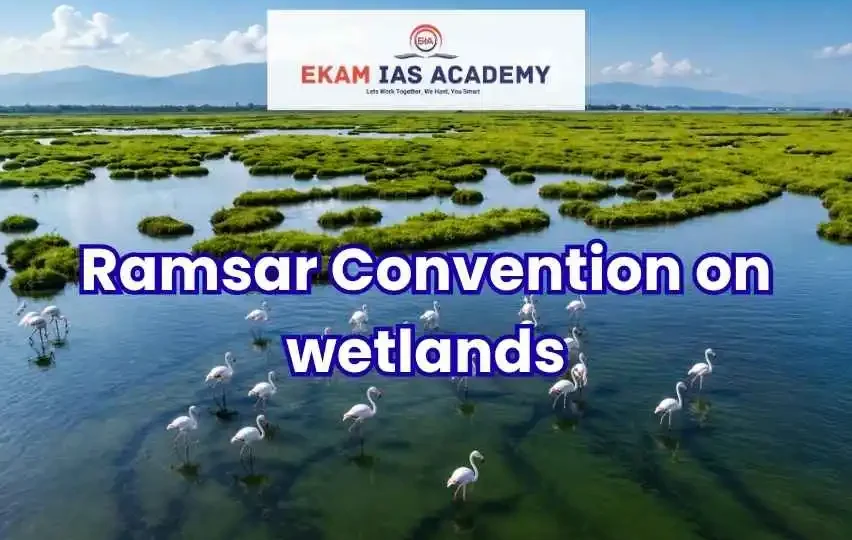
ToggleWetlands are transitional zones between terrestrial and aquatic ecosystems where the water table is usually at or near the surface. Due to rapid urbanization and land conversion, these fragile biomes are disappearing three times faster than forests. The Ramsar Convention stands as the premier global intergovernmental treaty dedicated to halting this degradation.
the Ramsar Convention
The Ramsar Convention is an international treaty officially known as the Convention on Wetlands of International Importance especially as Waterfowl Habitat. It provides the framework for national action and international cooperation for the conservation and wise use of wetlands and their resources.
Background of the Ramsar Convention
- Origin: The convention was adopted in the Iranian city of Ramsar on February 2, 1971.
- Enforcement: It came into force globally in 1975.
- World Wetlands Day: To mark the date of its adoption, February 2 is celebrated worldwide every year as World Wetlands Day.
- India’s Association: India became a party to the convention on February 1, 1982.
Objectives of the Ramsar Convention
- To stem the progressive encroachment on and loss of wetlands now and in the future.
- To recognize the fundamental ecological functions of wetlands for climate regulation, water purification, and biodiversity.
- To coordinate international responses for transboundary wetlands and migratory waterbird corridors.
Key Features of the Ramsar Convention
The Three Pillars
- Wise Use: Commit to working towards the wise use of all their wetlands through national land-use planning, policies, and legislation.
- List of International Importance: Designate suitable wetlands for the Ramsar List based on specific ecological, botanical, zoological, or hydrological criteria.
- International Cooperation: Cooperate internationally regarding transboundary wetlands, shared wetland systems, and shared species.
The Montreux Record
The Montreux Record is a register of wetland sites on the List of Wetlands of International Importance where changes in ecological character have occurred, are occurring, or are likely to occur as a result of technological developments, pollution, or other human interference. It is maintained as part of the Ramsar List.
Importance of Ramsar Sites
- Biodiversity Repositories: They support vulnerable, endangered, or critically endangered species and provide a refuge during critical stages of their life cycles.
- Flood Buffers: Wetlands act as natural sponges, absorbing excess rainfall and reducing the velocity of storm surges.
- Water Purification: They filter out sediments, heavy metals, and excess agricultural nutrients (nitrates/phosphates).
- Blue Carbon Sinks: Wetland soils store immense volumes of carbon, making them vital tools against global warming.
Ramsar Sites in India UPSC
India’s network of Ramsar sites is the largest in South Asia.
- Total Sites: India has 85 Ramsar sites covering over 1.3 million hectares.
- Largest Site: Sundarbans Wetland in West Bengal.
- Smallest Site: Renuka Wetland in Himachal Pradesh.
- First Sites: Chilika Lake (Odisha) and Keoladeo Ghana National Park (Rajasthan) were designated together in 1981.
- Indian Sites in Montreux Record: Currently, two sites remain on the record: Keoladeo National Park (Rajasthan) and Loktak Lake (Manipur). Chilika Lake was placed on the record but later removed due to successful restoration efforts.
Threats to Wetlands and Ramsar Sites
- Eutrophication: Untreated sewage and fertilizer runoff cause massive algal blooms, creating hypoxic “dead zones.”
- Encroachment and Reclamation: Converting marshes and swamps into residential zones, aquaculture ponds, or agricultural fields.
- Hydrological Alterations: Building dams and channels upstream blocks the natural silt and water flow that feeds wetlands.
- Invasive Species: The aggressive spread of Water Hyacinth and exotic fish species chokes native biodiversity.
India's Wetland Conservation Initiatives
India employs a multi-tiered strategy for wetland conservation in india:
- Wetlands (Conservation and Management) Rules, 2017: Decentralized wetland management by setting up State Wetland Authorities (SWAs) and prohibiting activities like solid waste dumping and industrial discharge.
- National Plan for Conservation of Aquatic Eco-systems (NPCA): A comprehensive, centrally funded scheme merging lake and wetland conservation objectives.
- Amrit Dharohar Capacity Building Scheme: Launched to promote the conservation values of Ramsar sites, generate livelihoods for local communities, and enhance eco-tourism.
Conservation Measures
- Mapping and Inventory: Utilizing satellite data (like ISRO’s National Wetland Inventory) to monitor seasonal changes in wetland health.
- Constructed Wetlands: Using eco-friendly bioremediation techniques to treat wastewater naturally before it enters pristine lakes.
- Community-Led Wise Use: Training local Wetland Mitras (Friends of Wetlands) to carry out surveillance, prevent poaching, and manage sustainable tourism.
Conclusion
For an effective grasp of the Ramsar sites in india UPSC syllabus, wetlands must be viewed as vital infrastructure rather than wasteland. Conserving these ecosystems is fundamental to securing India’s freshwater reserves and shielding coastal and inland communities from extreme weather events. Active implementation of domestic laws alongside international adherence to the Ramsar guidelines remains the best roadmap for sustainable development.
UPSC Prelims: PYQs & Practice Questions
Previous Year Questions (Prelims)
Q: If a wetland of international importance is brought under the ‘Montreux Record’, what does it imply?
(a) Changes in ecological character have occurred, are occurring or are likely to occur in the wetland as a result of human interference.
(b) The country must prohibit human activity within 5 km of the wetland.
(c) The wetland gets World Heritage status.
(d) Cultural diversity around the wetland must be preserved.
Answer: (a)
Explanation:
The Montreux Record is a register maintained under the Ramsar Convention. It includes wetlands where adverse changes in ecological character have occurred, are occurring, or are likely to occur because of pollution, encroachment, urbanization, or other forms of human interference. Inclusion in this record helps prioritize global conservation attention.
Q: With reference to the wetlands of India, consider the following statements:
1. Gujarat has the maximum wetland area in India.
2. Coastal wetlands are larger in area than inland wetlands in India.
Which of the statements given above is/are correct?
(a) 1 only
(b) 2 only
(c) Both 1 and 2
(d) Neither 1 nor 2
Answer: (a) 1 only
Explanation:
Gujarat possesses the largest wetland area in India because of its extensive coastal marshes, mudflats, and saline wetlands. Statement 2 is incorrect because inland wetlands occupy a larger total area than coastal wetlands in India.
Practice Questions
Q: Which of the following statements regarding Ramsar Sites is correct?
1. Ramsar Sites are declared only for biodiversity conservation.
2. Montreux Record is maintained under the Ramsar Convention.
3. India hosts more than 75 Ramsar Sites.
Select the correct answer:
(a) 1 and 2 only
(b) 2 and 3 only
(c) 1 and 3 only
(d) 1, 2 and 3
Answer: (b) 2 and 3 only
Explanation:
Statement 1 is incorrect because Ramsar Sites are designated not only for biodiversity conservation but also for the wise and sustainable use of wetlands. Statement 2 is correct as the Montreux Record is maintained under the Ramsar framework. Statement 3 is also correct because India currently has more than 75 Ramsar Sites.
Q: Which of the following wetlands are Ramsar Sites?
1. Chilika Lake
2. Keoladeo National Park
3. Wular Lake
4. Loktak Lake
Select the correct answer:
(a) 1 and 2 only
(b) 1, 2 and 3 only
(c) 2, 3 and 4 only
(d) 1, 2, 3 and 4
Answer: (d) 1, 2, 3 and 4
Explanation:
All the above wetlands are designated Ramsar Sites and are ecologically important for biodiversity conservation, fisheries, flood control, and supporting migratory birds. These wetlands are also crucial for maintaining regional hydrological balance and ecosystem stability.
UPSC Mains – Previous Year & Practice Questions
Mains Previous Year Questions
Question: How does biodiversity vary in India? How is the Biological Diversity Act, 2002 helpful in conservation of flora and fauna?
Question: Environmental Impact Assessment (EIA) studies are increasingly undertaken before a project is cleared by the Government. Discuss the environmental impacts of developmental projects on wetlands.
Question: What is water stress? How and why does it differ regionally in India?
Question: Discuss the causes and effects of depletion of mangroves and coral reefs.
Question: Wetlands are critical for ecological balance. Discuss the importance of wetlands in climate change mitigation.
Mains Practice Questions
[15 Marks | 250 Words]
Question: “Ramsar Sites play a crucial role in maintaining ecological security in India.” Discuss.
[10 Marks | 150 Words]
Question: Discuss the significance of wetlands in urban flood management with suitable examples from India.
[15 Marks | 250 Words]
Question: Examine the challenges faced in the conservation of Ramsar Sites in India despite legal and institutional frameworks.



Ramsar Convention and Wetlands-FAQs
What is the Ramsar Convention?
It is an international treaty for the conservation and sustainable use of wetlands signed in 1971 in Ramsar, Iran.
What is a Ramsar Site?
A wetland designated under the Ramsar Convention for its international ecological importance.
What is the Montreux Record?
A register of Ramsar Sites where ecological changes have occurred, are occurring, or are likely to occur.
Which is India’s first Ramsar Site?
Chilika Lake and Keoladeo National Park were among the first Ramsar Sites in India in 1981
Which Indian state has the highest number of Ramsar Sites?
Tamil Nadu currently has the highest number of Ramsar Sites in India.