Table of Contents
ToggleEnergy is the primary driver of industrialization, economic growth, and modern human civilization. However, the global utility infrastructure relies on processes that extract, alter, and burn natural assets. The cumulative effects of power generation on environment systems have moved beyond localized pollution to cause global planetary shifts, forcing a major reassessment of how we produce electricity.
Types of Power Generation and Their Importance
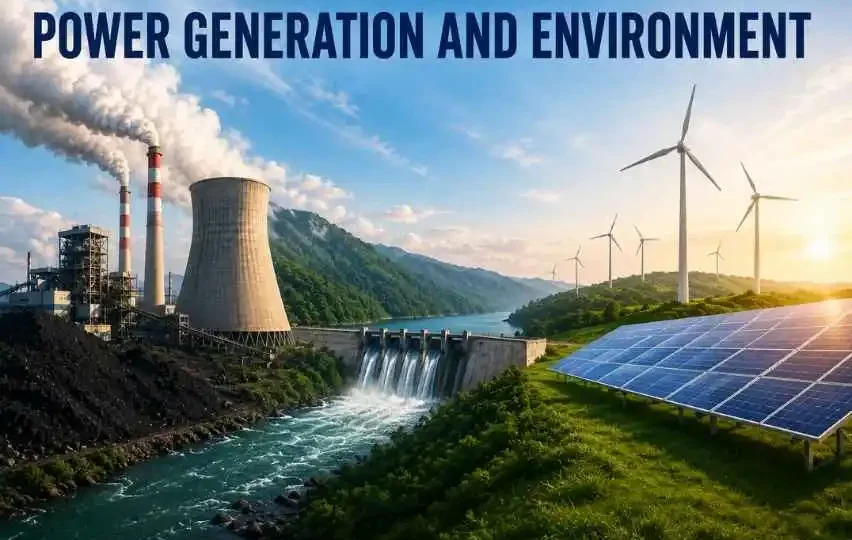
Electricity generation is critical for supporting public infrastructure, driving industries, and meeting the needs of rapid urbanization. However, different energy generation methods carry distinct environmental footprints:
                        ┌──> Thermal (Coal, Gas, Oil) - High GHG footprint
                        │
[Power Generation] ─────┼──> Hydropower (Large dams) - Heavy ecosystem alteration
  Source Matrix         │
                        ├──> Nuclear (Uranium/Thorium) - Radioactive risk & low carbon
                        │
                        └──> Renewables (Solar, Wind) - Low carbon but land-intensive
Environmental Effects of Specific Power Pathways
A. Thermal Power Generation (Coal and Gas)
Thermal energy remains the primary source of baseload power, but it causes significant environmental degradation:
- Air Pollution: Burning coal releases massive plumes of sulfur dioxide ($SO_2$), nitrogen oxides ($NO_x$), and carbon dioxide ($CO_2$), which drive acid rain and accelerate global warming.
- Fly Ash Management: Coal combustion produces vast quantities of fly ash, which contains heavy metals like arsenic, lead, and mercury. If mismanaged, fly ash pollutes local topsoil and leaches into groundwater tables.
- Thermal Pollution: Coal plants draw in large volumes of water from nearby rivers or lakes for cooling, releasing it back at significantly higher temperatures. This drop in dissolved oxygen levels causes severe thermal shock to aquatic life.
B. Hydropower Projects (Large Dams)
Though marketed as clean energy, large-scale hydroelectric dams cause significant ecological disruption:
- Submergence and Deforestation: Reservoir creation floods pristine forests, leading to massive habitat loss and driving localized biodiversity loss.
- River Fragmentation: Dams block the natural flow of rivers, trapping nutrient-rich silt and disrupting the migration and breeding patterns of aquatic species like Mahseer fish.
C. Nuclear Power
- The Dual Footprint: Nuclear energy is a low-carbon power source that helps mitigate climate change. However, it presents unique risks regarding the long-term storage of high-level radioactive waste and the catastrophic potential of nuclear meltdowns.
D. Renewable Energy (Solar and Wind)
- The Green Shift: Solar and wind systems emit virtually no greenhouse gases during operation. However, they are highly land-intensive. Large solar parks can cause localized desertification by blocking sunlight from native soil, while poorly cited wind turbines threaten migratory bird paths.
Power Generation and Environmental Issues in India
India faces distinct challenges at the intersection of urbanization and environment UPSC profiles track, where growing urban energy demands clash with strict environmental mandates:
- The Coal Dilemma: Over 50% of India’s electricity still comes from coal, making the power sector a primary source of ambient air pollution ($PM_{2.5}$) across the Indo-Gangetic Plain.
- The Himalayan Hydropower Crisis: Building cascading run-of-the-river hydropower projects in the ecologically fragile Hindu Kush-Himalayan region has destabilized mountain slopes, aggravating flash floods and landslides.
Sustainable Strategies and Government Initiatives in India
- Mitigating the environmental impacts of power generation requires a structural transition toward a decarbonized, highly efficient national grid.
Key Government Initiatives:
- The Renewable Energy Expansion: India has set an ambitious target of achieving 500 GW of non-fossil fuel energy capacity by 2030, a commitment central to its climate goals.
- Perform, Achieve and Trade (PAT) Scheme: Operating under the National Mission for Enhanced Energy Efficiency (NMEEE), this initiative uses a market-based mechanism to mandate energy consumption reductions across energy-intensive industries, including thermal power plants.
- National Green Hydrogen Mission: A strategic policy framework designed to transition hard-to-abate industries and backup power systems away from fossil fuels toward clean hydrogen energy.
- Flue-Gas Desulfurization (FGD) Mandates: Statutory directives issued by the Ministry of Environment, Forest and Climate Change (MoEFCC) requiring thermal power plants to install FGD systems to remove $SO_2$ from exhaust flue gases before release.
Conclusion
The study of energy and environment UPSC modules demonstrates that energy security must not come at the expense of ecological safety. While transitioning to solar, wind, and green hydrogen is essential to meet global climate goals, managing this shift requires careful environmental impact assessments. By enforcing strict emission controls on existing plants, investing in grid-scale battery storage, and prioritizing low-impact renewable energy placement, India can fuel its economic growth while preserving its rich biodiversity and protecting public health.
UPSC Prelims: PYQs & Practice Questions
Previous Year Questions (Prelims)
UPSC CSE Prelims 2020
Q: With reference to solar water pumps, consider the following statements:
1. Solar power can be used for running surface pumps and not submersible pumps.
2. Solar power can be used for running centrifugal pumps and not the ones with piston.
Which of the statements given above is/are correct?
(a) 1 only
(b) 2 only
(c) Both 1 and 2
(d) Neither 1 nor 2
Answer: (d) Neither 1 nor 2
Explanation:
Both statements are incorrect. Solar power can generate electricity to run different types of electric motor pumps.
It can efficiently power both surface pumps and deep submersible pumps. It can also run centrifugal pumps as well as piston-driven positive displacement pumps.
This question highlights how India’s agricultural energy policies are shifting toward low-carbon renewable decentralization to reduce the environmental impacts of conventional power generation.
UPSC CSE Prelims 2015
Q: With reference to fly ash produced by the power generation industry, which of the following statements is/are correct?
1. Fly ash can be used in the production of bricks for building construction.
2. Fly ash can be used as a replacement for some of the Portland cement contents of concrete.
3. Fly ash is made up of silicon dioxide and calcium oxide only, and does not contain any toxic elements.
Select the correct answer using the code given below:
(a) 1 and 2 only
(b) 2 only
(c) 1 and 3 only
(d) 1, 2 and 3
Answer: (a) 1 and 2 only
Explanation:
Statements 1 and 2 are correct. Fly ash is widely used in the circular economy as a sustainable material for making
building bricks and as a partial replacement for
Portland cement in concrete.
Statement 3 is incorrect. Fly ash is not made only of silicon dioxide and calcium oxide. It also contains compounds such as aluminium oxide, iron oxide, and hazardous heavy metals like arsenic, lead, cadmium, and mercury.
Therefore, safe utilization and regulated disposal of fly ash are important environmental concerns linked to thermal power generation.
Practice Questions
Q: In the context of the effects of power generation on environment systems, consider the following statements regarding the Flue-Gas Desulfurization (FGD) systems mandated for thermal power plants:
1. FGD systems are chemical scrubbers designed specifically to capture and convert
carbon dioxide (CO2) emissions into stable geological bicarbonates.
2. The implementation of FGD technology in coal-fired power plants drastically reduces the release of
sulfur dioxide (SO2), preventing the formation of acid rain downwind.
Which of the statements given above is/are correct?
(a) 1 only
(b) 2 only
(c) Both 1 and 2
(d) Neither 1 nor 2
Answer: (b) 2 only
Explanation:
Statement 1 is incorrect.
FGD systems do not treat carbon dioxide
(CO2). They are designed specifically to remove
sulfur dioxide (SO2) from the exhaust flue gases of fossil-fuel power plants.
Statement 2 is correct. In FGD systems, flue gas is mixed with an alkaline absorbent such as limestone. This captures a large share of sulfur dioxide emissions and prevents SO2 from reacting with atmospheric moisture to form acid rain.
Q: In the context of aquatic ecology, why is the Thermal Pollution caused by large thermal and nuclear electricity stations considered highly hazardous?
(a) It accelerates the chemical precipitation of atmospheric nitrogen directly into toxic ammonia.
(b) It increases the water temperature, which drastically lowers the solubility of dissolved oxygen while simultaneously increasing the metabolic rates of aquatic organisms.
(c) It instantly converts the surrounding river basins into highly acidic, non-potable sulfur channels.
(d) It induces an artificial winter-dormancy phase in native fish populations, permanently halting reproduction.
Answer: (b) It increases the water temperature, which drastically lowers the solubility of dissolved oxygen while simultaneously increasing the metabolic rates of aquatic organisms.
Explanation:
Large thermal and nuclear power plants use huge volumes of water from rivers, lakes, or reservoirs to
condense steam. When this heated water is discharged back into the natural source, it causes
thermal pollution.
Warm water holds less dissolved oxygen (DO) than cold water. At the same time, higher water temperature increases the metabolic rate of fish and other aquatic organisms, making them require more oxygen when less oxygen is available. This can create hypoxic conditions and may result in large-scale fish mortality.
UPSC Mains – Previous Year & Practice Questions
Mains Previous Year Questions
Mains 2023
Question: Identify the main causes of the loss of
biodiversity in India.
(Requires detailing how building mega-dams for hydropower fragments river ecosystems and destroys riverine flora and fauna.)
Mains 2022
Question: Clean energy is the order of the day.
Describe briefly India’s changing policy towards climate change in various international fora in the context of
COP-26.
(Directly maps to India’s energy transition targets.)
Mains 2021
Question: Explain the purpose of the
Green Grid Initiative —
One Sun One World One Grid (OSOWOG) launched at the World Leaders’ Summit of the
COP26 Climate Conference.
(Tests the international grid-integration framework for renewable energy.)
Mains 2018
Question: With growing energy needs, should India keep on expanding its
nuclear energy programme? Discuss the facts and fears associated with nuclear energy.
(Balances the carbon-free value of nuclear power against the threat of radioactive waste management.)
Mains 2016
Question: Give an account of the current status and the targets to be achieved pertaining to
renewable energy sources in the country. Discuss in brief the importance of
National Programme on Light Emitting Diodes (LEDs).
(Useful for linking renewable energy expansion, energy efficiency, and reduced environmental impact of power generation.)
Mains Practice Questions
[15 Marks | 250 Words]
Question: Analyze the ecological consequences of cascading run-of-the-river hydropower projects in the fragile ecosystem of the Indian Himalayas. Balance this against India’s regional green energy demands.
[15 Marks | 250 Words]
Question: While renewable energy is essential to fight climate change, large-scale utility solar parks and wind energy farms carry their own distinct land-use and biodiversity challenges. Critically examine.
[10 Marks | 150 Words]
Question: Enumerate the environmental hazards of unmanaged fly ash from coal-fired units. Evaluate how the implementation of the PAT (Perform, Achieve, and Trade) scheme helps reduce the ecological footprint of India’s power sector.



Power Generation and Environment-FAQs
Why does coal power cause acid rain?
Coal burning releases SO₂ and NOx, which react with atmospheric moisture to form sulphuric and nitric acids. These return as acid rain, damaging soils, lakes, crops, forests, and aquatic life.
What is Green Hydrogen?
Green Hydrogen is produced by splitting water through electrolysis using renewable energy like solar or wind. It helps reduce emissions because its main byproduct is only water vapour.
How do hydropower dams emit greenhouse gases?
Large dams submerge forests and soils under reservoirs. This organic matter decomposes anaerobically and releases methane and CO₂, especially in tropical regions.
How do large solar parks cause environmental degradation?
Utility-scale solar parks need huge land areas, often clearing vegetation and disturbing habitats. Panel cleaning also requires water, which can strain groundwater in dry regions.
What is the PAT scheme?
The Perform, Achieve and Trade scheme by BEE gives energy-saving targets to industries and power plants. Efficient units earn certificates, while underperformers must buy them.