
Table of Contents
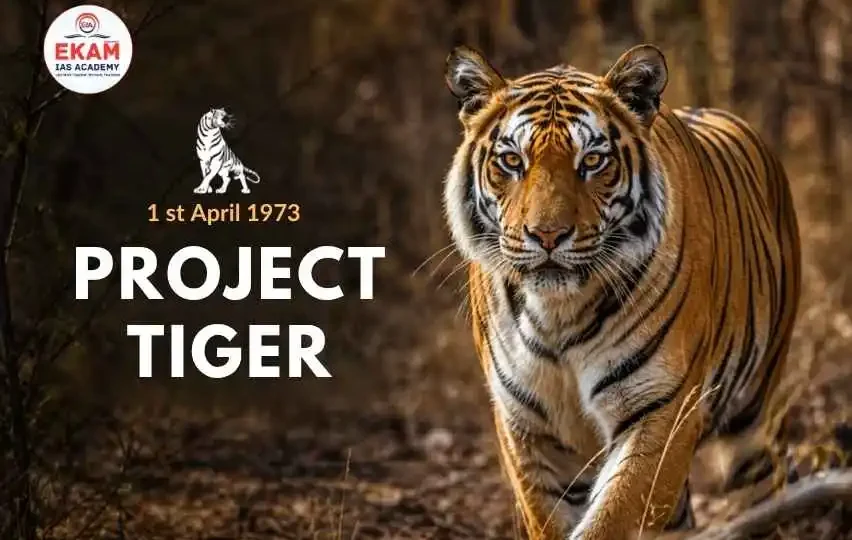
ToggleThe tiger (Panthera tigris) sits at the apex of India’s food chain, acting as an irreplaceable indicator of ecosystem health. However, unchecked hunting, commercial logging, and population expansion caused a catastrophic crash in tiger numbers by the early 1970s. This ecological emergency prompted a comprehensive national response that fundamentally transformed India’s approach to protecting its wilderness.
Background and Objectives of Project Tiger
- The Genesis: Launched on April 1, 1973, at Jim Corbett National Park by the Indira Gandhi government, Project Tiger was a pioneering effort to rescue an endangered apex predator.
Core Objectives:
- To ensure a viable population of Bengal tigers in India for scientific, economic, aesthetic, and ecological values.
- To preserve areas of biological importance as a natural heritage for the benefit of education and research.
- To implement a structured framework to reverse the systemic loss of contiguous forest habitats.
Key Features and Structure of Tiger Reserves
Project Tiger shifted conservation away from focusing on individual animals toward protecting entire landscapes. It pioneered the “Core-Buffer” structural framework now applied across major tiger reserves in India:
- Core Area (Critical Tiger Habitat): These areas are established with clear statutory backing and must be kept strictly inviolate. All forms of human resource extraction, collection of minor forest produce, and commercial tourism are legally prohibited to guarantee an undisturbed breeding sanctuary.
- Buffer Area: Surrounds the core zone. Here, a lower degree of habitat protection applies. Limited, regulated human activities—such as managed eco-tourism, sustainable livestock grazing, and traditional non-timber forest produce collection—are permitted to foster co-existence with local communities.
National Tiger Conservation Authority (NTCA)
The NTCA UPSC modules focus on is the central pillar of modern tiger governance.
- Establishment: Set up in December 2005 following recommendations by the Tiger Task Force, it was granted formal statutory status via the 2006 amendment of the Wild Life (Protection) Act, 1972.
- Mandate: The NTCA standardizes tiger reserve management, penalizes wildlife crimes, approves state-level Tiger Conservation Plans, and tables mandatory ecological audits before Parliament.
Tiger Reserves in India, Census, and Population Trends
From just 9 reserves at its inception in 1973, the network of tiger reserves in India has grown significantly, spanning diverse ecosystems from the mountain forests of the Himalayas to the coastal mangroves of the Sundarbans.
The Quadrennial Tiger Census:
The NTCA, alongside the Wildlife Institute of India (WII), conducts the national tiger estimation exercise every four years. This census relies on the advanced M-STrIPES (Monitoring System for Tigers – Intensive Protection and Ecological Status) software platform, combining digital forest guard patrol logs with rigorous camera-trap data and spatial mapping. This methodical approach has documented a steady, sustained recovery in India’s wild tiger populations.
Threats, Challenges, and Conservation Measures
- Habitat Fragmentation: Linear infrastructure projects, such as widening highways, railway lines, and irrigation canals, cut through critical tiger migration corridors, isolating gene pools and causing inbreeding depression.
- Human-Wildlife Conflict: As animal populations grow within fixed forest boundaries, tigers frequently venture into peripheral agricultural zones, leading to livestock depredation and retaliatory killings.
- Poaching: Organized international criminal networks continue to drive the illegal poaching of tigers for their skin, bones, and body parts used in traditional underground medicine markets.
Conservation Measures:
Project Tiger addresses these threats through tech-driven solutions. Anti-poaching camps, local Special Tiger Protection Forces (STPF), automated e-eye surveillance systems in sensitive areas, and voluntary, financially compensated village relocation programs work together to keep core habitats undisturbed.
Project Tiger and Global Initiatives
India’s domestic success directly reinforces global commitments. At the 2010 St. Petersburg Declaration, India pledged to support the international TX2 Goal—aiming to double its wild tiger numbers. By achieving this target ahead of schedule, India demonstrated that strong political commitment, backed by a robust legal framework and dedicated funding, can reverse species decline.
Conclusion
Project Tiger stands as a shining example of effective wildlife management under the Project Tiger UPSC curriculum. Its success proves that protecting an apex predator helps preserve entire ecosystems that secure clean water, carbon sinks, and rich biodiversity. To safeguard these achievements, future policy must focus on smart infrastructure design, protecting vital wildlife corridors, and ensuring local communities share in the benefits of forest conservation.
UPSC Prelims: PYQs & Practice Questions
Previous Year Questions (Prelims)
UPSC CSE Prelims 2017
Q: The term ‘M-STrIPES’ is sometimes seen in the news in the context of:
(a) Captive breeding of Wild Fauna
(b) Maintenance of Tiger Reserves
(c) Indigenous Satellite Navigation System
(d) Security of National Highways
Answer: (b) Maintenance of Tiger Reserves
Explanation:
M-STrIPES stands for
Monitoring System for Tigers - Intensive Protection and Ecological Status. It is a software-based application launched by the
National Tiger Conservation Authority (NTCA) and the
Wildlife Institute of India in 2010.
It is a critical technological tool used for digital patrolling, field monitoring, threat mapping, and ecological data collection inside Tiger Reserves. It helps standardize field protocols across tiger landscapes in India.
UPSC CSE Prelims 2020
Q: Among the following Tiger Reserves, which one has the largest area under Critical Tiger Habitat?
(a) Corbett
(b) Ranthambore
(c) Nagarjunsagar-Srisailam
(d) Sunderbans
Answer: (c) Nagarjunsagar-Srisailam
Explanation:
Nagarjunsagar-Srisailam Tiger Reserve, located across
Andhra Pradesh and Telangana, has the largest officially notified
Critical Tiger Habitat, also known as the core area, in India.
Under the Wild Life (Protection) Act, 1972, these core areas are legally mandated to be kept strictly inviolate to support breeding populations of wild tigers, ensure prey availability, and protect undisturbed tiger habitats.
Practice Questions
Q: With reference to the statutory framework governing tiger reserves in India, consider the following statements:
1. The boundary of a designated tiger reserve can be altered or denotified by a State Government via a public notification without any central institutional oversight.
2. No modification of the boundaries of a tiger reserve shall be made except on a recommendation of the
National Tiger Conservation Authority (NTCA) and the approval of the
National Board for Wildlife (NBWL).
Which of the statements given above is/are correct?
(a) 1 only
(b) 2 only
(c) Both 1 and 2
(d) Neither 1 nor 2
Answer: (b) 2 only
Explanation:
Statement 1 is incorrect. State Governments cannot unilaterally alter or denotify the boundaries of a tiger reserve because tiger reserves are governed by a strict ecological and statutory protection framework.
Statement 2 is correct. Under Section 38W of the Wild Life (Protection) Act, 1972, any modification or denotification of a tiger reserve requires a recommendation from the National Tiger Conservation Authority (NTCA) and approval from the National Board for Wildlife (NBWL).
Q: Consider the following pairings of Tiger Reserves and their primary geographical attributes:
1. Pakke Tiger Reserve — Arunachal Pradesh
2. Sathyamangalam Tiger Reserve — Western Ghats-Eastern Ghats confluence
3. Orang Tiger Reserve — Brahmaputra floodplain
Which of the pairings given above are correctly matched?
(a) 1 and 2 only
(b) 2 and 3 only
(c) 1 and 3 only
(d) 1, 2 and 3
Answer: (d) 1, 2 and 3
Explanation:
All three pairings are correct.
Pakke Tiger Reserve is located in Arunachal Pradesh and forms part of the Eastern Himalayan biodiversity landscape.
Sathyamangalam Tiger Reserve in Tamil Nadu is strategically located at the Western Ghats-Eastern Ghats confluence, acting as a crucial genetic corridor. Orang Tiger Reserve lies in Assam along the Brahmaputra floodplain and supports a significant tiger population in a riverine grassland ecosystem.
UPSC Mains – Previous Year & Practice Questions
Mains Previous Year Questions
Mains 2023
Question: Identify the main causes of the loss of
biodiversity in India.
(Requires analyzing how linear development fragments tiger landscapes.)
Mains 2020
Question: How does the draft
Environment Impact Assessment (EIA) Notification differ from the existing
EIA Notification, 2006?
(Crucial for discussing how relaxing clearance norms inside eco-sensitive zones impacts peripheral tiger habitats.)
Mains 2018
Question: How does biodiversity vary in India?
How is the Biological Diversity Act, 2002 helpful in conservation of flora and fauna?
(Can be linked with tiger reserves as umbrella landscapes that conserve multiple species, ecosystems, and local biodiversity resources.)
Mains 2019
Question: Coastal regions of India are prone to cyclones.
Discuss the role of mangroves in reducing the impact of such disasters.
(Ties directly into the multi-hazard protective value of the Sundarbans Mangrove Tiger Reserve.)
Mains 2015
Question: What are the main bottlenecks in the adoption of
genetically modified (GM) crops in India?
(Can be used comparatively to discuss regulatory caution, ecological risk assessment, and biodiversity protection frameworks.)
Mains Practice Questions
[15 Marks | 250 Words]
Question: The recent institutional merging of Project Tiger and Project Elephant under a unified administrative division within the MoEFCC has sparked conservation debates. Critically analyze the ecological and financial implications of this integration.
[15 Marks | 250 Words]
Question: While the Core-Buffer strategy under Project Tiger has successfully saved the Bengal Tiger from extinction, it has also intensified human-wildlife friction on the forest fringes. Suggest sustainable strategies to bridge this divide.
[10 Marks | 150 Words]
Question: Discuss how linear infrastructure expansion acts as a structural bottleneck for the long-term genetic viability of wild tigers in India. Evaluate the significance of eco-bridges and smart-green infrastructure solutions.



Project Tiger-FAQs
What is the statutory status of NTCA?
The National Tiger Conservation Authority (NTCA) is a statutory body under MoEFCC. It was established under the Wild Life (Protection) Amendment Act, 2006 to strengthen tiger reserve management.
Difference between Core and Buffer Area?
The Core Area or Critical Tiger Habitat is kept inviolate with strict protection. The Buffer Area allows limited regulated activities like eco-tourism, grazing, and minor forest produce collection.
How often is the National Tiger Census conducted?
India conducts the tiger estimation once every four years. It uses camera traps, field surveys, spatial models, and M-STrIPES technology.
Who can notify a new Tiger Reserve?
A State Government officially notifies a Tiger Reserve. But it must first get technical approval from the NTCA.
What is Inbreeding Depression in tigers?
Inbreeding depression occurs when isolated tiger populations breed among close relatives. It reduces genetic diversity, immunity, and reproduction, making wildlife corridors essential.