Table of Contents
ToggleWhile setting up National Parks and Wildlife Sanctuaries helps preserve broad landscapes, certain species experience such rapid population declines that general habitat protection is no longer enough. When a species reaches the brink of extinction, it requires highly specific, individualized biological interventions to survive.
Defining the Species Recovery Programme
The Species Recovery Programme UPSC notes track is a dedicated sub-component of the centrally sponsored flagship scheme, Integrated Development of Wildlife Habitats (IDWH).
Background and Institutional Hub:
Launched by the Ministry of Environment, Forest and Climate Change (MoEFCC), this program provides dedicated financial and technical assistance to state governments. It coordinates with premier scientific bodies like the Wildlife Institute of India (WII) to design and execute tailored species recovery plans.
Need and Objectives of the Programme
- The Need: Rapid industrialization, linear infrastructure expansion, invasive species, and targeted poaching have triggered localized population collapses. General territorial forest management cannot address specific biological challenges like low egg-hatching rates or highly restricted genetic gene pools.
Core Objectives:
- To recover and stabilize wild populations of critically endangered species in India.
- To build secure, managed captive-breeding facilities that act as insurance populations against catastrophic disease outbreaks.
- To restore specialized ecological niches and reintroduce captive-bred individuals back into their historical native ranges.
Key Components and Species Covered
The recovery program operates through a four-stage conservation framework:
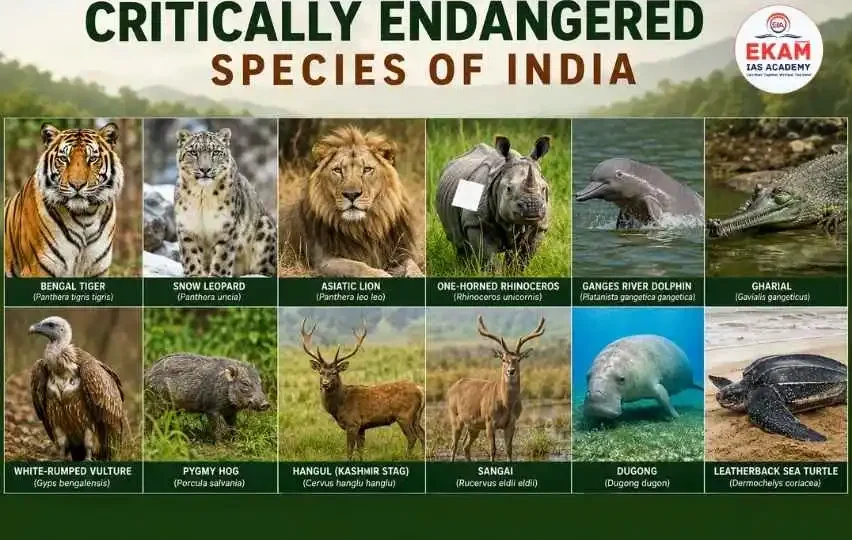
The MoEFCC originally identified a specific registry of highly vulnerable species for targeted recovery. This list includes a diverse range of birds, marine mammals, and terrestrial animals:
- Avifauna: Great Indian Bustard, Bengal Florican, Jerdon’s Courser, Forest Owlet.
- Mammals: Hangul (Kashmir Stag), Sangai (Brow-antlered Deer), Malabar Civet, Pygmy Hog, One-horned Rhinoceros, Asiatic Lion, Snow Leopard, Gangetic Dolphin, Dugong.
- Reptiles & Amphibians: Gharial, Leatherback Sea Turtle, Toad-skinned Frog.
Important Case Studies and Achievements
- The Vulture Recovery Success: The catastrophic collapse of India’s vulture population (Gyps species) was traced to the veterinary use of the anti-inflammatory drug Diclofenac. Under the recovery program, the government banned the drug and set up Vulture Conservation Breeding Centres (VCBCs). This intervention successfully stabilized populations and enabled the first successful soft-releases of captive-bred white-rumped vultures back into the wild.
- The Pygmy Hog Program: The world’s smallest wild pig (Porcula salvania) was brought back from the brink of extinction through a highly structured captive breeding and reintroduction program in Assam’s Manas National Park, helping it reclaim its historical grassland habitats.
Challenges in Implementation and Government Initiatives
- Inbreeding Depression: When a wild population shrinks to just a few dozen individuals, mating between close genetic relatives causes a loss of genetic diversity, reducing disease immunity and reproductive rates.
- Habitat Encroachment: Securing large, undisturbed zones for soft-releasing animals remains difficult due to the expansion of highways, power lines, and agricultural fields.
Supporting Government Initiatives:
The program operates under the strict protection of the Wild Life (Protection) Act, 1972, which places these animals under Schedule I to enforce the highest criminal penalties for poaching. It also leverages funds from the Compensatory Afforestation Fund Management and Planning Authority (CAMPA) to secure long-term financial backing for scientific field research.
Alignment with the IUCN Red List
The recovery programme works in close alignment with the international standards of the IUCN Red List. A species is classified as Critically Endangered if it meets extreme biological criteria, such as a population reduction of over 90% over a decade, a total wild population of fewer than 250 mature individuals, or a highly fragmented geographic footprint. The Indian recovery program uses these global metrics to prioritize funding and deploy urgent emergency conservation measures.
Conclusion
The Recovery Programme for Critically Endangered Species UPSC curriculum highlights demonstrates that saving biodiversity requires moving beyond general habitat protection to deploy targeted, science-based interventions. Preserving India’s unique wildlife heritage requires a strong commitment to funding scientific research, establishing secure captive breeding centers, and ensuring local communities share in the benefits of conservation. Reversing species decline ensures the long-term health and stability of the ecosystems that sustain all life.
UPSC Prelims: PYQs & Practice Questions
Previous Year Questions (Prelims)
UPSC CSE Prelims 2020
Q: With reference to India’s Desert National Park, which of the following statements are correct?
1. It is spread over two districts.
2. There is no human habitation inside the Park.
3. It is one of the natural habitats of Great Indian Bustard.
Select the correct answer using the code given below:
(a) 1 and 2 only
(b) 2 and 3 only
(c) 1 and 3 only
(d) 1, 2 and 3
Answer: (c) 1 and 3 only
Explanation:
Statement 1 is correct.
Desert National Park is spread across the
Jaisalmer and Barmer districts of Rajasthan.
Statement 3 is correct. It is one of the most important natural habitats and strongholds of the Great Indian Bustard, a critically endangered grassland bird and flagship species under India’s species recovery efforts.
Statement 2 is incorrect. Human habitation exists inside the park. Several traditional villages and settlements are present within this large desert landscape, making complete exclusion impractical.
UPSC CSE Prelims 2012
Q: Consider the following:
1. Black-necked crane
2. Cheetah
3. Flying squirrel
4. Snow leopard
Which of the above are naturally found in India?
(a) 1, 2 and 3 only
(b) 1, 3 and 4 only
(c) 2 and 4 only
(d) 1, 2, 3 and 4
Answer: (b) 1, 3 and 4 only
Explanation:
The question tests the natural distribution of important wildlife species in India.
The Black-necked crane is naturally found in high-altitude wetlands of Ladakh and parts of the Himalayan region. Flying squirrels, including species such as the Namdapha flying squirrel, are native to forested habitats of Northeast India. The Snow leopard is naturally found in the high-altitude Himalayan and trans-Himalayan landscapes.
The Cheetah was declared extinct in India in 1952. The recently introduced African cheetahs in Kuno are part of a translocation programme and do not represent a surviving natural Indian population.
Practice Questions
Q: The Recovery Programme for Critically Endangered Species is implemented in India as a specialized sub-component under which of the following institutional frameworks?
(a) National Biodiversity Action Plan funded by the Biological Diversity Act, 2002
(b) Integrated Development of Wildlife Habitats (IDWH), a Centrally Sponsored Scheme
(c) The National Wildlife Action Plan supervised directly by CITES
(d) National Green Tribunal’s Eco-Restoration Directive
Answer: (b) Integrated Development of Wildlife Habitats (IDWH), a Centrally Sponsored Scheme
Explanation:
The Species Recovery Programme is financially and structurally nested as a sub-component of the
Integrated Development of Wildlife Habitats (IDWH), a
Centrally Sponsored Scheme of the Ministry of Environment, Forest and Climate Change.
Under this scheme, the MoEFCC provides species-specific financial and technical assistance to State Governments for the recovery of highly threatened species facing imminent extinction risks.
Q: The catastrophic population crash of Indian vultures (Gyps species), which triggered an emergency intervention under the Species Recovery Programme, was primarily caused by the bioaccumulation of which veterinary drug?
(a) Ketoprofen
(b) Flunixin
(c) Diclofenac
(d) Aceclofenac
Answer: (c) Diclofenac
Explanation:
The widespread veterinary use of the non-steroidal anti-inflammatory drug
Diclofenac in cattle was the primary cause of the Indian vulture crisis.
Vultures feeding on cattle carcasses contaminated with diclofenac suffered acute renal failure and visceral gout, causing a population crash of nearly 99% in some Gyps vulture species.
This led to emergency recovery measures such as the veterinary ban on diclofenac and the establishment of Vulture Conservation Breeding Centres (VCBCs).
UPSC Mains – Previous Year & Practice Questions
Mains Previous Year Questions
Mains 2023
Question: Identify the main causes of the loss of
biodiversity in India.
(Requires explaining how the collapse of specific ecological niches mandates target-species recovery plans over simple boundary enforcement.)
Mains 2020
Question: How does the draft
Environment Impact Assessment (EIA) Notification differ from the existing
EIA Notification, 2006?
(Crucial for discussing how industrial expansion into fragile ecosystems affects the critical ranges of highly threatened wildlife.)
Mains 2018
Question: How does
biodiversity vary in India? How is the
Biological Diversity Act, 2002 helpful in conservation of flora and fauna?
(Can be linked with legal, institutional, and community-based tools required for protecting species under recovery programmes.)
Mains 2014
Question: Enumerate the
indirect services provided by an ecosystem.
How do wetlands act as “Earth’s Kidneys”?
(Useful for discussing how habitat restoration supports threatened wetland-dependent species and ecosystem services.)
Mains 2019
Question: Coastal regions of India are prone to cyclones.
Discuss the role of mangroves in reducing the impact of such disasters.
(Can link to the marine habitat restoration needs of recovery-listed species like the Dugong.)
Mains Practice Questions
[10 Marks | 150 Words]
Question: Differentiate between general habitat conservation and a targeted Species Recovery Programme. Why is habitat protection alone sometimes insufficient to save species facing imminent biological extinction?
[15 Marks | 250 Words]
Question: Examine the role of the Compensatory Afforestation Fund Management and Planning Authority (CAMPA) in financing the recovery plans of critically endangered species in India. Assess the implementation challenges encountered during ex-situ captive breeding.
[15 Marks | 250 Words]
Question: The Great Indian Bustard (Ardeotis nigriceps) is facing an existential crisis due to a combination of low reproductive rates and modern linear infrastructure. Evaluate the mitigation steps taken under the Species Recovery Programme to save this apex grassland species.



Recovery Programme for Critically Endangered Species-FAQs
How many species are covered under India’s Recovery Programme?
Initially, 17 critically endangered species were identified. The list has now expanded to over 22 species, including Hangul, Sangai, Dugong, Pygmy Hog, Great Indian Bustard, Gharial, and Vultures.
What funds these recovery plans?
The programme comes under the Integrated Development of Wildlife Habitats (IDWH) scheme. Funding support also comes through CAMPA, used for breeding centres, tracking, research, and field protection.
When is a species Critically Endangered under IUCN?
A species is Critically Endangered when it faces an extremely high risk of extinction. Criteria include severe population decline, very low mature individuals, or high probability of extinction in the wild.
What is Soft-Release?
Soft-release is a gradual method of reintroducing captive-bred animals into the wild. Animals are first kept in protected enclosures within natural habitat before full release.
Why are power lines dangerous for Great Indian Bustard?
The Great Indian Bustard has poor frontal vision and often collides with overhead power lines. Since mature breeding birds are already few, such deaths seriously affect recovery efforts.