Table of Contents
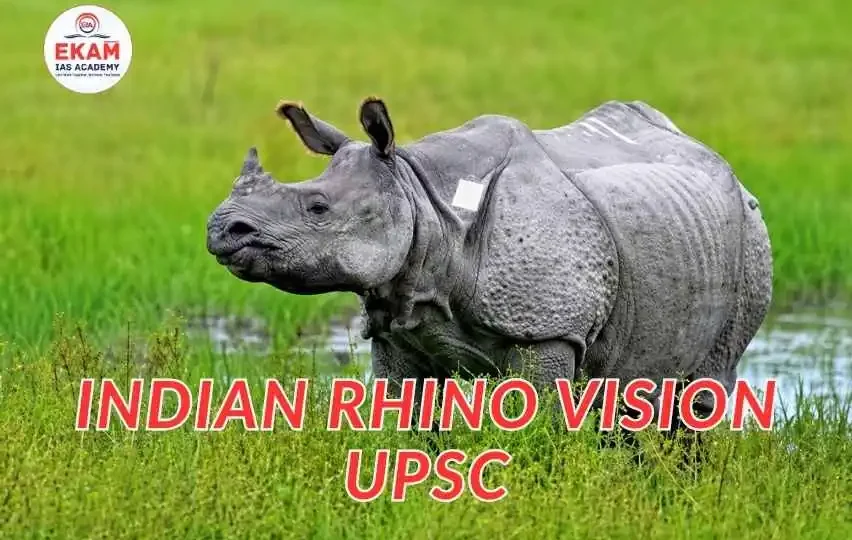
ToggleThe Greater One-Horned Rhinoceros (Rhinoceros unicornis) is a flagship species of the alluvial grasslands of the Indian subcontinent. Following centuries of intensive agricultural reclamation, sports hunting, and targeted poaching for its horn, the species faced a critical population bottleneck in the 20th century. To safeguard its future from localized disease outbreaks and catastrophic flooding, the state initiated a highly systematic, cross-landscape translocation program.
Background and Objectives of IRV 2020
Launched in 2005, the Indian Rhino Vision 2020 was an ambitious initiative designed to build an expansive, secure geographic footprint for the species.
Core Objectives:
- To increase the total wild rhino population in Assam to at least 3,000 individuals by the year 2020.
- To ensure that these rhinos are strategically distributed across at least seven protected areas within Assam, providing long-term genetic viability and reducing population concentration risk.
Implementing Agencies:
The initiative was rolled out under the leadership of the Assam Forest Department, working in close institutional collaboration with WWF India, the International Rhino Foundation (IRF), and local community conservation networks like Aaranyak.
About the Greater One-Horned Rhinoceros
Understanding the ecological traits of this megaherbivore is essential for Greater One-Horned Rhinoceros conservation modules:
| Parameter | Conservation and Ecological Status |
| IUCN Red List Status | Vulnerable |
| Wildlife Protection Act, 1972 | Schedule I (Highest level of legal protection) |
| CITES Status | Appendix I (Strict international trade prohibition) |
| Primary Habitat | Tropical riverine grasslands and alluvial plains of the Brahmaputra and Indus basins |
Key Components and Protected Areas Covered
The initiative relied on a carefully executed three-pronged strategy: expanding protection inside current strongholds, mapping range extension through wild-to-wild translocations, and restoring degraded grasslands.
                 ┌────────────────────────────────────────────────────────┐
                 │       SOURCE HABITATS (High Population Density)        │
                 │   - Kaziranga National Park  - Pobitora Wildlife Sanc. │
                 └───────────────────────────┬────────────────────────────┘
                                             │
                              [Wild-to-Wild Translocations]
                                             │
                                             ▼
                 ┌────────────────────────────────────────────────────────┐
                 │       TARGET HABITATS (Range Expansion Networks)       │
                 │   - Manas National Park     - Orang National Park       │
                 │   - Laokhowa Wildlife Sanc. - Burhachapori Wildlife Sanc.│
                 └────────────────────────────────────────────────────────┘
The program leveraged high-density source populations in Kaziranga National Park and Pobitora Wildlife Sanctuary to re-establish and bolster populations in target zones like Manas National Park and Orang National Park.
Achievements of Indian Rhino Vision
The original iteration of the program wrapped up with significant milestones:
- Population Turnaround: Assam’s total rhino population successfully climbed past the 3,000 mark.
- Reversing Local Extinctions: Wild translocations reintroduced breeding populations into Manas National Park, helping it reclaim its ecological health and secure its UNESCO World Heritage status.
- Evolution into IRV 2.0 (IRV 2030): Building on these foundations, IRV 2.0 targets a meta-population of 4,500 to 5,000 rhinos by 2030. This phase has already seen wild rhinos return naturally to the Laokhowa-Burhachapori Wildlife Sanctuaries via newly secured habitat corridors connecting them to Orang National Park.
Challenges and Threats Faced
- Invasive Species Encroachment: Grasslands are increasingly choked by invasive weeds like Mimosa invisa and Chromolaena odorata, which crowd out native forage plants and shrink available grazing grounds.
- Persistent Poaching Pressures: While strict enforcement has driven poaching rates down to historic lows, international syndicates continue to target rhino horns for underground markets.
- Genetic Bottlenecks: Small, isolated populations face the threat of inbreeding depression, which can compromise long-term reproductive health and disease immunity.
Global Conservation Framework and Future Strategies
The success of the IRV 2020 UPSC syllabus details underscores that saving wide-ranging megafauna requires looking beyond individual parks to manage entire landscapes. Future strategies focus on using AI-powered camera surveillance for anti-poaching, conducting DNA-based genetic monitoring, and providing alternative livelihoods to local communities through water hyacinth craft initiatives and eco-tourism.
Conclusion
The Indian Rhino Vision stands as a model for proactive, tech-driven wildlife restoration. By transforming vulnerable, highly concentrated populations into a resilient network of distinct meta-populations, India has set a global standard for endangered species recovery. Sustaining these gains will depend on maintaining strong anti-poaching measures, controlling invasive weeds, and ensuring local communities remain central stakeholders in protecting these unique grassland ecosystems.
UPSC Prelims: PYQs & Practice Questions
Previous Year Questions (Prelims)
UPSC CSE Prelims 2019
Q: Consider the following statements:
1. Asiatic lion is naturally found in India only.
2. Double-humped camel is naturally found in India only.
3. One-horned rhinoceros is naturally found in India only.
Which of the statements given above is/are correct?
(a) 1 only
(b) 2 and 3 only
(c) 1 and 3 only
(d) 1, 2 and 3
Answer: (a) 1 only
Explanation:
Statement 1 is correct. The wild
Asiatic Lion or Panthera leo persica is restricted entirely to
Gir National Park and its surrounding landscape in Gujarat.
Statement 2 is incorrect. The double-humped Bactrian camel is native to the cold deserts of Central Asia, including Mongolia and China. India has only a small domesticated population in Ladakh.
Statement 3 is incorrect. Although India holds a major share of the Greater One-Horned Rhinoceros population, the species is also naturally found in the Terai grasslands of Nepal.
UPSC CSE Prelims 2013
Q: Consider the following pairs:
1. Nokrek Biosphere Reserve : Garo Hills
2. Logtak / Loktak Lake : Barail Range
3. Namdapha National Park : Dafla Hills
Which of the pairs given above is/are correctly matched?
(a) 1 only
(b) 2 and 3 only
(c) 1, 2 and 3
(d) None
Answer: (a) 1 only
Explanation:
This question tests the precise geography of
Northeast India’s critical habitats, where many flagship and endemic species are found.
Pair 1 is correctly matched. Nokrek Biosphere Reserve is located in the Garo Hills of Meghalaya.
Pair 2 is incorrectly matched. Loktak Lake, famous for the Sangai deer and phumdis, is located in Manipur and is surrounded by the Manipur hills, not the Barail Range.
Pair 3 is incorrectly matched. Namdapha National Park in Arunachal Pradesh lies in the Patkai range, whereas the Dafla Hills lie further north. Understanding these terrains is important for mapping protected areas and species conservation landscapes such as Manas and Orang.
Practice Questions
Q: In the context of Greater One-Horned Rhinoceros conservation under the Indian Rhino Vision 2.0 (IRV 2030) framework, consider the following statements:
1. IRV 2.0 shifts the primary focus from active, manual wild-to-wild translocations to restoring natural habitat corridors.
2. The program seeks to establish a target meta-population of 4,500 to 5,000 rhinos across Assam by 2030.
3. It has successfully documented the natural return of wild rhinos to the Laokhowa-Burhachapori Wildlife Sanctuaries through secured corridors from Orang National Park.
Which of the statements given above are correct?
(a) 1 and 2 only
(b) 2 and 3 only
(c) 1 and 3 only
(d) 1, 2 and 3
Answer: (d) 1, 2 and 3
Explanation:
All three statements are correct. IRV 2.0 marks an evolution from the original
Indian Rhino Vision 2020. Instead of depending mainly on manual wild-to-wild translocations, the renewed approach gives greater importance to
habitat connectivity and natural range expansion.
The framework aims to build a larger rhino meta-population of around 4,500–5,000 individuals across Assam by 2030. Its corridor-based strategy was validated when wild rhinos naturally recolonized the Laokhowa-Burhachapori Wildlife Sanctuaries through secured habitat linkages from Orang National Park.
Q: Which of the following sets of protected areas served as the primary source habitats from which rhinos were caught and translocated to other parts of Assam under the IRV 2020 program?
(a) Manas National Park and Orang National Park
(b) Kaziranga National Park and Pobitora Wildlife Sanctuary
(c) Dibru-Saikhowa National Park and Nameri National Park
(d) Raimona National Park and Dehing Patkai National Park
Answer: (b) Kaziranga National Park and Pobitora Wildlife Sanctuary
Explanation:
Kaziranga National Park and Pobitora Wildlife Sanctuary hold some of the highest population densities of the
Greater One-Horned Rhinoceros in India.
Under the Indian Rhino Vision 2020, these high-density areas were used as source pools to translocate rhinos to other suitable habitats such as Manas National Park. This reduced the risk of over-concentration in a few sites and helped expand the species’ secure geographic range in Assam.
UPSC Mains – Previous Year & Practice Questions
Mains Previous Year Questions
Mains 2023
Question: What is the role of
geographical factors in determining the distribution of major wildlife species in India?
(Excellent for analyzing why the Greater One-Horned Rhino is ecologically restricted to alluvial, riverine floodplains.)
Mains 2020
Question: How does biodiversity vary in India?
Discuss the main legal provisions that aid in protecting
endangered fauna.
(Requires cross-referencing the strict Schedule I provisions of the Wild Life Protection Act, 1972.)
Mains 2018
Question: How does biodiversity vary in India?
How is the Biological Diversity Act, 2002 helpful in conservation of flora and fauna?
(Can be linked with rhino landscapes as examples of high-value floodplain biodiversity requiring legal and community-backed conservation.)
Mains 2014
Question: Enumerate the
indirect services provided by an ecosystem.
How do wetlands act as “Earth’s Kidneys”?
(Can link to how alluvial wetlands filter water and provide the primary biomass for megaherbivores like rhinos.)
Mains 2021
Question: Differentiate the causes of
landslides in the Himalayan region and
Western Ghats.
(Useful for comparing landscape vulnerabilities and shifting river channels in the Brahmaputra basin.)
Mains Practice Questions
[15 Marks | 250 Words]
Question: Explain the concept of an ecological metapopulation. How did the Indian Rhino Vision (IRV) utilize wild-to-wild translocations to reduce the vulnerability of the Greater One-Horned Rhinoceros to localized extinction risks?
[10 Marks | 150 Words]
Question: While manual animal translocations resolve the issue of population density, the rapid spread of invasive plant species threatens the long-term success of grassland conservation programs in Northeast India. Examine.
[15 Marks | 250 Words]
Question: The Indian Rhino Vision (IRV) is hailed as a successful blueprint for collaborative conservation. Evaluate the role of institutional coordination between state forest departments, international NGOs, and local communities in making this program a success.



Indian Rhino Vision-FAQs
Why move rhinos out of Kaziranga if population was thriving?
A large rhino population in one park is risky due to floods, disease, and poaching. Translocation spreads rhinos across parks, improves genetic diversity, and reduces extinction risk.
Difference between IRV 2020 and IRV 2.0?
IRV 2020 focused on translocating rhinos to reach 3,000 across seven protected areas. IRV 2.0 aims for 4,500–5,000 rhinos through habitat restoration, corridors, invasive weed control, and community participation.
How do invasive plants threaten rhinos?
Invasive plants like Lantana, Mimosa, and Chromolaena replace native grasses eaten by rhinos. This reduces food, pushes rhinos into farms, and increases conflict and poaching risk.
Conservation status of Greater One-Horned Rhinoceros?
It is listed as Vulnerable on the IUCN Red List. It is protected under Schedule I of the Wildlife Protection Act and Appendix I of CITES.
Future strategies under IRV 2.0 to stop poaching?
IRV 2.0 focuses on technology and community support. Key tools include AI cameras, thermal drones, DNA-based rhino identification, and livelihood support for local communities.