


Table of Contents
ToggleA Unified Policy Architecture for India’s Energy Future
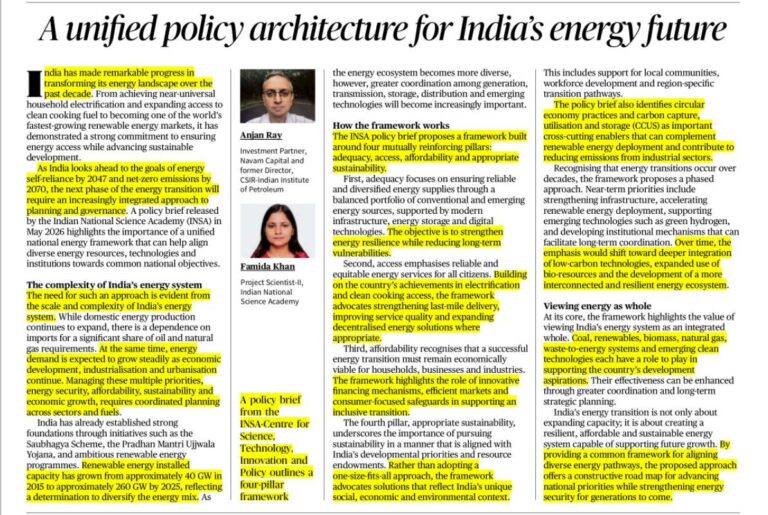
India’s energy future is entering a decisive phase. Over the past decade, the country has made major progress in household electrification, clean cooking fuel access, and renewable energy expansion. India’s renewable installed capacity has crossed the 50% share mark in total installed electricity capacity, showing the country’s strong shift towards cleaner power sources.
However, as India moves towards energy self-reliance by 2047 and net-zero emissions by 2070, the need for a unified and coordinated energy policy has become more important than ever.
Why India Needs a Unified Energy Policy
India’s energy system is large, diverse, and complex. The country depends on coal, renewables, natural gas, biomass, waste-to-energy systems, and emerging clean technologies. At the same time, rising industrialisation, urbanisation, and economic growth are increasing energy demand.
A fragmented approach can create gaps in planning, affordability, energy security, and sustainability. Therefore, India needs a unified energy policy architecture that connects generation, transmission, storage, distribution, finance, and technology under one coordinated framework.
Four Pillars of India’s Energy Framework
1. Adequacy
Energy adequacy means ensuring reliable and diversified energy supply for households, industries, agriculture, and businesses. India must strengthen infrastructure, storage systems, and digital technologies to reduce long-term energy vulnerabilities.
2. Access
Access focuses on reliable and affordable energy for all citizens. After achieving major progress in electrification and clean cooking fuel, the next step is improving service quality and expanding decentralised energy solutions.
3. Affordability
A successful energy transition must remain economically viable. Innovative financing, efficient markets, and consumer safeguards are essential to ensure that clean energy remains affordable for households and industries.
4. Sustainability
Sustainability requires India to follow clean energy pathways suited to its social, economic, and environmental needs. Renewable energy, green hydrogen, carbon capture, circular economy practices, and biomass-based solutions can support this transition.
Conclusion
India’s energy transition is not only about increasing renewable capacity. It is about creating a resilient, affordable, secure, and sustainable energy ecosystem. A unified policy architecture can help India align diverse energy pathways, strengthen energy security, and support future economic growth. For UPSC aspirants, this topic is important under energy security, climate change, sustainable development, and India’s net-zero strategy.
Vocabulary Boost
• Energy Transition → Shift from fossil fuels to clean energy.
• CCUS → Carbon Capture, Utilisation and Storage.
• Energy Resilience → Ability to withstand energy disruptions.
• Decentralised Energy → Localised generation and distribution systems.
• Net Zero → Balancing emissions with carbon removal.
Frequently Asked Questions (FAQs)
Why does India need a unified energy policy?
India needs a unified energy policy to coordinate renewable energy, coal, gas, storage, transmission, and clean technologies for secure and sustainable growth.
What are the four pillars of India’s energy framework?
The four pillars are adequacy, access, affordability, and sustainability.
Why is energy security important for India?
Energy security is important because India’s growing economy, industries, cities, and households need reliable and affordable energy supply.
How does renewable energy support India’s future?
Renewable energy reduces dependence on fossil fuels, lowers emissions, supports climate goals, and strengthens India’s clean energy transition.
Why is this topic important for UPSC?
It is important for UPSC because it connects energy security, sustainable development, climate change, net-zero target, and government policy planning.
Source From : The Hindu
As US Reshapes Its Asia Strategy, India Must Rewire Its Regional Leadership
The changing US Asia strategy has created a new geopolitical challenge for India. As Washington reassesses its approach towards China, South Asia, and the Indo-Pacific, India must protect its strategic autonomy and strengthen its own regional leadership. The article highlights that the United States is no longer focused only on containing China. Instead, it is increasingly treating China as a powerful economic and strategic competitor that must be managed carefully.
Why the US Asia Strategy Is Changing
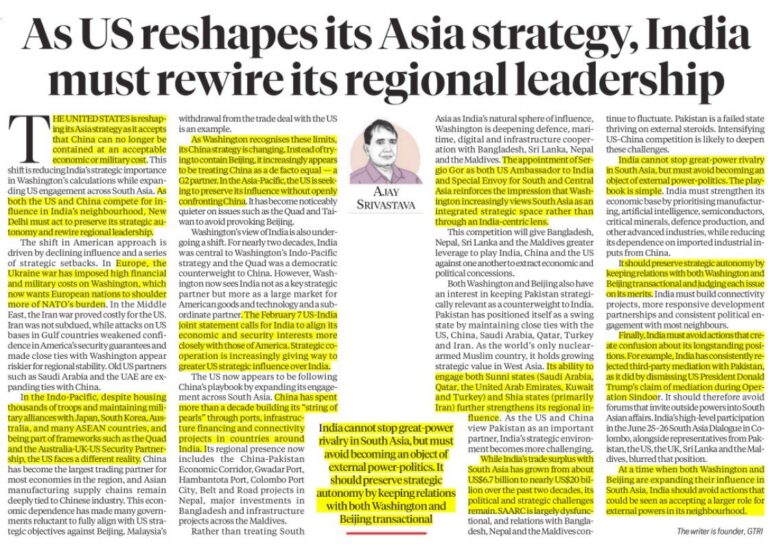
The United States has faced strategic setbacks in Europe, West Asia, and the Indo-Pacific. The Ukraine war, tensions in the Middle East, and China’s growing economic influence have forced Washington to rethink its global role. In Asia, the US continues to work with partners such as Japan, South Korea, Australia, and India, but its approach is becoming more flexible and transactional.
This means India cannot depend only on American support to manage regional challenges. It must build independent capacity in defence, manufacturing, trade, infrastructure, and diplomacy.
India’s Challenge in South Asia
Growing Chinese Influence
China has expanded its presence in South Asia through infrastructure projects, ports, trade, and financial assistance. Countries such as Pakistan, Nepal, Bangladesh, Sri Lanka, and the Maldives have seen growing Chinese engagement. This affects India’s traditional influence in its neighbourhood.
Need for Regional Leadership
India must treat South Asia as its natural sphere of influence. Instead of reacting to external powers, India should actively build connectivity, trade partnerships, digital cooperation, energy links, and development projects with neighbouring countries.
Strategic Autonomy for India
Balancing the US and China
India cannot stop great-power rivalry in South Asia, but it can avoid becoming a passive object of external politics. It must maintain relations with both Washington and Beijing while protecting its own national interest.
Strengthening Domestic Capacity
India’s regional leadership will depend on its economic strength. Manufacturing, critical minerals, defence production, advanced technology, and infrastructure must become central to India’s strategy.
Conclusion
As the US reshapes its Asia policy, India must rewire its regional leadership strategy. The focus should be on strategic autonomy, stronger neighbourhood engagement, economic resilience, and independent decision-making. For UPSC aspirants, this topic is important under India-US relations, India-China relations, South Asia, foreign policy, and geopolitics.
Vocabulary Boost
• Strategic Autonomy → Independent foreign policy decisions.
• Great-Power Rivalry → Competition among major powers.
• Regional Leadership → Influencing neighbouring countries.
• Geoeconomics → Use of economic tools for strategic goals.
• Transactional Diplomacy → Relations based on mutual interests.
Frequently Asked Questions (FAQs)
Why is the US reshaping its Asia strategy?
The US is reshaping its Asia strategy due to China’s rise, changing global conflicts, economic competition, and limits of direct military containment.
Why should India rewire its regional leadership?
India must rewire its regional leadership to protect strategic autonomy, counter external influence, and strengthen its role in South Asia.
How is China increasing influence in South Asia?
China is expanding influence through infrastructure projects, ports, trade, loans, and strategic partnerships with India’s neighbouring countries.
What should India focus on in its neighbourhood policy?
India should focus on connectivity, trade, digital cooperation, energy links, infrastructure, and strong diplomatic engagement with neighbours.
Why is this topic important for UPSC?
It is important for UPSC because it covers India-US relations, India-China rivalry, South Asia, strategic autonomy, and India’s foreign policy.
