

...
Daily Current affairs 21 July 2026

Daily Current Affairs 21-July-2026

Share this Post

PUBLIC PROTESTS AND GOVERNMENT RESPONSE

TOPIC: (GS2) POLITY: THE HINDU

Recent protests demanding the resignation of Union Education Minister Dharmendra Pradhan have drawn comparisons with the Anna Hazare anticorruption movement of 2011.

Current Protests

  • Trigger: Demonstrations erupted after NEET exam leaks (2026) and governance failures in higher education.
  • Public Sentiment: Youth frustration amplified by 14% urban unemployment rate (ages 15–29) and rising student debt.
  • Government Reaction: Authorities contained unrest, but protests like the Cockroach Janta Party (CJP) rally at Jantar Mantar drew thousands, with 22 million online supporters.
  • Exam System Failures: NEET scrapped in May 2026 after widespread leaks; students forced to retake exams.
  • Youth Unemployment: Urban youth unemployment stood at 14% in April 2026, fueling discontent.
  • Caste Discrimination Complaints: UGC data shows complaints rose 118% between 2019–24, from 173 cases in 2016–17 to over 350 in 2023–24.
  • Private School Fees: Survey of 22,443 parents (2026) found 7 in 10 reported fee hikes above 30% in three years, with 11% facing hikes above 80%.

Comparison with Anna Hazare Movement (2011)

  • Nature of Protest: Anna Hazare’s campaign mobilized millions nationwide against corruption, demanding the Jan Lokpal Bill.
  • Impact: Pressured government to initiate anticorruption reforms and shaped public discourse.
  • Similarity: Both movements reflect public disillusionment and demand for accountability.
  • Difference: Current protests are localized and issuespecific (exam leaks, unemployment, fee hikes), unlike the nationwide mobilization of 2011.

Democratic Dimensions

  • Citizen Participation: Protests reflect active involvement in governance beyond elections. Lokniti-CSDS survey (2024) found that 62% of youth believe street protests are a legitimate way to influence policy.
  • Government’s Capacity: State institutions adjust responses depending on protest scale. During farmers’ protests (2020–21), over 750 protest sites were monitored by police and administrative bodies, showing adaptive governance.
  • Media Role: Media amplifies voices and shapes narratives. Reuters Institute Digital News Report (2025) shows 74% Indians rely on social media for protest news, influencing political outcomes.

Broader Implications

  • Political Accountability: Protests remind leaders of their responsibility to public concerns. Anna Hazare’s 2011 movement forced government to draft the Lokpal Bill, showing accountability under pressure.
  • Evolution of Activism: Shift from street mobilization to hybrid forms using social media. Meta India report (2025) noted 40 million protest-related posts during NEET exam leak agitation.
  • Governance Challenge: Balancing stability with responsiveness is critical. CAA protests (2019–20) involved over 700 FIRs and 20,000 arrests, showing strain on governance systems.
  • Global Context: Similar democratic pressures seen worldwide.
    • Arab Spring (2011): 17 countries witnessed mass protests, leading to regime changes.
    • Hong Kong (2019): Over 2 million people protested against extradition law, showing global resonance of citizen activism.

What is Dissent?

  • Definition: Peaceful disagreement with government policies or actions.
  • Democratic Role: Essential for accountability, reform, and citizen participation.
  • Example: Student protests against exam leaks or farmers’ protests against farm laws reflect dissent in action.

Right to Freedom of Speech

  • Constitutional Basis: Article 19(1)(a) guarantees freedom of speech and expression.
  • Reasonable Restrictions: Article 19(2) permits limits for sovereignty, security, public order, decency, and morality.
  • Data Point: NCRB (2023) reported over 400 cases annually under speechrelated offences, showing tension between liberty and restrictions.

Sedition Law in India

  • Colonial Origin: Introduced in 1870 (Section 124A IPC) to suppress nationalist leaders like Tilak and Gandhi.
  • Judicial Interpretation:
    • Kedar Nath Singh v. State of Bihar (1962) upheld sedition but limited it to incitement to violence or public disorder.
    • Balwant Singh v. State of Punjab (1995) held that mere slogans without violence do not amount to sedition.
    • Vinod Dua v. Union of India (2021) reaffirmed protection of journalistic criticism.
  • Recent Development: In 2022, the Supreme Court suspended sedition prosecutions, urging legislative review.
  • Data Point: NCRB (2020–21) recorded 93 sedition cases, but conviction rate was less than 3%, showing misuse.

Conclusion:

Public protests remain a vital democratic instrument, reminding governments that legitimacy rests on responsiveness to people’s voices.

ANTIDEFECTION LAW IN INDIA

TOPIC: (GS2) POLITY: THE HINDU

During the Rajya Sabha Monsoon Session, largescale defections and political realignments reignited debate on the antidefection law. The appointment of new party whips and shifting loyalties highlighted the law’s limitations in ensuring political stability.

What is AntiDefection?

  • Definition: Antidefection refers to the legal framework that disqualifies legislators if they switch parties or vote against party directions (whip) after being elected.
  • Objective: To prevent political instability caused by frequent defections and to uphold the mandate of voters.

Constitutional Basis

  • 52nd Amendment Act, 1985: Inserted the Tenth Schedule into the Constitution.
  • 91st Amendment Act, 2003: Strengthened provisions by limiting size of ministries and tightening disqualification rules.

Key Provisions

  • Grounds for Disqualification:
    • Voluntarily giving up membership of a party.
    • Voting or abstaining against party whip without prior permission.
  • Authority: Decision taken by the Speaker/Chairman of the House.
  • Merger Provision: If twothirds members of a party merge with another, they are exempt from disqualification.

Examples

  • Between 2014–2024: Over 350 MLAs/MPs defected, altering government stability in states like Karnataka (2019) and Madhya Pradesh (2020).
  • NCRB Data (2023): Average disposal time of defection cases exceeded 12 months, weakening deterrence.
  • Judicial Oversight: In Kihoto Hollohan (1992), Supreme Court upheld law but allowed judicial review of Speaker’s decisions.

Current Issues

  • Frequent Defections:
    • Between 2014–2024, more than 350 MLAs/MPs switched parties.
    • This altered government stability in states like Karnataka (2019), Madhya Pradesh (2020), and Maharashtra (2022).
  • Judicial Delays:
    • Speakers often postpone rulings on disqualification petitions.
    • Average disposal time is 12–18 months, allowing defectors to consolidate power.
  • Political Bargaining:
    • Law is applied selectively, with ruling parties exploiting loopholes.
    • Mass defections are often legitimized through “mergers” under the Tenth Schedule.
  • Rajya Sabha Impact:
    • Recent crossvoting and resignations shifted majority equations.
    • Example: Defections in 2026 Rajya Sabha session altered party arithmetic, strengthening ruling coalition numbers.

Democratic Dimensions

  • Accountability: Law was intended to protect voter mandate. However, it often reduces legislators to party loyalists, weakening independent accountability.
  • Representation: MPs/MLAs are bound by the party whip, limiting their freedom to vote according to conscience or constituency needs. This undermines the principle of true representation in Parliament.
  • Judicial Oversight: In Kihoto Hollohan v. Zachillhu (1992), the Supreme Court upheld the law but allowed judicial review of Speaker’s decisions.
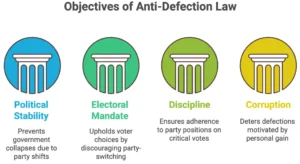
Anitdefection Law in India

Way Forward

  • Independent Tribunal: Shift decisionmaking from Speaker to neutral authority.
  • Mandatory Resignation: MPs/MLAs who defect should resign and seek reelection, ensuring voter accountability.
  • Timebound Disposal: Supreme Court suggested 3month limit for rulings on disqualification.
  • Strengthening Democracy: Balance between party discipline and individual freedom of legislators.

Conclusion:

India’s antidefection law, though designed to ensure stability, has become a tool for political bargaining reforms are essential to protect both democratic accountability and legislative independence.

RIGHT TO PROTEST IN INDIA

TOPIC: (GS2) POLITY: THE HINDU

Recent protests in New Delhi were halted by police before reaching Parliament Street, raising debate on the constitutional right to protest and its regulation under BNSS and CrPC provisions. The issue highlights the balance between citizens’ freedoms and state authority in maintaining public order.

Constitutional Basis

  • Article 19(1)(a): Guarantees freedom of speech and expression.
  • Article 19(1)(b): Grants citizens the right to assemble peacefully without arms.
  • Reasonable Restrictions: Allowed under Article 19(2) & 19(3) for sovereignty, public order, and morality.

Legal Framework

  • Section 163 BNSS: Provides police powers to regulate assemblies and processions.
  • Section 144 CrPC: Authorizes magistrates to impose restrictions in urgent cases of public safety.
  • Judicial View:
    • Mazdoor Kisan Shakti Sangathan v. Union of India (2018): Protests cannot obstruct public rights; designated spaces must be used.
    • Ramlila Maidan Incident (2012): Excessive police force against peaceful protest violates constitutional rights.

Data & Examples

  • Delhi Police (2025): Reported over 1,200 protest events annually, with 40% restricted under Section 144.
  • National Green Tribunal (2017): Prohibited protests at Jantar Mantar Road citing environmental and public nuisance concerns.
  • Mumbai (2024): Over 300 protest permissions denied citing traffic disruption and security risks.

Democratic Dimensions

  • Citizen Participation: Protests reflect active engagement beyond elections; surveys show 62% youth view protests as legitimate democratic tools.
  • Government’s Capacity: State adapts responses based on scale; e.g., farmers’ protests (2020–21) monitored across 750 sites.
  • Media Role: Social media amplifies voices; 74% Indians rely on digital platforms for protest news (Reuters Institute, 2025).

Importance of Right to Protest

  • Citizen Voice: Protests allow citizens to express dissatisfaction beyond elections. Example: Farmers’ protests (2020–21) mobilized millions, forcing government to repeal farm laws.
  • Checks on Power: Acts as a counterbalance to executive authority. Data: Lokniti-CSDS survey (2024) shows 62% youth believe protests are a legitimate way to influence policy.
  • Strengthening Accountability: Governments are reminded of their responsibility to public concerns. Example: Anna Hazare’s 2011 movement pressured Parliament to pass the Lokpal Bill.
  • Inclusive Participation: Provides marginalized groups a platform to highlight grievances. Example: Dalit student protests (2016–17) brought attention to discrimination in higher education.
  • Evolution of Activism: Hybrid activism combines street mobilization with social media campaigns. Meta India report (2025) recorded 40 million protest-related posts during NEET exam leak agitation.

Broader Implications

  • Political Accountability: Protests remind leaders of responsibility to public concerns.
  • Evolution of Activism: Hybrid activism — street mobilization + online campaigns; NEET exam protests saw 40 million social media posts.
  • Global Context: Arab Spring (2011) and Hong Kong (2019) show universal democratic pressures.

Conclusion:

The right to protest is a cornerstone of democracy, but its regulation must ensure a balance between citizens’ freedoms and public order, safeguarding both liberty and stability.

EPFO 3.0, EXPANDING PENSION AND SOCIAL SECURITY TO ALL WORKERS

TOPIC: (GS2) POLITY: THE HINDU

The Employees’ Provident Fund Organisation (EPFO) has announced EPFO 3.0, a new initiative aimed at providing universal pension coverage, including for gig and unorganised sector workers.

What is Provident Fund?

  • Definition: A retirement savings scheme where both employer and employee contribute a fixed percentage of salary to a common fund.
  • Purpose: Provides financial security to employees after retirement or in case of emergencies.
  • Managed in India by the Employees’ Provident Fund Organisation (EPFO) under the Ministry of Labour & Employment.

EPFO Evolution:

    • Established in 1952, the Employees’ Provident Fund Organisation manages provident fund, pension, and insurance schemes for workers in the organised sector.
    • Currently covers 6 crore subscribers, mainly salaried employees.

Need for Reform:

    • Over 90% of India’s workforce is in the unorganised sector, with little or no pension coverage.
    • Rising gig economy workforce — 7.7 million workers (NITI Aayog, 2022) projected to reach 23.5 million by 2030 — lacks social security.
    • Only 12% of Indian workers enjoy formal pension benefits, leaving the majority vulnerable in old age.

Policy Push:

    • EPFO 3.0 aligns with the Code on Social Security, 2020, which mandates extension of benefits to gig and platform workers.
    • Supports India’s commitment to Article 41 of the Constitution (Right to work and social security).
    • Integrates with government schemes like PMShram Yogi Maandhan (PMSYM) and Atal Pension Yojana (APY) to create a unified pension framework.

Features of EPFO 3.0

  • Universal Pension Cover: Pension scheme extended to all categories of workers, including gig and unorganised sector.
  • Target Retirement Sum (TRS): Workers can plan retirement savings with inflationlinked simulations.
  • Gig & Platform Workers: First time EPFO formally includes gig workers (e.g., delivery partners, appbased drivers).
  • TechEnabled Platform: Core Banking Solution (CBS) platform to integrate payments and track contributions.
  • MultiSource Contributions: Funding from workers, employers, and government cocontributions.
  • Family & Survivor Benefits: Ensures dependents receive pension in case of worker’s death.

Data & Context

  • India has 60 crore workers, of which ~50 crore are unorganised.
  • Gig economy employs 7.7 million workers (NITI Aayog, 2022), projected to reach 23.5 million by 2030.
  • Only 12% of Indian workforce currently enjoys formal pension coverage.
  • EPFO already covers 6 crore subscribers, but EPFO 3.0 aims to expand to 10 times that number.

Broader Implications

  • Social Justice: Extends welfare to vulnerable groups, aligning with Article 41 (Right to Work & Social Security).
  • Economic Security: Reduces oldage poverty and dependency.
  • Digital Governance: CBS platform ensures transparency and efficiency.
  • Global Comparison: Similar to Singapore’s CPF and UK’s autoenrolment pension system.

Conclusion:

EPFO 3.0 represents a transformative step in India’s welfare architecture, ensuring that every worker from factory employees to gig workers enjoys the dignity of pension and social security.

RBI’S POLYMER NOTES INITIATIVE

TOPIC: (GS3) ECONOMY: THE HINDU

The Reserve Bank of India (RBI) has initiated a trial project to introduce polymer (plastic) currency notes, aiming to reduce longterm printing costs. This move comes after rising expenditure on printing paper notes, which cost the RBI over ₹52,000 crore in the last decade.

Background

  • High Printing Costs: RBI spent ₹7,965 crore in 2016–17 (demonetisation year). Average annual cost between ₹4,000–6,000 crore in recent years.
  • Note Supply: Around 2,500–2,900 crore notes printed annually. Over the last decade, nearly 26,000 crore notes printed at a cost of ₹52,059 crore.

Features of Polymer Notes

  • Durability: Last 2–6 times longer than paper notes.
  • Cost Efficiency: Reduced replacement frequency lowers overall expenditure.
  • Security: Advanced design makes counterfeiting more difficult.
  • Sustainability: Less paper usage, aligning with ecofriendly goals.

Global Context

  • International Use: Countries like Australia, Canada, UK already use polymer notes.
  • Best Practices: These nations report lower costs and improved security features.

Broader Implications

  • Financial Efficiency: Helps RBI reduce recurring costs.
  • Public Trust: Durable and secure notes strengthen confidence in currency.
  • Policy Linkages: Supports RBI’s modernization agenda and financial inclusion.

Conclusion:

Polymer notes are a costeffective, durable, and secure innovation, strengthening India’s currency system for the future.

ELECTRONIC GOLD RECEIPTS

TOPIC: (GS3) ECONOMY: THE HINDU

The National Stock Exchange (NSE) has launched Electronic Gold Receipts (EGRs), a new exchangetraded segment for buying and selling gold in digital form. This initiative aims to make gold trading more transparent, standardised, and accessible to all categories of investors.

About Electronic Gold Receipts

  • Definition: EGRs are exchangetraded securities representing ownership of physical gold of specified purity stored in SEBIregulated vaults.
  • Holding: Investors hold EGRs in demat accounts, similar to shares.
  • Conversion: Can be converted into physical gold through a prescribed process.
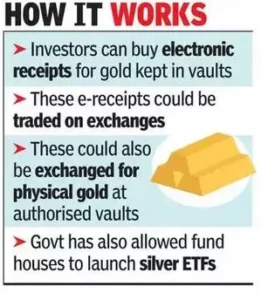
Electric Gold Receipts

Features

  • Trading Mechanism: Operates on a T+1 settlement cycle; receipts credited to buyer’s demat account the next day.
  • Participants: Retail investors, jewellers, bullion traders, refiners, and institutions can participate.
  • Purity Standards: Available in 999 (99.9%) and 995 (99.5%) purity.
  • Denominations: Six denominations — 10 mg, 100 mg, 1 g, 10 g, 100 g, and 1 kg.
  • Transparency: Removes concerns over purity and personal storage.

Significance

  • Investor Confidence: Provides a secure and standardised way to own gold.
  • Market Formalisation: Helps reduce blackmarket transactions and integrates gold into the formal financial system.
  • Financial Inclusion: Enables small investors to buy gold in microdenominations.
  • Policy Linkages: Operates under SEBI guidelines, ensuring regulatory oversight.

Conclusion:

Electronic Gold Receipts mark a transformative reform in India’s gold market, combining the trust of physical gold with the efficiency of digital trading.

ARAL SEA

TOPIC: (GS3) ENVIRONMENT: THE HINDU

A new study reveals that the drying of the Aral Sea has released over 200 teragrams of carbon from exposed sediments, turning a former carbon sink into a greenhouse gas source.

About the Aral Sea

  • Location: Straddles Uzbekistan (south) and Kazakhstan (north), east of the Caspian Sea.
  • Formation: Depression formed in the Neogene Period (23–2.6 million years ago), fed by Syr Darya and Amu Darya rivers.
  • Climate: Harsh desertcontinental climate with hot summers, cold winters, and sharp diurnal variations.
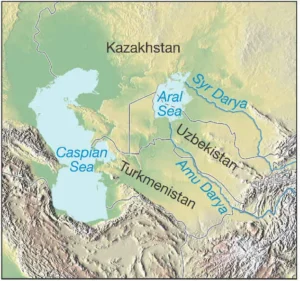
Aral Sea

Shrinking of the Aral Sea

  • Original Size: Once the world’s fourthlargest inland water body, covering 68,000 sq. km.
  • Soviet Diversion: In the 1960s, rivers were diverted for irrigation projects.
  • Rapid Decline: By the 1980s, the sea lost 80% of its volume, leading to collapse of fisheries and biodiversity.
  • Aralkum Desert: Emerged from dried seabed, now a major source of dust storms and carbon emissions.

Ecological & Global Impact

  • Carbon Release: Over 200 teragrams of carbon released, worsening climate change.
  • Health Hazards: Dust storms spread salts and pollutants, causing respiratory diseases in local populations.
  • Economic Loss: Collapse of fishing industry and agricultural decline in surrounding regions.
  • Global Lessons: Shows risks of unsustainable water diversion projects; relevant for India’s riverlinking debates.

Conclusion:

The Aral Sea’s collapse is a stark reminder that unsustainable resource exploitation can transform natural assets into global ecological threats.


INDIA’S FIRST IMMERSIVE LANGUAGE MUSEUM

TOPIC: (GS1) INDIAN ART AND CULTURE: THE HINDU

India’s first immersive language museum, called the Museum of Word (Shabdalok), has been inaugurated at the National Library campus in Kolkata. It highlights India’s linguistic diversity and cultural heritage through interactive, technologydriven exhibits.

About the Museum

  • Location: Situated at the National Library, Kolkata.
  • Developed By: Created under the Union Ministry of Culture.
  • Concept: Designed as an immersive cultural experience rather than a conventional repository.

Key Features

  • Interactive Exhibits: Uses digital displays, holograms, and motionsensor technology.
  • Nine Galleries: Explore facets of language history, scripts, and literature.
  • Evolution of Words: Visitors can trace pronunciation, meaning, and usage changes over centuries.
  • Celebration of Diversity: Showcases India’s 22 official languages, from oral traditions and manuscripts to modern texts.

Significance

  • Cultural Heritage: Preserves India’s rich linguistic traditions and promotes awareness.
  • Educational Value: Helps students and researchers understand evolution of Indian languages.
  • Technology Integration: Demonstrates how digital tools can enhance cultural learning.
  • Global Context: Similar to language museums in Europe and East Asia, but India’s version emphasizes multilingual heritage.

Conclusion:

The Museum of Word is a landmark initiative, blending tradition with technology to celebrate India’s linguistic diversity and strengthen cultural identity.

Write a Review

Your email address will not be published. Required fields are marked *

Seraphinite AcceleratorOptimized by Seraphinite Accelerator
Turns on site high speed to be attractive for people and search engines.