

...

Daily Current Affairs 24-July-2026

Share this Post

POLICE EXCESSES AND JUDICIAL OVERSIGHT

TOPIC: (GS2) POLITY: INDIAN EXPRESS

Allegations of disproportionate police force against student protesters have raised concerns about accountability. The matter reached the Supreme Court, where the Chief Justice of India (CJI) commented on police intervention and judicial time.

Background of Student Protest Issue

Use of Force

    • Student demonstrations in Delhi saw deployment of pellet guns, lathi charges, and tear gas shells.
    • These methods raised concerns about proportionality of police action.
    • Data: NCRB (2024) recorded over 1,200 protestrelated incidents nationwide, with Delhi accounting for nearly 15%.

Judicial Response

    • Lawyers presented video evidence of alleged brutality before the Supreme Court.
    • The Chief Justice of India (CJI) remarked: “We are not interested in videos. Don’t waste our time.”
    • This reflects judicial reluctance to engage with visual evidence in realtime hearings.

Gap Between Citizens and Institutions

    • The episode highlights a trust deficit between protesting citizens and state institutions.
    • Students and civil society groups argue that grievances are not being addressed substantively.
    • Example: Similar concerns were raised during the Ramlila Maidan incident (2012), where the Supreme Court stressed “least invasive methods” in crowd control.

Governance Dimension

    • Police Standing Orders (309 & 152) mandate minimum force and accountability in dispersal of protests.
    • Allegations of excesses suggest noncompliance with established guidelines.
    • Comparative Note: Countries like the UK adopt dialogue policing, focusing on communication rather than coercion.

Police Guidelines

  • Standing Order 309 (Delhi Police): Procedures for dispersing unlawful assemblies.
  • Standing Order 152: Mandates minimum force and proportionality in crowd control.
  • Judicial Precedent: In the Ramlila Maidan Case (2012), the Supreme Court emphasized “least invasive methods” for handling protests.

Issues Raised

  • Excessive Force: Use of pellet guns and tear gas against unarmed students.
  • Accountability Gap: Weak internal review mechanisms for police conduct.
  • Social Media Factor: Videos of police action amplify outrage and global scrutiny.
  • Democratic Deficit: Citizens question whether policing respects Article 19 rights (freedom of speech and peaceful assembly).

Broader Implications

  • Governance: Excessive policing undermines rule of law and public trust.
  • Human Rights: India is bound by UN Basic Principles on Use of Force (1990), which mandate restraint.
  • Comparative Example: Countries like the UK adopt dialogue policing to reduce confrontation.
  • Need for Reform: Calls for independent probes and stronger accountability mechanisms.

Conclusion:

Ensuring fair, restrained, and accountable policing is essential to protect democratic rights and maintain citizens’ trust in institutions.

YOUTH VOICES AND DEMOCRATIC POLITICS AMIDST JANTAR MANTAR STIR

TOPIC: (GS2) POLITY: THE HINDU

On July 20, 2026, thousands of young people gathered at Jantar Mantar, Delhi, protesting issues like the NEET exam controversy and demanding accountability from the Union Education Ministry.

Nature of the Protest

  • The protest was studentdriven and spontaneous, not formally organized by political parties.
  • Participation included students, activists, and ordinary citizens, reflecting broad social concern.
  • Symbolized unity across diverse backgrounds, amplified by social media platforms.
  • Significance: Demonstrates how youth activism can revive democratic debate and challenge institutional inertia.

Political Responses

  • Leaders from ruling and opposition parties engaged with the issue.
  • Prime Minister and senior ministers acknowledged the concerns, while opposition leaders like Rahul Gandhi voiced support for students.
  • Independent voices such as Sonam Wangchuk’s hunger strike added moral weight.
  • Significance: Shows how youth movements influence mainstream political discourse and compel leaders to respond.

Historical Parallels

  • Echoes earlier youthled movements:
    • JP Movement (1970s): Students mobilized against authoritarianism.
    • Anna Hazare’s anticorruption movement (2011): Youth participation reshaped governance debates.
    • Farmers’ protest (2020–21): Demonstrated sustained collective action.
  • Significance: Reinforces the constitutional right to protest under Article 19(1)(a) & (b).

SocioPolitical Impact

  • Revives public discourse on education reforms and accountability.
  • Encourages collective action beyond elections, strengthening democratic culture.
  • Highlights the role of digital platforms in mobilizing youth voices.
  • Example: Similar global movements like Fridays for Future (climate protests) show youth shaping policy debates worldwide.

Way Forward

  • Government must ensure dialogue with student groups to avoid confrontation.
  • Strengthen education governance and transparency in exams.
  • Promote civic education and youth forums to sustain democratic participation.
  • Balance between law and order and citizens’ rights is essential for healthy democracy.

CONSTITUTIONAL BASIS

  • Guaranteed under Article 19(1)(a) – freedom of speech and expression.
  • Protected by Article 19(1)(b) – right to assemble peacefully without arms.
  • Subject to reasonable restrictions under Article 19(2) & 19(3) (public order, sovereignty, morality).

Legal Framework

  • Section 144 CrPC: Magistrates can impose restrictions in urgent cases of public safety.
  • BNSS 2023 provisions: Empower police to regulate assemblies and processions.
  • Judicial View: Supreme Court has upheld peaceful protest as a fundamental right (Ramlila Maidan Case, 2012).

Democratic Significance

  • Acts as a check on government power and ensures accountability.
  • Provides a platform for marginalized voices to be heard.
  • Strengthens citizen participation beyond elections.
  • Example: Farmers’ protest (2020–21) led to repeal of farm laws.

Conclusion:

The Jantar Mantar youth protest of July 2026 underlines that India’s democracy is strongest when young citizens actively demand accountability and shape the national agenda.

PLASTIC CURRENCY NOTES

TOPIC: (GS3) ECONOMY: PIB

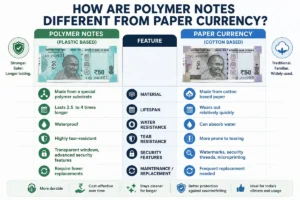
The Reserve Bank of India (RBI) has initiated trials for polymerbased plastic currency notes to replace paper notes. The move aims to reduce printing costs, improve durability, and enhance environmental sustainability.

Background

  • India currently uses cottonbased paper notes, which wear out quickly due to humidity, frequent handling, and soiling.
  • The Bharatiya Reserve Bank Note Mudran Pvt Ltd (BRBNMPL) floated tenders for producing polymer notes.
  • Earlier trials in countries like Australia, Canada, and the UK showed positive results in terms of longevity and cost efficiency.

Economic Advantages

  • Durability: Plastic notes last 2.5–4 times longer than paper notes, reducing replacement frequency.
  • Cost Efficiency: RBI data shows printing costs fell from ₹7,965 crore in FY17 (postdemonetisation) to ₹4,875 crore in FY24.
  • Reduced Supply Pressure: Fewer notes need to be printed annually, easing the burden on printing presses.
  • Example: Australia saved millions annually after shifting to polymer notes in the 1990s.
Plastic Currency Notes

Environmental Benefits

  • Lower Resource Use: Paper notes require cotton and waterintensive processes; polymer reduces this dependency.
  • Recyclability: Wornout polymer notes can be recycled into plastic products, unlike paper notes which are shredded and incinerated.
  • Reduced Carbon Footprint: Longer lifespan means fewer notes printed, cutting emissions from production and transport.

Security Features

  • Polymer notes allow advanced anticounterfeiting features like transparent windows, holograms, and microprinting.
  • Countries using polymer notes report lower counterfeit rates compared to paper notes.
  • Enhances public trust in currency integrity.

Challenges

  • High Initial Cost Polymer notes require greater upfront investment compared to paper notes, making the transition financially demanding in the short term.
  • Infrastructure Adaptation ATMs, vending machines, and cashhandling equipment may need technical recalibration to accept and dispense polymer notes smoothly.
  • Public Familiarity Citizens must adjust to the different texture, flexibility, and handling of plastic notes, which may initially cause hesitation or resistance.

Way Forward

  • Pilot Implementation Begin with limited trials in select regions to test durability, public acceptance, and ATM compatibility before a nationwide rollout.
  • Public Awareness Launch information campaigns to educate citizens about the benefits, handling, and recyclability of polymer notes, ensuring smooth transition.
  • Sustainability Integration Align the introduction of plastic notes with India’s climate commitments under the Paris Agreement, reducing resource use and carbon footprint.
  • Global Collaboration Partner with countries like Australia, Canada, and the UK, which already use polymer notes, to adopt best practices in design, security, and recycling.

Conclusion:

Transitioning to plastic notes can make India’s currency system more durable, costefficient, and ecofriendly, aligning with both economic and environmental priorities.

STATEHOOD AND GOVERNANCE IN JAMMU & KASHMIR

TOPIC: (GS2) POLITY: INDIAN EXPRESS

The issue of restoring statehood to Jammu & Kashmir has resurfaced, with political parties pressing the Centre for clarity. The debate focuses on governance, security, and the Centre’s approach since J&K was downgraded to a Union Territory in 2019.

Background of Statehood Issue

  • Abrogation of Article 370: On 5 August 2019, Article 370 was abrogated through Constitutional Orders C.O. 272 & 273 and the J&K Reorganisation Act, 2019.
    • J&K was split into two Union Territories – Jammu & Kashmir and Ladakh.
    • This marked the end of J&K’s special constitutional status.
    • Data: The region had 87 Assembly seats before reorganisation; delimitation in 2022 increased it to 90 seats.
  • Promise of Statehood Restoration: The Centre assured that statehood would be restored at an appropriate time.
    • In December 2023, the Supreme Court upheld the abrogation of Article 370 but directed the Centre to restore statehood “at the earliest.”
    • Despite repeated assurances, no official timeline has been announced.
  • Political Demands: Local parties like the National Conference (NC) and People’s Democratic Party (PDP) demand immediate restoration.
    • NC leader Omar Abdullah insists “statehood first, Article 370 later,” arguing that without statehood, State List powers remain under Union control.
    • PDP leaders criticize the Centre for “normalising” the abrogation and highlight the democratic deficit due to absence of an elected assembly.
  • Governance Context: Since 2018, J&K has been under Governor’s Rule followed by President’s Rule, and later UT administration.
    • Data: As of 2026, J&K has been without an elected government for 7+ years, the longest period since independence.
    • Panchayat and municipal elections have been held, but Assembly elections remain pending.

Centre concerns on Jammu and Kashmir

  • Security Concerns: Persistent crossborder terrorism and infiltration attempts remain a challenge. In 2025, security agencies recorded 70+ infiltration attempts, with 40 foiled successfully (MHA report).
  • Governance Stability: J&K has been under nonelected governance since 2018, the longest such period since independence. Over 7 years without an elected assembly, raising concerns about democratic deficit.
  • Integration of Central Schemes: Smooth rollout of flagship programmes like PM Development Package (₹80,000 crore, 2015) and Digital India is a priority. By 2025, more than 20,000 km of rural roads and 100+ health projects were completed under central funding.
  • Reforms Before Statehood: The Centre insists security stabilization and governance reforms must precede constitutional changes. The Supreme Court (Dec 2023) upheld abrogation of Article 370 but directed the Centre to restore statehood “at the earliest.”
  • Political Dimensions: Opposition parties argue that prolonged Union Territory status undermines federalism and democratic representation.Example: Similar debates occurred in Delhi and Puducherry, where limited state powers created friction with the Centre.

Governance & Development

  • Focus on infrastructure projects, tourism revival, and employment schemes.
  • Skill development programs and industrial incentives introduced to attract investment.
  • However, absence of an elected assembly raises concerns about accountability and local decisionmaking.

Way Forward

  • Security as the Starter Just like a meal begins with a starter, peace must begin with security stabilization. Tackling crossborder terrorism and infiltration attempts is the first step before moving to political transition.
  • Governance as the Main Course The core of the plate is administrative stability and development. Strong delivery of schemes, infrastructure projects, and transparent governance will build confidence among citizens.
  • Dialogue as the Side Dish Alongside the main course, dialogue acts as the side dish – Centre and regional parties must engage constructively. This reduces alienation and ensures local aspirations are heard.
  • Statehood as the Dessert The sweet ending is a clear roadmap for restoring statehood, balancing national security priorities with constitutional commitments. This will build trust and complete the democratic meal.

Conclusion:

The J&K statehood debate shows that lasting peace and stability require both strong governance and restoration of democratic representation.

UNPRECEDENTED FLOODS IN ASSAM

TOPIC: (GS1) GEOGRAPHY: INDIAN EXPRESS

Severe floods hit Upper Assam districts like Sivasagar, Charaideo, Jorhat, and Golaghat, far from the Brahmaputra’s main course.

Geographical Factors

  • Assam’s topography makes it highly floodprone, with lowlying plains and heavy rainfall.
  • The Brahmaputra River frequently shifts its course, increasing vulnerability.
  • Assam accounts for 40% of India’s floodprone area (Central Water Commission).
  • Sediment deposition reduces river depth, leading to overflow during monsoon.

Climate Change Impact

  • Rising rainfall intensity due to climate variability worsens flood frequency.
  • Data: IMD reports show a 15% increase in extreme rainfall events in Northeast India over the past two decades.
  • Melting Himalayan glaciers add to water flow, aggravating flood risks.

Infrastructure & Embankment Failures

  • Embankments built to control floods often fail due to poor maintenance.
  • Data: Assam has over 5,000 km of embankments, many breached repeatedly since the 1990s.
  • Lack of coordination between agencies delays repair and preparedness.

Humanitarian Impact

  • Thousands displaced, agricultural land submerged, and livelihoods disrupted.
  • Data: Over 2 lakh people affected in 2026 floods (State Disaster Management Authority).
  • Schools and health centres face closure, worsening social distress.

Way Forward

  • Strengthen forecasting systems with IMD and ISRO satellite data.
  • Improve embankment design and maintenance using modern engineering.
  • Enhance interstate coordination between Assam and Nagaland for water management.
  • Promote communitybased disaster preparedness and resilient infrastructure.
  • Integrate climate adaptation strategies into state planning.

BRAHMAPUTRA RIVER

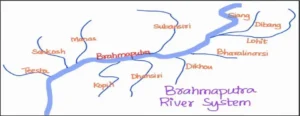
The Brahmaputra River is one of Asia’s most powerful rivers, stretching nearly 2,900–3,080 km across Tibet, India, and Bangladesh. It is known for its massive discharge, frequent floods, and unique geographical features like the Yarlung Tsangpo Grand Canyon and Majuli Island, the world’s largest river island.
Brahmaputra River

Facts about the Brahmaputra River

Origin

    • Source: Chemayungdung/Angsi Glacier near Mount Kailash in Tibet.
    • Elevation: ~5,210 m (17,090 ft).
    • Known as Yarlung Tsangpo in Tibet.

Course

    • Flows eastward in Tibet for ~1,600 km, then plunges through the Yarlung Tsangpo Grand Canyon (deepest canyon on Earth, ~5,382 m).
    • Enters India at Arunachal Pradesh (called Siang/Dihang), flows through Assam as the Brahmaputra.
    • In Bangladesh, it is called the Jamuna, merging with the Ganga (Padma) before emptying into the Bay of Bengal.

Length & Basin

    • Total length: 2,880–3,080 km.
    • Basin size: ~625,000 km², covering Tibet, India, Bhutan, and Bangladesh.
    • Width in Assam: Can exceed 10 km during floods, resembling an inland sea.

Discharge & Floods

    • Average discharge at confluence with Ganga: 21,000–27,000 m³/s, making it the 9th largest river by discharge globally.
    • Known for braided channels and frequent floods due to heavy rainfall and sediment load.
    • Data: Assam alone accounts for 40% of India’s floodprone area (Central Water Commission).

Unique Features

    • Majuli Island in Assam: World’s largest river island, though shrinking due to erosion.
    • Carries enormous sediment load, reshaping landscapes and creating new sandbars (chars).
    • Supports rich biodiversity, including Gangetic dolphins and wetlands crucial for migratory birds.

Economic & Cultural Importance

    • Vital for irrigation, inland navigation, fisheries, and hydropower projects.
    • Cultural significance in Assam, with festivals and settlements along its banks.
    • Strategic importance for India’s Act East Policy and connectivity with Bangladesh.

The Brahmaputra is both a lifeline and a challenge, providing fertile soil and water resources while causing devastating floods, making it central to India’s geography, economy, and disaster management strategies.


Conclusion:

Assam’s floods highlight that climate change, weak infrastructure, and poor coordination together demand urgent reforms in flood management and disaster resilience.

THE GREEN WE CELEBRATE, THE FORESTS WE FELL

TOPIC: (GS3) ENVIRONMENT: THE HINDU

Uttarakhand witnessed protests against largescale tree felling for infrastructure projects. The debate gained attention during the Harela festival, which celebrates greenery, highlighting the irony of celebrating nature while destroying forests.

Background

  • Expansion of roads, hydropower projects, and urban growth has led to rapid deforestation.
  • Local communities and activists argue that forest loss threatens wildlife corridors and water security.
  • The contradiction between cultural reverence for nature and development pressures is stark.

Ecological Concerns

  • Loss of Biodiversity: Habitat destruction affects species like snow leopards, Himalayan black bears, and pheasants.
  • Soil Erosion & Landslides: Deforestation destabilizes fragile Himalayan slopes.
  • Data: Uttarakhand reported over 1,000 landslides annually (NDMA, 2024).
  • Water Security: Forests regulate springs and rivers; their depletion worsens water scarcity.

Cultural Dimension

  • Harela Festival: Celebrated in July, symbolizes prosperity and green cover.
  • Irony: While communities plant saplings during Harela, government projects simultaneously clear thousands of trees.
  • Example: Similar contradictions seen in Arunachal Pradesh, where festivals celebrate forests but hydro projects cut them down.

Governance & Policy Issues

  • Forest Conservation Act (1980): Requires clearance for diversion of forest land.
  • CAMPA Funds: Allocated for afforestation, but utilization remains weak.
  • Data: India diverted over 1.2 lakh hectares of forest land between 1980–2020 (MoEFCC).
  • Lack of community participation in decisionmaking deepens mistrust.

Way Forward

  • Strengthen environmental impact assessments before approving projects.
  • Promote ecosensitive infrastructure using natural materials and sustainable designs.
  • Encourage communityled afforestation and integrate festivals like Harela into conservation campaigns.
  • Enhance wildlife corridor protection to balance development with ecology.
  • Adopt climateresilient policies, aligning with India’s National Action Plan on Climate Change (NAPCC).

CHIPKO ANDOLAN

Origin in Uttarakhand

    • Began in the 1970s in Chamoli district (then Uttar Pradesh, now Uttarakhand).
    • Villagers, led by activists like Sunderlal Bahuguna and Chandi Prasad Bhatt, hugged trees to prevent commercial logging.

Community Participation

    • Women played a central role, as forests were vital for fuel, fodder, and water security.
    • Symbolic act of embracing trees gave the movement its name “Chipko” (to cling).

Impact on Policy

    • Raised awareness about ecological balance and sustainable development.
    • Influenced government decisions, including a 15year ban on green felling in Himalayan forests (1980) announced by then PM Indira Gandhi.

Legacy & Relevance

    • Became a model for environmental activism in India, inspiring movements like Appiko in Karnataka.
    • Linked to broader goals of forest conservation, climate resilience, and community rights under later laws like the Forest Rights Act (2006).

Conclusion:

Uttarakhand’s case shows that true prosperity lies not in felling forests for growth, but in preserving them as the foundation of sustainable development.

US–SAUDI NUCLEAR DEAL

TOPIC: (GS2) INTERNATIONAL RELATIONS: THE HINDU

The US and Saudi Arabia discussed cooperation on a civilian nuclear program, raising concerns about nuclear proliferation in West Asia. The deal is linked to the “123 Agreement” under the US Atomic Energy Act (1954), which governs nuclear partnerships.

Background

  • Saudi Energy Diversification Saudi Arabia wants nuclear energy to reduce oil dependence and meet rising electricity demand.
  • US Strategic Interests The US seeks to counter China and Russia’s growing influence in the Middle East nuclear sector.
  • Regional Security Concerns Israel fears losing its nuclear edge, while Iran warns of a possible arms race if Riyadh gains nuclear capability.
  • Legal Framework The deal falls under the 123 Agreement (US Atomic Energy Act, 1954), requiring peaceful use of nuclear technology and IAEA safeguards.
  • Saudi Vision 2030 Nuclear power is part of Saudi Arabia’s Vision 2030 strategy, aimed at diversification and sustainability.
  • Global Energy Transition Nuclear energy is seen as a cleaner alternative to fossil fuels, aligning with global climate commitments.
  • Comparative Example India’s 2008 Civil Nuclear Agreement with the US shows how nuclear deals balance energy needs with nonproliferation norms.

Challenges

  • Proliferation Risk: Fear that civilian nuclear technology could be diverted for military use.
  • Regional Tensions: Iran–Saudi rivalry may intensify if Riyadh gains nuclear capability.
  • Strategic Balance: Israel worries about erosion of its nuclear edge in the region.
  • Global Competition: China and Russia already offer nuclear cooperation to Saudi Arabia, challenging US dominance.

Legal & Policy Framework

  • 123 Agreement: Requires partner nations to commit to peaceful use of nuclear technology.
  • IAEA Safeguards: Saudi Arabia must allow inspections to ensure compliance.
  • Example: India–US Civil Nuclear Agreement (2008) also followed Section 123 rules, balancing energy needs with nonproliferation commitments.

Geopolitical Dimensions

  • US Interests: Strengthen ties with Saudi Arabia, reduce Chinese/Russian influence.
  • Saudi Strategy: Diversify energy, gain leverage in regional politics.
  • Iran Factor: Tehran may accelerate its nuclear program, citing security concerns.
  • Global Energy Transition: Nuclear power seen as a cleaner alternative to fossil fuels, aligning with climate goals.

Way Forward

  • Strict IAEA Monitoring Ensure robust inspections and safeguards under the International Atomic Energy Agency (IAEA) to prevent diversion of nuclear material for weapons.
  • Regional Dialogue Promote confidencebuilding measures among West Asian nations to enhance nuclear safety, transparency, and reduce mistrust.
  • Balance Cooperation & NonProliferation Align nuclear energy cooperation with global nonproliferation commitments, ensuring compliance with the NPT framework.
  • Encourage Renewable Alternatives Invest in solar and wind energy projects alongside nuclear power to diversify energy sources and reduce proliferation risks.
  • Strengthen Legal Frameworks Push Saudi Arabia to adopt the IAEA Additional Protocol for intrusive inspections, ensuring transparency in nuclear activities.

Conclusion:

The US–Saudi nuclear deal reflects the delicate balance between energy security, geopolitical rivalry, and global nonproliferation norms, demanding cautious and transparent implementation.

DRDO’S ‘KUSHA’ MISSILE TEST

TOPIC: (GS3) SEQURITY: INDIAN EXPRESS

The Defence Research & Development Organisation (DRDO) successfully conducted the maiden flight test of ‘Kusha’, India’s longrange surfacetoair missile system.

About Kusha Missile System

  • Designed to counter fighter aircraft, ballistic missiles, and unmanned aerial vehicles.
  • Range: up to 400 km, comparable to advanced global systems.
  • Tested against an electronic target simulating highspeed aerial threats.
  • Part of India’s multilayered air defence architecture, complementing systems like Akash, Barak8, and S400 Triumf.
  • The test was carried out at APJ Abdul Kalam Island, Odisha, marking a major step in India’s selfreliance in air defence.

Strategic Significance

  • Reduces dependence on imported systems such as Russia’s S400.
  • Strengthens protection of strategic military bases and civilian assets.
  • Enhances India’s capability in deterrence and homeland security.
  • Supports the vision of Atmanirbhar Bharat in defence manufacturing.

Broader Defence Context

  • India is building a multilayered air defence shield, including:
    • Akash missile system (shortrange).
    • Barak8 (mediumrange, IndoIsrael collaboration).
    • Directed energy weapons under development.
  • Aligns with Defence Production and Export Promotion Policy (DPEPP 2020) to boost indigenous R&D and exports.

Way Forward

  • Rigorous Testing & Deployment: Gradual deployment across strategic zones like the Western and Eastern borders will strengthen layered defence. Data: India currently faces 350+ aerial incursions annually (IAF records), highlighting the urgency of operational readiness.
  • TriService Integration: This ensures a 360degree shield against fighter aircraft, drones, and cruise missiles. Example: The US Patriot & Aegis systems achieve similar joint force interoperability.
  • Export & Defence Diplomacy: Position Kusha as a strategic export product under Make in India and DPEPP 2020. Target friendly nations in South Asia, Africa, and ASEAN seeking costeffective longrange defence systems. Data: India’s defence exports crossed ₹21,000 crore in FY 2023–24, showing strong global demand for indigenous systems.
  • NextGen Innovation: Invest in hypersonic missile technology, AIenabled threat detection, and directed energy weapons. Collaboration with DRDO labs, IITs, IISc, and private startups will accelerate innovation. Global Benchmark: China and Russia are already testing hypersonic glide vehicles; India must match pace to maintain deterrence.

Conclusion:

The successful test of Kusha marks India’s decisive move towards a selfreliant, multilayered air defence system, strengthening national security and global standing.

Write a Review

Your email address will not be published. Required fields are marked *

Seraphinite AcceleratorOptimized by Seraphinite Accelerator
Turns on site high speed to be attractive for people and search engines.