Table of Contents
ToggleZonal Councils
Zonal Councils serve as vital statutory bodies established to promote inter-state cooperation and coordination across regional divisions in India. Understanding Zonal Councils UPSC concepts is essential for aspirants mastering Centre State Relations, preparing Zonal Councils Notes, and building high-scoring UPSC Polity Notes on Cooperative Federalism.
What are Zonal Councils & Establishment
Unlike constitutional bodies, Zonal Councils in India are statutory bodies created under Part III of the States Reorganisation Act 1956. Envisaged by Prime Minister Jawaharlal Nehru, they were established to arrest the growth of acute state-consciousness, regionalism, and linguistic chauvinism following the reorganization of states.
Composition and Classification of Zonal Councils
The Composition of Zonal Councils ensures balanced representation between the Union and the States:
- Chairman of Zonal Councils: The Union Home Minister acts as the ex-officio Chairman of all Zonal Councils.
- Members: Chief Ministers and two other ministers nominated by the Governor from each member state, along with the Administrator of each Union Territory in the zone.
- Advisors: A nominee of the NITI Aayog, Chief Secretaries, and Development Commissioners of member states (without voting rights).
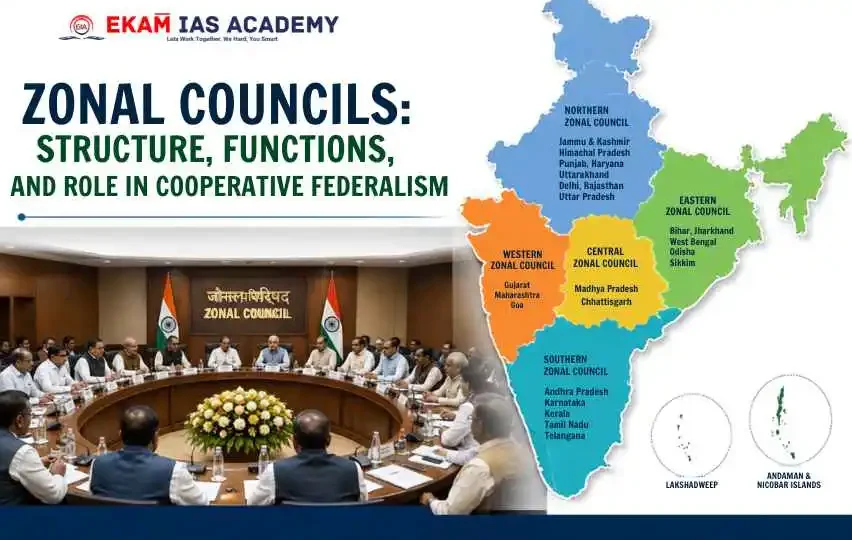
Under the States Reorganisation Act 1956, five Regional Councils India were formed: Northern, Southern, Eastern, Western, and Central Zonal Councils.
Zonal Councils Functions and Importance
Key Zonal Councils Functions operate under the administrative domain of the Ministry of Home Affairs Zonal Councils:
- Discussing matters of common interest in socio-economic planning, border disputes, linguistic minorities, and inter-state transport.
- Fostering Interstate Cooperation in India and advisory consensus on regional development.
- Strengthening Indian Federalism by facilitating emotional integration and resolving inter-state friction.
Comparative Analysis: Zonal Councils vs Other Bodies
- Zonal Councils vs Inter-State Council: While Zonal Councils are statutory bodies under the 1956 Act, the Inter State Council is a constitutional body established under Article 263.
- Zonal Councils vs North Eastern Council: The North Eastern Council was created under a separate statutory act—the North Eastern Council Act, 1971—to address the unique security and developmental needs of the northeastern states.
Challenges Faced, Way Forward
Despite their potential, challenges such as irregular meetings, non-binding advisory recommendations, and delayed implementation of decisions affect their efficacy. To strengthen Zonal Council Indian Polity dynamics, meetings should be institutionalized regularly, and recommendations should be backed by formal follow-up mechanisms.
Conclusion
In conclusion, Zonal Councils remain an indispensable tool for promoting Cooperative Federalism and national integration. Mastering these structural nuances provides a solid foundation for answering Zonal Councils MCQs, writing Zonal Councils Mains Notes, and understanding the Indian Constitution UPSC framework.
UPSC Prelims: PYQs & Practice Questions
Previous Year Questions (Prelims)
Q: With reference to India, consider the following bodies:
1. The Inter-State Council
2. The National Security Council
3. Zonal Councils
How many of the above were established as per the provisions of the Constitution of India?
(a) Only one
(b) Only two
(c) All three
(d) None
Answer: (a) Only one
Explanation:
Inter-State Council: It is provided for under
Article 263 of the Constitution and is therefore a constitutional body.
National Security Council: It was constituted in 1998 through an executive order and is therefore an
executive body.
Zonal Councils: They were established under the
States Reorganisation Act, 1956 and are therefore statutory bodies.
Hence, only the Inter-State Council was established under a constitutional provision.
Q: Which of the following bodies does/do
not find mention in the Constitution of India?
1. National Development Council
2. NITI Aayog, formerly the Planning Commission
3. Zonal Councils
Select the correct answer using the code given below:
(a) 1 and 2 only
(b) 2 only
(c) 1 and 3 only
(d) 1, 2 and 3
Answer: (d) 1, 2 and 3
Explanation:
National Development Council: It was created through an executive resolution in August 1952 and was an executive body.
NITI Aayog and the Planning Commission: Both were established through executive resolutions and are not constitutional bodies.
Zonal Councils: They were created under the
States Reorganisation Act, 1956 and are statutory bodies.
Therefore, none of these three bodies finds mention in the Constitution of India.
Practice Questions
Q: Consider the following statements regarding Zonal Councils in India:
1. The Prime Minister acts as the ex-officio Chairman of all five Zonal Councils.
2. The Chief Ministers of the member States act as Vice-Chairmen of the Council by rotation for a period of one year at a time.
3. The decisions made by Zonal Councils are legally binding on all member States.
Which of the statements given above is/are correct?
(a) 1 and 2 only
(b) 2 only
(c) 2 and 3 only
(d) 1, 2 and 3
Answer: (b) 2 only
Explanation:
Statement 1 is incorrect. The
Union Home Minister, not the Prime Minister, serves as the ex-officio Chairman of all five Zonal Councils.
Statement 2 is correct. The Chief Ministers of the member States act as Vice-Chairmen of the respective Zonal Council by rotation, holding office for
one year at a time.
Statement 3 is incorrect. Zonal Councils are
deliberative and advisory bodies. Their recommendations are not legally binding on the member States.
Q: With reference to the regional councils in India, consider the following statements:
1. The North Eastern Council was created as the sixth zone under the States Reorganisation Act, 1956.
2. Union Territories located within a zone are represented in the respective Zonal Council.
Which of the statements given above is/are correct?
(a) 1 only
(b) 2 only
(c) Both 1 and 2
(d) Neither 1 nor 2
Answer: (b) 2 only
Explanation:
Statement 1 is incorrect. The North Eastern States are not covered under the five Zonal Councils created by the
States Reorganisation Act, 1956.
They are served by a separate statutory body called the
North Eastern Council, established under the
North Eastern Council Act, 1971.
Statement 2 is correct. Union Territories situated within a geographical zone are represented in the respective Zonal Council through their
Administrator or Lieutenant Governor.
UPSC Mains – Previous Year & Practice Questions
Mains Previous Year Questions
[15 Marks | 250 Words]
Question: While the Inter-State Council provides a constitutional platform for resolving inter-state friction, Zonal Councils offer a statutory framework for regional development and coordination. Compare and contrast the roles and effectiveness of both mechanisms in fostering Cooperative Federalism.
[10 Marks | 150 Words]
Question: How far have the Zonal Councils succeeded in achieving the objectives of emotional integration and inter-state coordination in post-independence India? Discuss with recent examples. (UPSC CSE Mains 2020, GS Paper II)
[10 Marks | 150 Words]
Question: The Union Home Minister presides over meetings of the Zonal Councils. In this context, evaluate their mandate in bridging Centre-State political divides and maintaining administrative coherence. (UPSC CSE Mains 2018, GS Paper II)
[12.5 Marks | 200 Words]
Question: Cooperative Federalism in India is frequently tested by inter-state border disputes and water-sharing conflicts. Examine how institutional mechanisms such as Zonal Councils function as platforms for conflict resolution. (UPSC CSE Mains 2015, GS Paper II)
[10 Marks | 150 Words]
Question: Discuss the composition and functions of Zonal Councils. Are they effective instruments of federal harmony, or have they remained mere deliberative forums? (UPSC CSE Mains 2013, GS Paper II)
Mains Practice Questions
[15 Marks | 250 Words]
Question: Zonal Councils were envisaged by Jawaharlal Nehru as instruments to counter state chauvinism and provincialism. To what extent have they succeeded in fulfilling this structural mandate? Critically evaluate.
[10 Marks | 150 Words]
Question: The creation of the North Eastern Council through a separate statutory enactment reflects the unique developmental requirements of North-Eastern India. Compare its mandate and functional autonomy with those of the five standard Zonal Councils.
[15 Marks | 250 Words]
Question: Despite their potential for regional planning, inter-state coordination and security cooperation, Zonal Councils are constrained by irregular meetings and non-binding recommendations. Suggest actionable reforms to institutionalise them as stronger instruments of competitive-cooperative federalism.



Zonal Councils-FAQs
What are Zonal Councils?
Zonal Councils are statutory bodies created to promote cooperation and coordination among states grouped into different regional zones.
Are Zonal Councils constitutional bodies?
No. Zonal Councils are statutory bodies created under the States Reorganisation Act, 1956.
Who is the Chairman of Zonal Councils?
The Union Home Minister acts as the ex-officio Chairman of all Zonal Councils.
What is the main function of Zonal Councils?
Their main function is to discuss common regional issues such as border disputes, inter-state transport, linguistic minorities, socio-economic planning and regional development.
Why are Zonal Councils important for UPSC?
They are important because they connect Centre-State relations, cooperative federalism, regional coordination, Indian federalism and inter-state dispute resolution.