

Table of Contents
ToggleSC/ST (PREVENTION OF ATROCITIES) ACT, 1989 AND REHABILITATION
TOPIC: (GS2) SOCIAL JUSTICE AND HEALTH: THE HINDU
A Central Task Force and the National Commission for Scheduled Tribes (NCST) have proposed changes to strengthen the SC/ST (Prevention of Atrocities) Act, 1989, including higher compensation, counselling support, and protection of tribal livelihoods.
About the Act
- Purpose: Enacted in 1989, effective from 1990, to prevent atrocities against SC/ST communities, provide relief, and ensure rehabilitation.
- Scope: Recognises violence, humiliation, dispossession, and exploitation linked to caste/tribal identity.
- Safeguards: Goes beyond general criminal law by establishing special courts, prosecutors, victim protection, and preventive measures.
Key Features
- Identifies offences such as physical violence, social discrimination, land dispossession, and denial of dignity.
- Provides for Exclusive Special Courts for speedy trials.
- Ensures relief and rehabilitation for victims and dependents.
- Mandates protection of witnesses and accountability of officials.
Amendments
- 2015: Expanded offences, strengthened victim rights, introduced presumption clauses, and mandated accountability of public servants.
- 2018: Restored provisions after SC judgment — no prior approval for arrest and anticipatory bail restricted, ensuring stronger safeguards.
Current Proposals
- Task Force Recommendations:
- Increase relief amounts (currently ₹85,000–₹8.25 lakh, fixed in 2016).
- Establish special relief and rehabilitation cells in States/UTs.
- Introduce counselling mechanisms for victims and dependents.
- Ensure FIRs and chargesheets reach officials within 24 hours for faster monitoring.
- NCST Suggestions:
- Protect tribal land and livelihoods from alienation.
- Prevent counter FIRs against atrocity complainants.
- Strengthen socioeconomic security alongside criminal justice.
Parliamentary Committee Observations
- Highlighted delays in scholarship disbursal for SC/OBC students due to slow verification by States.
- Recommended revising the ₹8 lakh income ceiling for free coaching schemes.
- Pointed out inadequate special police stations under the Act — only 7 States/UTs have them.
- Urged early approval of budget proposals for strengthening implementation (2026–31 cycle).
Significance
- Effective implementation requires timely compensation, institutional capacity, efficient policing, and victim support.
- The proposals reflect a rightsbased approach, focusing not only on punishment but also on rehabilitation and socioeconomic protection.
- Comparative perspective: Similar victimcentric laws exist globally, e.g., Civil Rights Act (USA), but India’s framework uniquely integrates criminal justice with welfare delivery.
Conclusion
Strengthening the SC/ST Act through enhanced relief, livelihood protection, and institutional reforms is vital to ensure that social justice moves from statutory promise to lived reality.
NATIONAL CHILD SURVEY AND CHILD WELL-BEING INDEX
TOPIC: (GS2) POLITY: THE HINDU
The Ministry of Statistics and Programme Implementation (MoSPI) and the Ministry of Women and Child Development (MoWCD) have collaborated to launch a National Child Survey under Mission Vatsalya, aiming to create India’s first Child Well-being Index to assess the status of children across states.
Policy Framework for Child Welfare
- The initiative stems from the need for data-driven child welfare policies.
- India has multiple schemes for children. Mission Vatsalya, Poshan Abhiyaan, Saksham Anganwadi, and PM CARES for Children, but lacks a unified national database.
- The survey will cover health, nutrition, education, safety, and social inclusion indicators.
- It aligns with UNICEF’s global child development frameworks and India’s National Policy for Children (2013).
Objectives of the National Child Survey
- Data Integration: Combine child-related data from different ministries for a holistic view.
- Child Index Creation: Develop a composite index ranking states on child welfare parameters.
- Policy Support: Help design targeted interventions under Mission Vatsalya.
- Monitoring Progress: Track outcomes of schemes like Poshan 2.0 and Samagra Shiksha.
Mission Vatsalya
- Implemented by MoWCD, Mission Vatsalya focuses on child protection and welfare.
- It supports Child Care Institutions (CCIs), adoption agencies, and juvenile justice systems.
- The new survey will strengthen its evidence base for better resource allocation.
Dimensions of the Child Index
- Health & Nutrition: Immunization, malnutrition rates, access to healthcare.
- Education: Enrollment, learning outcomes, dropout rates.
- Safety & Protection: Child labour, trafficking, abuse prevention mechanisms.
- Social Inclusion: Access for children with disabilities and marginalized groups.
- Digital Access: Use of technology in education and protection services.
Significance
- Policy Alignment: Supports India’s SDG commitments (Goal 3, 4, 5, and 10).
- Inter-Ministerial Coordination: Encourages collaboration between MoWCD, MoSPI, and NITI Aayog.
- State Ranking: Promotes competition among states to improve child welfare outcomes.
- Evidence-based Governance: Strengthens accountability and transparency in child-related schemes.
Challenges
- Data Accessibility: Collecting reliable information from remote villages and informal urban settlements remains difficult due to poor connectivity and lack of records.
- Human Resource Capacity: Requires welltrained enumerators and uniform survey methods to ensure accuracy and comparability across states.
- Digital Integration: Harmonising data systems across multiple ministries is a challenge, as platforms often work in silos without interoperability.
- Data Privacy: Safeguarding children’s personal information is critical; ethical use of data must be ensured to prevent misuse or breaches.
CHILD LABOUR
Child labour refers to the employment of children below the legal age in work that harms their physical, mental, or moral development.
Constitutional Safeguards:
- Article 24: Prohibits employment of children below 14 years in factories, mines, or hazardous occupations.
- Article 39(e) & (f): Directs the State to ensure children are not abused and receive opportunities for healthy development.
Statutory Framework:
- The Child Labour (Prohibition and Regulation) Amendment Act, 2016 bans child labour under 14 years and regulates adolescent work (14–18 years) in nonhazardous sectors.
- Linked with Right to Education Act, 2009, ensuring compulsory schooling for children aged 6–14.
Institutional Mechanisms:
- National Child Labour Project (NCLP) provides rehabilitation and education for rescued children.
- Mission Vatsalya integrates protection and rehabilitation through district child protection units.
Conclusion
The National Child Survey and Child Index under Mission Vatsalya mark a transformative step toward evidence-based child welfare governance, ensuring every child’s well-being is measured, monitored, and improved.
RUSSIA’S OIL SHARE IN INDIA AND STRATEGIC CONCERNS
TOPIC: (GS2) INTERNATIONAL RELATIONS: THE HINDU
India’s oil imports from Russia touched an alltime high of 48% in June 2026, despite the U.S. Senate passing a bill proposing 100% tariffs on top importers of Russian oil.
Recent Trends
- Import Volume: India imported 8.7 MMT of Russian oil in June 2026, 25% higher than June 2025.
- Overall Imports: Total crude imports fell to 18.2 MMT, down 16.5% from May 2026.
- Price Dynamics: Import bill was 40% higher yearonyear, despite lower volumes, due to elevated global crude prices.
- Discount to Premium Shift: Russia moved from offering discounts earlier in 2026 to charging a small premium, though steadily declining ($77.7/tonne in April → $10.6/tonne in June).
U.S. Tariff Threat
- The Sanctioning Russia and Iran Act (2026) proposes tariffs up to 100% on countries among the top five importers of Russian oil.
- India qualifies under this criterion, alongside China.
- The bill awaits passage in the U.S. House of Representatives before becoming law.
Strategic Dimensions
- Energy Security: India’s dependence on Russia rose due to disruptions in Gulf supplies after the Strait of Hormuz crisis.
- Diversification Strategy: Petroleum Ministry clarified India uses shiptoship transfers via Red Sea routes to avoid single choke points.
- Global Context: Similar concentration seen with UAE, which now accounts for 17.5% of India’s imports, making Russia + UAE nearly twothirds of India’s oil basket.
- Policy Linkages: India’s stance reflects balancing Atmanirbhar Bharat energy goals with external pressures.
Challenges in India’s Rising Oil Dependence
- Sanctions Risk: India faces exposure to possible U.S. sanctions and tariffs under proposed legislation targeting top importers of Russian oil, which could impact trade and diplomatic relations.
- OverDependence: Heavy reliance on Russia and UAE for crude imports creates vulnerability, as nearly twothirds of India’s oil basket now comes from these two countries.
- Diversification Imperative: Longterm energy security requires diversification into renewables, strategic petroleum reserves, and alternative suppliers to reduce geopolitical risks.
- Price Volatility: Managing fluctuations in global crude prices is a challenge, as it directly affects India’s import bill, inflation, and fiscal stability.
Way Forward
- Diversification of Sources: India must reduce reliance on Russia and Gulf suppliers by expanding imports from Africa (Nigeria, Angola), Latin America (Brazil, Venezuela), and exploring Central Asian pipelines.
- Strategic Petroleum Reserves: Expanding reserves beyond the current ~5.3 MMT capacity is vital to cushion against global supply shocks. Countries like China and Japan maintain far larger reserves, offering lessons for India.
- Renewable Energy Push: Accelerating solar, wind, and green hydrogen projects under National Hydrogen Mission and International Solar Alliance will reduce longterm crude dependence.
- Domestic Production Boost: Enhancing exploration in KG Basin, Rajasthan fields, and offshore blocks through private investment and technology partnerships can strengthen selfreliance.
Conclusion
India’s record reliance on Russian oil highlights the tension between energy security and geopolitical risks, making diversification and resilience the only sustainable path forward.
MERCHANT DISCOUNT RATE (MDR) ON UPI
TOPIC: (GS3) ECONOMY: THE HINDU
The government has proposed a nominal Merchant Discount Rate (MDR) on select UPI transactions above a threshold, while keeping persontoperson transfers and small merchant payments free.
Merchant Discount Rate
- MDR is the fee charged to merchants when they accept digital payments from customers.
- Payment Chain: The fee covers costs of multiple players, banks, card networks (Visa, RuPay, Mastercard), payment gateways, and processors — who enable the transaction.
- Components: MDR includes:
- Interchange fee (charged by issuing banks).
- Processor fee (charged by payment processors like Razorpay).
- Assessment fee (charged by card networks).
- Fraud prevention/extra service charges.
- Rate Range: Usually 1–3% of the transaction value, deducted before the merchant receives the payment settlement.
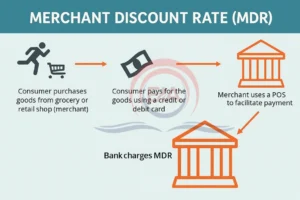
MDR and UPI
- Launch Phase (2016): MDR applied to UPI transactions initially.
- Zero MDR Policy (2020): Government removed MDR on UPI and RuPay debit cards to promote digital payments.
- Industry Impact: Banks, NPCI, and fintechs earned nothing per transaction, government compensated them via subsidies.
- Recent Amendment (2026): The Taxation and Other Laws (Amendment) Bill empowers government to levy MDR of 0.25–0.4% on businessrelated UPI transactions above a threshold.
Features of New Proposal
- Nominal Rate: Much lower than debit/credit card MDRs.
- Limited Scope: Applies only to merchant transactions above a certain value.
- Consumer Protection: Persontoperson transfers remain free.
- Small Merchants: Transactions below threshold exempt to safeguard small businesses.
Key Aspects of MDR Policy
- Digital Push: MDR reforms are designed to strengthen Digital India and promote a cashless economy, ensuring wider adoption of electronic payments across all sectors.
- Revenue Model: Introducing a nominal MDR provides sustainable funding for banks, NPCI, and fintechs that maintain UPI infrastructure, reducing reliance on government subsidies.
- Global Comparison: Countries like Singapore and UK levy small fees on digital transactions. India’s proposed MDR remains lower, reflecting its focus on affordability and inclusion.
Conclusion
The MDR reform seeks to balance digital adoption with financial sustainability, ensuring UPI remains free for individuals while creating a viable ecosystem for merchants and payment providers.
DIRAC MEDAL
TOPIC: (GS3) SCIENCE AND TECHNOLOGY: THE HINDU
Indian physicist Deepak Dhar from Uttar Pradesh has been named a corecipient of the Dirac Medal 2026, awarded by the International Centre for Theoretical Physics (ICTP).
Dirac Medal
- Origin: Instituted in 1985 to honour P.A.M. Dirac, one of the greatest theoretical physicists of the 20th century.
- Awarding Body: Conferred annually by the ICTP, Trieste (Italy), a UNESCO Category1 institute.
- Date: Presented on August 8, Dirac’s birthday.
- Eligibility: Recognises scientists for outstanding contributions to theoretical physics. Nobel, Fields, or Wolf Prize winners are excluded, though many medallists later received those honours.
- Prize: Includes a US $5,000 cash award along with the medal.

Selection Process
- Winners are chosen by an international committee of eminent scientists.
- Candidates are nominated globally, ensuring transparency and recognition of diverse contributions.
International Centre for Theoretical Physics (ICTP)
- Founded in 1964 under a tripartite agreement between the Italian Government, UNESCO, and IAEA.
- Functions as a hub for research and training in physical and mathematical sciences.
- Promotes collaboration between scientists from developing and developed countries, strengthening global scientific networks.
Significance for India
- Deepak Dhar’s recognition highlights India’s growing presence in global theoretical physics.
- Builds on India’s legacy of contributions by scientists like C.V. Raman, Satyendra Nath Bose, and Meghnad Saha.
- Encourages young researchers to pursue fundamental science, crucial for innovation and national progress.
Conclusion
The Dirac Medal exemplifies how scientific excellence transcends borders, and Deepak Dhar’s achievement reinforces India’s stature in global theoretical physics.
80TH INDEPENDENCE DAY CELEBRATIONS AND VANDE MATARAM
TOPIC: (GS2) POLITY: THE HINDU
On India’s 80th Independence Day, Prime Minister Narendra Modi addressed the nation from the Red Fort, highlighting “Yuva Shakti” (power of youth) and invoking Vande Mataram as a symbol of national unity and cultural pride.
Background
- The Independence Day address from the Red Fort is a tradition since Jawaharlal Nehru’s “Tryst with Destiny” speech in 1947.
- This year marks the 80th anniversary of independence, making it a milestone celebration.
- The Prime Minister emphasized the role of youth in nation-building, linking it to India’s demographic advantage.
- The slogan “Vande Mataram”, historically tied to the freedom struggle, was used to inspire collective responsibility.
Highlights of the Address
- Youth Empowerment: PM stressed that India’s future depends on the energy, innovation, and discipline of its young population.
- National Unity: Invocation of Vande Mataram as a reminder of cultural heritage and unity across regions.
- Economic Vision: Focus on self-reliance (Atmanirbhar Bharat) and technological progress.
- Global Role: India’s rising stature in international forums was highlighted, linking youth participation to global leadership.
Broader Dimensions
- Historical Context: Vande Mataram was first sung in 1896 at the Indian National Congress session, later becoming a rallying cry during the freedom struggle.
- Youth Demographics: India has over 65% population below 35 years, making youth-centric policies crucial.
- Policy Linkages: Initiatives like Skill India, Start-up India, Digital India, and National Education Policy (NEP 2020) directly connect to the vision of empowering youth.
- Cultural Integration: Independence Day celebrations reinforce patriotism, cultural identity, and constitutional values.
- Comparative Insight: Similar youth-centric national addresses are seen globally, e.g., John F. Kennedy’s call to youth in the U.S.
Challenges Ahead
- Bridging the gap between education and employability.
- Ensuring inclusive growth for rural and marginalized youth.
- Tackling issues of climate change, unemployment, and digital divide.
- Strengthening civic responsibility and democratic participation among young citizens.
Vande Mataram
Written by Bankim Chandra Chattopadhyay in 1870s, later included in his novel Anandamath (1882). It became a symbol of resistance against colonial rule.
- Freedom Struggle: Adopted as a national song by the Indian National Congress in 1937; widely sung during protests, inspiring leaders like Bipin Chandra Pal and Aurobindo Ghosh.
- Significance: The song praises the motherland as divine, blending patriotism with spirituality, and uniting diverse communities under a common identity.
- Legal & Constitutional Status: While Jana Gana Mana was adopted as the National Anthem, Vande Mataram was given equal respect as the National Song, recognized by Parliament resolutions and Supreme Court rulings.
Conclusion
The 80th Independence Day address underscores that India’s destiny rests on the strength of its youth, with Vande Mataram symbolizing unity and collective resolve for a stronger nation.
BORDER PEACE AND INDIA CHINA RELATIONS
TOPIC: (GS2) INTERNATIONAL RELATIONS: THE HINDU
The Government of India recently stated that peace and stability along the India–China border are of utmost importance for bilateral ties, following reports of Chinese troop incursions in Arunachal Pradesh.
Background
- Allegations surfaced of Chinese troops crossing the Line of Actual Control (LAC) at Pukar La and Ollo in Upper Subansiri district, Arunachal Pradesh.
- The Ministry of External Affairs (MEA) conveyed to China that border issues are serious and directly affect overall relations.
- The Indian Army and IndoTibetan Border Police (ITBP) have been deployed to dominate the border areas and check Chinese activities.
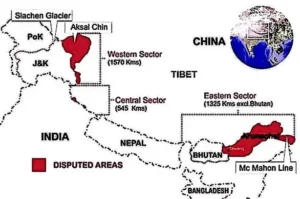
India’s Strategic Approach to Border Management
- Peace as Priority: India underscores that peace and tranquility along the border are essential for stable diplomatic and economic relations.
- Firm Response: Security forces remain prepared to counter incursions and safeguard territorial sovereignty.
- Diplomatic Channels: India continues to engage China through bilateral talks, WMCC consultations, and military commander meetings to resolve disputes.
Challenges in Border Management
- Recurring LAC Violations: Regular incidents of Chinese troops crossing the Line of Actual Control highlight different perceptions of the boundary, creating friction and mistrust.
- Balancing Security with Economy: India must manage economic ties with China (as a major trading partner) while simultaneously addressing national security concerns at the border.
- Civilian Safety and Development: Ensuring local population security, infrastructure growth, and livelihood opportunities in border districts remains a pressing challenge.
- ConfidenceBuilding Measures: Stronger mechanisms for dialogue, transparency, and military coordination are needed to prevent escalation and maintain peace.

INDIA CHINA BORDER
India considers the border to be 3,488 km long, while China claims it is about 2,000 km.
- Nature: The boundary is not formally demarcated; instead, the Line of Actual Control (LAC) separates areas under Indian and Chinese control.
- Terrain: The border runs across highaltitude regions of Ladakh, Himachal Pradesh, Uttarakhand, Sikkim, and Arunachal Pradesh.
Historical Context
- 1962 War: China occupied Aksai Chin and advanced across the McMahon Line, leading to India’s defeat.
- 1967 Clashes: At Nathu La and Cho La (Sikkim), India repelled Chinese forces.
Recent Standoffs:
- Doklam (2017): India intervened in Bhutanese territory against Chinese road construction.
- Galwan Valley (2020): Violent clash in Ladakh led to casualties on both sides.
Conclusion
India’s message is clear: border peace is the foundation of bilateral relations, and without stability along the LAC, broader cooperation with China cannot progress.
AVIATION DRUG TESTING RULES IN INDIA AND DGCA REGULATIONS
TOPIC: (GS2) POLITY: THE HINDU
The Air India Phuket–Delhi flight suffered a sudden altitude drop injuring 24 passengers, and the pilot-in-command tested positive for marijuana in confirmatory tests. This has renewed focus on DGCA’s aviation drug testing framework.
The Incident
- The Airbus A320 lost 300 feet altitude suddenly, initially attributed to turbulence.
- Sources suggest possible hydraulic and control system snags.
- The Aircraft Accident Investigation Bureau (AAIB) is probing the case.
- Following protocol, the pilot underwent drug testing — first test was “nonnegative,” second confirmed marijuana use.
India’s Aviation Drug Testing Framework
- Civil Aviation Requirement (CAR): Issued in Sept 2021, effective Jan 2022.
- Coverage: Pilots, air traffic controllers, aircraft maintenance engineers, certifying staff, trainee pilots, instructors, examiners.
- Random Testing: Mandatory for 10% of pilots and ATCs annually.
- EventBased Testing: Conducted after safety incidents, at hiring, or when suspicion arises.
- Substances Tested: Amphetamines, opiates, cannabis (THC), cocaine, barbiturates, benzodiazepines.
Testing Process
- Sample Collection: Urine split into two containers.
- Screening Test: Immediate check; “nonnegative” leads to removal from duty.
- Confirmatory Test: Sent to labs using GC/MS or LCMS techniques.
- Medical Review: A Medical Review Officer verifies if result is due to legitimate medication (e.g., codeinebased painkillers) or substance abuse.
Disciplinary Consequences
- First Offence: Referral to rehabilitation; return only after negative test and fitness clearance.
- Second Offence: Licence suspension for 3 years.
- Third Offence: Permanent licence cancellation.
- Refusal to Test: Treated as positive; penalties range from 1year suspension to cancellation depending on repeat violations.
Conclusion
India’s aviation drug testing regime reflects a zerotolerance approach to substance abuse, ensuring passenger safety while balancing rehabilitation and accountability.