

Table of Contents
ToggleJudicial Appointments in India: Why Collegium Transparency Matters
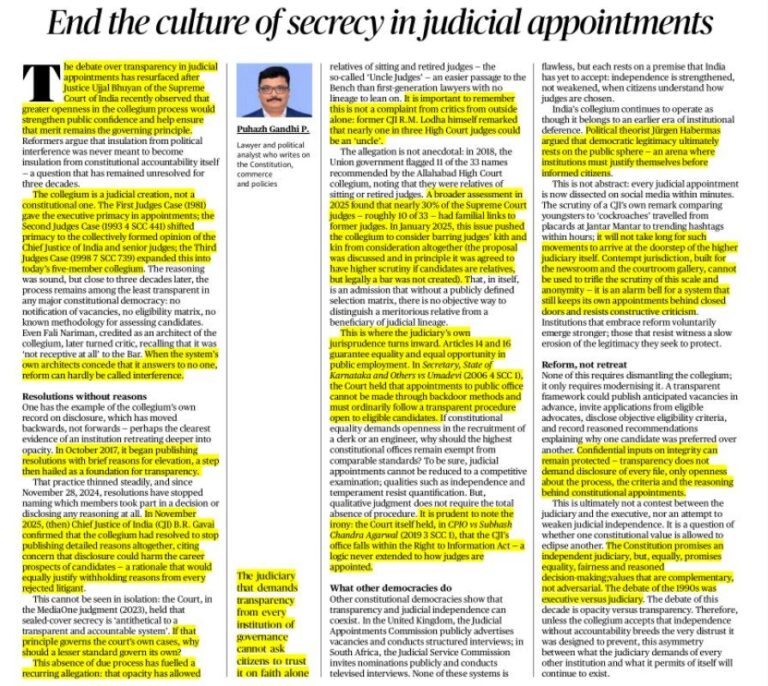
The debate over transparency in judicial appointments in India has resurfaced after Supreme Court judge Justice Ujjal Bhuyan observed that greater openness in the collegium process could strengthen public confidence and ensure that merit remains central to judicial appointments. The article argues that judicial independence and transparency should complement, rather than undermine, each other.
How Did the Collegium System Evolve?
The Collegium System is a judicially evolved mechanism and is not explicitly mentioned in the Constitution.
The First Judges Case (1981) gave the executive primacy in judicial appointments. The Second Judges Case (1993) shifted primacy to the Chief Justice of India and senior judges, while the Third Judges Case (1998) expanded the Supreme Court collegium to five members.
While the system protects judicial appointments from excessive political interference, concerns persist about the secrecy surrounding candidate selection.
Why Is Transparency in Judicial Appointments Important?
The article highlights several shortcomings in the existing process, including the absence of publicly notified vacancies, clear eligibility criteria and a transparent method of assessing candidates.
The Supreme Court had started publishing detailed collegium resolutions in 2017, including reasons supporting appointments. However, the article argues that disclosure has gradually reduced, reviving concerns about opacity.
A transparent process could strengthen public confidence, accountability and equality of opportunity without compromising judicial independence.
Constitutional Principles and Judicial Transparency
The article connects judicial appointments with the broader constitutional principles contained in Articles 14 and 16, which protect equality and equality of opportunity.
It also refers to Secretary, State of Karnataka v. Umadevi (2006) to highlight the importance of openness in public appointments and CPIO v. Subhash Chandra Agarwal (2019) in the context of transparency and the judiciary.
What Can India Learn From Other Democracies?
The United Kingdom’s Judicial Appointments Commission publicly advertises vacancies and follows structured selection procedures. South Africa’s Judicial Service Commission invites nominations and conducts publicly accessible interviews.
India need not copy these systems entirely, but greater disclosure could make the collegium more accountable.
Conclusion
Reforming judicial appointments does not require dismantling the collegium. Instead, India can strengthen it by publishing vacancies, establishing objective eligibility criteria and providing reasoned recommendations.
Confidential information concerning a candidate’s integrity may require protection, but secrecy should not become the default. Greater transparency can reinforce both judicial independence and public trust in the judiciary.
Vocabulary
1. Collegium – Judicial appointment mechanism
2. Opacity – Lack of transparency
3. Judicial Independence – Freedom from external interference
4. Due Process – Fair and established procedure
5. Reasoned Decision – Decision supported by stated reasons
Frequently Asked Questions (FAQs)
What is the Collegium System in India?
The Collegium System is a judicially created mechanism for appointing and transferring judges of the Supreme Court and High Courts. It evolved primarily through the Three Judges Cases.
Why is transparency needed in judicial appointments?
Transparency can help citizens understand how judges are selected and whether merit and fairness guide appointments. It can also strengthen institutional accountability and public confidence.
Is the Collegium System mentioned in the Constitution?
No. The Constitution provides for judicial appointments, but the present collegium mechanism developed through Supreme Court judgments, especially the Second and Third Judges Cases.
Can transparency weaken judicial independence?
Transparency does not necessarily undermine judicial independence. Objective criteria and reasoned recommendations can be disclosed while sensitive information regarding candidates’ integrity remains confidential.
What reforms can improve the Collegium System?
Reforms could include public notification of vacancies, clear eligibility criteria, transparent selection procedures and reasoned collegium recommendations while protecting legitimately confidential information.
Source From : The Hindu
Indian Economy Resilient Amid Global Uncertainty: RBI Report
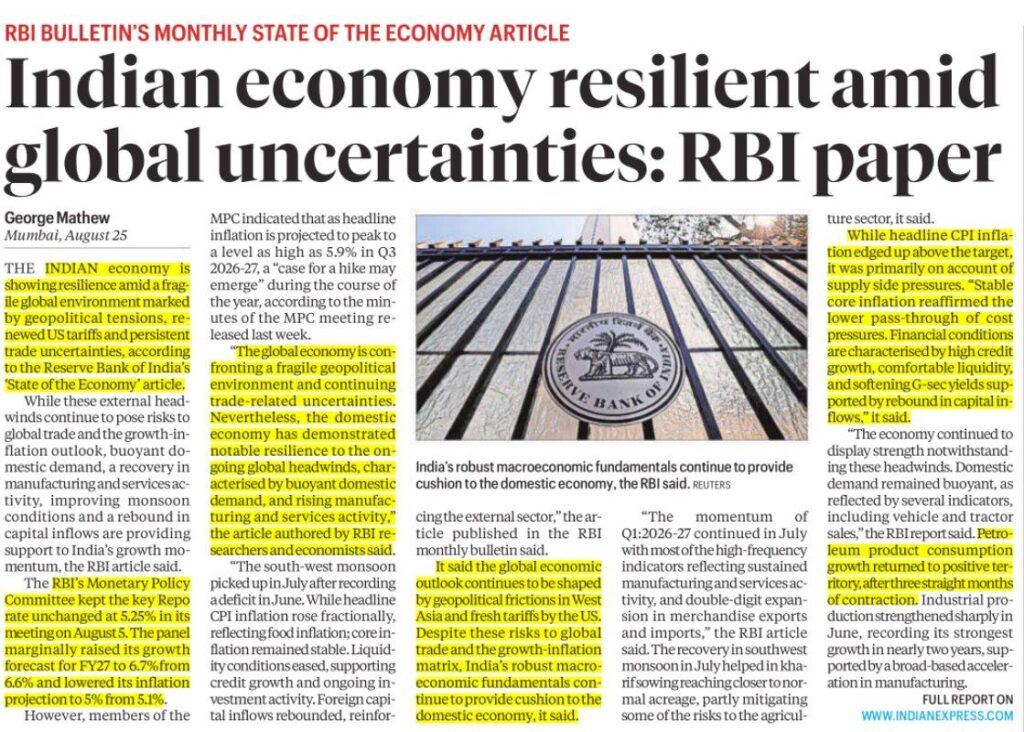
The Indian economy remains resilient despite rising global uncertainties, according to the Reserve Bank of India’s latest State of the Economy article published in the RBI Bulletin. While geopolitical tensions, renewed U.S. tariffs and trade-related uncertainties continue to affect the global outlook, strong domestic demand and improving macroeconomic indicators are supporting India’s growth momentum.
RBI Raises India’s GDP Growth Forecast
The Reserve Bank of India’s Monetary Policy Committee (MPC) kept the repo rate unchanged at 5.25% at its August 5 meeting.
The RBI marginally increased its FY 2026-27 GDP growth forecast to 6.7% from 6.6%, while lowering its inflation projection to 5% from 5.1%.
The RBI article noted that India’s domestic economy has demonstrated resilience due to buoyant consumption, rising manufacturing activity and expansion in services.
Domestic Demand and Manufacturing Support Growth
Economic momentum continued during July, with several high-frequency indicators showing sustained manufacturing and services activity.
Merchandise exports and imports recorded double-digit expansion, while petroleum product consumption returned to positive growth after three consecutive months of contraction.
Industrial production also strengthened sharply in June, recording its strongest growth in nearly two years, supported by broad-based improvement in manufacturing.
Monsoon and Agriculture Outlook Improve
The recovery of the south-west monsoon during July has strengthened the agricultural outlook. Kharif sowing area has moved closer to normal levels, reducing some risks to agricultural production.
Improved monsoon conditions can support rural demand, agricultural output and food supply during the coming months.
Inflation Remains a Key Concern
Although headline CPI inflation moved above the RBI’s target, the article attributed much of the increase to supply-side pressures.
Core inflation remained stable, indicating relatively limited transmission of cost pressures. However, some MPC members reportedly warned that headline inflation could rise to around 5.9% in Q3 of 2026-27, potentially creating a case for monetary tightening later in the year.
Global Risks Facing the Indian Economy
The international environment remains uncertain because of geopolitical tensions in West Asia, fresh U.S. tariffs and global trade disruptions.
Despite these risks, the RBI highlighted India’s robust macroeconomic fundamentals, comfortable liquidity, strong credit growth, easing government bond yields and recovering capital inflows.
Conclusion
The Indian economy in 2026-27 continues to display resilience despite an uncertain global environment. Strong domestic demand, improving manufacturing, a recovering monsoon and supportive financial conditions provide important growth buffers.
However, policymakers must remain alert to inflation, geopolitical tensions and global trade uncertainty to sustain India’s economic growth while maintaining macroeconomic stability.
Vocabulary
1. Macroeconomic Resilience – Ability to withstand economic shocks
2. Headline Inflation – Overall CPI inflation
3. Core Inflation – Inflation excluding volatile components
4. Repo Rate – RBI’s lending rate to banks
5. Capital Inflows – Foreign funds entering an economy
Frequently Asked Questions (FAQs)
What is the RBI’s GDP growth forecast for India in FY 2026-27?
The RBI has raised its growth projection marginally from 6.6% to 6.7%. Strong domestic demand, manufacturing and services activity are supporting the outlook.
What is the current RBI repo rate?
The RBI’s Monetary Policy Committee kept the repo rate unchanged at 5.25% at its August meeting. Future decisions will depend largely on inflation and economic conditions.
Why does the RBI consider the Indian economy resilient?
Buoyant domestic demand, improving manufacturing, services growth, better monsoon conditions and recovering capital inflows are helping India withstand external economic pressures.
What are the major risks to India’s economic growth?
Major risks include geopolitical tensions, U.S. tariffs, global trade uncertainty and inflationary pressures. These factors could affect exports, prices and financial conditions.
What is the RBI’s inflation outlook for FY 2026-27?
The RBI lowered its overall inflation projection to around 5%, although some MPC members warned that headline inflation could rise further during parts of the year.