Table of Contents
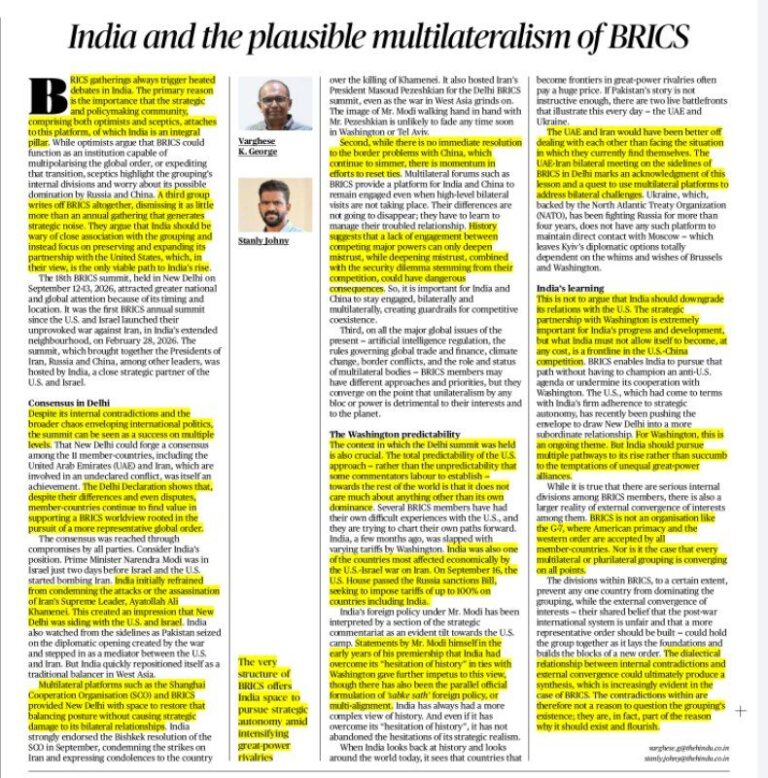
ToggleIndia and the Plausible Multilateralism of BRICS
The evolution of BRICS as a multilateral platform has gained significance in the changing global order. Initially formed as an economic grouping of emerging economies, BRICS has gradually expanded its focus towards issues such as global governance reform, development cooperation, financial stability and representation of the Global South.
For India, BRICS provides an important platform to engage with multiple power centres while maintaining its policy of strategic autonomy and multi-alignment.
BRICS and the Changing Global Order
BRICS originally consisted of Brazil, Russia, India, China and South Africa and later expanded with additional members. The grouping represents a significant share of the global economy and population, giving it greater influence in international discussions.
The article highlights that BRICS aims to provide a platform for countries seeking greater representation in global institutions and a more balanced international order.
However, internal differences among members remain a challenge. Countries have different geopolitical priorities, strategic interests and approaches towards global issues.
India’s Role in BRICS
India views BRICS as a platform for cooperation rather than as an alliance against any country. Its approach focuses on:
- Strengthening multilateral institutions
- Promoting development cooperation
- Supporting Global South concerns
- Encouraging economic collaboration
India has also maintained engagement with other groupings such as the Quad, G20 and SCO, reflecting its multi-alignment approach.
The article emphasises that India’s participation in BRICS does not mean reducing engagement with other partners, including the United States and European countries.
Challenges Before BRICS
BRICS faces several challenges, including:
Geopolitical Differences
Members have different foreign policy priorities. While some countries may seek a stronger challenge to existing global structures, others focus more on economic cooperation.
Internal Divergences
Differences among members can affect consensus-building and limit the group’s ability to take unified positions on global issues.
Expanding Membership
The expansion of BRICS increases its representation but also creates greater complexity in managing diverse interests.
India’s Strategic Approach
The article highlights that India should continue using BRICS as one among multiple platforms to pursue national interests. Maintaining relationships with different power centres allows India to preserve flexibility in global diplomacy.
India’s objective is not to create a new bloc but to strengthen cooperation on issues such as development, technology, climate change and economic reform.
Conclusion
BRICS represents an important experiment in plausible multilateralism in a changing world order. While differences among members create challenges, the grouping provides India with an opportunity to promote Global South interests, support institutional reforms and maintain strategic autonomy through balanced engagement.
Vocabulary
1. Multipolarity – A global system with multiple centres of power.
2. Strategic Autonomy – Ability to take independent decisions based on national interests.
3. Multilateralism – Cooperation among multiple countries through common platforms.
Prelims MCQs
MCQ 1
Consider the following statements:
1. BRICS aims to promote cooperation among emerging economies.
2. India uses platforms like BRICS to engage multiple global power centres.
3. BRICS functions as a military alliance among its members.
Which are correct?
A) 1 and 2 only
B) 2 and 3 only
C) 1 and 3 only
D) 1, 2 and 3
Answer: A
UPSC Mains Question
“BRICS provides India an opportunity to balance strategic autonomy with global cooperation.” Discuss.
(10 Marks)
Frequently Asked Questions (FAQs)
What is BRICS?
BRICS is a multilateral grouping of emerging economies focused on economic cooperation, global governance issues and development-related challenges.
Why is BRICS important for India?
BRICS provides India a platform to engage with major economies, promote Global South concerns and pursue strategic autonomy.
What are the major challenges faced by BRICS?
Major challenges include geopolitical differences among members, varying national interests and difficulties in achieving consensus.
How does BRICS support India’s foreign policy?
BRICS complements India’s multi-alignment approach by allowing engagement with multiple global power centres.
Is BRICS an alternative to existing global institutions?
BRICS seeks greater representation and reform in global governance but operates alongside existing international institutions.
Source From : The Hindu
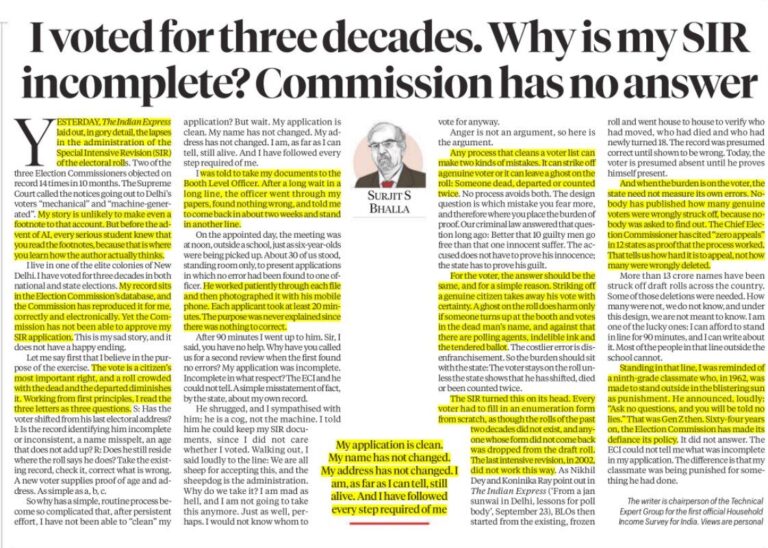
Special Intensive Revision (SIR) of Electoral Rolls: Concerns Over Voter Inclusion and Transparency
The Special Intensive Revision (SIR) of electoral rolls has raised important questions regarding voter inclusion, accuracy of electoral databases and the balance between preventing fraudulent entries and protecting genuine voters. The debate highlights the need for transparent electoral processes that ensure both clean voter lists and universal adult franchise.
Purpose of Electoral Roll Revision
Electoral roll revision is conducted to ensure that voter lists remain accurate by:
- Removing deceased voters
- Updating details of migrated voters
- Correcting errors in voter information
- Adding eligible new voters
Accurate electoral rolls are essential for conducting free and fair elections and maintaining public trust in democratic institutions.
Concerns Around SIR Process
The article highlights concerns raised by voters regarding difficulties faced during the SIR process. Some individuals who have voted for several decades reported that their applications remained incomplete despite providing required documents.
A major concern discussed is that genuine voters may face difficulties because of documentation requirements, procedural delays or verification issues.
The article raises the question of whether administrative errors could unintentionally exclude eligible citizens from electoral participation.
Balancing Accuracy and Inclusion
A voter list must prevent wrongful inclusion of ineligible names while also ensuring that eligible citizens are not removed.
The challenge lies in maintaining a balance between:
- Electoral integrity
- Protection of voting rights
- Transparent verification procedures
- Accessible correction mechanisms
The article argues that errors in electoral rolls should be addressed through proper verification rather than creating barriers for genuine voters.
Role of Transparency and Accountability
A transparent electoral revision process requires:
- Clear reasons for deletion or exclusion
- Opportunity for affected voters to respond
- Accessible appeal mechanisms
- Accountability in administrative decisions
Public confidence in elections depends not only on accurate voter lists but also on citizens believing that the process is fair and transparent.
Constitutional Importance
The right to vote is a statutory right under Indian law, while free and fair elections are a fundamental feature of the constitutional system.
The Election Commission of India plays a crucial role in maintaining electoral rolls and ensuring that eligible citizens can participate in the democratic process.
Conclusion
The SIR debate highlights the importance of improving electoral databases while protecting genuine voters from wrongful exclusion. A robust electoral system requires both accuracy of voter lists and safeguards for citizen participation. Transparent procedures, effective grievance redressal and accountability can strengthen trust in electoral institutions.
Vocabulary
1. Electoral Roll – Official list of eligible voters.
2. Disenfranchisement – Loss of voting rights.
3. Grievance Redressal – Process to resolve complaints and disputes.
Prelims MCQs
MCQ 1
Consider the following statements:
1. The Election Commission of India conducts revision of electoral rolls.
2. Incorrect deletion of eligible voters can affect the right to vote.
3. Right to vote is a Fundamental Right under the Constitution.
Which are correct?
A) 1 and 2 only
B) 2 and 3 only
C) 1 and 3 only
D) 1, 2 and 3
Answer: A
UPSC Mains Question
“Electoral roll revision must balance accuracy with protection against wrongful exclusion of voters.” Discuss.
(10 Marks)
Frequently Asked Questions (FAQs)
What is Special Intensive Revision (SIR) of electoral rolls?
SIR is a detailed process of reviewing and updating electoral rolls to ensure accurate voter information.
Why are electoral roll revisions important?
They help remove incorrect entries, include eligible voters and maintain reliable voter lists for elections.
What is the main concern regarding SIR?
The concern highlighted is that genuine voters may face difficulties or possible exclusion due to documentation and verification challenges.
Who conducts electoral roll revisions in India?
The Election Commission of India supervises the preparation and revision of electoral rolls.
Why is voter inclusion important in democracy?
Headline GDP growth should be examined alongside GVA, the GDP deflator, IIP and other economic indicators to understand the actual drivers and sustainability of growth.