
Flash floods devastated Nepal’s Rasuwa district and parts of Tibet this week. Initially suspected to be earthquaketriggered, experts later confirmed the seismic signal was caused by a glacial collapse.
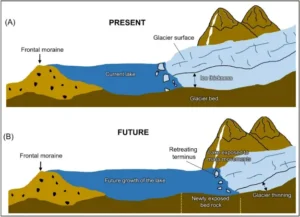
What is a Glacial Collapse?
- Sudden detachment of large ice, rock, and water masses from a glacier.
- Occurs on steep slopes; millions of cubic metres may break away.
- Transforms into fastmoving avalanches or debris flows.
- Broadly classified as gravitydriven failures of glacier ice, including ice avalanches and rockice avalanches.
Formation and Collapse Process
- Glacier Formation: Snow layers compress into firn, then recrystallise into ice.
- Collapse Triggers:
- Heavy glacial mass flowing outward on steep gradients.
- Meltwater channels beneath glaciers opening suddenly.
- Stress fractures from uneven terrain and freezethaw cycles.
- Base Role: Wetbase glaciers resting on mud/clay accumulate water, which mixes with debris during collapse, creating destructive torrents.
Past Instances
- 2016, Aru Range (Tibet): 68 million m³ ice collapse killed nine herders; another nearby glacier collapsed two months later.
- 2018, Sedongpu Basin (Tibet): Icerock avalanches blocked the Yarlung Tsangpo River.
- 2022, Bukadaban Feng (Kunlun Mountains): 40 million m³ ice detached, creating a 13metre wave.
- 2018, Ronti Peak (Uttarakhand): Rockice avalanche killed over 200 people.
- 2025, Blatten (Switzerland): Rocksoilice cascade buried a village, linked to climate change.
Climate Change Link
- Himalayan glaciers retreating rapidly; ice loss 65% faster (2011–2020) than previous decade.
- Nepal’s glaciers lost nearly onethird of ice volume in three decades.
- Heatwaves, permafrost reduction, and glacial retreat increase collapse risks.
- Warning challenge: Absence of rainfall before collapses defeats conventional flood forecasting systems.
Impacts
- Catastrophic floods from debrisladen torrents.
- Temporary natural dams formed by collapsed ice/rock can burst, causing secondary floods.
- Fastmoving mud flows behave “like liquid concrete,” leaving little time for escape.
Way Forward
- Enhanced Monitoring: Seismic and satellite systems to detect nonrainfall triggers.
- Early Warning Systems: Develop models beyond precipitationbased alerts.
- Regional Cooperation: Crossborder hydrological data sharing in the Himalayas.
- Community Preparedness: Training and evacuation drills in vulnerable valleys.
Conclusion
The Nepal–Tibet floods highlight how accelerated Himalayan glacial melt under climate change raises risks of recurrence. Strengthening monitoring, earlywarning systems, and regional cooperation is essential to protect downstream communities from future disasters.
The 25th round of Special Representative (SR)level talks between NSA Ajit Doval and Chinese Foreign Minister Wang Yi in Beijing produced an eightpoint consensus.
India–China Boundary Dispute
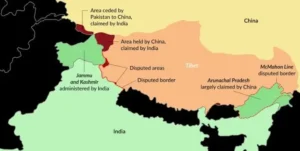
- Length: About 3,488 km contested frontier.
- Western Sector (Aksai Chin): China controls ~38,000 sq. km claimed by India.
- Eastern Sector (Arunachal Pradesh): China claims ~90,000 sq. km, rejecting the 1914 McMahon Line.
- Central Sector: Smaller overlaps in Himachal Pradesh and Uttarakhand.
- 2020 Ladakh Crisis: Severely disrupted ties, making peace along the LAC a prerequisite for normalisation.
Towards “Early and Substantial Harvest”
- Guided by the 2005 Agreement on Political Parameters and Guiding Principles.
- Two WMCC mechanisms:
- Expert Group on Boundary Delimitation: To discuss alignment of the boundary.
- Working Group on Border Management: To improve frontier management.
- Current talks focus on Terms of Reference (ToR), not final settlement.
Strengthening Military Communication
- Establish two new meeting points for senior military commanders.
- Create two additional hotlines in Eastern and Middle sectors.
- Address ground situations promptly via WMCC and local commander meetings.
- Aim: Prevent misunderstanding, miscalculation, and escalation along the LAC.
Border Trade, Pilgrimage & Engagement
- Reopening of three designated border trading points.
- Cooperation in border trade, pilgrimage, and exchanges.
- China to increase batches for the KailashMansarovar Yatra.
- Shift from purely securitycentric to dialogue and cooperation.
TransBorder Rivers
- Next meeting of ExpertLevel Mechanism on Transborder Rivers scheduled for September.
- Focus: Hydrological data sharing, MoU renewal, and river management.
- Critical for the Brahmaputra (Yarlung Tsangpo), where India fears downstream ecological impacts from Chinese hydropower projects.
Institutionalising the Peace Process
- Peace and tranquillity reaffirmed as the foundation of bilateral ties.
- 26th SRlevel talks to be held in India in 2027.
- Significance:
- Moves beyond crisis management to structured border management.
- Strengthens confidencebuilding measures (CBMs).
- Keeps boundary settlement goal alive.
- Reduces risk of accidental escalation.
- Provides framework for cooperation on rivers, trade, and pilgrimage.
Conclusion
Progress on delimitation should be incremental, verifiable, and based on established agreements, ensuring stability and creating space for broader bilateral cooperation.
First photographic evidence of the spoontailed duskhawker (Gynacantha basiguttata) was recently verified in Arunachal Pradesh.
SpoonTailed Duskhawker
- About: A dragonfly species belonging to the Aeshnidae family.
- Habitat: Found near streams and forest pools.
- Distribution: Native to the Philippines and parts of Southeast Asia.
- Ecological Role: Hunts flying insects like mosquitoes and gnats, contributing to aquatic food webs.

- Features:
- Black Tshaped mark on the frons.
- Olivegreen thorax without stripes.
- Distinctive wing pigmentation.
- Spoonlike abdominal appendages (cerci).
- Significance: Strong, fast fliers that hunt on the wing, making them effective insect predators.
The restoration of the Buckingham Canal has once again drawn attention in Tamil Nadu after the new government prioritized reviving this historic waterway.
Buckingham Canal
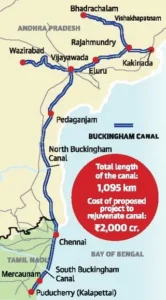
- Runs along India’s east coast for 450 km (250 km in Andhra Pradesh, 200 km in Tamil Nadu).
- Once linked with Krishna and Godavari irrigation canals, forming a 650 km navigable stretch.
- Served as an economic lifeline, transporting bulky commodities like fuel, salt, and dried fish profitably to Madras (now Chennai).
Historical Background
- Constructed in 1806 by Basil Cochrane as Cochrane Canal.
- Taken over by the government in 1837, renamed East Coast Canal, and extended to Dugarajapatnam in 1857.
- In 1878, renamed Buckingham Canal after the Governor of Madras, the Duke of Buckingham and Chandos.
Issues
- Encroachment: Urban expansion has narrowed and blocked canal stretches.
- Pollution: Untreated sewage and solid waste severely degrade water quality.
- Loss of Navigation: Once a thriving transport route, now largely defunct due to neglect.
Way Forward
- Restoration Projects: Dredging, desilting, and removal of encroachments.
- Pollution Control: Sewage treatment and solid waste management.
- Integration: Linking canal revival with urban water transport and ecotourism.
Conclusion
The Buckingham Canal, once a vital economic artery, now suffers from neglect and pollution. Its restoration requires sustained political will, community participation, and ecological planning to revive its role as both a transport corridor and a water conservation asset.
The Union Ministry of Tribal Affairs has launched the Jago AI Assistant, an AIpowered conversational tool designed to extend the reach of tribal welfare schemes and programmes.
About Jago AI Assistant
- An AI chatbot initiative of the Ministry of Tribal Affairs.
- Provides simplified access to information on tribal welfare schemes, policies, programmes, guidelines, and official documents.
- Currently available in English and Hindi.

Features
- Allows citizens to ask questions in simple language and receive quick, relevant responses.
- Improves accessibility by breaking down complex policy details into understandable information.
- AIbased architecture enables continuous expansion of its knowledge base with new schemes and documents.
Significance
- Bridges the gap between government information and intended beneficiaries.
- Enhances transparency, efficiency, and accessibility in tribal welfare delivery.
- Supports technologydriven governance, ensuring secure and private conversations.
- Empowers tribal communities by making welfare information more citizenfriendly.
Conclusion
By simplifying access to welfare schemes and ensuring secure, transparent delivery, it strengthens the government’s commitment to empowering tribal communities through digital innovation.