

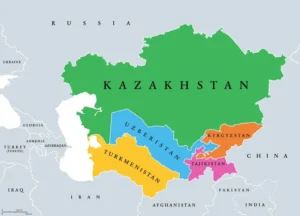
Prime Minister Modi is visiting Uzbekistan (Aug 29–30) on a bilateral trip, followed by the Kyrgyz Republic (Aug 31–Sep 1) to attend the 26th SCO Summit.
Civilisational Links with Uzbekistan
- Kara Tepa Monastery (Termez): Key Buddhist site during Kushana era.
- Shared Language: ~3,000 common words between Hindi and Uzbek.
- Cuisine Parallels: Gheesariyok, samosasamsa, naannon, pulaopilaf.
- Economic Ties: India among Uzbekistan’s top 10 trading partners; bilateral trade ~USD 1 billion (2025–26).
What Central Asia Offers
- Traditionally Russia’s strategic backyard, with 20–30% ethnic Russian population.
- Increasing global importance, highlighted by Xi Jinping’s 2022 visit.
- Resource wealth:
- Kazakhstan – uranium, coal, zinc, gold, iron ore.
- Kyrgyz Republic – gold, hydropower.
- Turkmenistan – vast natural gas reserves.
- Tajikistan – hydropower potential.
- Uzbekistan – gold, uranium, natural gas.
- Attracts global powers seeking energy and mineral access.
India’s Strategic Stakes
- Security Cooperation: Crucial after Taliban’s takeover in Afghanistan.
- Countering China: Balancing Beijing’s Belt and Road Initiative footprint.
- Connectivity: Push for INSTC and Chabahar port integration.
- Energy Security: Kazakhstan’s uranium and Turkmenistan’s role in TAPI pipeline.
- Civilisational Links: Centuriesold cultural ties, Buddhist heritage.
- Trade Potential: Expanding partnerships; Central Asia seen as India’s extended neighbourhood.
Challenges
- No direct land access: Pakistan blocks overland routes.
- Security Risks: Taliban resurgence and radicalism threats.
- Russia–Ukraine Conflict: Skilled Russians migrating to Central Asia, creating demographic shifts and potential tensions.
Conclusion
India’s Central Asia outreach underscores security, energy, and connectivity interests, counters China’s influence, and leverages civilisational ties despite blocked routes and instability.
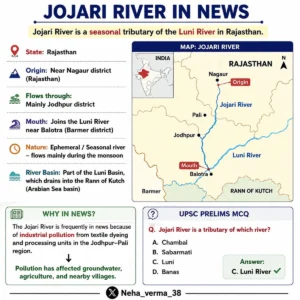
The Supreme Court of India recently banned construction or development within 100 metres of the Jojari River in Rajasthan, highlighting urgent environmental concerns.
About Jojari River
- A seasonal river originating in Pandalu village, Nagaur district.
- Flows through Jodhpur and merges with the Luni River near Balotra city.
- Unique as the only rightbank tributary of the Luni River.
- Distinctive feature: It is the only branch of Luni not originating from the Aravalli Mountains.
Environmental Issues
- Severe contamination from industrial waste and untreated sewage.
- Major pollution source: chemicalladen water from Jodhpur’s textile and steel industries.
- Threatens aquatic ecosystems, groundwater quality, and public health in adjoining areas.
Supreme Court Intervention
- Court took suo motu cognizance of a documentary exposing the ecological crisis.
- Prohibited hazardous industries within 500 metres of either side of the flood line.
- Mandated strict enforcement to prevent further degradation and protect river ecology.
Significance
- Reinforces the judiciary’s role in environmental protection.
- Sets a precedent for safeguarding rivers from industrial encroachment and pollution.
- Highlights the need for sustainable industrial practices and stronger regulatory mechanisms.
Conclusion
The Jojari River case underscores the urgent need to balance industrial growth with ecological responsibility, ensuring rivers remain lifelines for communities and ecosystems.
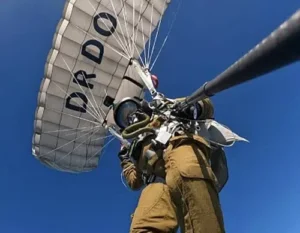
The Defence Research and Development Organisation (DRDO) successfully tested the Military Combat Parachute System (MCPS) at 22,000 feet in Nyoma, Ladakh — one of the world’s highest drop zones.
About MCPS
- Indigenously developed by DRDO.
- Designed by Aerial Delivery Research and Development Establishment (Agra) and Defence Bioengineering & Electromedical Laboratory (Bengaluru).
- Represents India’s push for selfreliance in defence technology.
Key Features
- Successfully tested in combat freefall jumps from 32,000 feet.
- Only parachute system in Indian Armed Forces capable of deployment above 25,000 feet.
- Enhanced tactical features: lower descent rate and superior steering capabilities.
- Compatible with Navigation with Indian Constellation (NavIC) for precise landing.
Significance
- Enables paratroopers to safely exit aircraft, deploy at set altitudes, navigate accurately, and land at designated zones.
- Strengthens India’s special operations capability in highaltitude regions like Ladakh.
- Reduces dependence on foreign parachute systems, ensuring serviceability during conflict and war.
- Opens doors for induction of indigenous parachute systems, boosting Atmanirbhar Bharat in defence.
Conclusion
The successful testing of MCPS marks a strategic leap in India’s airborne combat capability, combining indigenous innovation with operational excellence. It enhances India’s preparedness for highaltitude warfare while reinforcing the vision of selfreliance in defence technology.