
Table of Contents
ToggleBabur Towards India: Central Asian Politics & Mughal Rise
The interplay between Central Asian Politics and Babur Towards India laid the foundation for the Rise of the Mughal Empire. Driven out of his ancestral homeland in Fergana due to fierce power struggles, Babur and the Mughal Empire began with a quest for survival before expanding into South Asia. His arrival permanently altered the socio-political trajectory of medieval India.
Political Background of Central Asia
- Central Asian Politics Before Babur were defined by constant conflict among rival Timurid princes fighting over fragmented territories.
- The relentless Uzbek Expansion in Central Asia under the leadership of Shaibani Khan and Babur‘s clashes created an environment of extreme instability.
- Rise of the Safavid Empire in Iran further complicated the regional balance of power, displacing smaller rulers.
Babur's Early Life and Timurid Background
- Babur’s Early Life and Struggles began in Fergana, where he inherited the throne at a young age amidst hostile relatives.
- He possessed a proud lineage from the Timurid Empire and Babur traced his descent from Timur on his father’s side and Genghis Khan on his mother’s.
- Despite his noble heritage, internal feuds forced him to live a life of wandering and military uncertainty.
Decline of Timurid Power and Babur's Struggles
- The Timurid principality fractured rapidly due to fratricidal wars and weak administrative cohesion.
- Babur captured and lost Samarkand three times against the rising power of the Uzbeks.
- Driven out of Transoxiana, Babur realized that his dream of restoring Timur’s Central Asian realm was unachievable.
Babur's Establishment in Kabul
- In 1504, Babur moved south, crossed the Hindu Kush, and secured Babur’s Establishment in Kabul.
- Kabul served as an ideal strategic outpost, protecting him from Uzbek incursions while offering a base for future campaigns.
- From Kabul, Babur began looking eastward toward the fertile plains of Hindustan to sustain his troops and empire.
Why Did Babur Turn Towards India?
- The rich agricultural wealth of India offered a solution to the poor revenue base of Kabul.
- Babur’s Invasion of India was fueled by his vision to match Timur’s legacy of conquering Delhi.
- Continuous Uzbek threats from the north blocked any potential re-expansion into Central Asia.
Political Condition of North India Before Babur
- The Political Condition of North India Before Babur was marked by extreme political fragmentation and weak central authority.
- The Delhi Sultanate under Ibrahim Lodi faced internal rebellion from disgruntled Afghan nobles.
- Disaffected leaders like Daulat Khan Lodi and Babur‘s prospective allies, alongside Alam Khan Lodi and Babur, invited him to overthrow Ibrahim Lodi.
Babur's Early Expeditions Towards India
- Between 1519 and 1524, Babur led several preliminary Babur’s Expeditions to India to test the regional defenses.
- He secured key frontier outposts including Bhira, Sialkot, and Lahore to establish operational bases.
- These reconnaissance raids exposed the political disunity among the Afghan chieftains in Punjab and Delhi.
Babur's Advance Towards India
- In late 1525, the full-scale Babur Advance Towards India commenced as he marched from Kabul with a disciplined army.
- He subdued rebellious governors in Punjab, consolidating his supply line before heading toward Delhi.
- His force was smaller than the Sultanate’s army but superior in tactical mobility and coordination.
First Battle of Panipat, 1526
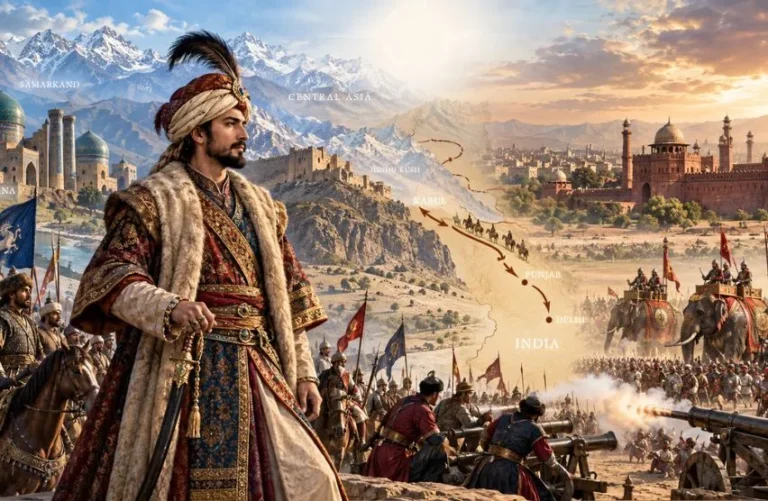
- The First Battle of Panipat 1526 took place on April 21, pitting Babur against Ibrahim Lodi’s massive forces.
- Babur secured a decisive victory, leading to the death of Ibrahim Lodi on the battlefield.
- This historic battle shattered the Delhi Sultanate and paved the way for Mughal rule in northern India.
Babur's Struggle After Panipat
- Following Panipat, Babur faced intense resistance from the Rajput confederacy led by Rana Sanga.
- He defeated Rana Sanga at the crucial Battle of Khanwa 1527, securing his position in Agra and Rajasthan.
- He subsequently suppressed remaining Afghan rebellions in eastern India at the Battle of Ghagra.
Significance of Babur's Advent into India
- Re-established strong centralized governance, linking India more closely with Central Asian trade routes.
- Ended the era of regional Afghan dominance and established a durable imperial tradition.
- Introduced new cultural, architectural, and literary influences to the Indian subcontinent.
Babur's Military Techniques
- Babur’s Military Techniques relied on gunpowder technology, field artillery, and mobile cavalry units.
- He effectively deployed the Tulughma and Araba System, surrounding the enemy while protecting his matchlockmen and cannons.
- Combined Central Asian horse archery with modern firearm tactics to neutralize larger elephant-based armies.
Timeline of Central Asian Politics and Babur's Advance
- 1494: Babur inherits the throne of Fergana at age 11.
- 1504: Babur captures Kabul after being pushed out of Central Asia by Shaibani Khan.
- 1526: Victory at Panipat establishes Mughal presence in India.
Conclusion
The transition from Central Asian Politics and Babur Towards India marks a decisive turning point in medieval history. Driven out of his homeland, Babur converted military adversity into an empire. His tactical genius and ability to exploit regional disunity enabled the Rise of the Mughal Empire, forever transforming the political landscape of South Asia.
UPSC Prelims: PYQs & Practice Questions
Previous Year Questions (Prelims)
Q: Consider the following statements regarding the
arrival of Babur into India:
1. It led to the introduction of gunpowder in the Indian subcontinent.
2. It led to the introduction of the arch and dome in the architecture of the region.
3. It led to the establishment of the Timurid dynasty in the region.
Which of the statements given above is/are correct?
(a) 1 and 2 only
(b) 3 only
(c) 1 and 3 only
(d) 1, 2 and 3
Answer: (b) 3 only
Explanation:
Statement 1 is incorrect: Gunpowder was known and used in India
before Babur's arrival, particularly in the Bahmani and Vijayanagara kingdoms
during the 14th–15th centuries. However, Babur introduced the effective use of
field artillery and firearms tactics in North Indian warfare.
Statement 2 is incorrect: The arch and dome had
already appeared in Indian architecture much earlier, particularly during the
Delhi Sultanate period.
Statement 3 is correct: Babur belonged to the
Timurid lineage on his father's side. His conquest of North India
resulted in the establishment of the Timurid (Mughal) dynasty
in the Indian subcontinent.
Q: With reference to the medieval history of India,
who among the following invited Babur to invade India?
(a) Ibrahim Lodi
(b) Daulat Khan Lodi
(c) Sher Shah Suri
(d) Mahmud Lodi
Answer: (b) Daulat Khan Lodi
Explanation:
Daulat Khan Lodi, the governor of Punjab, along with
Alam Khan Lodi, the uncle of Ibrahim Lodi, sent emissaries to
Babur in Kabul and invited him to invade India.
Their objective was to overthrow the unpopular Sultan
Ibrahim Lodi. They expected Babur to raid Delhi and return to
Kabul like Timur, thereby allowing them to expand their own political influence.
Practice Questions
Q: With reference to the tactical military innovations brought by Babur to India, consider the following statements:
1. The Tulughma system involved dividing the main army into left, right, and center divisions to flank the enemy from the sides and rear.
2. The Araba system was a naval defense structure designed to protect riverine supply routes.
Which of the statements given above is/are correct?
(a) 1 only
(b) 2 only
(c) Both 1 and 2
(d) Neither 1 nor 2
Answer: (a) 1 only
Explanation:
Statement 1 is correct: The Tulughma system was a Central Asian military maneuver in which the army was divided into specialized units. Flanking parties positioned on the extreme left and right attempted to encircle the enemy from the sides and rear.
Statement 2 is incorrect: The Araba system was not a naval defense structure. It involved linking carts together with hide ropes to create a defensive barrier for matchlockmen and field artillery on land.
Q: Which of the following factors compelled Babur to abandon his ambitions in Transoxiana and turn toward India?
1. The rapid rise of Uzbek power under Shaibani Khan.
2. The weak economic capacity of Kabul to support his army and administration.
3. An invitation from the Safavid ruler Shah Ismail to establish a joint rule over Punjab.
Select the correct answer using the code given below:
(a) 1 and 2 only
(b) 2 and 3 only
(c) 1 and 3 only
(d) 1, 2 and 3
Answer: (a) 1 and 2 only
Explanation:
Statements 1 and 2 are correct: Babur was repeatedly driven out of Samarkand by the Uzbeks under Shaibani Khan. With his ambitions in Central Asia blocked and the relatively limited revenues of Kabul insufficient to sustain his followers and military establishment, Babur increasingly turned toward the wealth of India.
Statement 3 is incorrect: Babur briefly allied with Shah Ismail of Iran in his attempt to recapture Samarkand, but there was no proposal or invitation from Shah Ismail to establish joint rule over Punjab.
UPSC Mains – Previous Year & Practice Questions
Mains Previous Year Questions
Question: "Babur’s advent into India marked a significant turning point in the military tactics and political structure of Northern India." Elaborate. (UPSC CSE Mains 2014)
Question: Discuss the socio-political conditions of North India on the eve of Babur’s invasion. How far did these conditions facilitate the establishment of the Mughal Empire? (UPSC CSE Mains 2002)
Question: Analyze the geopolitical factors in Central Asia that influenced Babur's decision to march toward the Indian subcontinent. (UPSC CSE Mains 1998)
Question: Compare the military tactics of Babur with those of the contemporary Afghan rulers in India, highlighting the role of artillery and cavalry coordination. (UPSC CSE Mains 1992)
Question: Examine the significance of the Battle of Khanwa (1527) in consolidating Mughal power in Northern India compared to the First Battle of Panipat (1526). (UPSC CSE Mains 1987)
Mains Practice Questions
[15 Marks | 250 Words]
Question: The shift of the Timurid political base from Central Asia to Kabul and subsequently to Delhi was driven more by political necessity than imperial design. Critically examine.
[15 Marks | 250 Words]
Question: Analyze how Babur utilized the combination of Tulughma flanking tactics and firearm technology to overcome numerically superior armies in Northern India.
[15 Marks | 250 Words]
Question: To what extent did the rivalry between the Uzbeks, Safavids, and Timurids in 16th-century Central Asia alter the geopolitical map of South Asia?
Babur Towards India-FAQs
Why did Babur turn towards India?
Babur turned towards India because Uzbek pressure blocked his Central Asian ambitions, while India offered wealth, political fragmentation and the chance to revive Timur’s imperial legacy.
What was the role of Kabul in Babur’s Indian campaign?
Kabul became Babur’s strategic base after 1504, giving him military security, revenue support and access to routes leading into Punjab and Hindustan.
Who invited Babur to invade India?
Disaffected Afghan nobles such as Daulat Khan Lodi and Alam Khan Lodi invited Babur to challenge Ibrahim Lodi’s authority.
Why was the First Battle of Panipat important?
The First Battle of Panipat in 1526 ended Lodi power, established Mughal rule in North India and marked a major turning point in medieval Indian history.
What military techniques helped Babur succeed?
Babur used field artillery, matchlocks, mobile cavalry, Tulughma tactics and the Araba system to defeat larger armies dependent on elephants and traditional formations.