Table of Contents
ToggleFirst Half of the 18th Century UPSC
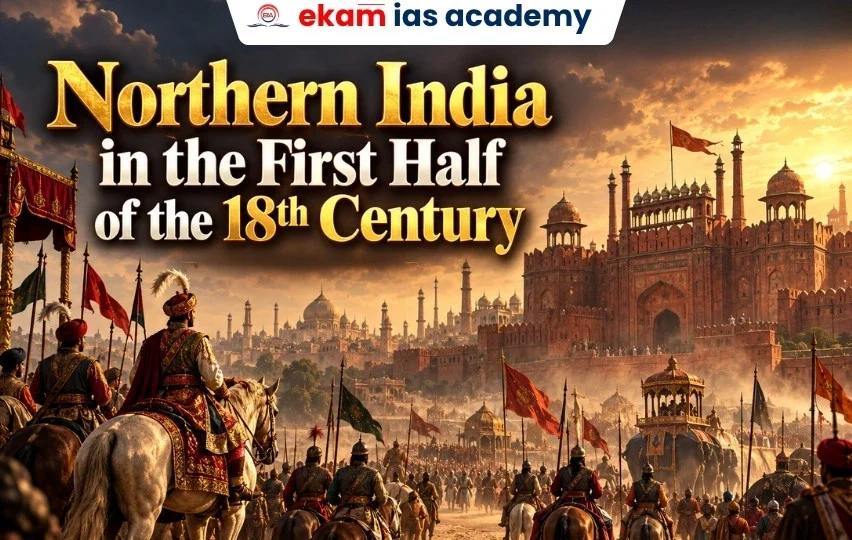
The political landscape of Northern India in the First Half of the 18th Century witnessed a profound transformation from a centralized imperial structure to a highly fragmented regional state system. The rapid Decline of the Mughal Empire following the death of Emperor Aurangzeb in 1707 created a power vacuum across the Indo-Gangetic plains. For civil services candidates preparing for Medieval Indian History UPSC and Modern Indian History UPSC, analyzing the political, military, and administrative realignments during this transitional era provides critical foundational knowledge regarding 18th-century state formation.
Historical Background
- Marked by the breakdown of imperial authority, fiscal crisis within the Jagirdari system, and widespread agrarian unrest.
- Characterized by a shift in political gravity away from the imperial center at Delhi toward vibrant provincial seats of power.
- Defined the transition period covering 18th Century Indian History and the emergence of early modern regional polities.
The War of Succession After Aurangzeb
- Triggered immediately upon Aurangzeb’s death in 1707, involving his sons Bahadur Shah I, Azam Shah, and Kam Bakhsh.
- Depleted the royal treasury, thinned the ranks of veteran commanders, and exposed deep factional rivalries at court.
- Compromised imperial prestige as competing princes made political concessions to gain military support from regional nobles.
The Mughal Succession Crisis, 1712–1720
- Dominated by rapid, violent royal assassinations and short-lived puppet emperors under Later Mughals in India.
- Witnessed the rise of powerful kingmaker factions, most notably the Sayyid Brothers (Abdullah Khan and Hussain Ali Khan).
- Destabilized central administration and severely weakened imperial control over distant subahs during this turbulent phase of Northern India History.
Rise of Autonomous and Regional States
- Driven by ambitious provincial governors (Subedars) seeking hereditary control while maintaining nominal allegiance to Delhi.
- Categorized broadly into successor states (Awadh, Bengal, Hyderabad), warrior states (Marathas, Sikhs, Jats), and independent principalities.
- Transformed the Political Conditions of India in the 18th Century into a competitive, multi-polar political ecosystem.
Awadh
- Founded as an autonomous state by Saadat Khan Burhan-ul-Mulk in 1722, who secured hereditary governorship over the province.
- Developed a prosperous agrarian base and successfully contained local Zamindari rebellions through direct state administration.
- Transformed Lucknow into a major socio-cultural center, serving as a prominent model among the Successor States of the Mughal Empire.
Bengal
- Established by Murshid Quli Khan, who reorganized provincial finances, converted Jagirs into crown lands (Khalisa), and boosted trade.
- Maintained regular revenue remittances to Delhi while operating with virtually total administrative independence.
- Fostered a powerful merchant-banking class (such as the Jagat Seths) that exerted massive influence over regional governance.
Hyderabad and the Nizam
- Carved out by Nizam-ul-Mulk Asaf Jah in 1724 following his victory over imperial forces at the Battle of Shakarkheda.
- Established the hereditary Asaf Jahi dynasty, shifting the political focus of Deccani politics away from northern direction.
- Functioned as a crucial sovereign power, checking both southern Maratha expansion and regional Sultanate remnants.
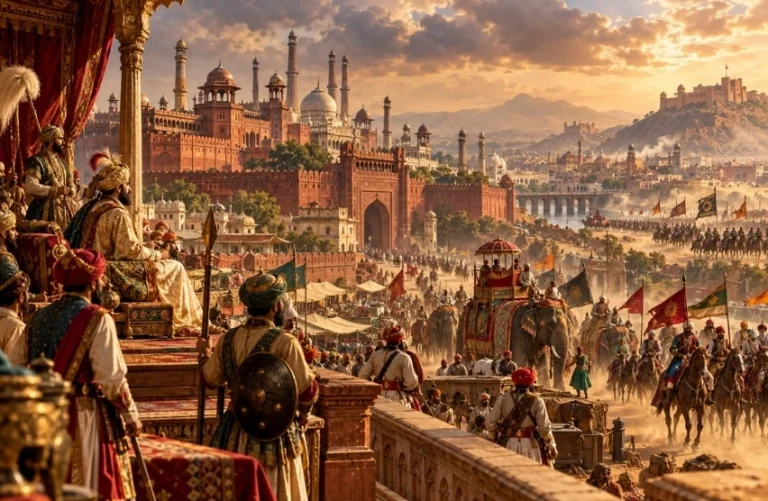
Maratha Expansion into Northern India
- Spearheaded by Peshwa Baji Rao I under the strategic banner of expanding Maratha influence north of the Narmada River.
- Resulted in the rapid acquisition of Malwa, Bundelkhand, and Gujarat during the ongoing Rise of Marathas in Northern India.
- Culminated in direct Maratha military presence near Delhi, challenging the long-standing authority of the Mughal Empire in the 18th Century.
Military and Administrative
- Marked by foreign invasions that exposed Northern India’s military vulnerabilities, starting with the catastrophic Nadir Shah Invasion of India in 1739.
- Followed by the devastating Ahmad Shah Abdali Invasions, which repeatedly looted Delhi and accelerated imperial collapse.
- Demonstrated the shift from heavy, centralized imperial armies toward agile, regional military contingents leveraging firepower and light cavalry.
Chronological Timeline
- 1707: Death of Aurangzeb; ascension of Bahadur Shah I after the War of Succession.
- 1713–1719: Political dominance of the Sayyid Brothers; rise and fall of puppet emperors.
- 1722–1724: Formal establishment of autonomous states in Awadh (Saadat Khan) and Hyderabad (Nizam-ul-Mulk).
- 1739: Nadir Shah’s invasion and sack of Delhi, dealing a lethal blow to imperial prestige.
- 1748–1761: Repeated invasions by Ahmad Shah Abdali, culminating in the Third Battle of Panipat.
Conclusion
The historical trajectory of Northern India in the First Half of the 18th Century reflects a complex balance of imperial decline and regional resurgence. While the political collapse of the central Mughal court enabled devastating foreign interventions, it simultaneously catalyzed dynamic state-building across successor polities. Understanding this structural transition and the Rise of Regional Powers in India remains essential for candidates analyzing the foundational background of modern Indian history in Mughal Empire UPSC examinations.
UPSC Prelims: PYQs & Practice Questions
Previous Year Questions (Prelims)
Q: Which of the following sequence of historical events in
Northern India during the first half of the 18th century
is in the correct chronological order?
(a) Death of Aurangzeb → Battle of Shakarkheda → Nadir Shah’s Invasion → First Invasion of Ahmad Shah Abdali
(b) Battle of Shakarkheda → Death of Aurangzeb → First Invasion of Ahmad Shah Abdali → Nadir Shah’s Invasion
(c) Death of Aurangzeb → Nadir Shah’s Invasion → Battle of Shakarkheda → First Invasion of Ahmad Shah Abdali
(d) Nadir Shah’s Invasion → Death of Aurangzeb → First Invasion of Ahmad Shah Abdali → Battle of Shakarkheda
Answer: (a)
Explanation:
Death of Aurangzeb: 1707 CE (At Ahmednagar).
Battle of Shakarkheda: 1724 CE (Nizam-ul-Mulk defeated the Mughal governor Mubariz Khan and established the autonomous state of Hyderabad).
Nadir Shah’s Invasion: 1739 CE (Plundered Delhi and carried away the Peacock Throne and Koh-i-Noor diamond).
First Invasion of Ahmad Shah Abdali: 1748 CE (Fought at the Battle of Manpur).
Q2: With reference to the 18th-century successor states of the Mughal Empire,
who among the following rulers reorganized Bengal's finances, converted several
Jagir lands into Khalisa (crown) lands, and introduced the
Izaredari (revenue farming) system?
(a) Saadat Khan Burhan-ul-Mulk
(b) Murshid Quli Khan
(c) Alivardi Khan
(d) Asaf Jah Nizam-ul-Mulk
Answer: (b) Murshid Quli Khan
Explanation:
Murshid Quli Khan, the founder of autonomous Bengal, transferred many
Jagirdars out of Bengal to Orissa and converted their assigned lands into
central Khalisa (crown) lands to ensure direct, regular revenue collection
for the treasury. He also introduced the Izaredari system to maximize
land revenue assessments.
Practice Questions
Q: Regarding the role of the Sayyid Brothers ("Kingmakers") in the Mughal court between 1713 and 1720, consider the following statements:
1. They abolished the Jizyah tax and pilgrimage tax across imperial territories to win the support of Rajput and Maratha leaders.
2. They concluded an agreement with Peshwa Balaji Vishwanath in 1719, granting the Marathas the right to collect Chauth and Sardeshmukhi across six subahs of the Deccan.
Which of the statements given above is/are correct?
(a) 1 only
(b) 2 only
(c) Both 1 and 2
(d) Neither 1 nor 2
Answer: (c) Both 1 and 2
Explanation:
Statement 1 is correct: Abdullah Khan and Hussain Ali Khan (the Sayyid Brothers) pursued an inclusive policy, abolishing Jizyah and pilgrimage taxes to build a strong political alliance with Rajput rulers (like Ajit Singh) and Marathas.
Statement 2 is correct: In 1719, Hussain Ali Khan negotiated a landmark treaty with Peshwa Balaji Vishwanath, recognizing Maratha rights to collect Chauth and Sardeshmukhi from the six Deccan subahs in exchange for maintaining a Maratha troop contingent in imperial service.
Q2: What was the immediate political impact of Peshwa Baji Rao I’s expansionist campaign into Northern India during the 1730s?
(a) Total unification of Sikh and Maratha armies under a single military command.
(b) Formal detachment of Malwa, Gujarat, and Bundelkhand from Mughal imperial authority and their integration into the Maratha sphere of influence.
(c) Immediate establishment of British East India Company paramountcy over Delhi.
(d) Treaty of Purandar restoring all conquered territories back to Emperor Muhammad Shah.
Answer: (b)
Explanation:
Under Peshwa Baji Rao I, Maratha armies crossed the Narmada and systematically wrested
Malwa, Gujarat, and Bundelkhand from Mughal governors, culminating in the
Battle of Bhopal (1737) where Nizam-ul-Mulk was forced to sign a convention
conceding Malwa and the territory between the Narmada and Chambal to the Marathas.
UPSC Mains – Previous Year & Practice Questions
Mains Previous Year Questions
Question: The rise of autonomous successor states in the 18th century was not a breakdown of state authority, but a decentralization and relocation of political and economic power from Delhi to the provinces. Critically analyze. (UPSC CSE Mains 2021)
Question: Evaluate the geopolitical consequences of Nadir Shah’s invasion (1739) and Ahmad Shah Abdali’s repeated invasions on the internal stability of Northern India. (UPSC CSE Mains 2017)
Question: Discuss the factors that facilitated the rapid Maratha expansion into Malwa, Gujarat, and the Gangetic plains in the first half of the 18th century. (UPSC CSE Mains 2012)
Question: Examine the administrative and revenue reforms introduced by Murshid Quli Khan in Bengal and Saadat Khan in Awadh that enabled them to function as autonomous rulers. (UPSC CSE Mains 2006)
Question: The party factionalism (Turani, Irani, Hindustani groups) at the Mughal court after 1707 created administrative paralysis that accelerated imperial collapse. Elucidate. (UPSC CSE Mains 1999)
Mains Practice Questions
[15 Marks | 250 Words]
Question: How far is it correct to view the early 18th century in Indian history not as a period of unmitigated chaos and dark ages, but as an era of dynamic regional state formation and economic reorientation?
[15 Marks | 250 Words]
Question: Analyze the military and structural shortcomings that prevented the Later Mughals from repelling external invasions like those of Nadir Shah and Ahmad Shah Abdali.
[15 Marks | 250 Words]
Question: The rise of powerful regional banking houses, such as the Jagat Seths in Bengal, fundamentally altered the relationship between state power and commercial finance in 18th-century India. Discuss.
First Half of the 18th Century UPSC-FAQs
What happened in Northern India in the first half of the 18th century?
Northern India witnessed the decline of Mughal authority, the rise of autonomous regional states, increasing Maratha expansion, and repeated foreign invasions by Nadir Shah and Ahmad Shah Abdali.
Why did the Mughal Empire decline in the 18th century?
The decline was caused by succession conflicts, weakening of the Jagirdari system, fiscal problems, agrarian unrest, factional politics, administrative decentralization, and prolonged military pressures.
Which regional states emerged after the decline of the Mughal Empire?
Important regional states included Awadh, Bengal, and Hyderabad, while the Marathas, Sikhs, and Jats emerged as powerful warrior and regional political forces.
Who established the autonomous states of Awadh and Hyderabad?
Saadat Khan Burhan-ul-Mulk established the autonomous state of Awadh in 1722, while Nizam-ul-Mulk Asaf Jah established Hyderabad as an autonomous power in 1724.
Why is Northern India in the first half of the 18th century important for UPSC?
The period explains the transition from Mughal imperial rule to regional political formations, Maratha expansion, foreign invasions, and the political conditions that eventually shaped the emergence of British power in India.