Table of Contents
ToggleMaratha Bid for Supremacy UPSC
The Maratha Bid for Supremacy during the 18th century represents one of the most defining political transformations in pre-colonial South Asia. Following the decline of centralized Mughal authority, the Marathas transitioned from a regional guerrilla force into an pan-Indian empire. For civil services candidates covering Medieval Indian History UPSC and Maratha Empire UPSC, analyzing Maratha Supremacy in India provides essential insights into 18th-century state-building, military expansion, and regional confederacy dynamics.
Historical Background: Marathas after Shivaji
- Preserved state survival through a 20-year war of resistance (1687–1707) against the full military might of Emperor Aurangzeb.
- Transformed from a tightly centralized state into a decentralized movement of regional military commanders (Sardars).
- Built upon the foundations of Shivaji and Maratha Power to prepare for expansion north of the Narmada River.
Shahu and the Maratha Succession Conflict
- Triggered by the release of Chhatrapati Shahu from Mughal captivity in 1707, leading to a civil war with Tarabai’s Kolhapur faction.
- Resolved through the political support of prominent regional chieftains and the diplomatic genius of Balaji Vishwanath.
- Established Satara as the imperial seat of Chhatrapati Shahu, stabilizing internal politics for the Rise of Maratha Power.
Rise of the Peshwas
- Initiated with the appointment of Balaji Vishwanath and Maratha Empire financial consolidation as Prime Minister (Peshwa) in 1713.
- Institutionalized prime ministerial authority, making the office of Peshwa hereditary based at Pune.
- Replaced direct royal command with a flexible imperial system led by dynamic leaders like Baji Rao I and Balaji Baji Rao.
Maratha Political and Administrative Structure
- Evolved into the Maratha Confederacy, featuring semi-autonomous ruling families like Scindia (Gwalior), Holkar (Indore), Gaekwad (Baroda), and Bhonsle (Nagpur).
- Combined central policy direction from Pune with regional initiative on distant military frontiers.
- Exhibited political flexibility that accelerated rapid Maratha Empire Expansion across Northern and Central India.
Maratha Revenue Claims and Economic Foundations
- Depended on external levies of Chauth (25%) and Sardeshmukhi (10%) from non-Maratha territories in exchange for protection.
- Secured formal legal rights (Sanads) from the Mughal court in 1719 to collect revenues across the six subahs of the Deccan.
- Created a lucrative fiscal network that funded continuous military campaigns and sustained the Maratha Empire in India.
Conflict with the Nizam of Hyderabad
- Sparked by Nizam-ul-Mulk’s attempts to check Maratha revenue collections and sow discord within Maratha ranks.
- Highlighted by Baji Rao I’s tactical brilliance at the Battle of Palkhed (1728), where the Nizam’s army was outmaneuvered.
- Resulted in the Treaty of Mungi-Shevgaon, forcing the Nizam to recognize Maratha revenue claims in the Deccan.
Expansion into Malwa and Gujarat
- Driven by Baji Rao I Expansion strategies aiming to strike at the core of imperial territory.
- Detached fertile trade corridors and strategic passes from Mughal control through victories at Bhopal and Dabhoi.
- Established Maratha provincial headquarters across Central India, integrating Malwa and Gujarat into the state.
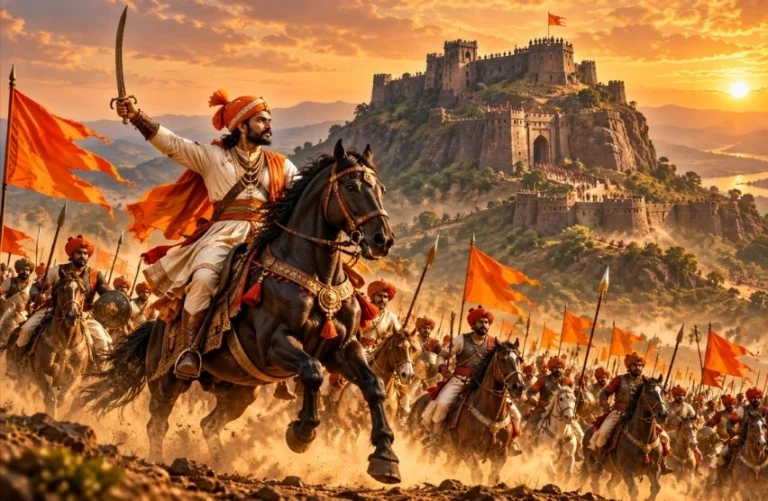
Marathas and the Mughal Empire
- Shifted from outright anti-imperial resistance to acting as the primary military protectors of the Mughal throne in Delhi.
- Culminated in the 1752 treaty where the Peshwa agreed to defend the empire from internal and external threats in exchange for Chauth.
- Positioned the Marathas as the paramount political arbiter in the Maratha Mughal Conflict.
Why Did the Maratha Bid for Supremacy Face Limits
- Alienated regional powers (Rajputs, Jats, and Rohillas) due to harsh revenue demands and predatory plundering.
- Failed to modernize infantry and artillery tactics, remaining overly reliant on traditional light cavalry.
- Suffered a catastrophic defeat in the Third Battle of Panipat 1761 against Ahmad Shah Abdali, shattering imperial momentum.
Chronological Timeline
- 1707: Release of Shahu; outbreak of Maratha succession struggle.
- 1713: Balaji Vishwanath appointed Peshwa; foundation of hereditary Peshwa rule.
- 1728: Battle of Palkhed; defeat of the Nizam of Hyderabad by Baji Rao I.
- 1737: Baji Rao I’s daring cavalry raid on the outskirts of Delhi.
- 1761: Third Battle of Panipat 1761 halts northern expansion.
Conclusion
The Maratha Bid for Supremacy fundamentally reshaped the geopolitical landscape of 18th-century South Asia. Although structural weaknesses and diplomatic isolation capped their total unification of the subcontinent, the Marathas successfully dismantled Mughal hegemony. A thorough study of Maratha History UPSC and Peshwas and Maratha Empire is indispensable for analyzing pre-colonial Indian statecraft.
UPSC Prelims: PYQs & Practice Questions
Previous Year Questions (Prelims)
Q: Which one of the following battles effectively crippled the
Nizam of Hyderabad's attempt to challenge Maratha revenue supremacy
in the Deccan in 1728?
(a) Battle of Bhopal
(b) Battle of Palkhed
(c) Battle of Shakarkheda
(d) Battle of Vasai
Answer: (b) Battle of Palkhed
Explanation:
The Battle of Palkhed (1728) was a tactical masterpiece executed by
Peshwa Baji Rao I against Nizam-ul-Mulk. Baji Rao outmaneuvered the
Nizam's heavy artillery using rapid, light cavalry movements, surrounding the Nizam's
forces at Palkhed and forcing him to sign the Treaty of Mungi-Shevgaon,
which recognized Chhatrapati Shahu's sovereign rights to collect
Chauth and Sardeshmukhi in the Deccan.
Q2: With reference to the 18th-century Maratha Empire,
consider the following statements regarding the 1752 treaty between
Peshwa Balaji Baji Rao and the Mughal court.
1. The Marathas agreed to protect the Mughal Empire against internal and external
enemies like Ahmad Shah Abdali.
2. In return, the Marathas were granted the rights to collect Chauth
across the northern provinces, including the Punjab and Multan.
Which of the statements given above is/are correct?
(a) 1 only
(b) 2 only
(c) Both 1 and 2
(d) Neither 1 nor 2
Answer: (c) Both 1 and 2
Explanation:
Both statements are correct: Under the 1752 agreement negotiated by
the Peshwa's court, the Marathas became the official military protectors of the Mughal
throne in Delhi. In return for defending imperial borders against external invaders
such as Ahmad Shah Abdali and internal rebels, the Mughal Emperor ceded
rights to collect revenue (Chauth) across northwestern provinces,
drawing the Marathas directly into the politics of Punjab.
Practice Questions
Q: Regarding the structural nature of the Maratha Confederacy during the reign of the Peshwas, consider the following statements:
1. The major Maratha families—Scindias of Gwalior, Holkars of Indore,
Gaekwads of Baroda, and Bhonsles of Nagpur—operated with complete internal
autonomy while recognizing the Peshwa as the central executive head.
2. The expansion into Central and Northern India was managed through direct
state administration by the central treasury at Satara rather than regional
military command bases.
Which of the statements given above is/are correct?
(a) 1 only
(b) 2 only
(c) Both 1 and 2
(d) Neither 1 nor 2
Answer: (a) 1 only
Explanation:
Statement 1 is correct: The Maratha Confederacy evolved as
a loose alliance of autonomous military commanders (Sardars)
who expanded into different geographical zones while maintaining nominal
allegiance to the Peshwa at Pune and the Chhatrapati at Satara.
Statement 2 is incorrect: Expansion was spearheaded directly
by regional commanders, such as Scindias in Malwa/Delhi, Holkars in Malwa,
and Gaekwads in Gujarat, who maintained their own military bases, armies,
and regional administrative apparatuses rather than relying on central
administration from Satara.
Q2: What was the primary geopolitical reason behind the diplomatic isolation of the Marathas prior to the Third Battle of Panipat (1761)?
(a) The refusal of the Marathas to fight against European trading companies
along the Western coast.
(b) Indiscriminate financial extractions (Chauth) and
predatory territorial raids into Rajputana, Jat, and Rohilla territories.
(c) Formal military alliance between the Peshwa and the British East India
Company against Northern powers.
(d) Complete conversion of non-Maratha territories into directly administered
crown lands.
Answer: (b) Indiscriminate financial extractions (Chauth) and predatory territorial raids
Explanation:
During their rapid northern expansion, the Marathas alienated potential
allies like the Rajputs of Amber/Marwar, the
Jats of Bharatpur, and the Rohilla Afghans
by imposing heavy financial levies (Chauth) and interfering
in local succession disputes. Consequently, when Ahmad Shah Abdali invaded
in 1761, no major Northern Indian regional power came forward to support
the Marathas at Panipat.
UPSC Mains – Previous Year & Practice Questions
Mains Previous Year Questions
Question: The transition of the Maratha state from a unified, centralized kingdom under Shivaji to a loose confederacy under the Peshwas carried inherent structural limits that contributed to its ultimate decline. Critically analyze. (UPSC CSE Mains 2022)
Question: Evaluate the strategic and geopolitical factors that led to the Third Battle of Panipat (1761). How far did this defeat alter the political trajectory of 18th-century India? (UPSC CSE Mains 2018)
Question: Discuss the military genius and expansionist vision of Peshwa Baji Rao I in transforming the Maratha movement into a pan-Indian empire. (UPSC CSE Mains 2013)
Question: Examine the financial underpinnings of the Maratha Empire, with special reference to the revenue collections of Chauth and Sardeshmukhi. (UPSC CSE Mains 2007)
Question: The Maratha bid for all-India supremacy failed not because of a lack of military valor, but due to political isolation, administrative loose-coupling, and strategic short-sightedness. Comment. (UPSC CSE Mains 2002)
Mains Practice Questions
[15 Marks | 250 Words]
Question: How far is it correct to argue that the Marathas stepped into the shoes of the declining Mughals as military protectors of Delhi, yet failed to construct an enduring pan-Indian state institutional structure?
[15 Marks | 250 Words]
Question: Analyze the political and economic conflict between the Maratha Empire and the Nizam of Hyderabad during the first half of the 18th century. How did it impact Deccani regional politics?
[10 Marks | 150 Words]
Question: “The Third Battle of Panipat (1761) did not decide who would rule India, but rather who would not.” Re-evaluate this classic historical statement in the context of 18th-century state formation.
Maratha Bid for Supremacy UPSC-FAQs
What was the Maratha Bid for Supremacy?
The Maratha Bid for Supremacy was the 18th-century expansion of Maratha political and military power from the Deccan into Northern and Central India following the decline of Mughal authority.
Who were the major Peshwas responsible for Maratha expansion?
Balaji Vishwanath laid the foundation for Peshwa dominance, while Baji Rao I significantly expanded Maratha influence into Malwa, Gujarat and Northern India.
What was the significance of the Battle of Palkhed?
The Battle of Palkhed (1728) demonstrated Baji Rao I’s superior mobile warfare strategy and forced the Nizam of Hyderabad to recognize important Maratha revenue claims.
What were Chauth and Sardeshmukhi?
Chauth was a levy generally amounting to 25% of revenue, while Sardeshmukhi was an additional 10% claim imposed by the Marathas on territories outside their core domain.
Why did the Maratha Bid for Supremacy decline?
The Maratha expansion faced limitations due to diplomatic isolation, resistance from regional powers, military weaknesses in infantry and artillery, and the decisive defeat at the Third Battle of Panipat in 1761.