Table of Contents
ToggleMedieval Indian Society UPSC
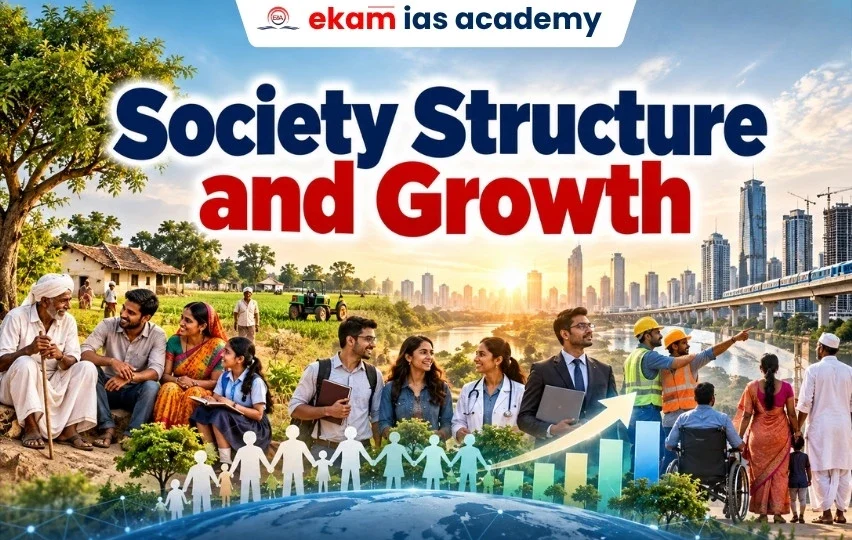
The evolution of Society Structure and Growth during the medieval period transformed the socio-cultural fabric of the Indian subcontinent. Characterized by complex social stratification, agrarian consolidation, and vibrant urban centers, this era bridged ancient traditions with early modern dynamics. For civil services aspirants studying Indian Society UPSC, evaluating Social Structure in India and the drivers of Social Change in India provides essential analytical insights into social hierarchy, institutional development, and cultural synthesis.
Historical Background
- Emerged from the realignment of post-Gupta regional polities into centralized Sultanates and the Mughal Empire.
- Witnessed the integration of diverse regional, pastoral, and migrant populations into the agrarian fold.
- Marked a period of significant Social Growth in India, driven by expanding agricultural frontiers and trade routes.
Structure of Medieval Indian Society
- Divided broadly into rural agrarian masses, urban artisan-merchant guilds, and a multi-ethnic ruling elite.
- Influenced deeply by traditional Social Institutions in India, including joint families, village communities, and caste councils.
- Reflected a dynamic matrix of Indian Society and Culture, balancing rigid social hierarchies with mobility.
Caste and Jati Structure
- Governed by Social Stratification in India, where the traditional Varna model overlapped with localized Jati occupational sub-castes.
- Saw the proliferation of intermediate occupational groups through agrarian expansion and craftsmanship under the Caste System in India.
- Utilized sub-caste councils (Jati Panchayats) to regulate marriage, social customs, and intra-community trade conduct.
Ruling Classes and Nobility
- Composed of a cosmopolitan ruling class including Turks, Afghans, Persians, Rajputs, Marathas, and Deccanis.
- Occupied key administrative and military positions within state hierarchies like the Iqta and Mansabdari systems.
- Defined standard patterns of courtly culture, political patronage, and urban luxury consumption.
Peasants and Agricultural Communities
- Formed the vast economic backbone of rural society, divided into resident cultivators (Khudkasht) and migratory farmers (Pahi-kasht).
- Endured heavy state land revenue demands while maintaining strong collective ties to village landholdings.
- Played a pivotal role in driving agrarian expansion across regional river valleys and frontiers.
Zamindars and Local Elites
- Acted as critical intermediaries between the imperial central state and local rural peasant communities.
- Retained hereditary land rights (Milkiyat), armed retainers, and traditional revenue-collection privileges.
- Exercised significant local power, frequently leading regional peasant resistance during times of excessive fiscal demands.
Artisans, Traders and Merchants
- Organized into specialized urban and rural craft guilds to supply imperial workshops (Karkhanas) and overseas markets.
- Benefited from growing commercialization, regional trade networks, and monetary standardization.
- Included influential mercantile communities like the Banias, Chettis, Multanis, and Oswals, who facilitated widespread credit systems (Hundis).
Women in Medieval Indian Society
- Experienced patriarchal constraints reflected in prevalent customs such as the Pardah system, Sati, and child marriage.
- Maintained significant economic roles in rural households, agriculture, textile processing, and cottage crafts.
- Saw notable exceptions of political leadership and cultural patronage, alongside a rigid Family Structure in India.
Tribal and Forest Communities
- Inhabited extensive forest frontiers, hill regions, and peripheral zones outside traditional settled agriculture.
- Transitioned gradually toward settled farming, contributing to ongoing Social Development in India.
- Formed powerful regional dynasties, such as the Gonds and Ahoms, preserving distinct socio-cultural identities.
Bhakti and Sufi Movements
- Challenged rigid socio-religious orthodoxies and social inequality through egalitarian spiritual philosophies.
- Promoted regional vernacular languages, democratization of learning, and inclusive community gatherings (Sangat and Khanqah).
- Catalyzed powerful socio-religious reform, fostering lasting harmony across diverse communities under Society and Social Change UPSC.
Growth of Towns and Urban Culture
- Accelerated urban expansion through the flourishing of administrative capitals, commercial hubs, and pilgrimage centers.
- Fostered a distinctive syncretic urban ethos (Ganga-Jamuni Tehzeeb) across major regional centers.
- Facilitated spatial and occupational mobility, driving multi-faceted structural transformations in Indian Social Structure.
Conclusion
The study of Society Structure and Growth in medieval India highlights a resilient, highly structured, yet evolving social order. By examining the interplay of traditional hierarchies, economic development, and transformative social movements, candidates gain a deeper understanding of Social Structure in India. Mastering these socio-economic transformations is essential for excelling in Indian Society UPSC and medieval history modules.
UPSC Prelims: PYQs & Practice Questions
Previous Year Questions (Prelims)
Q: With reference to medieval India, which one of the following terms refers to the specialized negotiable bill of exchange used by merchant networks for credit and money transfer?
(a) Khati
(b) Hundi
(c) Taqavi
(d) Abwab
Answer: (b) Hundi
Explanation:
A Hundi was a financial instrument/bill of exchange developed in medieval India for credit transactions and long-distance money transfers without physically moving specie. It was widely utilized by mercantile groups like Banias, Multanis, and Oswals, reflecting commercial growth and urban credit mechanisms.
Q: Consider the following statements regarding the agrarian social structure during the Mughal period:
1. Khudkasht were resident peasants who cultivated land in their own villages where they held permanent occupancy rights.
2. Pahikasht were non-resident, migratory farmers who cultivated land in villages other than their own on a contractual basis.
Select the correct answer:
(a) 1 only
(b) 2 only
(c) Both 1 and 2
(d) Neither 1 nor 2
Answer: (c) Both 1 and 2
Explanation:
Statement 1 is correct: Khudkasht peasants owned their land, agricultural implements, and bullocks within their native village, paying land revenue directly or through village headmen.
Statement 2 is correct: Pahikasht were itinerant or non-resident cultivators who moved to neighboring villages either due to favorable revenue rates or distress (droughts/famines).
Practice Questions
Q: With reference to the medieval social structure and rural institutions, consider the following statements:
1. Jati Panchayats functioned as autonomous community councils that enforced occupational standards, resolved marital disputes, and regulated ritual conduct within specific sub-castes.
2. The state strictly prohibited local Jati Panchayats from imposing fines or excommunicating members to maintain centralized judicial control.
Which of the statements given above is/are correct?
(a) 1 only
(b) 2 only
(c) Both 1 and 2
(d) Neither 1 nor 2
Answer: (a) 1 only
Explanation:
Statement 1 is correct: Jati Panchayats exercised substantial social authority, regulating internal caste norms, occupational conduct, marriage customs, and civil disputes.
Statement 2 is incorrect: The state (both Sultanates and Mughals) generally recognized and respected the autonomy of Jati Panchayats, allowing them to levy social fines or excommunicate members without state interference.
Q2: During the medieval period, the terms Karkhanas referred to which of the following?
(a) Military outposts established along major trade highways to collect road cesses (Rahdari).
(b) Royal state-managed manufacturing workshops producing luxury goods, textiles, and military equipment.
(c) Specialized educational institutes attached to urban Khanqahs for judicial training.
(d) Agricultural grain reserves maintained exclusively for drought relief in royal capital cities.
Answer: (b) Royal state-managed manufacturing workshops producing luxury goods, textiles, and military equipment.
Explanation:
Karkhanas were manufacturing establishments run by the royal court (Buyutat) to supply the imperial household, court, and army with high-end textiles, metalwork, weapons, and courtly luxury items.
UPSC Mains – Previous Year & Practice Questions
Mains Previous Year Questions
Question: Bhakti and Sufi movements were not merely religious revivals, but powerful social catalysts that challenged traditional caste hierarchies and democratized vernacular culture. (UPSC CSE Mains 2022)
Question: Analyze the social and economic impact of urban growth, craft commercialization, and trade guilds in medieval India during the 16th and 17th centuries. (UPSC CSE Mains 2018)
Question: Discuss the composition, rights, and role of local rural elites (Zamindars) in the socio-agrarian structure of Mughal India. (UPSC CSE Mains 2013)
Question: Examine the socio-economic status and economic contributions of women in medieval Indian agrarian and artisan households. (UPSC CSE Mains 2008)
Question: Trace the process of assimilation of tribal and forest communities into the settled agrarian economy during the medieval period. (UPSC CSE Mains 2001)
Mains Practice Questions
[15 Marks | 250 Words]
Question: The medieval Indian urban space represented a melting pot of cosmopolitan trade networks, guild structures, and syncretic culture (Ganga-Jamuni Tehzeeb). Discuss with suitable examples.
[10 Marks | 150 Words]
Question: How far did the proliferation of Jatis and regional sub-castes during the medieval period reflect expanding agricultural frontiers and economic specialization?
[15 Marks | 250 Words]
Question: While patriarchal structures restricted women in formal political spheres, their participation in rural production, cottage industries, and devotional movements was central to medieval society. Critically evaluate.
Medieval Indian Society UPSC-FAQs
What was the social structure of medieval Indian society?
Medieval Indian society consisted broadly of ruling elites, zamindars, peasants, artisans, merchants, tribal communities, and religious groups. Caste, occupation, land ownership, and political status influenced social hierarchy.
What role did peasants play in medieval Indian society?
Peasants formed the economic foundation of medieval India through agricultural production and payment of land revenue. Groups such as Khudkasht and Pahi-kasht contributed to the expansion of cultivation across different regions.
How did the Bhakti and Sufi movements influence medieval Indian society?
The Bhakti and Sufi movements challenged rigid social and religious boundaries, encouraged vernacular traditions, and promoted devotional and inclusive forms of spiritual expression. They contributed significantly to social and cultural change.
What was the role of zamindars in medieval Indian society?
Zamindars acted as important local intermediaries between the state and rural communities. They exercised influence over land, revenue collection, local administration, and armed retainers, making them significant regional power holders.
How did towns and trade contribute to social growth in medieval India?
The growth of administrative centres, commercial towns, pilgrimage centres, and craft production increased occupational and social mobility. Expanding trade networks also strengthened merchant communities and contributed to the development of urban culture.