
Table of Contents
ToggleIndia and the Gulf: A New Strategic Partnership
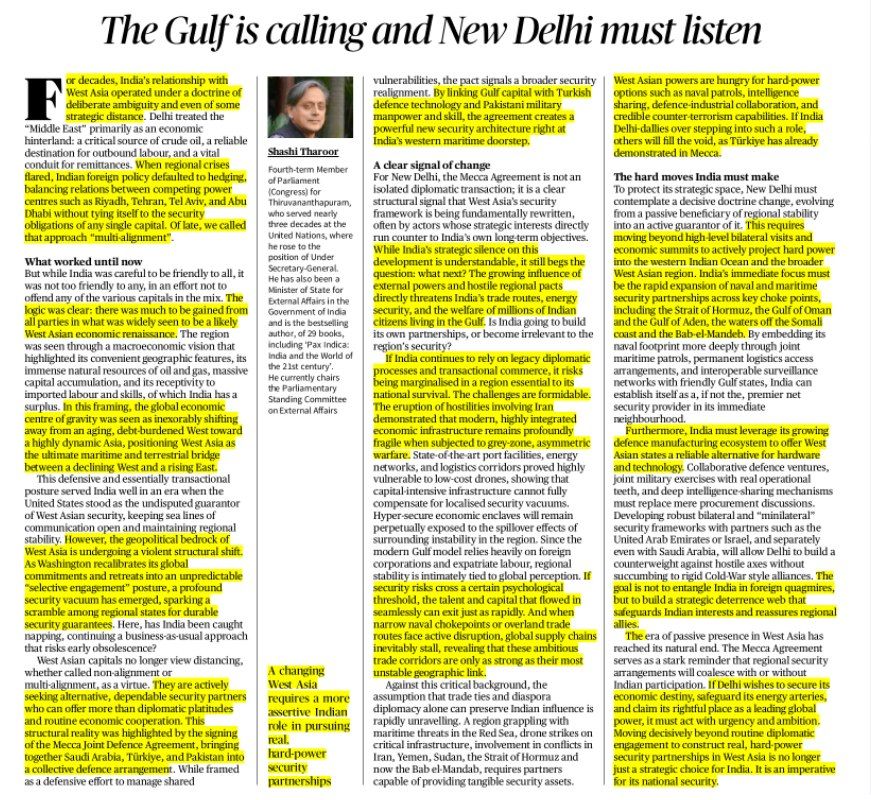
India’s relationship with the Gulf region is undergoing a significant transformation. Traditionally driven by energy, trade and the Indian diaspora, India–Gulf relations are increasingly expanding into defence, maritime security, technology and strategic cooperation.
From Economic Engagement to Strategic Partnership
For decades, India’s engagement with West Asia was largely shaped by economic interests. The Gulf remains crucial for India because of energy supplies, trade and remittances from Indian workers.
However, changing geopolitical conditions are pushing India towards a more comprehensive strategic approach.
The Mecca Agreement between Saudi Arabia, Türkiye and Pakistan, which envisaged collective defence cooperation, highlights the changing security environment in the region.
Why the Gulf Matters to India
The Gulf is strategically important because of its proximity to the Arabian Sea and the Indian Ocean.
Instability in the region can affect:
- India’s energy security
- Maritime trade
- Shipping routes
- Indian diaspora
- Remittance flows
- Regional stability
Conflicts and instability around the Strait of Hormuz and Bab-el-Mandeb can have direct consequences for India’s economy and maritime interests.
The Need for a New Security Architecture
The article argues that India can no longer rely only on traditional diplomatic engagement. West Asian states are increasingly seeking hard-power partnerships, including intelligence sharing, defence-industrial cooperation and counter-terrorism capabilities.
India therefore needs to strengthen its security partnerships while maintaining its strategic autonomy.
Its growing defence cooperation with countries such as the UAE and Saudi Arabia provides opportunities for deeper military exercises, technology cooperation and maritime security.
India’s Maritime Role
India’s geographical position gives it an important role in securing the wider Indian Ocean region.
India can contribute through:
- Maritime domain awareness
- Naval cooperation
- Intelligence sharing
- Anti-piracy operations
- Protection of sea lanes
- Defence logistics and infrastructure
Greater cooperation with Gulf countries can therefore strengthen security across the Arabian Sea and Indian Ocean.
Balancing Strategic Partnerships
India must also avoid becoming dependent on any single regional or global power.
The article suggests deeper engagement with West Asian countries, ASEAN partners, Australia and other regional actors while avoiding the rigid bloc politics of the Cold War.
This approach can provide India with greater strategic flexibility and help build a multipolar regional security architecture.
Conclusion
India’s relationship with the Gulf is moving beyond traditional energy and diaspora diplomacy towards a broader strategic and security partnership.
As geopolitical competition intensifies, India must strengthen defence cooperation, maritime security, intelligence sharing and technological partnerships while preserving its strategic autonomy. A stable and secure Gulf is not only important for West Asia but also for India’s national security, economic interests and wider Indo-Pacific strategy.
Vocabulary
1. Multi-alignment – Engaging multiple powers
2. Hard Power – Military/economic influence
3. Deterrence – Preventing hostile action
4. Minilateralism – Small-group cooperation
5. Strategic Autonomy – Independent decision-making
Prelims MCQs
MCQ 1
With reference to India–Gulf relations, consider the following statements:
- India’s engagement with the Gulf has traditionally been driven by energy, trade and remittances.
- India’s relationship with Gulf countries is increasingly expanding into defence and maritime security.
- The Gulf region has no significant relevance to India’s energy security.
Which of the statements given above is/are correct?
A) 1 only
B) 1 and 2 only
C) 2 and 3 only
D) 1, 2 and 3
Answer: B) 1 and 2 only
MCQ 2
Which of the following are important strategic maritime routes/waterways for India’s interests in West Asia?
- Strait of Hormuz
- Bab-el-Mandeb
- Arabian Sea
Select the correct answer using the code below:
A) 1 only
B) 1 and 2 only
C) 2 and 3 only
D) 1, 2 and 3
Answer: D) 1, 2 and 3
UPSC Mains Question
“India’s engagement with the Gulf is shifting from an energy-centric relationship towards a broader strategic and security partnership.” Discuss.
Key points to cover:
- Traditional pillars: energy, trade and Indian diaspora
- Strategic importance of the Gulf for India
- Importance of the Strait of Hormuz and Bab-el-Mandeb
- Impact of West Asian conflicts on India’s energy and maritime security
- Growing defence cooperation with Gulf countries
- Intelligence sharing and counter-terrorism cooperation
- Maritime domain awareness and protection of sea lanes
- Defence technology and industrial cooperation
- India’s role in the Indian Ocean and Arabian Sea
- Need to engage Saudi Arabia, UAE and other regional partners
- Maintaining strategic autonomy
- Avoiding rigid bloc politics and strengthening a multipolar regional security architecture
- Linking Gulf engagement with India’s wider Indo-Pacific strategy
Frequently Asked Questions (FAQs)
Why is the Gulf region strategically important for India?
The Gulf is vital for India’s energy security, trade, remittances, diaspora interests and maritime security, particularly because of its proximity to key Indian Ocean sea routes.
How are India–Gulf relations changing?
Relations are moving beyond traditional energy and economic cooperation towards defence, intelligence sharing, maritime security, technology and strategic partnerships.
Why are the Strait of Hormuz and Bab-el-Mandeb important for India?
Disruptions in these strategic waterways can affect India’s energy supplies, shipping routes and trade, making maritime security a major Indian interest.
What role can India play in Gulf security?
India can contribute through maritime domain awareness, naval cooperation, intelligence sharing, anti-piracy operations and protection of critical sea lanes.
How can India maintain strategic autonomy in West Asia?
India should deepen partnerships with Gulf countries and other regional powers while avoiding dependence on any single bloc or power and pursuing a flexible, multipolar regional strategy.
Source From : The Hindu
India’s GDP Growth: Understanding the Numbers Behind the Headline
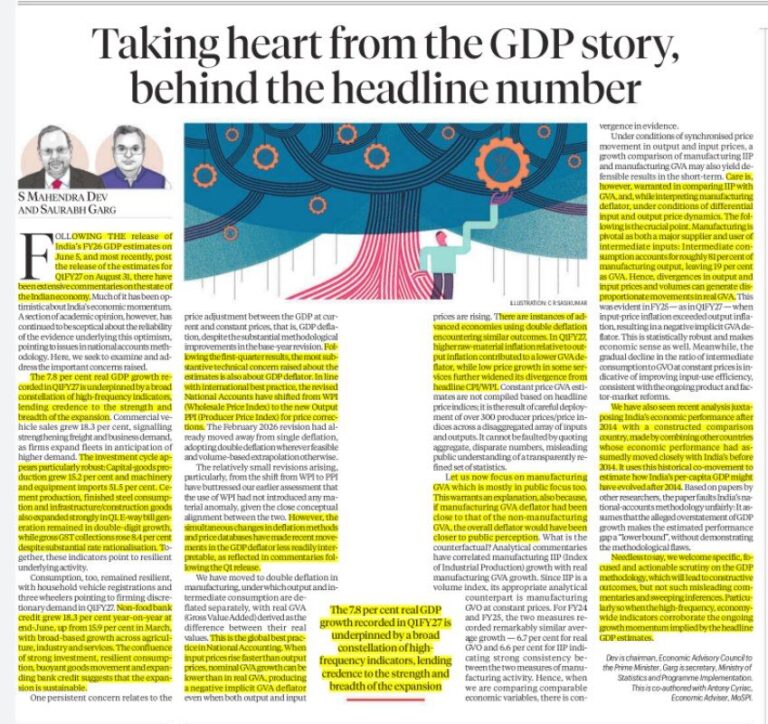
India’s 7.8% real GDP growth in Q1 FY27 has generated considerable attention. The article argues that the headline growth figure is supported by improvements across several economic indicators, although questions remain about the methodology used to measure real economic activity.
Strong Growth Across Key Sectors
The 7.8% real GDP growth reflects broad-based economic expansion. The article highlights improvements in:
- Private consumption
- Capital goods production
- Investment activity
- Government expenditure
- Services
- Manufacturing
The growth therefore cannot be attributed to a single sector or temporary factor.
Consumption and Investment Support Growth
Private consumption has remained an important driver of India’s economic expansion. Indicators such as vehicle registrations, household purchasing activity and consumption demand point towards continued domestic momentum.
Investment has also strengthened, with capital goods production and fixed investment supporting productive capacity.
Understanding the GDP Deflator
One important issue discussed is the GDP deflator, which is used to convert nominal GDP into real GDP.
The article notes that changes in price-adjustment methods can influence the measurement of real growth. Therefore, interpreting GDP figures requires attention not only to the headline growth rate but also to the underlying price and volume movements.
Manufacturing Data and Measurement Challenges
The article gives particular attention to manufacturing. It argues that manufacturing growth should be assessed using multiple indicators rather than relying exclusively on a single measure.
Indicators such as the Index of Industrial Production (IIP), manufacturing GVA and company-level data can provide different perspectives on economic activity.
Differences between these measures may arise because they capture different aspects of production.
Why High-Frequency Indicators Matter
High-frequency indicators provide additional evidence about the strength of economic activity. These include:
- Industrial production
- Capital goods output
- Vehicle registrations
- Electricity demand
- Investment activity
- Consumption indicators
A broad improvement across such indicators strengthens confidence that headline GDP growth reflects underlying economic momentum.
Need for Better GDP Measurement
The article stresses the importance of continuously improving India’s national accounts framework. GDP estimates should capture structural changes in the economy and provide reliable information for policymaking.
Better data quality and transparent methodology are particularly important when economic policy decisions depend heavily on growth estimates.
Conclusion
India’s 7.8% real GDP growth appears to be supported by broad improvements in consumption, investment, manufacturing and other economic indicators. However, the headline number should be interpreted alongside the GDP deflator, GVA, IIP and high-frequency indicators.
A comprehensive assessment of India’s economic performance therefore requires looking beyond the headline GDP figure and examining the underlying drivers and measurement methodology.
Vocabulary
1. Real GDP – Output adjusted for inflation
2. GDP Deflator – Economy-wide price measure
3. GVA – Value added by producers
4. Double Deflation – Separately deflating output and inputs
5. High-Frequency Indicators – Short-term economic activity measures
Prelims MCQs
MCQ 1
With reference to India’s GDP growth, consider the following statements:
- Real GDP growth reflects changes in the volume of economic activity after accounting for price changes.
- The GDP deflator is used in converting nominal GDP into real GDP.
- A rise in nominal GDP necessarily implies an equivalent rise in real GDP.
Which of the statements given above is/are correct?
A) 1 and 2 only
B) 1 only
C) 2 and 3 only
D) 1, 2 and 3
Answer: A) 1 and 2 only
MCQ 2
Which of the following indicators can provide supporting evidence for assessing the underlying strength of economic activity?
- Index of Industrial Production (IIP)
- Capital goods production
- Vehicle registrations
- Consumption indicators
Select the correct answer using the code below:
A) 1 and 2 only
B) 1, 2 and 3 only
C) 2, 3 and 4 only
D) 1, 2, 3 and 4
Answer: D) 1, 2, 3 and 4
UPSC Mains Question
“India’s headline GDP growth should be assessed alongside underlying economic indicators and the methodology used to measure real output.” Discuss.
Key points to cover:
- India’s 7.8% real GDP growth in Q1 FY27
- Meaning and significance of real GDP
- Role of the GDP deflator in measuring real growth
- Importance of GVA in sector-wise assessment
- Contribution of consumption and investment
- Manufacturing and services performance
- Role of IIP and capital goods production
- Importance of high-frequency indicators such as vehicle registrations and consumption trends
- Why different indicators may provide different signals
- Need for reliable and transparent national accounts methodology
- Importance of looking beyond headline GDP for assessing the quality and sustainability of growth
Frequently Asked Questions (FAQs)
What was India’s real GDP growth in Q1 FY27?
India recorded 7.8% real GDP growth in Q1 FY27, reflecting broad-based expansion across key areas of economic activity.
What are the major drivers of India’s GDP growth?
Private consumption, investment, manufacturing, services and government expenditure have contributed to the recent growth momentum.
What is the GDP deflator?
The GDP deflator is a price measure used to distinguish changes in the value of economic output caused by prices from changes in actual production.
Why are high-frequency indicators important for GDP analysis?
Indicators such as IIP, capital goods production, vehicle registrations and consumption data provide additional evidence about the underlying strength of economic activity.
Why should GDP growth figures be analysed carefully?
Headline GDP growth should be examined alongside GVA, the GDP deflator, IIP and other economic indicators to understand the actual drivers and sustainability of growth.