Table of Contents
ToggleEmployment Guarantee Crisis in India: MGNREGA to VB-G RAM G
India’s rural employment guarantee system is undergoing a major transition from MGNREGA to the Viksit Bharat–Guarantee for Rozgar and Ajeevika Mission (Gramin), or VB-G RAM G. However, the article highlights a sharp fall in employment generation during 2026, raising concerns over the effectiveness of the new rural employment framework.
Sharp Decline in Rural Employment Generation
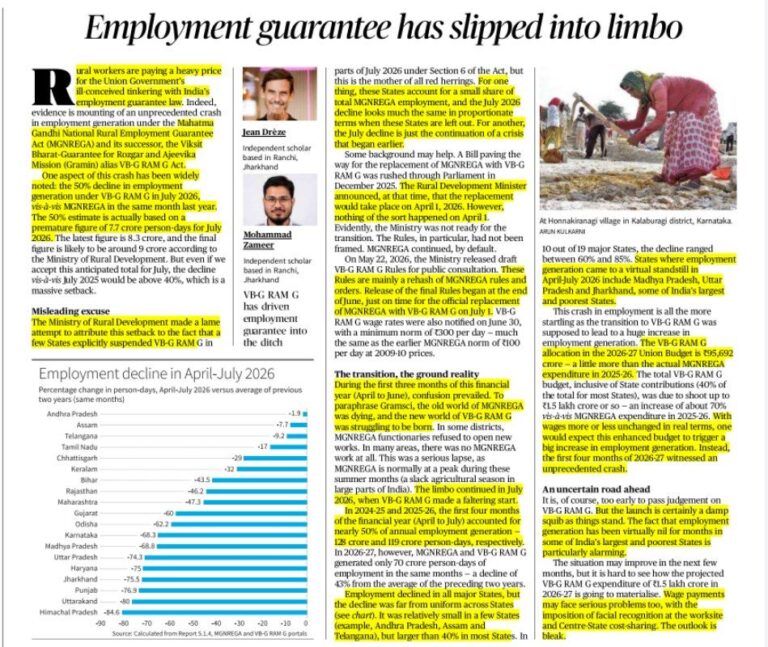
According to the article, employment generation declined significantly during the first four months of 2026-27. In April-July 2024-25 and 2025-26, employment generation stood at around 128 crore and 119 crore person-days, respectively.
In the same period of 2026-27, MGNREGA and VB-G RAM G together generated only around 70 crore person-days, representing a decline of approximately 43% compared with the average of the previous two years.
State-Level Employment Decline
The fall was not uniform across States. While States such as Andhra Pradesh, Assam and Telangana experienced relatively smaller reductions, employment declined by more than 40% in most major States.
The article notes that in 10 of 19 major States, the decline ranged between 60% and 85%. Employment generation reportedly came close to a virtual standstill in States such as Uttar Pradesh and Jharkhand
Problems During the MGNREGA Transition
The first months of the financial year were marked by administrative uncertainty as the old MGNREGA system was being replaced by VB-G RAM G.
In some areas, officials reportedly stopped opening new works, while other areas witnessed little or no employment generation. This is particularly significant because summer months normally witness high demand for employment due to reduced agricultural activity.
Funding and Implementation Challenges
The 2026-27 Union Budget allocated ₹95,692 crore for VB-G RAM G. Including State contributions, the total programme budget was expected to reach around ₹1.5 lakh crore.
Despite this higher allocation, employment generation witnessed an unprecedented decline. The article also raises concerns about future wage payments, Centre-State cost-sharing and fiscal recognition of expenditure.
Conclusion
India’s rural employment guarantee remains crucial for protecting vulnerable workers during periods of economic and agricultural distress. The transition to VB-G RAM G must therefore ensure uninterrupted employment, timely wages and adequate financial support.
The success of the new system will ultimately depend not on higher allocations alone, but on whether rural households can actually access reliable and demand-driven employment opportunities.
Vocabulary
1. Person-days – Total days of work generated
2. Employment Guarantee – Legal assurance of work
3. Fiscal Sharing – Centre–State cost division
4. Transition – Shift between programmes
5. Implementation Gap – Difference between policy and delivery
Frequently Asked Questions (FAQs)
Why has rural employment generation declined in 2026?
The article attributes the fall partly to administrative confusion during the transition from MGNREGA to VB-G RAM G. In several areas, new works were delayed or employment generation remained extremely low.
How much did employment generation fall in April-July 2026?
MGNREGA and VB-G RAM G generated around 70 crore person-days, about 43% below the average for the corresponding period in the previous two years.
Which States experienced major employment declines?
The article reports declines exceeding 40% in most major States. In 10 of 19 major States, employment fell by roughly 60% to 85%.
How much funding has been allocated to VB-G RAM G?
The 2026-27 Union Budget allocated ₹95,692 crore, while the overall programme resources could reach around ₹1.5 lakh crore after including State contributions.
What are the major challenges facing the new employment guarantee?
Key concerns include administrative transition problems, declining employment opportunities, wage payments, fiscal recognition and Centre-State cost-sharing.
Source From : The Hindu
India-Japan Defence Partnership: Strategic Role in a Changing Asia
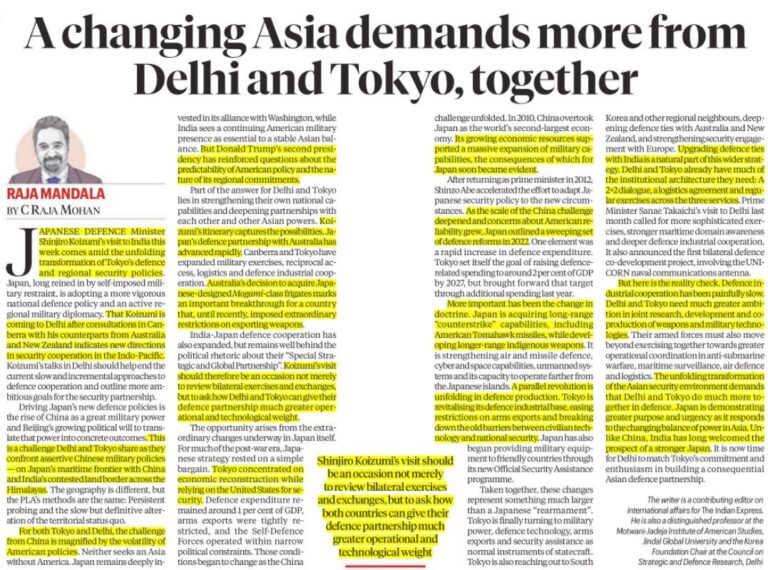
The India-Japan defence partnership is gaining greater strategic importance as Asia faces a rapidly changing security environment. The article argues that Japanese Defence Minister Shinjiro Koizumi’s visit to India comes at a crucial moment, with Tokyo transforming its defence posture and both countries confronting growing regional uncertainty.
Why India and Japan Need Stronger Defence Cooperation
Two major factors are reshaping Asian security: China’s growing military power and uncertainty surrounding the long-term predictability of American security policy.
India and Japan face different but connected security challenges. Japan encounters increasing pressure along its maritime neighbourhood, while India faces strategic competition with China along the Himalayan frontier. This creates a strong case for Delhi and Tokyo to strengthen their own defence capabilities while deepening cooperation with each other and other Indo-Pacific partners.
Japan’s Changing Defence Policy
Japan has traditionally maintained a restrained post-war defence policy. However, growing security challenges have encouraged Tokyo to undertake significant reforms.
Japan is increasing defence expenditure towards 2% of GDP by 2027, acquiring long-range counter-strike capabilities, strengthening air and missile defence, and investing in cyber and space capabilities. It is also gradually easing restrictions on defence exports and expanding security assistance to friendly countries.
Lessons from Japan-Australia Cooperation
The article highlights Japan’s rapidly expanding defence partnership with Australia, including military exercises, logistics cooperation and defence-industrial collaboration.
Australia’s decision to acquire Japanese-produced Mogami-class frigates demonstrates how defence cooperation can move beyond diplomatic declarations towards concrete industrial partnerships.
India-Japan Defence Cooperation: Areas for Expansion
India and Japan already conduct regular exercises across the armed services and have strengthened logistics and strategic dialogue. However, their defence relationship still remains below its full potential.
Greater cooperation can focus on joint research, defence technology development, co-production, maritime domain awareness, anti-submarine warfare, air defence and military logistics.
Defence-industrial cooperation is particularly important if the bilateral partnership is to gain greater technological and operational depth.
Conclusion
A changing Asian balance of power demands a more ambitious India-Japan strategic partnership. Japan is becoming a more capable security actor, while India is strengthening its role in the Indo-Pacific.
Delhi and Tokyo must now convert strategic convergence into practical defence cooperation through technology partnerships, joint production, stronger military coordination and deeper security engagement.
Vocabulary
1. Indo-Pacific – Strategic region linking Indian and Pacific Oceans
2. Counterstrike – Capability to retaliate against an attack
3. Reciprocal Access – Mutual military access arrangements
4. Defence Diplomacy – Security cooperation through defence engagement
5. Balance of Power – Distribution of power preventing dominance
Frequently Asked Questions (FAQs)
Why is the India-Japan defence partnership important?
India and Japan face common concerns arising from China’s growing military capabilities and regional uncertainty. Stronger cooperation can improve security and strategic stability in the Indo-Pacific.
How is Japan changing its defence policy?
Japan is increasing defence spending, developing long-range capabilities and strengthening missile defence, cyber and space systems. It is also gradually expanding defence exports and international security partnerships.
What can India learn from Japan-Australia defence cooperation?
Japan and Australia have expanded exercises, logistics arrangements and defence-industrial cooperation. Their partnership shows how strategic ties can develop into concrete military and technological collaboration.
Which areas can India and Japan cooperate in defence?
Key areas include maritime surveillance, anti-submarine warfare, air defence, military logistics, joint research and defence manufacturing. These can give the partnership greater operational value.
How can India-Japan ties strengthen Indo-Pacific security?
Deeper India-Japan cooperation can contribute to a more stable regional balance and strengthen both countries’ strategic autonomy. It can also improve coordination with other Indo-Pacific partners.