Table of Contents
ToggleAMERICA’S UNILATERALISM IN A POST-UNIPOLAR WORLD
TOPIC: (GS2) INTERNATIONAL RELATIONS: THE HINDU
Twentyfive years after 9/11, the U.S. finds itself trapped in prolonged conflicts in West Asia and North Africa, while rivals like China and Russia assert themselves in a multipolar order.
Background
- Unipolar Moment: After the Cold War, the U.S. emerged as the sole superpower, expanding NATO and intervening militarily in Europe and West Asia.
- War on Terror: Post9/11, the U.S. launched regimechange wars in Afghanistan, Iraq, and Libya, aiming to reshape regions under its worldview.
- Consequences: Rise of ISIS, expansion of Iranian influence, destabilisation of Libya, and spread of jihadist groups across Africa.
Geopolitical Chain Effects
- Afghanistan Withdrawal: Taliban’s return in 2021 symbolised U.S. defeat, weakening credibility.
- Russia’s Assertiveness: Withdrawal interpreted as weakness; Russia invaded Ukraine in 2022, challenging U.S. security commitments in Europe.
- West Asia Crisis: Hamas attack (2023) and U.S.Israeli bombing of Iran (2026) dragged Washington deeper into regional instability.
Changing Global Order
- Rise of Multipolarity: China has emerged as the second pole, while Russia violently contests U.S. dominance in Europe.
- Transatlantic Strains: NATO allies frustrated with U.S. transactionalism and unilateral decisions.
- Persistence of Terrorism: Terrorist groups have dispersed into localised cells across South Asia, West Asia, and Africa.
COLD WAR
The Cold War was a period of political, ideological, and military rivalry between the United States (USA) and the Soviet Union (USSR) from the late 1940s until the early 1990s.
- Nature of Conflict:
- No direct largescale war between USA and USSR.
- Characterised by proxy wars, arms race, space race, and ideological competition (capitalism vs communism).
- Major Features:
- Bipolar World Order: USA led Western capitalist democracies; USSR led socialist bloc.
- Military Alliances: NATO (1949) vs Warsaw Pact (1955).
- Nuclear Arms Race: Development of atomic and hydrogen bombs; concept of Mutually Assured Destruction (MAD).
- Space Race: USSR’s Sputnik (1957) vs USA’s Apollo moon landing (1969).
- Proxy Wars: Korean War, Vietnam War, Afghanistan conflict.
- Impact on Global Politics:
- Division of Europe (Iron Curtain).
- Rise of NonAligned Movement (NAM) led by countries like India, seeking neutrality.
- Spread of ideological conflicts in Asia, Africa, and Latin America.
- End of Cold War:
- Collapse of the Soviet Union in 1991.
- USA emerged as the sole superpower, ushering in a unipolar world order.
Conclusion
In the postunipolar world, America’s persistence with unilateralism clashes with the realities of multipolarity, regional assertiveness, and dispersed terrorism. For India, the lesson lies in balancing partnerships while safeguarding autonomy in an increasingly fluid global order.
REGULATING RUPPS AND ACCOUNTABILITY IN INDIAN DEMOCRACY
TOPIC: (GS2) POLITY: THE HINDU
A recent investigation revealed that six Registered Unrecognised Political Parties (RUPPs) in Gujarat received ₹1,700 crores in donations (202324), surpassing the combined receipts of five national parties (excluding BJP). This raises concerns about misuse of tax exemptions and poor compliance.
What are RUPPs?
- Legal Basis: Registered under Section 29A of the Representation of the People Act, 1951.
- Benefits: Tax exemptions under Income Tax Act, common election symbol, and 20 star campaigners.
- Compliance Requirements: Must disclose donors above ₹20,000 and accept donations above ₹2,000 only via cheque/bank transfer.
Issues with RUPPs
- Proliferation: Over 2,800 RUPPs exist, but only ~750 contested the 2024 elections. Many are “letter pad parties.”
- Poor Transparency: ADR reports show only 26% of RUPPs’ annual reports are publicly available.
- Legal Gap: EC lacks explicit power to deregister parties for noncompliance. Supreme Court (2002) limited EC’s authority to fraud or unconstitutional activity.
- Misuse: Used as opaque channels for money laundering and tax evasion under the guise of political activity.
Reform Options
- Deregistration Powers: Law Commission (255th Report) recommended deregistration if a party fails to contest elections for 10 years.
- Vote Threshold: EC suggested tax exemptions only for parties crossing a minimum vote share, similar to the 1% threshold for common symbols.
- Digital Monitoring: Income Tax Department and enforcement agencies can track suspicious transactions using digital tools.
- Transparency Mandates: Mandatory disclosure of audited accounts and donor lists in public domain.
- Empowering EC: Amend RP Act to give EC authority to act against nonserious parties.
REGISTERED POLITICAL PARTIES
- Legal Basis: Section 29A of the Representation of the People Act, 1951.
- Requirements: Parties must submit details like name, office bearers, constitution, and address to the ECI.
- Privileges: Registered parties can contest elections but do not automatically get reserved election symbols.
- Numbers: As of August 2025, India had ~2,520 RUPPs after the ECI delisted 334 for noncompliance.
RECOGNISED POLITICAL PARTIES
Recognition is granted based on electoral performance:
- National Party: Must secure at least 6% of valid votes in four or more states in Lok Sabha/Assembly elections and win at least 2% of Lok Sabha seats (11 seats).
- State Party: Must secure at least 6% of valid votes in the state and win at least 2 seats in the Legislative Assembly.
- Privileges:
- Reserved election symbol.
- Free airtime on Doordarshan/All India Radio.
- Access to electoral rolls.
- Eligibility for star campaigners.
Current Status
- National Parties (6):
- Bharatiya Janata Party
- Indian National Congress
- Communist Party of India (Marxist)
- Bahujan Samaj Party
- Aam Aadmi Party
- National People’s Party
- State Parties (67): Includes AIADMK, Trinamool Congress, Biju Janata Dal, Bharat Rashtra Samithi, Communist Party of India, among others.
Conclusion
Empowering the EC with deregistration powers, introducing voteshare thresholds for tax exemptions, and leveraging digital monitoring can curb misuse. Balanced reforms will ensure that RUPPs remain genuine vehicles of political participation rather than conduits for financial irregularities.
GENERATIVE AI IN PRIMARY EDUCATION
TOPIC: (GS3) SCIENCE AND TECHNOLOGY: THE HINDU
New York City has imposed a oneyear moratorium on Gen AI tools for students up to Class 8 (202627), citing risks to independent learning. India is still evolving its policy framework on AI in education.
Ai usage in India
- Enterprise Adoption: By 2026, 64% Indian firms adopted AI, highest globally, surpassing U.S. adoption rate of 59%.
- Government Mission: IndiaAI Mission invests ₹10,372 crore, building sovereign compute with 10,000+ GPUs across national data centers.
- Language Inclusion: Indic LLMs improved 28% translation accuracy, covering 12 languages, targeting 500M+ vernacular users by 2026.
- Industry Impact: AI contributed $10–12 billion to India’s $315 billion tech industry revenue in FY26.
Benefits of AI in Classrooms
- Personalised Learning: Tools like Kahoot! and Quizlet help tailor lessons, quizzes, and assessments to individual student needs.
- Gamified Engagement: AI apps create interactive, sensorial experiences that move beyond rote learning.
- Teacher Support: AI assists in preparing resources, slide decks, and differentiated teaching methods, saving time and enhancing pedagogy.
- Skill Development: Apps like Seesaw track reading fluency, transcribe passages, and highlight errors, helping children improve accuracy.
Challenges
- Loss of Critical Thinking: Readymade answers discourage struggle, trialanderror, and logical reasoning.
- Accent Bias: AI scoring systems may misinterpret nonWestern accents, undermining inclusivity.
- Dependency: Excessive reliance on AI tools risks weakening cognitive skills and creativity.
- Human Connection: Primary education thrives on teacherstudent bonds, storytelling, and mentorship aspects AI cannot replicate.
Way forward
- Balanced Approach: Experts argue for restrictions rather than outright bans, ensuring AI supplements rather than replaces teachers.
- India’s Pilot Projects: Central and State governments are testing AI in rural schools to bridge teacher shortages, but emphasise AI as a learning assistant, not a substitute.
- Global Trends: While some countries impose bans, others integrate AI cautiously with guardrails to protect critical thinking.
LARGE LANGUAGE MODELS (LLMS)
LLMs are advanced artificial intelligence models trained on massive datasets of text to understand, generate, and process human language.
- Core Function: They predict the next word in a sequence, enabling tasks like text generation, summarisation, translation, and questionanswering.
- Training Data: Built on billions of words from books, articles, websites, and other sources, allowing them to capture grammar, facts, and reasoning patterns.
- Examples: GPT4, Gemini, Claude, LLaMA, and other models widely used in education, research, and industry.
Conclusion
A complete ban on Gen AI in schools may be impractical, However, serious restrictions in primary education are necessary to preserve critical thinking, creativity, and human connection. The way forward lies in regulated use, where AI acts as a supplementary assistant while teachers remain the central pillars of learning.
RETHINKING SKILLS, JOBS, AND PRODUCTIVE WORK IN INDIA
TOPIC: (GS3) ECONOMY: THE HINDU
India, now the world’s fourthlargest economy, risks falling into a middleincome, lowproductivity trap. Weak job creation, stagnant wages, and sluggish private investment reinforce one another, threatening sustainable growth.
Vocational Training Deficit
- India has 14,000 ITIs with 25 lakh seats, but intake is only 48%.
- Employment rate among ITI graduates is 63%, far below global benchmarks of 90%+.
- University degrees command prestige, while trades like welding, plumbing, and carpentry remain undervalued despite industrial importance.
Global Lessons
- South Korea and China: Escaped the middleincome trap by investing in technical education, health, and diffusion of useful knowledge.
- Brazil, Argentina, Philippines: Failed to build inclusive institutions, remaining stuck in lowproductivity economies.
- Productivism Approach: Proposed by Dani Rodrik — focus on productive employment, dissemination of opportunity, and dignity of work.
Structural Challenges
- Jobless Growth: Productivity gains remain concentrated in capitalintensive sectors, creating few jobs and widening inequality.
- Weak Investment: Private capital focuses on costcutting rather than innovation, with R&D spending at just 0.65% of GDP.
- Education Bias: Mass education and vocational training remain underfunded; fewer than 3% of the workforce has formal vocational education.
- Social Norms: Castebased occupational hierarchies undervalue manual and artisanal work, perpetuating inequality and low productivity.
Way Forward
- Vocational Education: Expand ITIs, polytechnics, and skill centres; integrate trades into mainstream education.
- Industrial Policy: Promote manufacturing jobs with incentives for innovation and labourintensive sectors.
- Social Revaluation: Restore dignity to skilled manual work, breaking castebased occupational hierarchies.
- Technology Diffusion: Spread digital and industrial technologies beyond elite enclaves to rural and informal sectors.
GOVERNMENT INITIATIVES
Skill India Mission: Launched 2015, aims to train 40 crore youth in diverse skills by 2022.
Pradhan Mantri Kaushal Vikas Yojana: Provides free skill training, certification, and monetary rewards to enhance employability nationwide.
National Apprenticeship Promotion Scheme: Encourages industry participation by subsidising 25% stipend and training costs for apprentices.
Deen Dayal Upadhyaya Grameen Kaushalya Yojana: Targets rural poor youth, offering placementlinked skill training to reduce poverty and unemployment.
Conclusion
Building institutions that diffuse useful knowledge, restoring dignity to skilled labour, and creating inclusive employment opportunities are essential for India to achieve sustainable highincome status.
INTERNATIONAL ATOMIC ENERGY AGENCY (IAEA)
TOPIC: (GS2) INTERNATIONAL RELATIONS: THE HINDU
The International Atomic Energy Agency (IAEA) has, for the first time in 20 years, formally reported Iran to the United Nations Security Council (UNSC), highlighting concerns over Tehran’s nuclear activities and compliance issues.
International Atomic Energy Agency (IAEA)
- The International Atomic Energy Agency (IAEA) is the world’s leading intergovernmental body for nuclear cooperation, established in 1957 after U.S. President Eisenhower’s “Atoms for Peace” speech (1953).
- Headquartered in Vienna, Austria, it reports to both the UN General Assembly and the UN Security Council.
- With 180 member states, the IAEA promotes the safe, secure, and peaceful use of nuclear technologies.
Objectives and Functions
- Peaceful Uses: Encourages nuclear energy for electricity, medicine, agriculture, and industry.
- Safety Standards: Establishes global benchmarks for nuclear safety and emergency preparedness.
- Verification: Conducts inspections under the NPT safeguards system to prevent diversion of nuclear material for weapons.
- Limitations: Lacks enforcement powers; relies on member states’ cooperation.
Governance
- General Conference: Annual meeting of all members to set policy.
- Board of Governors: 35 members oversee safeguards and appoint the Director General.
- Secretariat: Manages daily operations.
Case Studies
- Reported Iran to the UNSC in 2026 for noncompliance.
- Limited role in North Korea after its NPT withdrawal.
- Assisted in global safety reviews postFukushima (2011).
Conclusion
The IAEA remains vital to global nuclear governance, balancing developmental applications with nonproliferation safeguards. For India, cooperation with the IAEA ensures access to nuclear fuel, technology, and credibility in civilian nuclear programmes.
WILDLIFE CRIME CONTROL BUREAU (WCCB)
TOPIC: (GS3) ENVIRONMENT: THE HINDU
The Environment Ministry formed a fourmember WCCB inquiry team to probe international crime links in Balasore orangutan case.
Wildlife Crime Control Bureau (WCCB)
- The Wildlife Crime Control Bureau (WCCB) is a statutory body established under Section 38Y of the Wildlife (Protection) Act, 1972 and became operational in 2008.
- It functions under the Ministry of Environment, Forest and Climate Change (MoEF&CC) to combat organized wildlife crime in India.
Structure
- Headquarters: New Delhi.
- Regional Offices: Delhi, Kolkata, Mumbai, Chennai, Bhopal.
- Multidisciplinary Composition: Officials from police, forest, customs, and intelligence agencies.
Functions
- Intelligence Collection: Collates and disseminates data on wildlife crimes; maintains a centralized database.
- Coordination: Works with state governments, enforcement agencies, and border units.
- International Obligations: Assists in implementing conventions like CITES (since 1976).
- Capacity Building: Provides training, species identification support, and scientific investigation infrastructure.
- Global Liaison: Coordinates with Interpol and the World Customs Organization to track trafficking routes.
Operations
- The WCCB has successfully conducted operations such as Operation Save Kurma, Thunderbird, WildNet, Lesknow, Birbil, Thunderstorm, targeting turtle smuggling, cyberenabled wildlife trade, and crossborder trafficking.
- Its Wildlife Crime Database Management System enables realtime analysis of crime trends.
Conclusion
The WCCB plays a crucial role in safeguarding India’s biodiversity by tackling organized wildlife crime, and ensuring compliance with international commitments. Its integration of intelligence, and global cooperation makes it a vital pillar of India’s conservation strategy.
FOOTANDMOUTH DISEASE (FMD)
TOPIC: (GS3) SCIENCE AND TECHNOLOGY: THE HINDU
After nearly 60 years, a serotype of FootandMouth Disease (FMD) has reemerged in parts of Europe and the Middle East, raising global concerns.
About the Disease
- Nature: A highly contagious viral infection affecting clovenhoofed animals such as cattle, buffaloes, sheep, and goats.
- Cause: Caused by an Aphthovirus of the family Picornaviridae.
- Symptoms: Fever, blisterlike sores on tongue, lips, mouth, teats, and between hooves; weakness and debilitation postrecovery.
- Mortality: Rarely fatal in adults but high mortality in young animals due to myocarditis.
Transmission
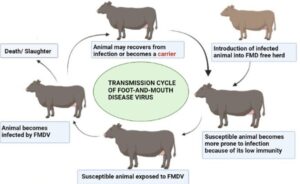
- Through infected animals (saliva, milk, semen).
- Contaminated pens, vehicles, feed, water, clothing, footwear, or equipment.
- Virusinfected meat or products when raw or improperly cooked.
Impact
- Classified as a Transboundary Animal Disease (TAD).
- Causes severe production losses and disrupts regional and international trade in livestock and animal products.
- Intensively reared animals are more vulnerable than traditional breeds.
Prevention
- Vaccination: The only effective preventive measure.
- Requires regular immunisation campaigns and strict biosecurity measures.
Conclusion
FMD remains a serious global livestock challenge, threatening food security and trade. Strengthening surveillance, vaccination, and international cooperation is vital to control outbreaks and safeguard rural livelihoods.