

RUSSIA–UKRAINE CONFLICT
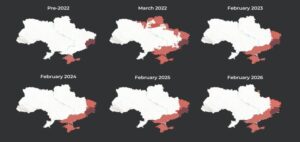
Tensions increased after Ukraine’s growing ties with NATO and the European Union, alongside Russia’s concerns over NATO expansion and its strategic interests in Ukraine.
- Russian Invasion: On 24 February 2022, Russia launched a full-scale military invasion of Ukraine, escalating an earlier conflict that began in 2014 with Russia’s annexation of Crimea and fighting in eastern Ukraine.
- Humanitarian & Economic Impact: The war has caused large-scale displacement, loss of civilian lives, destruction of infrastructure and disruptions to global food, energy and fertiliser supplies.
- Global Geopolitical Impact: Western countries imposed extensive sanctions on Russia and provided support to Ukraine. The conflict has also intensified divisions between Russia and the West and affected global security and trade.
- India’s Position: India has consistently advocated dialogue and diplomacy to resolve the conflict. It has maintained relations with both Russia and Western countries, reflecting its policy of strategic autonomy, while also offering support for peace efforts.
Prime Minister Narendra Modi presented Russian President Vladimir Putin with a Russian translation of the Thirukkural during their bilateral meeting in New Delhi.
What is Thirukkural?
- Thirukkural is a classical Tamil work composed by the renowned poet and philosopher Thiruvalluvar.
- It is also known as Kural or Tamil Marai (Tamil Veda).
- The text consists of 1,330 couplets (kurals) organised into 133 chapters, with 10 couplets in each chapter.
- It is divided into three major sections:
- Aram (Virtue): Ethics, morality and righteous conduct.
- Porul (Wealth/Governance): Society, politics, administration, leadership and economic life.
- Inbam (Love): Human relationships and love.
- The work does not focus on a particular religion; instead, it presents universal ethical principles applicable to individuals and society.
- Its teachings emphasise truth, compassion, justice, self-discipline, good governance and responsible leadership.

Significance
- Thirukkural represents the richness of Tamil literature and India’s civilisational heritage.
- Its translation into Russian helps promote India’s cultural diplomacy and soft power.
- Its universal ethical message makes it relevant to contemporary discussions on good governance, morality and peaceful coexistence.
Conclusion:
Presenting the Thirukkural demonstrates how India’s ancient intellectual traditions can serve as a bridge for strengthening modern international relations.
The Supreme Court has asked the Ministry of Road Transport and Highways to consider measures to reduce road deaths, including stronger compliance with seat belts, helmets and child restraints. Scale of the Problem
- India accounts for around 11% of global road traffic fatalities, despite having about 1% of the world’s vehicles.
- According to the Ministry of Road Transport and Highways (MoRTH), India recorded 4.81 lakh road accidents and 1.73 lakh deaths in 2023.
- This translates to approximately 1,317 accidents and 474 deaths every day.
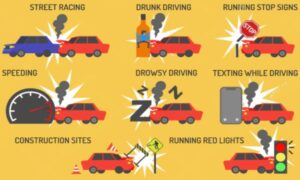
- Two-wheelers accounted for 46.2% of road deaths in 2024, while pedestrians constituted 20.6%, highlighting the vulnerability of road users outside enclosed vehicles.
- In 2022, over-speeding accounted for 71.2% of road deaths, making speed management a critical intervention.
- Young adults aged 18–45 years constituted 66.5% of road accident victims in 2022, indicating significant economic and demographic costs.
Challenges
- Weak enforcement: Shortage of traffic personnel and inconsistent enforcement reduce compliance with safety regulations.
- Unsafe road design: Accident-prone locations, inadequate pedestrian infrastructure and poor road engineering increase crash risks.
- Human error: Road safety cannot depend entirely on individual behaviour.
- Post-crash care: Delays in ambulance services, trauma care and emergency response increase mortality.
Way Forward
- Safer roads: Identify black spots, improve road design, pedestrian crossings, lighting and traffic-calming infrastructure.
- Speed management: Enforce speed limits through cameras, automated enforcement and scientifically designed speed-control measures.
- Safer vehicles: Mandate effective seat-belt reminders, safety features and child-restraint systems while preventing unsafe vehicle modifications.
- Vulnerable road users: Prioritise pedestrians, cyclists and two-wheeler users through dedicated infrastructure and safer urban mobility.
- Better enforcement and trauma care: Strengthen traffic police, emergency response systems and timely access to trauma centres.
Government Measures for Road Safety
- Motor Vehicles (Amendment) Act, 2019: Strengthened penalties, licensing provisions, vehicle fitness standards and enforcement mechanisms.
- 4E Strategy: Combines Education, Engineering, Enforcement and Emergency Care to comprehensively address road safety challenges.
- Black Spot Rectification: Identifies accident-prone locations and improves road engineering to reduce crashes and fatalities.
- Bharat NCAP (2023): Introduced vehicle safety ratings to encourage safer manufacturing and informed consumer choices.
Conclusion
India needs to move from a blame-the-driver approach to a Safe System approach, where roads, vehicles, enforcement and emergency care collectively minimise both the probability and severity of crashes.
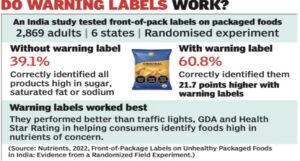
The Supreme Court has sought a clear, scientifically justified timeline from the Food Safety and Standards Authority of India (FSSAI) for implementing front-of-pack warning labels (FoPL) on packaged foods high in added sugar, salt and fat.
What are Front-of-Pack Warning Labels?
- FoPL are simple warning symbols or labels displayed prominently on food packages.
- They help consumers quickly identify products containing excessive levels of nutrients associated with health risks.
- FSSAI has proposed a two-phase implementation:
- Phase I: Warnings for products high in two or more nutrients of concern.
- Phase II: Extend warnings to products exceeding the prescribed limit for any one nutrient.
- The Supreme Court questioned the absence of a definite timeline between the two phases.
Food Safety and Standards Authority of India (FSSAI)
- FSSAI is a statutory authority established under the Food Safety and Standards Act, 2006.
- It functions under the Ministry of Health and Family Welfare.
- Its headquarters is in New Delhi.
- It is responsible for regulating and supervising food safety and standards across India.
- Major functions include:
- Setting food standards and regulating food additives.
- Laying down procedures for food testing and laboratories.
- Regulating food imports.
- Providing scientific advice to governments on food safety.
- Creating awareness about safe and healthy food practices.
- It also implements initiatives such as Eat Right India to promote healthier dietary choices.
Significance
- Consumer protection: Enables consumers to identify potentially unhealthy packaged foods quickly.
- Public health: Can discourage excessive consumption of sugar, salt and unhealthy fats.
- Industry reformulation: Encourages food manufacturers to reduce harmful nutrients.
- Children’s nutrition: Nutritional literacy can help children make informed dietary choices.
Challenges
- Industry concerns regarding reformulation costs and compliance.
- Need for scientifically robust nutrient thresholds.
- Ensuring consistent enforcement across food manufacturers.
- Risk of consumer confusion if labelling systems are complicated.
Conclusion:
Front-of-pack warnings can strengthen India’s preventive healthcare approach by combining consumer awareness, industry accountability and scientific regulation.
A recent study of Red-Naped Ibises in Udaipur found diverse bacteria in their faecal samples, including multidrug-resistant bacterial strains, highlighting concerns about antimicrobial resistance in wildlife and the environment.
About Red-Naped Ibis
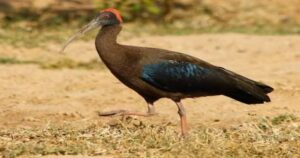
- Scientific name: Pseudibis papillosa
- Also known as the Indian Black Ibis or Black Ibis.
- It is a common, resident and non-migratory wading bird of the Indian subcontinent.
- Appearance: Black plumage with a bare dark head and a distinctive crimson-red patch of warty skin on the crown and nape.
- Habitat: Lakes, marshes, riverbeds, irrigated farmlands and dry agricultural fields; it is often found away from water bodies.
- Distribution: Widely distributed across the plains of the Indian Subcontinent, extending from northern India to southern India.
- Behaviour: Diurnal and commonly forages in small groups.
- Diet: An opportunistic omnivore feeding on insects, amphibians, reptiles, small fish, carrion and plant matter.
Conservation Status
- IUCN Red List: Least Concern
- Wild Life (Protection) Act, 1972: Schedule II
Significance of the Study
- Detection of multidrug-resistant bacteria in wildlife indicates the possible spread of antimicrobial resistance beyond hospitals and human populations.
- Birds can act as environmental indicators, reflecting contamination in ecosystems.
- The findings highlight the importance of a One Health approach, linking human, animal and environmental health.
Conclusion
The Red-Naped Ibis highlights the interconnectedness of wildlife conservation, environmental health and antimicrobial resistance, requiring integrated One Health surveillance.