Table of Contents
ToggleForeign Policy of the Mughals UPSC
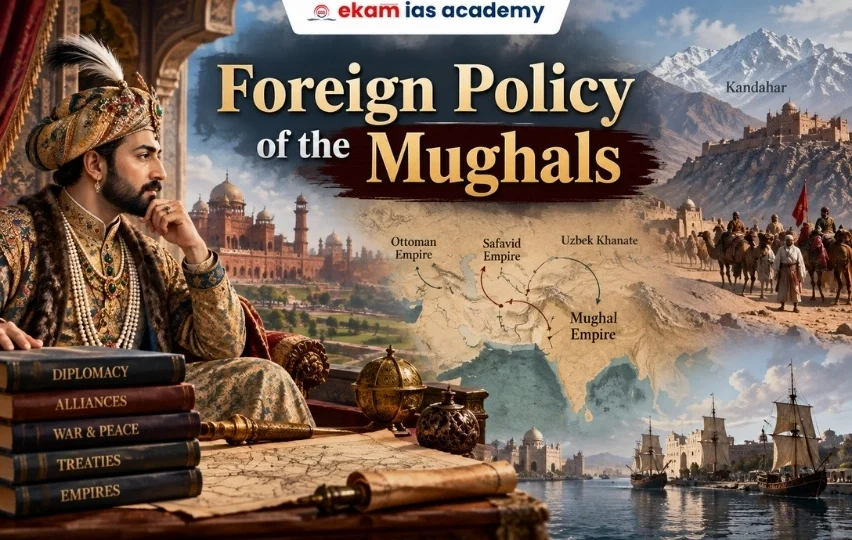
The Foreign Policy of the Mughals was a sophisticated combination of geopolitical strategy, territorial ambitions, and diplomatic alliances across early modern Eurasia. Positioned between Safavid Persia, the Ottoman Empire, and the Uzbek Khanates of Central Asia, the Mughal court conducted active international diplomacy. Analyzing Mughal Foreign Policy UPSC modules provides critical insights into how imperial rulers projected power beyond the frontiers of the subcontinent within Medieval Indian History UPSC.
Geographical and Strategic Context
- The Northwest frontier, particularly the strategic outpost of Qandahar, formed the main gateway for imperial defense and trade routes.
- Positioned between three great Muslim empires—the Ottomans, Safavids, and Mughals—the state had to constantly balance regional alliances.
- Controlling Central Asian trade corridors was essential for securing high-bred warhorses, commercial goods, and international diplomatic prestige.
Babur’s Foreign Policy
- Focused on preserving ties with his ancestral homeland in Transoxiana while establishing a foothold in Kabul and Delhi.
- Cultivated tactical alliances with Safavid Persia to counter the rising power of the Sunni Uzbeks under Shaibani Khan.
- Laid the groundwork for Mughal Central Asia Relations by maintaining diplomatic exchanges with regional rulers across the Northwest.
Humayun’s Foreign Policy
- Faced complete political displacement in India, forcing him to seek direct foreign intervention and asylum.
- Formed a critical alliance with Shah Tahmasp of Safavid Persia, securing military backing to reclaim his throne.
- Established deep Persian influence within the Mughal court, shaping early Mughal Safavid Relations for generations.
Akbar’s Foreign Policy
- Adopted a pragmatic forward strategy aimed at securing the Northwest frontier along the Hindu Kush mountains.
- Captured Qandahar in 1595 to construct a formidable defensive buffer against Safavid or Uzbek incursions.
- Promoted a policy of triple alliance equilibrium, maintaining balanced diplomatic channels with the Safavids, Ottomans, and Uzbeks.
Jahangir’s Foreign Policy
- Prioritized diplomatic negotiations with Shah Abbas I of Persia to preserve commercial trade routes and regional peace.
- Suffered a major setback when Safavid forces captured the strategic city of Qandahar in 1622 due to internal court rivalries.
- Strengthened ties with the Ottoman Empire and Central Asian Khanates to counter growing Persian dominance along the border.
Shah Jahan’s Foreign Policy
- Launched aggressive forward campaigns in Central Asia, briefly occupying Balkh and Badakhshan (1646–1647) to reclaim ancestral Timurid lands.
- Recaptured Qandahar in 1638 through diplomacy, only to lose it permanently to Persia in 1649.
- Led three costly, unsuccessful sieges of Qandahar (1649, 1652, 1653), severely draining imperial finances and army resources.
Aurangzeb’s Foreign Policy
- Shifted focus away from costly trans-Indus expansion toward consolidating internal frontiers and expanding in the Deccan.
- Maintained formal Mughal Diplomatic Relations by receiving embassies from Mecca, Abyssinia, the Ottoman Empire, and Central Asian Khanates.
- Kept a cautious, defensive posture along the Northwest border to prevent costly border conflicts with Persia.
Major Diplomatic Events and Conflicts
- The Qandahar Dispute: Served as the central flashpoint in Mughal Relations with Persia for over a century.
- Balkh and Badakhshan Campaigns: Marked the peak of Mughal Relations with Central Asia, demonstrating imperial power projection.
- Ottoman Correspondence: Involved periodic diplomatic missions focused on securing Sunni religious legitimacy and protecting trade routes.

Comparison of Mughal Foreign Policies
- Babur & Humayun: Depended on Persian diplomatic and military support for survival and territorial recovery.
- Akbar & Jahangir: Maintained a balanced, defensive border strategy through diplomatic alliances and regional dominance.
- Shah Jahan & Aurangzeb: Transitioned from expensive forward military campaigns to strict defensive border policies.
Major Themes in Mughal Foreign Policy
- Ancestral Nostalgia: A persistent desire among rulers to reclaim the Timurid homeland of Samarkand and Transoxiana.
- Northwest Security: Securing the Kabul-Ghazni-Qandahar line to prevent foreign invasions into Northern India.
- Sectarian Neutrality: Balancing Sunni identity with practical, non-sectarian alliances across Persia and Central Asia.
Reasons for the Limitations of Mughal Foreign Policy
- Harsh winter geography and difficult mountain terrain across Afghanistan and Central Asia made long-term occupation unsustainable.
- Protracted military sieges over Qandahar caused massive financial drain and overextended imperial troop supply lines.
- Lack of a strong imperial navy limited diplomatic leverage along ocean trade routes controlled by European powers.
Conclusion
The Foreign Policy of the Mughals played a vital role in protecting imperial security, trade networks, and international diplomatic prestige across early modern Asia. From Babur’s initial alliances to Shah Jahan’s ambitious Central Asian campaigns, understanding Mughal Foreign Policy provides indispensable context for mastering Mughal History UPSC and Mughal Empire UPSC examinations.
UPSC Prelims: PYQs & Practice Questions
Previous Year Questions (Prelims)
Q: Consider the following statements regarding the capture of Qandahar during the Mughal period:
1. Akbar annexed Qandahar to the Mughal Empire in 1595 without fighting a major battle.
2. Loss of Qandahar during Jahangir’s reign was primarily due to the refusal of Prince Khurram (Shah Jahan) to lead the expedition.
3. Shah Jahan permanently recaptured Qandahar for the Mughals after three successive military sieges.
Which of the statements given above are correct?
(a) 1 and 2 only
(b) 2 and 3 only
(c) 1 and 3 only
(d) 1, 2, and 3
Answer: (a) 1 and 2 only
Explanation:
Statement 1 is correct: In 1595, Akbar secured Qandahar peacefully when its Safavid governor, Muzaffar Husain Mirza, surrendered the fortress in exchange for a high rank (mansab) and jagir in the Mughal court.
Statement 2 is correct: When Shah Abbas I of Persia besieged Qandahar in 1622, Jahangir ordered Prince Khurram to lead the relief army. Khurram rebelled instead, leading to the fall of Qandahar to Persia.
Statement 3 is incorrect: Shah Jahan temporarily regained Qandahar in 1638, but Shah Abbas II recaptured it in 1649. Shah Jahan's three subsequent sieges failed, and Qandahar was permanently lost to the Mughals.
Q: Which Mughal Emperor sent a forward military expedition to Balkh and Badakhshan in Central Asia to secure the northwestern frontier and establish a friendly buffer state?
(a) Akbar
(b) Jahangir
(c) Shah Jahan
(d) Aurangzeb
Answer: (c) Shah Jahan
Explanation:
In 1646–1647, Shah Jahan launched the Balkh and Badakhshan campaign under Prince Murad and later Prince Aurangzeb. The objective was to establish a friendly ruler in Transoxiana and secure the imperial frontier near the Hindu Kush. Severe winter conditions and guerrilla resistance ultimately forced the Mughals to withdraw.
Practice Questions
Q: With reference to the diplomatic relations between the Mughal Empire and Safavid Persia, consider the following statements:
1. Humayun obtained military support from Shah Tahmasp of Persia to reclaim his throne in India.
2. The strategic importance of Qandahar lay in its position as a major trade gateway and a vital defensive bastion for Kabul and Punjab.
Which of the statements given above is/are correct?
(a) 1 only
(b) 2 only
(c) Both 1 and 2
(d) Neither 1 nor 2
Answer: (c) Both 1 and 2
Explanation:
Statement 1 is correct: After being exiled by Sher Shah Suri, Humayun sought refuge at the Safavid court. Shah Tahmasp provided him military support, enabling him to capture Qandahar, Kabul, and eventually restore Mughal rule in India in 1555.
Statement 2 is correct: Qandahar was a crossroads for caravan trade routes connecting India, Persia, and Central Asia. It also served as a vital defensive bastion protecting Kabul and the plains of Northern India.
Q: Which of the following best describes the principle of the "Triple Alliance Equilibrium" pursued by Akbar in his foreign policy?
(a) A formal naval treaty signed between the Mughals, the Portuguese, and the British.
(b) A diplomatic balancing strategy among the Mughals, Safavids, and Uzbeks to prevent any single power from dominating Central Asia.
(c) A military pact between the Mughals, the Deccani Sultanates, and the Rajputs.
(d) An economic trade alliance between India, China, and the Ottoman Empire.
Answer: (b) A diplomatic balancing strategy among the Mughals, Safavids, and Uzbeks to prevent any single power from dominating Central Asia.
Explanation:
Akbar recognized that the expansion of the Uzbek ruler Abdullah Khan Uzbek posed a common threat to both the Mughals and Safavid Persia. He maintained diplomatic channels with Persia and the Ottoman Empire to prevent aggressive Uzbek domination of the northwestern frontier.
UPSC Mains – Previous Year & Practice Questions
Mains Previous Year Questions
Question: "The strategic importance of Qandahar was the main bone of contention in Mughal-Safavid relations during the 16th and 17th centuries." Elucidate. (UPSC CSE Mains 2017)
Question: Analyze the motives, course, and historical consequences of Shah Jahan’s Central Asian campaign (Balkh and Badakhshan). How far was it a geopolitical failure? (UPSC CSE Mains 2010)
Question: Evaluate the foreign policy of Akbar with special reference to his Northwest frontier strategy. (UPSC CSE Mains 2002)
Question: Discuss how Humayun’s exile in Safavid Persia influenced subsequent Mughal diplomatic, administrative, and cultural policies. (UPSC CSE Mains 1996)
Question: Critically examine the limitations of Mughal foreign policy in dealing with the trans-Indus powers and European maritime expansion. (UPSC CSE Mains 1989)
Mains Practice Questions
[15 Marks | 250 Words]
Question: "Nostalgia for their ancestral Timurid homeland in Transoxiana often overruled pragmatic geopolitics in the foreign policy of the early Mughal Emperors." Critically examine.
[15 Marks | 250 Words]
Question: Compare and contrast the diplomatic strategies adopted by Akbar and Jahangir in handling the threat of Safavid expansion toward the Indian frontier.
[15 Marks | 250 Words]
Question: To what extent did the financial and military drain of the Qandahar sieges under Shah Jahan weaken the internal administrative stability of the Mughal Empire?



Foreign Policy of the Mughals-FAQs
What were the main objectives of Mughal foreign policy?
Mughal foreign policy focused mainly on securing the northwest frontier, protecting Qandahar and Kabul, and maintaining relations with Persia, Central Asian states and the Ottomans.
Why was Qandahar important to the Mughals?
Qandahar was strategically important as a frontier fortress and gateway between India, Afghanistan and Persia. Its control was central to Mughal-Safavid rivalry.
How did Humayun benefit from Safavid support?
After losing his Indian throne, Humayun sought assistance from Shah Tahmasp of Persia. Safavid military support helped him regain territory and eventually restore Mughal rule.
What was Shah Jahan’s Central Asian policy?
Shah Jahan attempted to extend Mughal influence into Balkh and Badakhshan, partly reflecting Timurid connections. The campaigns proved difficult and costly.
Why did Mughal expansion beyond the northwest face limitations?
Difficult terrain, harsh climate, long supply lines and high military costs made sustained expansion into Afghanistan and Central Asia challenging for the Mughals.