Table of Contents
ToggleChina-US Rapprochement: Strategic Competition Continues
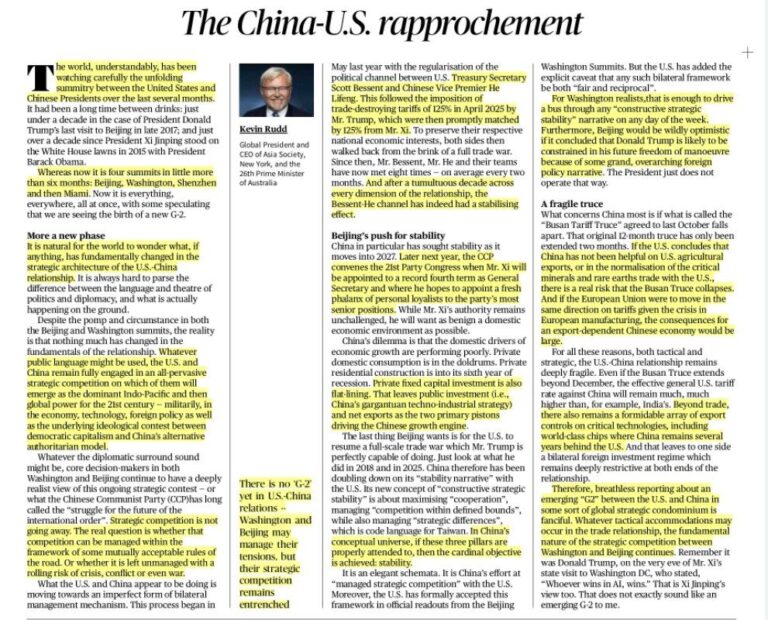
The recent China-US rapprochement has attracted global attention, particularly as Presidents Donald Trump and Xi Jinping engage in renewed diplomatic dialogue. Multiple meetings and summits have raised speculation about whether Washington and Beijing are entering a new phase of relations. However, the underlying strategic rivalry between the two major powers remains deeply entrenched.
A New Phase in China-US Relations
The article argues that the recent diplomatic engagement should not be mistaken for a fundamental transformation in the China-US relationship. While both sides have shown an interest in reducing tensions, their competition continues across economic, technological, military and geopolitical domains.
The regularisation of communication channels between senior officials, including the US Treasury Secretary and Chinese Vice Premier, has helped create mechanisms for managing tensions. Such dialogue can reduce the risk of escalation, particularly in areas where economic disagreements could develop into broader confrontation.
Beijing's Push for Stability
China has strong incentives to maintain stability. Its domestic economy faces challenges including weak private consumption, problems in the property sector and pressures affecting private investment. At the same time, China’s technology and industrial strategy remains central to its long-term economic ambitions.
For Beijing, stabilising relations with Washington can therefore provide greater economic and strategic room for manoeuvre.
Washington's Strategic Approach
The United States also appears interested in managing competition rather than completely ending it. The concept of “constructive strategic stability” involves maintaining cooperation where possible while continuing to manage differences in areas such as technology, trade and security.
However, significant disagreements remain, particularly over trade, critical technologies, export controls and Taiwan.
Why There Is No “G2”
Despite the renewed diplomatic engagement, the article cautions against interpreting the developments as the emergence of a G2, or a formal US-China condominium over global affairs.
The relationship remains fundamentally competitive. Both Washington and Beijing continue to pursue their own strategic interests, while other major powers retain independent interests and influence.
Conclusion
The emerging China-US rapprochement should therefore be viewed as an effort to manage rivalry rather than eliminate it. Diplomatic engagement may reduce immediate tensions and prevent escalation, but structural competition over technology, trade, security and global influence is likely to continue. For the international system, the key question is whether Washington and Beijing can manage their rivalry without allowing competition to develop into prolonged confrontation.
Vocabulary
1. Rapprochement – Improvement in strained relations.
2. Managed Competition – Rivalry controlled through dialogue and rules.
3. G2 – Informal idea of U.S.-China joint global leadership.
Prelims MCQs
MCQ 1
U.S.-China strategic competition includes:
1. Technology
2. Trade
3. Indo-Pacific influence
A) 1 and 2 only
B) 2 and 3 only
C) 1, 2 and 3
D) 1 only
Answer: C
UPSC Mains Question
“U.S.-China rapprochement represents managed competition rather than an end to strategic rivalry.” Discuss.
(10 Marks)
Frequently Asked Questions (FAQs)
What is China-US rapprochement?
China-US rapprochement refers to efforts by Beijing and Washington to improve communication, manage tensions and stabilise bilateral relations despite continuing strategic competition.
Is China-US rivalry ending?
No. The article indicates that competition remains deeply rooted in trade, technology, security and geopolitics, even as diplomatic engagement increases.
What is the “G2” concept?
The G2 concept refers to the idea of the United States and China jointly managing major global affairs. The article argues that current developments do not indicate the emergence of such an arrangement.
Why is strategic stability important?
Strategic stability can help both countries manage disagreements, reduce escalation risks and maintain dialogue even when their broader interests remain in conflict.
Source From : The Hindu
ECI Internal Disagreement and the Challenges to Electoral Integrity
The Election Commission of India (ECI) is a constitutional institution responsible for conducting free and fair elections in India. However, recent disagreements within the Commission over the Special Intensive Revision (SIR) and changes to electoral forms have raised important questions about institutional functioning, transparency and electoral integrity.
What is the Issue?
The article highlights an unusual disagreement among members of the Election Commission, particularly concerning the SIR exercise and modifications to Form 6, which is used in the voter-registration process.
Two Election Commissioners reportedly questioned the changes made to Form 6, describing them as unauthorised and expressing concerns about the decision-making process. The disagreement has brought attention to differences within the three-member Commission.
The issue becomes more significant because the ECI has been facing judicial scrutiny over electoral matters, including questions concerning mass disenfranchisement and voter-list revisions. High Courts have also questioned certain decisions, adding pressure on the Commission to demonstrate that its actions are legally justified and procedurally transparent.
Role of the Supreme Court
The article refers to the Supreme Court’s May 27 judgment, which observed that Form 6 establishes a framework for documentation and that the framework is connected with the revision process under Section 21(2) of the Representation of the People Act.
The central concern is whether the Election Commission’s authority allows it to modify or formulate electoral procedures without sufficient statutory basis. Any such exercise must maintain a rational connection with the objective of electoral-roll revision while protecting the accuracy and integrity of voter lists.

Institutional Credibility and Electoral Integrity
The disagreement within the ECI raises broader questions about institutional accountability. The Election Commission exercises significant constitutional responsibilities, and disagreements among its members can affect public confidence in the electoral process.
Transparency in decision-making, proper documentation, adherence to statutory procedures and effective judicial oversight are therefore important safeguards.
Conclusion
The controversy surrounding the ECI and electoral-roll revisions highlights the importance of institutional independence accompanied by accountability. Electoral reforms and voter-list revisions must balance administrative efficiency with the fundamental objective of protecting every eligible citizen’s right to participate in elections. Maintaining public trust requires the ECI to ensure that its procedures remain transparent, legally grounded and consistent with democratic principles.
Vocabulary
1. SIR – Special Intensive Revision of electoral rolls.
2. Disenfranchisement – Denial of voting rights.
3. Institutional Credibility – Public trust in an institution.
Prelims MCQs
MCQ 1
The Election Commission derives its constitutional authority primarily from:
A) Article 280
B) Article 324
C) Article 356
D) Article 368
Answer: B
UPSC Mains Question
“Institutional independence must be accompanied by transparency and accountability.” Examine with reference to the Election Commission of India. (10 Marks)
Frequently Asked Questions (FAQs)
What is the Election Commission of India?
The Election Commission of India is a constitutional body responsible for supervising and conducting elections in India.
What is Special Intensive Revision (SIR)?
SIR refers to an intensive exercise for revising electoral rolls, including verification and updating of voter information.
What is Form 6?
Form 6 is associated with the process of applying for inclusion of a person’s name in the electoral roll.
Why is the ECI controversy significant?
The controversy raises questions about the Commission’s decision-making process, statutory authority, electoral-roll revisions and institutional credibility.
Why is electoral-roll accuracy important?
Accurate electoral rolls help ensure that eligible citizens can exercise their voting rights while preventing wrongful inclusion or exclusion from the electoral process.