Table of Contents
ToggleArticle 30 of the Indian Constitution
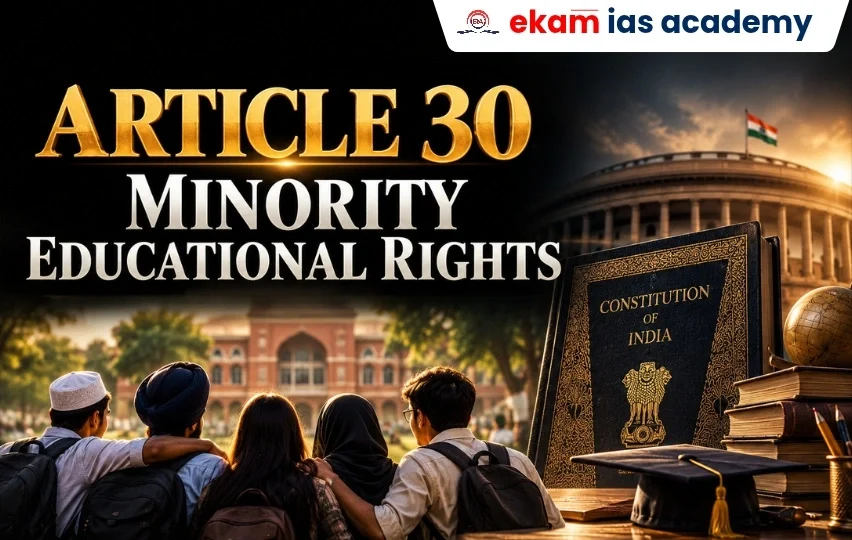
- Article 30 forms the bedrock of Cultural and Educational Rights UPSC and Indian Polity UPSC frameworks.
- Enshrined in Part III, it provides absolute protection to Religious and Linguistic Minorities India to preserve their cultural and educational identity.
- Studying Article 30 Fundamental Rights gives civil services candidates comprehensive insights into how equity and non-discrimination operate within academic administration.
- A complete understanding of Article 30 UPSC is essential to analyze the balance between state regulatory oversight and institutional autonomy.
Exact Constitutional Text of Article 30
- Article 30(1) Indian Constitution: Grants all minorities, whether based on religion or language, the Right to Establish Educational Institutions and the Right to Administer Minority Institutions of their choice.
- Article 30(1A) Provision: Added by the 44th Amendment Act (1978), ensuring that compulsory state acquisition of minority institution property must guarantee compensation that does not abrogate their fundamental rights.
- Article 30(2) Constitution of India: Directs the State not to discriminate against any educational institution in granting financial aid on the grounds that it is under minority management.
- Dual Protection Structure: Safeguards both institutional management autonomy and financial parity in state welfare distribution.
Meaning and Scope of Article 30
- Right to Establish: Empowers minority groups to found institutions across primary, secondary, higher, and professional education streams.
- Right to Administer: Encompasses choosing governing bodies, selecting staff, admitting students, and managing internal finances.
- Choice Component: Allows minorities to impart general secular education alongside religious or linguistic instruction based on preference.
- Non-Absolute Freedom: While conferring managerial freedom, the Supreme Court has clarified that Article 30 does not protect maladministration or academic standard violations.
Article 30 and the Concept of Minorities
- Religious and Linguistic Basis: Explicitly recognizes two categories—religious minorities and linguistic minorities.
- State-Wise Determination: In T.M.A. Pai Foundation (2002), the Supreme Court ruled that minority status must be determined unit-wise taking the State (not the nation) as the unit.
- Absence of Textual Definition: The Constitution does not explicitly define the term “minority,” leaving it to statutory and judicial interpretations.
- Numerical Metric: Applies to communities that are numerically less than 50% of the population within a given State.

Article 30 vs Article 29
| Feature / Criteria | Article 29 | Article 30 |
| Target Beneficiaries | Covers “any section of citizens” (includes majority and minority groups). | Confined exclusively to Religious and Linguistic Minorities India. |
| Core Protection Granted | Right to conserve language, script, or culture. | Right to Establish Educational Institutions and administer them. |
| Institutional Scope | Governs non-discrimination in state-maintained or aided admissions. | Protects managerial independence of Minority Educational Institutions. |
Rights and Responsibilities of Minority Educational Institutions
- Staff Selection Freedom: Autonomy to appoint qualified principals and teaching staff subject to basic state eligibility criteria.
- Admission Autonomy: Permitted to give preference to students of their own community while maintaining academic merit.
- Regulatory Compliance: State can enforce regulatory standards regarding health, sanitation, employment contracts, and academic excellence.
- Anti-Maladministration: State authorities retain the right to intervene in cases of gross corruption or mismanagement.
Article 30 and the Right to Education
- Exemption from Statutory Quotas: Un-aided Minority Educational Institutions are exempted from compulsory 25% quota reservations under Section 12(1)(c) of the Right to Education (RTE) Act.
- Judicial Confirmation: Upheld in Pramati Educational and Cultural Trust (2014) to prevent infringement of Article 30(1) rights.
- Balancing Access: Harmonizes constitutional guarantees of fundamental education access with minority institutional rights.
- State Aid Obligations: Aided minority institutions must satisfy state-directed general admissions parity while retaining minority identity.
Article 30 and Contemporary Issues
- Transparency in Admissions: Debates surrounding centralized entrance tests (e.g., NEET) for professional seats in minority colleges.
- National Commission Oversight: Role of the National Commission for Minority Educational Institutions (NCMEI) in issuing minority certificates.
- Regulatory Oversight vs Autonomy: Legal friction between state university statutes and administrative freedom under Article 30(1).
- National Education Policy (NEP): Integrating national curriculum frameworks without diluting Minority Educational Rights in India.
Conclusion
- Constitutional Anchor: Article 30 serves as a paramount guarantee preserving educational diversity and minority identity.
- Balanced Ecosystem: Successfully reconciles management autonomy with state academic regulation.
- UPSC Core Topic: Mastery over Fundamental Rights UPSC provisions equips candidates to solve analytical questions in General Studies Paper II.
UPSC Prelims: PYQs & Practice Questions
Previous Year Questions (Prelims)
Q: Which of the following provisions of the Constitution of India explicitly provides for the protection of interests of minorities?
(a) Article 15
(b) Article 19
(c) Article 29 and Article 30
(d) Article 32
Answer: (c) Article 29 and Article 30
Explanation:
Articles 29 and 30 form the dedicated cluster under Part III titled "Cultural and Educational Rights." Article 29 protects the language, script, and culture of any section of citizens, while Article 30 guarantees religious and linguistic minorities the right to establish and administer educational institutions of their choice.
Q2: A category of Fundamental Rights that incorporates protection against discrimination in establishing and administering educational institutions of choice is available under:
(a) Right to Freedom
(b) Right against Exploitation
(c) Right to Freedom of Religion
(d) Cultural and Educational Rights
Answer: (d) Cultural and Educational Rights
Explanation:
Article 30(1) falls under the Cultural and Educational Rights category covering Articles 29–30. It grants religious and linguistic minorities the constitutional right to establish and administer educational institutions of their choice, while Article 30(2) protects such institutions from discrimination in the grant of State aid.
Practice Questions
Q: With reference to Article 30 of the Indian Constitution, consider the following statements:
1. The term "minority" is explicitly defined under Article 30 as any community comprising less than 50% of the total population of India.
2. In the T.M.A. Pai Foundation (2002) case, the Supreme Court ruled that minority status must be determined taking the State, and not the whole of India, as the unit.
3. The right of minorities to administer educational institutions under Article 30(1) includes the right to maladminister without state interference.
Which of the statements given above is/are correct?
(a) 1 and 2 only
(b) 2 only
(c) 1 and 3 only
(d) 2 and 3 only
Answer: (b) 2 only
Explanation:
Statement 1 is incorrect: The Constitution does not define the term "minority" anywhere.
Statement 2 is correct: In T.M.A. Pai Foundation v. State of Karnataka (2002), the Supreme Court held that minority status is determined by taking the State as the unit, rather than the national population.
Statement 3 is incorrect: The right to administer does not mean a right to maladminister. The State may impose reasonable regulations relating to academic standards, teacher qualifications, sanitation and other legitimate requirements.
Q2: Consider the following statements regarding Minority Educational Institutions (MEIs) in India:
1. Under Article 30(1A), introduced by the 44th Constitutional Amendment Act, 1978, the State must ensure that compensation for compulsory acquisition of MEI property does not restrict their constitutional rights.
2. Unaided minority educational institutions are exempted from providing the mandatory 25% quota reservation under the Right to Education (RTE) Act, 2009.
Which of the statements given above is/are correct?
(a) 1 only
(b) 2 only
(c) Both 1 and 2
(d) Neither 1 nor 2
Answer: (c) Both 1 and 2
Explanation:
Statement 1 is correct: Article 30(1A), inserted by the 44th Constitutional Amendment Act, 1978, protects the constitutional rights of minority educational institutions in cases of compulsory acquisition of their property.
Statement 2 is correct: In Pramati Educational and Cultural Trust v. Union of India (2014), the Supreme Court held that applying the RTE Act's 25% reservation requirement to minority educational institutions would violate the protection guaranteed under Article 30(1).
UPSC Mains – Previous Year & Practice Questions
Mains Previous Year Questions
Question: What are the constitutional provisions for the protection of linguistic and religious minorities in India? How far have these provisions met their intended objectives? (Mains 2020 - GS Paper II)
Question: Examine the scope of Article 30 of the Indian Constitution. How has judicial interpretation balanced the administrative autonomy of minority institutions with regulatory controls imposed by the State? (Mains 2018 - GS Paper II)
Question: Discuss the impact of the Supreme Court judgment in the Pramati Educational and Cultural Trust case regarding the application of the Right to Education Act on Minority Educational Institutions. (Mains 2014 - GS Paper II)
Question: Analyze the conflict between state-mandated centralized entrance tests (such as NEET) and the rights guaranteed to minority educational institutions under Article 30. (Mains 2012 - GS Paper II)
Question: Comment on the criteria used for determining 'minority' status under Article 30 in light of the T.M.A. Pai Foundation judgment. (Mains 2008 - GS Paper II)
Practice Questions
[15 Marks | 250 Words]
Q: "The right guaranteed under Article 30(1) is 'to administer, not to maladminister.' Critically evaluate how courts have upheld reasonable state regulations on staff recruitment and academic standards in Minority Educational Institutions."
[15 Marks | 250 Words]
Q: Compare and contrast the beneficiary scope and institutional protections under Article 29 and Article 30 of the Indian Constitution.
[10 Marks | 150 Words]
Q: Examine the role and statutory powers of the National Commission for Minority Educational Institutions (NCMEI) in safeguarding constitutional rights under Article 30.
Article 30 of the Indian Constitution-FAQs
What does Article 30 of the Indian Constitution provide?
Article 30 grants religious and linguistic minorities the right to establish and administer educational institutions of their choice. It is an important Fundamental Right under Part III of the Constitution.
Who are considered minorities under Article 30?
Article 30 recognizes religious and linguistic minorities. The Constitution does not expressly define the term “minority”; the Supreme Court has examined its meaning and application in cases such as T.M.A. Pai Foundation v. State of Karnataka (2002).
Does Article 30 give minority institutions absolute administrative freedom?
No. Article 30 protects institutional autonomy, but minority institutions remain subject to reasonable regulations concerning academic standards, administration, health, discipline and other legitimate public interests. The right to administer does not include a right to maladministration.
What is the difference between Article 29 and Article 30?
Article 29 primarily protects the right of a section of citizens to conserve its language, script or culture and protects against certain forms of discrimination in educational admissions. Article 30 specifically protects the right of religious and linguistic minorities to establish and administer educational institutions.
How does Article 30 interact with the Right to Education Act?
Article 30 has an important relationship with the Right to Education framework. The Supreme Court in Pramati Educational & Cultural Trust v. Union of India (2014) considered the application of the RTE Act to minority educational institutions and the constitutional protection under Article 30.