Table of Contents
ToggleArticle 32 of the Indian Constitution
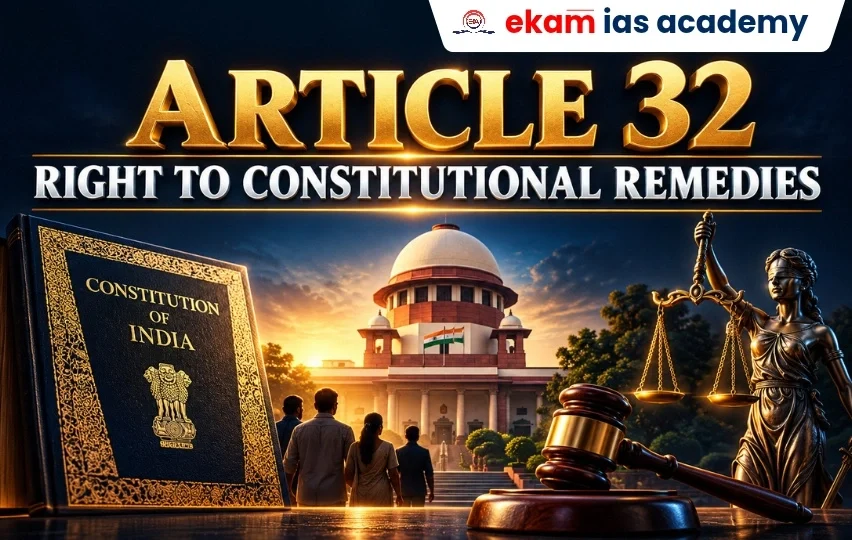
- Article 32 of the Indian Constitution is hailed as the cornerstone of Fundamental Rights in the Indian Constitution, serving as an indispensable pillar for civil services candidates preparing for Indian Polity UPSC and Constitutional Remedies UPSC modules.
- Famously referred to as the “heart and soul of the Constitution” by Dr BR Ambedkar Article 32 guarantees citizens direct judicial protection against state infringement of their fundamental freedoms.
- Studying Article 32 Explained clarifies how the judiciary acts as a protector, safeguarding fundamental rights through Supreme Court Writ Jurisdiction.
- A comprehensive understanding of Article 32 Fundamental Rights enables civil services aspirants to evaluate how the rule of law and constitutional morality are upheld in Fundamental Rights Enforcement in India.
Constitutional Background of Article 32
- Foundational Shield: Drafted by the Constituent Assembly to ensure that Part III guarantees were not merely programmatic declarations, but enforceable legal rights.
- Basic Structure Status: Upheld in L. Chandra Kumar v. Union of India (1997), confirming that judicial review under Article 32 forms an unalterable part of the basic structure.
- Guaranteed Remedy: Unlike other fundamental rights that define freedoms, Article 32 guarantees a direct judicial remedy, making the right to enforce rights a fundamental right itself.
- Supreme Court as Custodian: Entrusts the Supreme Court of India Powers directly with the responsibility of acting as the protector and guarantor of fundamental rights.
Exact Provisions of Article 32
- Article 32(1): Guarantees the right to move the Supreme Court by appropriate proceedings for the enforcement of rights conferred under Part III.
- Article 32(2): Empowers the Supreme Court to issue directions, orders, or Writs Under the Indian Constitution for enforcing fundamental rights.
- Article 32(3): Authorizes Parliament to empower any other court to exercise similar writ jurisdiction within its local limits without prejudice to the Supreme Court.
- Article 32(4): Directs that the right to move the Supreme Court shall not be suspended except as otherwise provided for by the Constitution (such as during a National Emergency under Article 359).
The Five Constitutional Writs
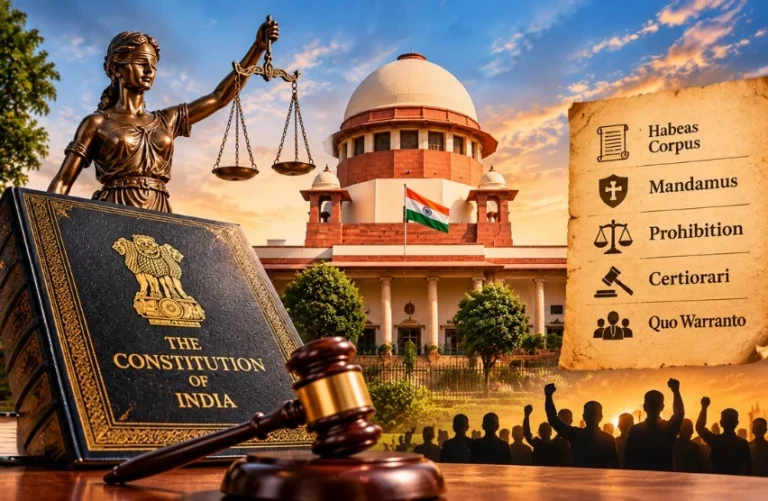
- Habeas Corpus: Translates to “to have the body of”; issued to command the production of a detained person to examine the legality of detention (remedy against illegal state or private detention).
- Mandamus: Translates to “we command”; issued to compel a public official, tribunal, or lower authority to perform an obligatory public duty.
- Prohibition & Certiorari:
- Prohibition: Issued to a lower court or judicial tribunal to prevent it from exceeding its jurisdiction (preventive writ).
- Certiorari: Issued to quash an order already passed by an inferior court or tribunal acting without or in excess of jurisdiction (curative writ).
- Quo Warranto: Translates to “by what authority”; issued to inquire into the legality of a person’s claim to a public office, preventing illegal usurpation.
Article 32 and Other Constitutional Provisions
Comparison Metric | Article 32 | Article 226 |
| Constitutional Court | Supreme Court of India. | State High Courts. |
| Nature of Right | A Fundamental Right in itself under Part III. | A Constitutional Right under Part VI (not a fundamental right). |
| Scope of Jurisdiction | Confined strictly to Fundamental Rights Enforcement in India. | Broader scope: covers Fundamental Rights AND “any other legal right”. |
| Territorial Jurisdiction | Territorial jurisdiction covers the entire territory of India. | Confined to the state’s territorial limits or cause of action origin. |
Who Can Approach the Supreme Court Under Article 32
- Aggrieved Individual: Traditionally restricted under the strict legal rule of Locus Standi (only the person whose fundamental right is directly violated can file).
- Relaxation for Marginalized Groups: Courts relaxed rigid locus standi norms to ensure justice is accessible to poor, illiterate, or disadvantaged citizens.
- Non-Citizens Coverage: Available to non-citizens for universally applicable fundamental rights (such as Articles 14, 20, 21, 21A, and 22).
- Corporations & Entities: Statutory corporations and companies can approach the Supreme Court when corporate fundamental rights are infringed.
Article 32 vs Article 226
| Basis | Article 32 | Article 226 |
|---|---|---|
| Court | Supreme Court | High Courts |
| Constitutional Location | Part III (Fundamental Rights) | Part VI (The States) |
| Purpose | Enforcement of Fundamental Rights | Enforcement of Fundamental Rights and other legal rights |
| Nature of Remedy | Itself a Fundamental Right | Constitutional power of the High Court |
| Scope | Limited to enforcement of Fundamental Rights | Wider subject-matter jurisdiction |
| Territorial Reach | Supreme Court exercises its constitutional jurisdiction nationally | High Court jurisdiction is governed by Article 226, including territorial and cause-of-action rules |
Article 32 and Public Interest Litigation
- PIL Revolution: Pioneer judges like Justice P.N. Bhagwati and Justice V.R. Krishna Iyer expanded Article 32 into a tool for socio-economic justice through Public Interest Litigation (PIL).
- Epistolary Jurisdiction: Allowed the Supreme Court to treat informal letters, postcards, and newspaper reports as formal writ petitions under Article 32.
- Expanded Protection: Brought issues like bonded labor, custodial violence, environmental protection, and prisoner rights under Right to Constitutional Remedies scrutiny.
- Third-Party Standing: Enabled public-spirited citizens and NGOs to approach the court on behalf of oppressed communities unable to access judicial remedies.
Limitations and Constitutional Safeguards
- Emergency Suspension: Under Article 359, the President can suspend the right to move any court for enforcing fundamental rights during a National Emergency (except Articles 20 and 21).
- Res Judicata Applicability: A writ petition dismissed on merits by a High Court under Article 226 cannot generally be re-filed on identical grounds under Article 32.
- No Alternate Remedy Bar: While existence of an alternate remedy is a consideration, the Supreme Court ruled that Article 32 petitions cannot be dismissed solely because High Court relief under Article 226 was not exhausted first.
- Curbing Judicial Overreach: Safeguards prevent frivolous or politically motivated PILs from overburdening the judicial system.
Importance of Article 32 in Indian Democracy
- Guardian of Liberty: Converts abstract constitutional guarantees into actionable, enforceable rights for ordinary citizens.
- Check on Executive Arbitrariness: Restrains executive overreach, illegal detentions, and unconstitutional legislative enactments.
- Preserving Rule of Law: Ensures that state agencies act strictly within statutory and constitutional boundaries.
- Democratic Pillar: Forms the supreme shield protecting individual liberty against state encroachment in the Indian republic.
Landmark Supreme Court Judgments
| Case | Year | Key Principle | UPSC Significance |
|---|---|---|---|
| Romesh Thappar v. State of Madras | 1950 | Protection of freedom of expression through constitutional remedies | Early landmark case involving Article 32 and freedom of speech and expression |
| State of Madras v. V.G. Row | 1952 | Judicial review and assessment of restrictions on Fundamental Rights | Established principles for assessing the reasonableness of restrictions on Fundamental Rights |
| Daryao v. State of Uttar Pradesh | 1961 | Res judicata and successive constitutional remedies | Explained when a decision under Article 226 may bar a subsequent petition under Article 32 |
| S.P. Gupta v. Union of India | 1981 | Public Interest Litigation and liberalisation of locus standi | Expanded access to constitutional justice through PIL |
| People’s Union for Democratic Rights v. Union of India | 1982 | Enforcement of Fundamental Rights through public-interest proceedings | Applied Articles 21 and 23 to labour exploitation and supported PIL-based enforcement of rights |
| Bandhua Mukti Morcha v. Union of India | 1984 | PIL and enforcement of the rights of bonded labourers | Strengthened access to justice for vulnerable groups and enforcement of Article 21 and Article 23 |
| L. Chandra Kumar v. Union of India | 1997 | Judicial review by constitutional courts as part of the Basic Structure | Affirmed the constitutional role of the Supreme Court and High Courts in judicial review |
| K.S. Puttaswamy v. Union of India | 2017 | Recognition of privacy as a Fundamental Right | Recognised privacy as part of Article 21 and the broader framework of Fundamental Rights |
| Lalita Kumari v. Government of Uttar Pradesh | 2013 | Registration of FIRs in cognizable cases | Primarily concerns criminal procedure and police duties; relevant to constitutional remedies only in the broader context of enforcing legal rights |
Contemporary Relevance and Challenges
- Pendency and Backlog: Rising case volumes and mounting judicial backlog lead to delays in resolving urgent writ petitions.
- High Court First Preference: Recent judicial trends encourage petitioners to exhaust High Court remedies under Article 226 before approaching the Supreme Court under Article 32.
- Digital Rights Protection: Applying traditional writs like Habeas Corpus Mandamus Certiorari Prohibition Quo Warranto to contemporary digital issues, privacy violations, and cyber-surveillance.
- Balancing Public Interest: Managing the tension between judicial intervention under Article 32 and maintaining separation of powers with the executive and legislature.
Conclusion
- Ultimate Constitutional Shield: Article 32 of the Indian Constitution remains the indispensable protector of fundamental liberties in the Indian republic.
- Judicial Keystone: Ensures that democratic governance operates strictly under constitutional accountability and the rule of law.
- UPSC Core Preparation: Achieving absolute clarity on Article 32 UPSC equips candidates to excel in high-scoring General Studies Paper II questions.
UPSC Prelims: PYQs & Practice Questions
Previous Year Questions (Prelims)
Q: With reference to the writs issued by the Courts in India, consider the following statements:
1. Mandamus will not lie against a private organization unless it is entrusted with a public duty.
2. Mandamus will not lie against a Company even though it may be a Government Company.
3. Any public-minded person can be a petitioner to move the Court to obtain the writ of Quo Warranto.
Which of the statements given above are correct?
(a) 1 and 2 only
(b) 2 and 3 only
(c) 1 and 3 only
(d) 1, 2 and 3
Answer: (c) 1 and 3 only
Explanation:
Statement 1 is correct: The writ of Mandamus is issued to compel performance of a public duty. It does not lie against a private body or individual unless that private entity is entrusted with a statutory or public duty.
Statement 2 is incorrect: Mandamus can lie against a Government Company or a statutory corporation if it fails to discharge a public or statutory duty assigned to it by law.
Statement 3 is correct: The traditional rule of Locus Standi is relaxed in the case of Quo Warranto. Any public-spirited or interested person can move the court to challenge the legal right of an individual holding a public office.
Q: Which one of the following categories of Fundamental Rights incorporates protection against untouchability as a form of discrimination?
(a) Right against Exploitation
(b) Right to Freedom
(c) Right to Constitutional Remedies
(d) Right to Equality
Answer: (d) Right to Equality
Explanation:
The Right to Equality spans Articles 14 to 18 of the Indian Constitution. Protection against untouchability is explicitly provided under Article 17 ("Abolition of Untouchability"). While Article 32 provides the mechanism to enforce Fundamental Rights, Article 17 itself is structurally categorized under the Right to Equality.
Practice Questions
Q: With reference to the constitutional scope of Article 32, consider the following statements:
1. Under Article 32(3), Parliament can empower any other court—including local subordinate courts—to issue writs within their local limits without prejudice to the Supreme Court.
2. The Supreme Court can refuse to exercise its jurisdiction under Article 32 if an adequate alternative legal remedy is available to the aggrieved citizen.
3. Article 32 cannot be invoked simply to determine the general constitutionality of an executive order or legislative act unless it directly violates a Fundamental Right.
Which of the statements given above are correct?
(a) 1 and 2 only
(b) 1 and 3 only
(c) 2 and 3 only
(d) 1, 2, and 3
Answer: (b) 1 and 3 only
Explanation:
Statement 1 is correct: Article 32(3) explicitly authorizes Parliament to pass a law empowering any other court, such as district courts, to issue directions, orders, or writs within their jurisdiction.
Statement 2 is incorrect: Unlike the discretionary jurisdiction of High Courts under Article 226, the Supreme Court's jurisdiction under Article 32 is mandatory. The mere existence of an alternative statutory remedy is not an absolute ground for refusing an Article 32 petition.
Statement 3 is correct: Article 32 provides remedies specifically for the enforcement of Fundamental Rights. Abstract questions of constitutionality without a direct infringement of a Fundamental Right cannot ordinarily be adjudicated under Article 32.
Q: Which of the following writs can be issued against both administrative authorities and judicial/quasi-judicial bodies?
(a) Prohibition only
(b) Mandamus and Certiorari
(c) Certiorari only
(d) Prohibition and Certiorari
Answer: (b) Mandamus and Certiorari
Explanation:
Mandamus can be issued against public officials, administrative bodies, corporations, tribunals, and lower courts to compel performance of a public duty.
Certiorari was originally available against judicial and quasi-judicial bodies. Its scope was subsequently expanded to cover administrative authorities affecting citizens' rights.
Prohibition, on the other hand, remains restricted to judicial and quasi-judicial bodies and is used to prevent them from exceeding their jurisdiction.
UPSC Mains – Previous Year & Practice Questions
Mains Previous Year Questions
Question: Analyse the distinction between the writ jurisdiction of the Supreme Court under Article 32 and that of the High Courts under Article 226 of the Constitution of India. (Mains 2022)
Question: Public Interest Litigation (PIL) under Article 32 has democratized access to justice, but has also led to judicial overreach and burdening of courts. Critically evaluate. (Mains 2019)
Question: Examine how the Supreme Court used its powers under Article 32 to expand the horizons of Right to Life (Article 21) through creative judicial activism. (Mains 2016)
Question: Discuss the constitutional safeguards that protect Article 32 from being rendered meaningless during a National Emergency under Article 359. (Mains 2013)
Question: “Article 32 is not merely a provision for issuing writs, but the fundamental guarantee of constitutionalism.” Comment in light of the basic structure doctrine. (Mains 2008 – GS Paper II / Law Paper)
Mains Practice Questions
[15 Marks | 250 Words]
Question: Dr. B.R. Ambedkar famously referred to Article 32 as the “very soul of the Constitution”. How has the relaxation of the doctrine of Locus Standi under Article 32 transformed the Indian Supreme Court from a traditional constitutional court into a court of social justice?
[15 Marks | 250 Words]
Question: While Article 32 guarantees a fundamental right to constitutional remedies, the Supreme Court increasingly directs petitioners to first exhaust their remedies under Article 226 before High Courts. Critically analyze the rationale and implications of this practice.
[10 Marks | 150 Words]
Question: Distinguish between the preventative writ of Prohibition and the curative writ of Certiorari. How has judicial interpretation expanded the scope of Certiorari to administrative actions?
Article 32 of the Indian Constitution-FAQs
Why is Article 32 called the “heart and soul of the Constitution”?
Dr. B.R. Ambedkar described Article 32 this way because it guarantees the right to approach the Supreme Court for enforcement of Fundamental Rights. The Supreme Court can issue directions, orders and writs for this purpose.
What are the five writs that can be issued under Article 32?
The Supreme Court can issue Habeas Corpus, Mandamus, Prohibition, Certiorari and Quo Warranto for enforcing Fundamental Rights.
What is the difference between Article 32 and Article 226?
Article 32 gives a Fundamental Right to approach the Supreme Court for enforcement of Fundamental Rights, whereas Article 226 empowers High Courts to issue writs not only for Fundamental Rights but also for other legal rights.
How did Article 32 contribute to Public Interest Litigation (PIL)?
The Supreme Court expanded access to Article 32 through PIL, allowing public-spirited individuals and groups to approach the Court on behalf of disadvantaged persons. In appropriate cases, even letters, telegrams, postcards and news reports have been treated as writ petitions.
Can the right to approach the Supreme Court under Article 32 be suspended?
Yes. Under Article 359, the President may suspend the right to move a court for enforcement of specified Fundamental Rights during a National Emergency. However, Articles 20 and 21 cannot be suspended under the present constitutional position.