
Table of Contents
ToggleTROPICAL CYCLONES AND BAY OF BENGAL VULNERABILITY
TOPIC: (GS1) GEOGRAPHY: THE HINDU
Recently Cyclone Murasu struck coastal Andhra Pradesh, causing deaths, crop damage, displacement and disruption of transport and electricity.
What Is a Tropical Cyclone?
- A tropical cyclone is an intense low-pressure system developing over warm tropical oceans, accompanied by strong rotating winds and heavy rainfall.
- Formation conditions: Sea surface temperature around 26.5°C or higher, moist air, atmospheric instability, low vertical wind shear and sufficient Coriolis force.
- Rotation: Cyclones rotate anticlockwise in the Northern Hemisphere and clockwise in the Southern Hemisphere.
- They rarely form near the Equator because the Coriolis force is very weak.
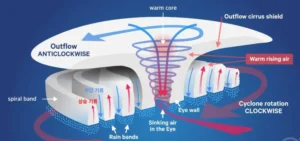
How Does the Eye Work?
- Eye: The relatively calm central region, where air generally sinks and clouds may clear.
- Eyewall: A ring of powerful thunderstorms surrounding the eye, producing the strongest winds and intense rainfall.
- Rainbands: Curved cloud bands extending outward, bringing showers and gusty winds.
- When the eye passes over an area, conditions may briefly improve before dangerous winds return from another direction.
Northern vs Southern Hemisphere Cyclones
- Northern Hemisphere: Winds spiral anticlockwise around the low-pressure centre.
- Southern Hemisphere: Winds spiral clockwise because the Coriolis force acts in the opposite direction.
- Their basic structure and formation processes remain similar.
- In India, cyclone activity is concentrated around the Bay of Bengal and Arabian Sea, mainly during pre-monsoon and post-monsoon periods.
Why Does the Bay of Bengal Experience More Cyclones?
- Warm waters: High sea temperatures provide energy for cyclone development.
- Freshwater inflow: Major rivers create surface-water stratification, which can limit cooling caused by ocean mixing.
- Atmospheric conditions: Favourable moisture, disturbances and wind patterns support cyclone formation.
- Arabian Sea conditions: Historically, stronger vertical wind shear and cooler water from upwelling have often restricted cyclone development.
- Coastal vulnerability: The Bay’s funnel-shaped northern coastline can amplify storm surges, particularly near low-lying deltas.
Impacts and Disaster Management
- Human: Deaths, displacement, injuries and disease risks.
- Economic: Damage to crops, fisheries, transport and electricity networks.
- Environmental: Coastal erosion, saline-water intrusion and habitat destruction.
- Preparedness: IMD forecasts, evacuation shelters, resilient buildings and coastal shelterbelts.
- Institutions: NDMA, NDRF and State disaster authorities coordinate preparedness and response.
Conclusion
Reducing cyclone losses requires accurate forecasting, strong community preparedness and climate-resilient coastal development rather than relying on emergency response alone.
INDIA–CHINA BORDER TENSIONS IN ARUNACHAL PRADESH
TOPIC: (GS2) POLITY: THE HINDU
Reports of fresh India–China military face-offs in Arunachal Pradesh’s Asaphila, Taksing and Longju areas have raised concerns about border security.
Background of the India–China Border Dispute
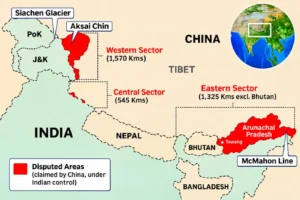
- Line of Actual Control (LAC): The line separating areas under Indian and Chinese control; its alignment is not mutually agreed in several locations.
- McMahon Line (1914): Forms the basis of India’s boundary position in the eastern sector, but China disputes it.
- China’s claim: Beijing describes Arunachal Pradesh as Zangnan or South Tibet, which India firmly rejects.
- 1959 Line: A historical Chinese proposal for the LAC that India has never accepted.
Recent Concerns in Arunachal Pradesh
- Reported face-offs: Asaphila, Taksing and Longju have emerged as areas of concern.
- Patrolling disputes: Reports suggest possible restrictions on Indian patrol access.
- Infrastructure: Allegations of Chinese construction near traditional grazing grounds require verification.
- Salami-slicing: A strategy of making small, gradual territorial advances to change the situation on the ground.
Eastern and Northeastern Border States
Country | Indian States sharing the border | Principal border guarding force |
China | Arunachal Pradesh, Sikkim; also Uttarakhand, Himachal Pradesh and Ladakh UT | ITBP |
Myanmar | Arunachal Pradesh, Nagaland, Manipur, Mizoram | Assam Rifles |
Nepal | Sikkim, West Bengal, Bihar, Uttar Pradesh, Uttarakhand | SSB |
Bhutan | Arunachal Pradesh, Assam, West Bengal, Sikkim | SSB |
Bangladesh | West Bengal, Assam, Meghalaya, Tripura, Mizoram | BSF |
Major Security Agencies
- Indian Army: Defends the border against external military threats.
- ITBP: Guards the India–China frontier and conducts border patrols.
- Assam Rifles: Guards the Myanmar border and supports counter-insurgency operations.
- SSB: Guards India’s borders with Nepal and Bhutan.
- BSF: Guards the India–Bangladesh border.
Diplomatic Agreements and Mechanisms
- 1993 Agreement: Promotes peace and stability along the LAC.
- 1996 Agreement: Establishes military confidence-building measures.
- 2005 Agreement: Provides political principles for boundary settlement.
- WMCC: Facilitates consultation and coordination on border affairs.
- Special Representatives mechanism: Enables high-level discussions on the boundary question.
Challenges
- Border ambiguity: Accelerate mutually agreed clarification of the LAC.
- Infrastructure gaps: Improve roads, communications and surveillance.
- Local participation: Include border communities in development and information-sharing.
- Transparency: Communicate verified major developments without compromising security.
- Diplomacy: Combine military preparedness with sustained political dialogue.
Conclusion
India’s eastern frontier requires a coordinated strategy combining credible deterrence, diplomatic engagement, border development and transparent governance to protect territorial integrity.
EDUCATION LOANS IN INDIA AND DECLINING STUDENT ACCESS
TOPIC: (GS3) ECONOMY: THE HINDU
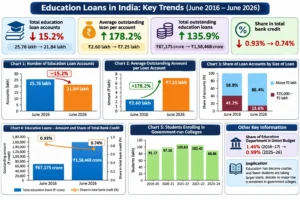
RBI data highlighted that education loan accounts declined by 15.2% between June 2016 and June 2026, while the average outstanding loan increased sharply.
Key Findings from RBI Data
- Fewer borrowers: Education loan accounts declined from 25.76 lakh to 21.84 lakh.
- Higher loan burden: Average outstanding loans increased from ₹2.60 lakh to ₹7.25 lakh, a rise of 178.2%.
- Shrinking small loans: Accounts involving loans up to ₹2 lakh declined from approximately 11.44 lakh to three lakh.
- Larger loans: Accounts above ₹2 lakh increased, reflecting greater dependence on higher borrowing.
- Bank credit share: Education loans declined from 0.93% to 0.74% of total scheduled commercial bank credit.
Reasons Behind the Trend
- Rising education costs: Tuition fees, accommodation and living expenses have increased.
- Private institutions: Dependence on expensive private colleges can raise financial requirements.
- Overseas education: International tuition and living expenses may require larger loans.
- Banking barriers: Collateral requirements, repayment concerns and complicated procedures may discourage applicants.
- Employment uncertainty: Students may hesitate to borrow because of uncertain salaries and job opportunities.
Major Implications
- Social inequality: Students from economically weaker families may struggle to finance higher education.
- Household debt: Larger loans increase repayment pressure on graduates and families.
- Human capital: Financial barriers can restrict skill development and workforce productivity.
- Gender inequality: Financial constraints may disproportionately affect women in some households.
- Economic mobility: Reduced educational opportunities can weaken intergenerational progress.
Government Initiatives
- PM-Vidyalaxmi: Provides collateral-free, guarantor-free education loans to eligible students admitted to specified quality higher education institutions, with interest support for qualifying families.
- Central Sector Interest Subsidy Scheme: Supports eligible economically weaker students through interest subsidy during the moratorium period.
- National Education Policy 2020: Emphasises equitable access, quality education and multidisciplinary learning.
- National Scholarship Portal: Facilitates access to various government scholarship schemes.
Challenges
- Limited awareness of financial assistance schemes.
- Unequal access to formal banking services.
- Risk of repayment difficulties among unemployed graduates.
- Regional differences in institutional quality and affordability.
- Insufficient public investment may increase dependence on private financing.
Way Forward
- Expand affordable, quality public higher education.
- Simplify education loan applications and improve financial awareness.
- Strengthen scholarships, targeted subsidies and repayment flexibility.
- Improve employability through industry-linked courses and internships.
- Monitor tuition increases and promote institutional transparency.
- Encourage fair lending without excluding disadvantaged students.
Conclusion
India must ensure that rising education costs do not turn higher learning into a debt burden or make financial background a barrier to opportunity.

NEED FOR A NATIONAL URBANISATION POLICY AND INDIA'S RURAL–URBAN TRANSITION
TOPIC: (GS2) GOVERNANCE: THE HINDU
Census 2027 will continue using older urban classification criteria, raising concerns that India’s rapidly expanding urban settlements may remain undercounted.
How Does India Define Urban Areas?
- Statutory towns: Settlements officially declared urban by State governments, such as municipalities and municipal corporations.
- Census towns: Settlements satisfying three conditions:
- Minimum population of 5,000.
- Population density of at least 400 persons per sq. km.
- At least 75% of male main workers engaged in non-agricultural activities.
- Limitation: These criteria may overlook rapidly urbanising villages and settlements surrounding major cities.
Key Urbanisation Trends
- Census 2011: India had approximately 377 million urban residents.
- UN estimates: Around 44% of India’s population is urban, depending on the definition used.
- Uneven growth: Small towns account for approximately 94% of urban settlements.
- Population concentration: Nearly 60% of urban residents live in Class I cities, having populations above one lakh.
- Peri-urban expansion: Areas outside municipal boundaries are growing faster than many established cities.
Challenges
- Outdated classification: Rural settlements may develop urban characteristics without receiving municipal status.
- Planning gaps: Many smaller towns lack approved master plans.
- Weak local bodies: Municipalities often face limited financial and administrative powers.
- Infrastructure shortages: Water supply, sanitation, housing and transport fail to match population growth.
- Climate risks: Urban flooding, heatwaves and pollution increasingly affect expanding settlements.
- Fragmented governance: Administrative boundaries frequently fail to reflect actual economic and environmental regions.
Constitutional and Institutional Framework
- 74th Constitutional Amendment: Provides constitutional recognition to urban local bodies.
- Article 243Q: Deals with the constitution of municipalities.
- Article 243W: Enables States to devolve powers and responsibilities to municipalities.
- Twelfth Schedule: Lists 18 municipal functions.
- Articles 243ZD and 243ZE: Provide for District and Metropolitan Planning Committees.
Need for a National Urbanisation Policy
- Standardised classification: Regularly review urban status using transparent criteria and satellite data.
- Regional planning: Plan cities alongside surrounding villages and economic corridors.
- Fiscal reforms: Strengthen property taxation, predictable grants and municipal revenue.
- Institutional coordination: Establish a National Urbanisation Council for cooperation across governments.
- Functional governance: Manage air pollution, river basins and transport beyond municipal boundaries.
- Local innovation: Promote knowledge-sharing and capacity-building among smaller towns.
Way Forward
- Apply the principle of subsidiarity, assigning responsibilities to the lowest capable level of government.
- Expand urban planning to emerging settlements before infrastructure problems become severe.
- Link financial assistance with accountability, transparency and service delivery.
- Encourage climate-resilient, inclusive and low-carbon urban development.
Conclusion
India needs an integrated urbanisation policy that recognises emerging towns, empowers local governments and plans development according to people’s needs rather than outdated administrative boundaries.
DEATH PENALTY IN INDIA AND FAIR SENTENCING
TOPIC: (GS2) GOVERNANCE: THE HINDU
The World Day Against the Death Penalty (October 10) renewed debate over the fairness and constitutionality of capital punishment in India.
Constitutional and Legal Framework
- Article 21: Guarantees life and personal liberty, except through a legally established procedure that must be fair, just and reasonable.
- Article 14: Ensures equality before law and protection against arbitrary sentencing.
- Article 72: Empowers the President to grant pardons and commute death sentences.
- Article 161: Provides the Governor with clemency powers, subject to constitutional limits.
- BNSS, 2023: Requires special reasons when courts impose the death penalty instead of life imprisonment.
Evolution Through Supreme Court Judgments
- Bachan Singh (1980): Upheld capital punishment but restricted its application to the rarest of rare cases.
- Machhi Singh (1983): Developed guidelines focusing on the seriousness and circumstances of crimes.
- Santosh Kumar Bariyar (2009): Reaffirmed that courts must consider the possibility of rehabilitation.
- Manoj (2022): Required systematic collection of information relevant to sentencing.
- Vasanta Sampat Dupare (2025): Strengthened the constitutional importance of a fair sentencing hearing.
- Waris (2026): Emphasised that the seriousness of a crime alone cannot establish that rehabilitation is impossible.
Safeguards in Death Penalty Cases
- Individualised sentencing: Examine the accused person’s age, upbringing, circumstances and psychological condition.
- Mental health assessment: Consider psychological evaluations before determining punishment.
- Conduct reports: Examine behaviour during imprisonment and prospects for reform.
- Meaningful hearing: Give the defence adequate opportunity to present mitigating evidence.
- State’s responsibility: Require evidence supporting the claim that rehabilitation is not realistically possible.
Major Concerns
- Irreversible punishment: Wrongful executions cannot be corrected.
- Investigation failures: Weak forensic evidence and unreliable confessions increase miscarriage-of-justice risks.
- Unequal representation: Poor defendants may lack effective legal assistance.
- Inconsistent sentencing: Similar offences may receive different punishments.
- Procedural gaps: Trial courts sometimes impose death sentences without sufficient consideration of mitigating circumstances.
Arguments in the Debate
- In favour: Supporters emphasise punishment for exceptionally grave crimes, deterrence and victims’ interests.
- Against: Critics question deterrence, highlight judicial errors and stress human dignity.
- Law Commission: Its 262nd Report (2015) recommended abolishing the death penalty for ordinary crimes while retaining it for terrorism-related offences and waging war.
Way Forward
- Ensure mandatory, meaningful sentencing hearings and competent legal aid.
- Improve forensic investigation and prosecution standards.
- Strengthen judicial training and review of death sentences.
- Expand access to psychological assessments and rehabilitation reports.
- Maintain strict constitutional scrutiny before imposing irreversible punishment.
Conclusion
The legitimacy of capital punishment depends not merely on the gravity of the crime but on a fair, evidence-based and constitutionally sound process that protects human dignity.
CHIDAMBARAM NATARAJA TEMPLE AND TEMPLE ADMINISTRATION
TOPIC: (GS1) INDIAN ART AND CULTURE: THE HINDU
The Madras High Court reportedly constituted a five-member Management Board for the Chidambaram Sabanayagar Temple in Tamil Nadu over allegations of administrative irregularities.
About Chidambaram Sabanayagar Temple
- Location: Chidambaram, Cuddalore district, Tamil Nadu.
- Other names: Thillai Nataraja Temple and Sri Sabanayagar Temple.
- Deity: Lord Shiva as Nataraja, representing the cosmic dance of creation and destruction.
- Religious importance: One of the Pancha Bhoota Sthalams, representing the element Akasha (space).
Historical Background
- The shrine existed before the seventh century CE.
- Chola dynasty: Significantly expanded the temple from the tenth century onwards.
- Parantaka Chola I: Traditionally credited with covering the sanctum roof with gold.
- Later contributions came from Vijayanagara rulers, Nayakas and other patrons.
Architectural Features
- Dravidian style: Characterised by monumental gateways, courtyards and pillared halls.
- Temple complex: Covers approximately 40 acres.
- Gopurams: Elaborately sculpted entrance towers.
- Dance sculptures: Depictions of the 108 karanas described in Bharata Muni’s Natya Shastra.
- Five Sabhas: Chit Sabha, Kanaka Sabha, Nritta Sabha, Deva Sabha and Raja Sabha.
Temple Administration and Constitutional Issues
- Podhu Dikshitars: Hereditary priestly community traditionally responsible for temple administration.
- 2014 Supreme Court ruling: Protected their denominational management rights in the relevant dispute.
- Article 26: Protects religious denominations’ rights to manage religious affairs, subject to public order, morality and health.
- Governance challenge: Balancing religious autonomy with accountability and protection of temple resources.
Conclusion
Chidambaram Temple represents India’s rich Chola heritage, where preservation of sacred traditions must coexist with transparent and constitutionally sound administration.