Table of Contents
ToggleSIR Exercise and the Technology Failure in Electoral Roll Revision
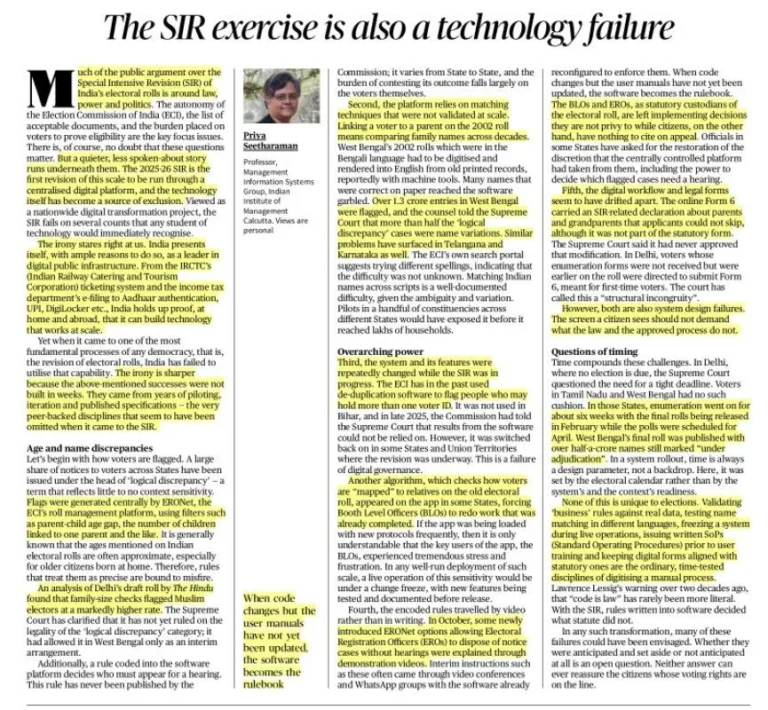
The Special Intensive Revision (SIR) of electoral rolls has raised concerns not only about law and procedure but also about the technology used to identify, map and verify voters. The editorial argues that technological shortcomings can themselves become a source of electoral exclusion.
Technology and Electoral Roll Revision
India has demonstrated its ability to build large-scale digital public infrastructure. However, the SIR exercise highlights the risks of deploying technology without adequate testing, standardisation and transparency.
The process involves matching current voters with historical electoral rolls, including the 2002 electoral rolls, to establish eligibility and lineage.
Major technological concerns include:
- Matching names across different databases and languages.
- Variations in spelling and transliteration.
- Linking voters with parents or grandparents in older electoral rolls.
- Mapping voters to relatives in legacy databases.
- Different software rules being used across States.
- Software changes being introduced while the SIR process was underway.
Problems with Data Matching
In West Bengal, around 1.3 crore entries were reportedly flagged. Similar concerns were reported in Telangana and Karnataka.
The problem becomes more complicated when Indian names appear differently across languages and scripts. A software system may identify legitimate variations as discrepancies, potentially requiring voters to undergo additional verification.
The editorial also points to difficulties with the EC’s own search portal, suggesting that the matching process can become cumbersome for voters.
Changing Software and Accountability
A major concern is that software rules were reportedly modified during the SIR process.
If software changes while the exercise is underway, questions arise regarding:
- Which version of the software governs decisions?
- Whether earlier decisions remain valid.
- Whether voters were given adequate notice.
- Whether the process is auditable.
- Who is accountable when an automated decision is incorrect?
The editorial argues that when software rules change without adequate communication, the software can effectively become the rulebook.
Role of BLOs and EROs
The technology is also placing significant responsibility on Booth Level Officers (BLOs) and Electoral Registration Officers (EROs).
Where automated matching fails, BLOs may have to manually verify records and correct discrepancies. This creates additional administrative burdens and increases the possibility of inconsistent implementation across States.
Way Forward
India needs a technology framework for electoral-roll revision that ensures:
- Standardised software across States.
- Independent testing and auditing of algorithms.
- Clear documentation of software rules.
- Human review of automated exclusions.
- Transparent grievance-redress mechanisms.
- Adequate notice before technological changes.
- Protection against wrongful deletion of eligible voters.
Conclusion
Technology can improve electoral-roll management, but it cannot substitute for due process, transparency and human oversight. The SIR experience demonstrates that a technically sophisticated electoral system must also be constitutionally accountable. The ultimate objective should be to prevent both electoral fraud and the wrongful exclusion of genuine voters.
Vocabulary
1. Algorithmic Bias – Systematic unfairness in automated decisions.
2. Digital Governance – Use of technology in public administration.
3. Logical Discrepancy – Inconsistency identified through automated checks.
Prelims MCQs
MCQ 1
Consider the following statements:
1. Article 324 empowers the ECI to supervise elections.
2. Electoral roll revisions must comply with applicable statutory procedures.
3. Algorithmic decisions can automatically override statutory electoral safeguards.
Which are correct?
A) 1 and 2 only
B) 2 and 3 only
C) 1 and 3 only
D) 1, 2 and 3
Answer: A
UPSC Mains Question
“Digitalisation of electoral processes must ensure transparency and accountability.” Examine with reference to SIR. (10 Marks)
Frequently Asked Questions (FAQs)
What is SIR?
Special Intensive Revision is an exercise undertaken to comprehensively verify and revise electoral rolls.
Why is technology important in SIR?
Technology is used for data matching, voter mapping, verification and identification of discrepancies.
What is the major technological concern highlighted by the editorial?
Different software rules, name-matching difficulties and changes to software during the exercise can create discrepancies and potentially exclude genuine voters.
What is the role of BLOs?
Booth Level Officers undertake field-level verification and may have to manually resolve discrepancies identified through the digital process.
What is the key governance lesson?
Automated electoral systems must remain transparent, auditable and subject to human and constitutional oversight.
Source From : The Hindu
Celebrating the Voter in the Age of SIR
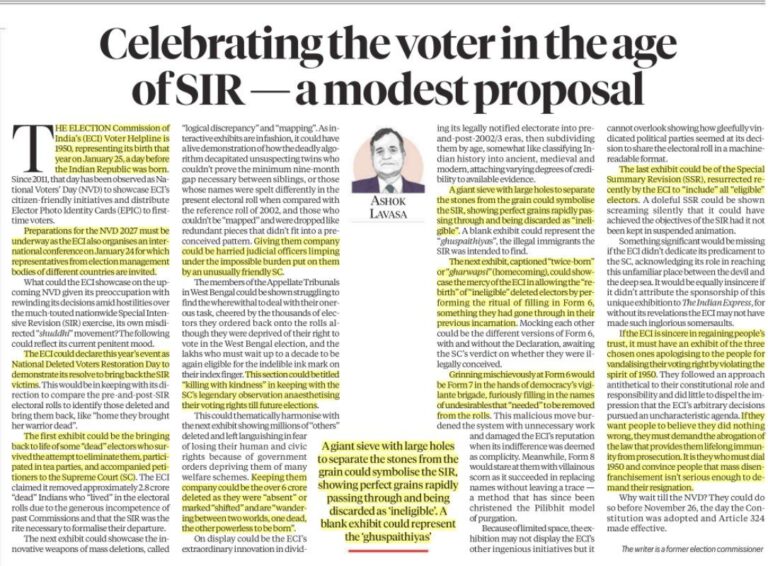
The Election Commission of India (ECI) has been preparing for National Voters’ Day (NVD), observed on January 25, which marks the foundation day of the Election Commission. In the context of the ongoing Special Intensive Revision (SIR) of electoral rolls, the editorial proposes a renewed focus on voters who have been deleted or excluded from electoral rolls.
From Voter Celebration to Voter Restoration
The editorial suggests that the ECI could consider a National Deleted Voters Restoration Day, aimed at restoring eligible voters whose names were removed from electoral rolls.
This could particularly address cases involving voters categorised as:
- “Deceased”
- “Shifted”
- “Absent”
- Those affected by alleged “logical discrepancies” or mapping issues.
The proposal is based on the principle that electoral administration should not merely maintain accurate rolls but also ensure that eligible citizens are not wrongfully deprived of their right to vote.
SIR and the Problem of Exclusion
The editorial uses the metaphor of a “giant sieve” to describe the SIR process, where the objective is to separate genuine voters from ineligible entries.
However, an excessively large or poorly designed sieve may allow genuine voters to fall through.
The editorial highlights concerns regarding:
- Deletion of voters from electoral rolls.
- Classification of voters as deceased or shifted.
- Difficulties in restoring eligible voters.
- The impact of “logical discrepancy” and mapping procedures.
- The need to reconcile electoral-roll accuracy with democratic inclusion.
The Role of the Election Commission
The ECI has a constitutional responsibility to supervise elections and electoral rolls. The editorial argues that its credibility depends not only on eliminating ineligible entries but also on protecting the legitimate voting rights of citizens.
The proposed restoration initiative could therefore serve as a public demonstration of the ECI’s commitment to correcting wrongful exclusions.
Democratic Significance
The issue raises an important constitutional balance:
Electoral integrity + Universal adult franchise + Due process + Voter inclusion
Preventing bogus or duplicate entries is necessary for free and fair elections. However, genuine voters must have accessible mechanisms to challenge deletion and restore their names.
Conclusion
Electoral-roll revision should ultimately strengthen democracy rather than create uncertainty among legitimate voters. A dedicated initiative for restoring wrongly deleted voters could symbolically reaffirm that the voter remains at the centre of the electoral process. The editorial also suggests that such an initiative could be linked to the constitutional foundations of the ECI and democratic governance.
Vocabulary
1. Disenfranchisement – Deprivation of voting rights.
2. Electoral Integrity – Fairness and credibility of electoral processes.
3. Voter Restoration – Reinstatement of eligible voters on electoral rolls.
Prelims MCQs
MCQ 1
Consider the following statements:
1. Article 324 vests the ECI with the superintendence, direction and control of elections.
2. National Voters’ Day is observed on January 25.
3. The right to vote in India is an absolute Fundamental Right.
Which are correct?
A) 1 and 2 only
B) 2 and 3 only
C) 1 and 3 only
D) 1, 2 and 3
Answer: A
UPSC Mains Question
“Electoral roll accuracy must not compromise universal adult franchise.” Examine in the context of SIR. (10 Marks)
Frequently Asked Questions (FAQs)
What is National Voters’ Day?
It is observed on January 25 and is associated with the foundation of the Election Commission of India.
What is SIR?
Special Intensive Revision is an exercise for intensive revision and verification of electoral rolls.
What is the proposed National Deleted Voters Restoration Day?
It is an editorial proposal to recognise and facilitate the restoration of eligible voters whose names were wrongly deleted from electoral rolls.
Why is voter restoration important?
It helps balance the objective of maintaining accurate electoral rolls with the protection of eligible citizens’ voting rights.
What is the UPSC relevance?
The issue connects Election Commission, electoral reforms, universal adult franchise, electoral-roll management, constitutional governance and democratic participation.