
Table of Contents
TogglePM in Manila: Giving New Momentum to Act East Policy
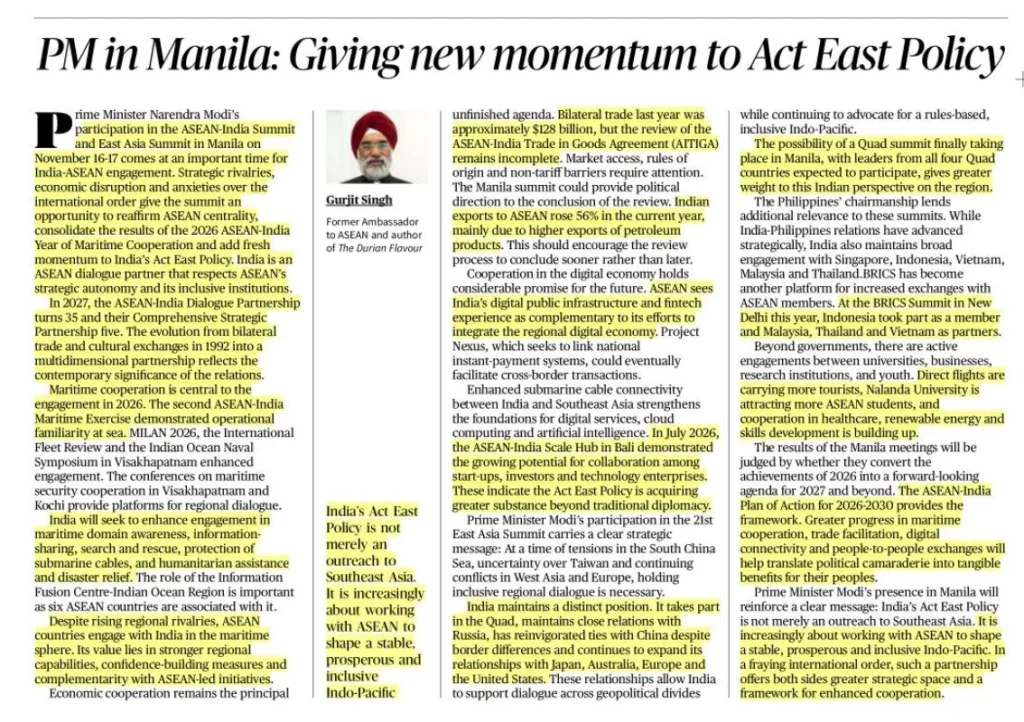
Prime Minister Narendra Modi’s participation in the ASEAN-India Summit and East Asia Summit in Manila provides an opportunity to strengthen India’s engagement with Southeast Asia and give fresh momentum to the Act East Policy amid geopolitical tensions and economic disruptions.
Importance of ASEAN-India Relations
India-ASEAN relations have evolved from bilateral trade and cultural exchanges into a broader strategic partnership covering:
- Maritime security
- Digital connectivity
- Trade and investment
- Disaster relief and humanitarian assistance
- People-to-people exchanges
The ASEAN-India Comprehensive Strategic Partnership and the ASEAN-India Plan of Action 2026–2030 provide an institutional framework for deeper cooperation.
Maritime Cooperation
Maritime security is emerging as an important pillar of India-ASEAN engagement.
The ASEAN-India Maritime Exercise, along with initiatives such as the Indian Ocean Naval Symposium and MILAN, strengthens operational familiarity and maritime cooperation.
India can further contribute through:
- Maritime domain awareness
- Information sharing
- Search and rescue
- Humanitarian assistance and disaster relief
- Protection of sea lanes and submarine cables
This is particularly significant amid growing strategic competition in the Indo-Pacific.
Economic and Digital Connectivity
Bilateral trade remains substantial, but the editorial highlights the unfinished agenda under the ASEAN-India Trade in Goods Agreement (AITIGA).
Issues such as market access, rules of origin and non-tariff barriers require attention.
Digital cooperation offers another opportunity. India’s digital public infrastructure and fintech expertise can complement ASEAN’s digital-economy ambitions. Projects such as Nexus could facilitate cross-border digital transactions.
Strategic Significance
India’s engagement with ASEAN is not limited to Southeast Asia. It forms an important component of India’s broader Indo-Pacific strategy.
Growing cooperation with the Philippines, Indonesia, Vietnam, Malaysia and Thailand can strengthen India’s strategic presence while supporting a rules-based, inclusive Indo-Pacific.
The possibility of a Quad summit in Manila could further enhance the strategic importance of the Philippines and strengthen India’s role in regional security discussions.
Way Forward
India should focus on:
- Faster implementation of the ASEAN-India Plan of Action.
- Completing the AITIGA review.
- Expanding maritime security cooperation.
- Strengthening digital and physical connectivity.
- Increasing educational, tourism and people-to-people exchanges.
- Converting strategic partnerships into tangible economic outcomes.
Conclusion
India’s Act East Policy has evolved from an outreach strategy into a comprehensive Indo-Pacific partnership. Stronger ASEAN engagement can help India balance strategic competition, expand economic opportunities and contribute to a stable, prosperous and inclusive Indo-Pacific.
Vocabulary
1. ASEAN Centrality – ASEAN’s leading role in regional cooperation.
2. AITIGA – ASEAN–India Trade in Goods Agreement.
3. Multi-alignment – Engagement with multiple strategic partners.
Prelims MCQs
MCQ 1
With reference to ASEAN-India relations, consider the following statements:
India became a Sectoral Dialogue Partner of ASEAN in 1992.
India and ASEAN elevated their relationship to a Comprehensive Strategic Partnership in 2022.
All ASEAN member countries are members of the Quad.
Which of the statements given above are correct?
A) 1 and 2 only
B) 2 and 3 only
C) 1 and 3 only
D) 1, 2 and 3
Answer: A) 1 and 2 only
MCQ 2
With reference to India’s Act East Policy, consider the following statements:
ASEAN Centrality is an important principle of India’s Indo-Pacific vision.
The ASEAN-India Trade in Goods Agreement (AITIGA) covers trade in both goods and services.
The ASEAN-India Maritime Exercise aims to enhance maritime cooperation and interoperability.
Which of the statements given above are correct?
A) 1 only
B) 1 and 3 only
C) 2 and 3 only
D) 1, 2 and 3
Answer: B) 1 and 3 only
UPSC Mains Question
“ASEAN centrality is crucial to India’s Act East Policy and its vision of an inclusive Indo-Pacific.” Examine. (10 Marks)
Key points to cover:
- ASEAN Centrality: India supports ASEAN-led institutions and a stable, inclusive Indo-Pacific.
- Maritime Cooperation: Joint exercises, maritime security, information-sharing and disaster relief strengthen regional ties.
- Economic Integration: Reviewing AITIGA and expanding digital payments, fintech and connectivity can boost trade.
- Strategic Partnerships: India’s multi-alignment approach promotes regional stability amid geopolitical rivalries.
Frequently Asked Questions (FAQs)
What is India's Act East Policy?
It is India’s policy of strengthening economic, strategic, cultural and diplomatic engagement with Southeast Asia and the wider Indo-Pacific.
Why is ASEAN important for India?
ASEAN is central to India’s Indo-Pacific strategy, maritime security, regional connectivity and economic engagement.
What is AITIGA?
The ASEAN-India Trade in Goods Agreement provides the framework for trade in goods between India and ASEAN.
Why is maritime cooperation important?
It supports maritime security, disaster response, information sharing and protection of critical sea lanes and infrastructure.
How can digital cooperation strengthen India-ASEAN ties?
India’s digital public infrastructure and fintech capabilities can support cross-border payments and regional digital connectivity.
Source From : The Hindu
What AQI Isn’t Telling You About the Air We Breathe
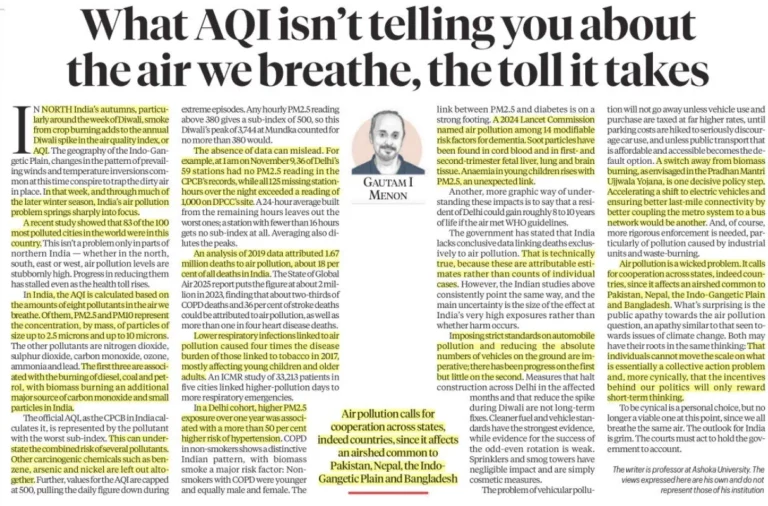
Air pollution remains a major public-health challenge in India, particularly across the Indo-Gangetic Plain and northern India. The editorial argues that excessive focus on the Air Quality Index (AQI) can obscure the long-term health burden of pollution and the limitations of existing monitoring systems.
AQI Does Not Tell the Complete Story
India’s AQI is calculated using concentrations of multiple pollutants, including:
- PM2.5 and PM10
- Nitrogen dioxide
- Sulphur dioxide
- Carbon monoxide
- Ozone
- Ammonia
- Lead
However, the editorial highlights that AQI can become an oversimplified indicator when used as the primary measure of pollution.
Monitoring gaps are also significant. Some monitoring stations may have missing data or incomplete hourly observations, making it difficult to accurately capture pollution exposure, particularly during extreme episodes.
The Health Burden of Air Pollution
The consequences extend far beyond temporary respiratory discomfort.
The editorial cites evidence linking air pollution with:
- Chronic obstructive pulmonary disease (COPD)
- Stroke
- Cardiovascular diseases
- Respiratory infections
- Hypertension
- Other long-term health impacts
It also highlights research suggesting associations between PM2.5 exposure and diabetes, indicating that the health effects of pollution may be broader than traditionally recognised.
Children, older persons and vulnerable populations can face particularly significant risks.
Beyond Seasonal Measures
Pollution-control measures often intensify during episodes such as Diwali, crop-burning periods and winter smog. However, the editorial argues that short-term restrictions are insufficient.
Measures such as temporary construction bans, odd-even vehicle schemes and seasonal restrictions may provide limited relief but cannot substitute for structural reforms.
Need for Regional Cooperation
Air pollution does not respect administrative boundaries. The Indo-Gangetic Plain extends across multiple States and neighbouring countries, including Pakistan, Nepal and Bangladesh.
Therefore, effective pollution control requires:
- Inter-State coordination.
- Regional air-quality monitoring.
- Shared pollution data.
- Coordinated action on biomass burning.
- Cleaner transport systems.
- Better industrial and waste-management enforcement.
Way Forward
The editorial emphasises reducing vehicle use through better public transport, promoting cleaner fuels and strengthening last-mile connectivity. Policies such as the Pradhan Mantri Ujjwala Yojana can also support cleaner household energy use.
India needs to move from seasonal emergency responses to year-round source-based pollution control.
Conclusion
AQI is an important communication tool, but it cannot become a substitute for comprehensive environmental governance. India needs stronger monitoring, better health-impact assessment, regional cooperation and sustained action against pollution sources. Clean air must be treated as a continuous public-health priority rather than a seasonal crisis.
Vocabulary
1. PM2.5 – Fine particulate matter with a diameter of 2.5 micrometres or less.
2. AQI – Index indicating ambient air pollution levels.
3. Airshed – Geographical area sharing common air circulation and pollution.
Prelims MCQs
MCQ 1
Consider the following statements:
1. India’s National AQI considers eight air pollutants.
2. PM2.5 can penetrate deep into the respiratory system.
3. India’s AQI directly measures the combined health effects of all airborne toxic substances.
Which are correct?
A) 1 and 2 only
B) 2 and 3 only
C) 1 and 3 only
D) 1, 2 and 3
Answer: A
UPSC Mains Question
“Air Quality Index alone cannot capture the full public health burden of air pollution.” Examine its limitations and suggest sustainable solutions. (10 Marks)
Frequently Asked Questions (FAQs)
What is AQI?
AQI is an index used to communicate the overall level of ambient air pollution based on concentrations of selected pollutants.
Why is PM2.5 important?
PM2.5 consists of very fine particles that can penetrate deep into the respiratory system and are associated with serious health risks.
Why is the Indo-Gangetic Plain particularly important?
It experiences persistent and severe pollution episodes and pollution can move across State and national boundaries.
Why are seasonal pollution measures insufficient?
They address pollution during peak episodes but may not tackle year-round sources such as transport, industry, waste burning and household energy use.
What is the key UPSC takeaway?
Air pollution should be approached through public health, environmental governance, federal coordination and regional cooperation, rather than AQI monitoring alone.