Table of Contents
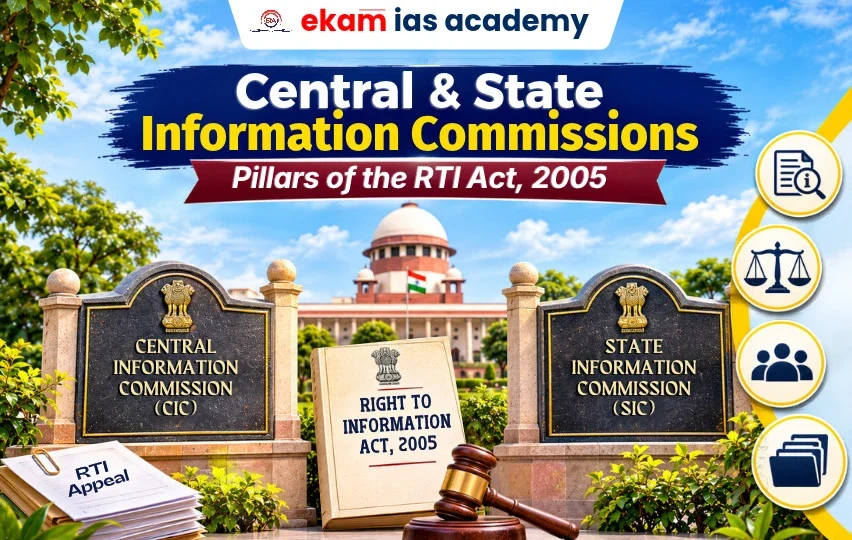
ToggleCentral and State Information Commissions
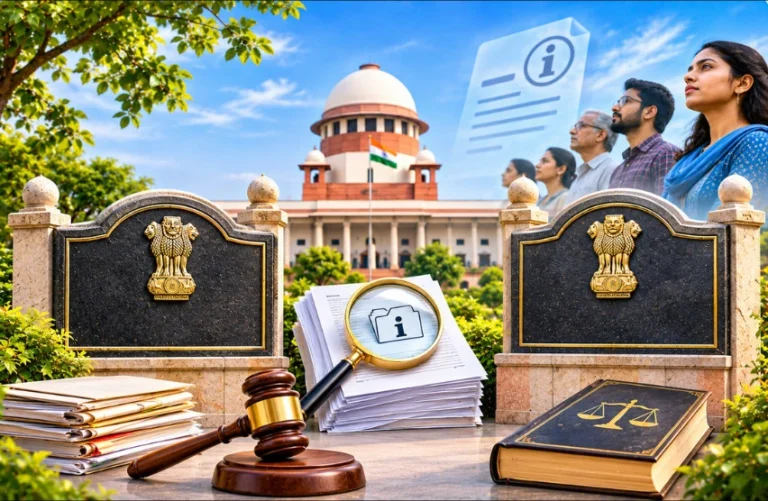
- The Central Information Commission and State Information Commission serve as apex appellate and oversight bodies strengthening Transparency and Accountability in Governance across India.
- Established under the Right to Information Act 2005, they safeguard Right to Information in India by adjudicating RTI Appeals and Complaints when public authorities delay or deny records.
- For Indian Polity and Governance UPSC preparation, studying CIC UPSC and SIC UPSC helps aspirants analyze how Statutory Bodies in India operationalize citizen oversight over executive power.
Historical Background
- Grassroots transparency movements—such as Jan Sunwai (public hearings) and state-level right-to-know campaigns—alongside the earlier Freedom of Information Act, 2002 built momentum for a stronger central law.
- Parliament enacted the RTI Act in India in 2005 to replace secrecy norms with an enforceable statutory framework for accessing information held by public authorities.
- Following enactment, the Central Information Commission and state commissions were constituted to provide independent review mechanisms independent of departmental control.
Legal and Constitutional Framework
- Unlike constitutional commissions named in specific articles, the Central Information Commission and State Information Commission are Statutory Bodies in India created under Sections 12 and 15 of the Right to Information Act 2005.
- The Supreme Court has long linked the right to know to Article 19(1)(a) (freedom of speech and expression), making the RTI Act in India a vital statutory instrument realizing Transparency and Accountability in Governance.
- Both commissions exercise civil court powers during inquiries, summon records, and handle RTI Appeals and Complaints while subject to statutory exemptions and reporting duties.
Central Information Commission (CIC)
- The Central Information Commission consists of a Chief Information Commissioner and up to 10 Information Commissioners appointed by the President on the recommendation of a committee comprising the Prime Minister (chairperson), Leader of the Opposition in the Lok Sabha, and a Union Cabinet Minister nominated by the Prime Minister.
- Under Central Information Commission Powers and Functions, the body receives and inquires into complaints, hears second appeals against appellate authority decisions, monitors compliance, and submits annual reports tabled before Parliament.
- Members are drawn from eminent persons in public life with wide knowledge and experience in law, science and technology, social service, management, journalism, mass media, or administration and governance, and cannot hold conflicting political or business roles.
State Information Commission (SIC)
- A State Information Commission is constituted by a state government under Section 15 of the Right to Information Act 2005, comprising a State Chief Information Commissioner and up to 10 State Information Commissioners.
- Information Commissioners Appointment at the state level is made by the Governor on the recommendation of a committee consisting of the Chief Minister (chairperson), Leader of the Opposition in the Legislative Assembly, and a State Cabinet Minister nominated by the Chief Minister.
- Under State Information Commission Powers and Functions, an SIC handles RTI Appeals and Complaints concerning state public authorities, monitors disclosures, and submits annual reports laid before the state legislature.
CIC vs SIC
- CIC UPSC covers central ministries, central public sector undertakings, and central public authorities (including the Union Territory of Delhi), whereas SIC UPSC covers respective state governments and state-level public authorities.
- At the central level, Information Commissioners Appointment is made by the President on a central committee’s advice, while at the state level, the Governor appoints them on a state committee’s advice; removal of both follows inquiry/reference procedures involving the Supreme Court.
- The Central Information Commission and State Information Commission operate as parallel appellate authorities within their respective jurisdictions rather than one sitting in appeal over the other.
Important Provisions of the RTI Act, 2005
- Under Section 4, public authorities must make proactive suo motu disclosures of their organization, functions, duties, and financial details so citizens need minimal formal requests under the RTI Act in India.
- Public Information Officers (PIOs) must generally respond within 30 days (with transfer within five days if held by another authority), followed by a first appeal within the department and a second appeal to the Central Information Commission or State Information Commission.
- Commissions can impose penalties (such as ₹250 per day up to ₹25,000 for unreasonable delay or refusal) and recommend compensation, while Section 8 sets exemptions and Section 24 covers intelligence/security organizations (subject to corruption and human rights provisos).
CIC vs SIC
← Swipe left or right to view the full comparison →
| Comparison Feature | Central Information Commission (CIC) | State Information Commission (SIC) |
|---|---|---|
| Jurisdiction | Central ministries, central public sector undertakings and central public authorities, including public authorities of the Union Territory of Delhi. | The respective State Government and state-level public authorities. |
| Appointing Authority | Appointed by the President on the recommendation of the central selection committee. | Appointed by the Governor on the recommendation of the state selection committee. |
| Removal Authority | The President exercises the statutory power of removal. | The Governor exercises the statutory power of removal. |
| Institutional Relationship | An appellate authority within its jurisdiction, operating parallel to State Information Commissions. | An appellate authority within its jurisdiction, operating parallel to the Central Information Commission. |
RTI Amendment Act, 2019
- The RTI Amendment Act, 2019 amended Sections 13 and 16 of the Right to Information Act 2005, empowering the Central Government—rather than fixing them directly in the statute—to prescribe the term of office, salaries, allowances, and other service conditions of the Chief Information Commissioner and Information Commissioners at both central and state levels.
- Prior to the amendment, commissioners had a fixed five-year term (subject to age limits) and parity in salary/status with Election Commissioners/Chief Election Commissioner.
- Proponents argued for executive flexibility across statutory bodies, whereas critics contended that linking tenure and service terms to central rules could affect commission independence and state-level autonomy.
Challenges and Issues
- Mounting backlogs of RTI Appeals and Complaints, unfilled vacancies, and periods when several commissions operated below full strength or became non-functional have slowed disposal timelines across CIC UPSC and SIC UPSC.
- Under-utilization of penalty provisions, uneven quality of information provided by PIOs, and low awareness among disadvantaged sections limit Transparency and Accountability in Governance.
- Debates over institutional autonomy after the 2019 rules, safety concerns for information seekers, and statutory interactions with data privacy provisions (such as the Digital Personal Data Protection framework) continue to shape Right to Information in India.
Important Supreme Court Judgments
- In State of U.P. v. Raj Narain (1975) and S.P. Gupta v. Union of India (1981), the Supreme Court affirmed that the right to know is intrinsic to Article 19(1)(a) and open governance, laying constitutional groundwork for the RTI Act in India.
- In CPIO, Supreme Court of India v. Subhash Chandra Agarwal (2019), a Constitution Bench held that the office of the Chief Justice of India is a “public authority” under the Act while balancing transparency, judicial independence, and privacy/public-interest tests under Section 8.
- In Anjali Bhardwaj v. Union of India (2019) and related transparency litigation, the Court has emphasized timely appointments and functional effectiveness of the Central Information Commission and State Information Commission.
Conclusion
- The Central Information Commission and State Information Commission remain indispensable pillars of Transparency and Accountability in Governance and Right to Information in India.
- Strengthening timely Information Commissioners Appointment, clearing RTI Appeals and Complaints, and enforcing proactive disclosures will keep Statutory Bodies in India effective.
- A clear grasp of Central Information Commission Powers and Functions, State Information Commission Powers and Functions, CIC UPSC, and SIC UPSC equips aspirants for Indian Polity and Governance UPSC.
UPSC Prelims: PYQs & Practice Questions
Previous Year Questions (Prelims)
Q: Local self-government can be best explained as an exercise in:
(a) Federalism
(b) Democratic decentralization
(c) Administrative delegation
(d) Direct democracy
Answer: (b) Democratic decentralization
Explanation:
The core constitutional objective behind establishing Urban Local Bodies such as Municipal Councils and Municipal Corporations under the 74th Constitutional Amendment Act and Rural Local Bodies such as Panchayats under the 73rd Amendment is democratic decentralization.
It empowers grassroots communities by transferring political decision-making power, financial resources, and functional accountability directly to local elected representatives.
Q: With reference to the 74th Constitutional Amendment Act, consider the following statements:
1. It added Part IXA to the Constitution of India titled "The Municipalities".
2. It mandates the constitution of Nagar Panchayats for smaller urban areas and Municipal Councils for transitional areas.
Which of the statements given above is/are correct?
(a) 1 only
(b) 2 only
(c) Both 1 and 2
(d) Neither 1 nor 2
Answer: (a) 1 only
Explanation:
Statement 1 is correct: The 74th Constitutional Amendment Act, 1992 added Part IXA (Articles 243P to 243ZG) titled "The Municipalities".
Statement 2 is incorrect: Under Article 243Q, a Nagar Panchayat is constituted for a transitional area (rural to urban), whereas a Municipal Council is constituted for a smaller urban area, and a Municipal Corporation is for a larger urban area.
Practice Questions
Q: With reference to Municipal Councils in India (Nagar Palikas), consider the following statements:
1. A Municipal Council is constituted for a smaller urban area based on factors such as population, density, and percentage of non-agricultural employment.
2. The administrative head of a Municipal Council is typically an officer designated as the Chief Municipal Officer (CMO), appointed by the State Government.
3. The 74th Amendment Act mandates that members nominated to a Municipal Council for their special knowledge in municipal administration have the right to vote in Council meetings.
Which of the statements given above are correct?
(a) 1 and 2 only
(b) 2 and 3 only
(c) 1 and 3 only
(d) 1, 2, and 3
Answer: (a) 1 and 2 only
Explanation:
Statement 1 is correct: Article 243Q(2) states that a Governor specifies a smaller urban area for constituting a Municipal Council by considering factors such as population, density, non-agricultural employment, revenue, and economic importance.
Statement 2 is correct: Unlike a Municipal Corporation, the executive wing of a Municipal Council is generally headed by a Chief Municipal Officer (CMO) or Executive Officer appointed by the State Government.
Statement 3 is incorrect: Under Article 243R(2)(a), persons having special knowledge or experience in municipal administration who are nominated to the Municipality do not have the right to vote in meetings of the Municipality.
Q: Consider the following statements regarding the constitution and tenure of Municipal Councils under Part IXA of the Indian Constitution:
1. Every Municipal Council is granted a fixed 5-year tenure from the date appointed for its first meeting.
2. In case of premature dissolution of a Municipal Council, elections must be completed within 6 months of dissolution.
3. If the remainder of the period for which a dissolved Municipal Council would have continued is less than six months, no election is necessary to be held.
Which of the statements given above are correct?
(a) 1 and 2 only
(b) 2 and 3 only
(c) 1 and 3 only
(d) 1, 2, and 3
Answer: (d) 1, 2, and 3
Explanation:
Statement 1 is correct: Under Article 243U(1), every Municipality continues for five years from the date appointed for its first meeting unless dissolved earlier.
Statement 2 is correct: Article 243U(3) requires elections to reconstitute a Municipality to be completed before the expiration of six months from the date of its dissolution.
Statement 3 is correct: The proviso to Article 243U(3) states that where the remainder of the period for which the dissolved Municipality would have continued is less than six months, it is not necessary to hold an election for constituting the Municipality for such period.
UPSC Mains – Previous Year & Practice Questions
Mains Previous Year Questions
Question: The 74th Constitutional Amendment Act intended to decentralize municipal governance, but Municipal Bodies in smaller towns continue to suffer from financial dependency and functional paralysis. Discuss. (Mains 2020)
Question: Assess the importance of the State Finance Commission in strengthening the financial health of Urban Local Bodies like Municipal Councils and Municipalities in India. (Mains 2018)
Question: In the absence of a well-articulated revenue generation mechanism, local self-governments remain mere implementing agencies for central and state schemes. Comment in the context of Municipal Councils. (Mains 2015)
Question: Discuss the role of District Planning Committees (DPCs) constituted under Article 243ZD in integrating the planning processes of rural Panchayats and urban Municipal Councils. (Mains 2013)
Question: Compare the structural hierarchy, political leadership, and executive authority between a Municipal Corporation and a Municipal Council in India. (Mains 2009 – GS Paper II / Public Administration)
Mains Practice Questions
[15 Marks | 250 Words]
Question: Municipal Councils (Nagar Palikas) represent the vital middle tier of urban governance in India. Analyze the key structural impediments preventing them from effectively managing rapid urbanization in Tier-2 and Tier-3 towns.
[15 Marks | 250 Words]
Question: The dual friction between the political executive (Council Chairperson) and the state-appointed administrative executive (Chief Municipal Officer) often paralyzes decision-making in Municipal Councils. Suggest administrative reforms to resolve this executive impasse.
[10 Marks | 150 Words]
Question: Evaluate how the non-devolution of functional items listed under the Twelfth Schedule has weakened the operational autonomy of Municipal Councils.


Municipal Councils in India-FAQs
What is a Municipal Council in India?
A Municipal Council is an urban local government body constituted for a smaller urban area under Article 243Q of the Constitution. Its composition and functioning are governed by Part IXA of the Constitution and relevant state laws.
Which Constitutional Amendment gave constitutional status to Municipal Councils?
The 74th Constitutional Amendment Act, 1992 gave constitutional recognition to urban local bodies and inserted Part IXA (Articles 243P–243ZG) relating to Municipalities.
What are the main functions of a Municipal Council?
Municipal Councils may undertake functions such as urban planning, regulation of land use, roads, water supply, sanitation, solid waste management, slum improvement, urban poverty alleviation, parks and street lighting, as provided through the Twelfth Schedule and state legislation.
What is the difference between a Municipal Council and a Municipal Corporation?
Under Article 243Q, a Municipal Council is constituted for a smaller urban area, whereas a Municipal Corporation is constituted for a larger urban area. The precise criteria for determining these areas are specified by the Governor through public notification, considering factors such as population, density, revenue and non-agricultural employment.
Who is responsible for urban local government and development in India?
Urban development is primarily a State subject, while the Ministry of Housing and Urban Affairs (MoHUA) plays a coordinating, policy and programme-support role at the Union level. The 74th Amendment provides the constitutional framework for Urban Local Bodies.