Table of Contents
ToggleArticle 51A of the Indian Constitution
- Article 51A of the Indian Constitution enshrines the Fundamental Duties in India within Part IVA of Indian Constitution, outlining civic and moral obligations for citizens.
- Unlike Fundamental Rights and Fundamental Duties where Part III grants enforceable claims, Article 51A Explained highlights how Duties of Indian Citizens balance personal liberties with collective responsibility.
- For Indian Polity UPSC and Constitutional Provisions UPSC preparation, mastering Article 51A UPSC is vital because civic responsibility underpins constitutional democracy and social harmony.
Constitutional Background
- Fundamental Duties Constitution of India were not part of the original 1950 Constitution; they were inserted via the 42nd Constitutional Amendment Act 1976, creating Part IVA of Indian Constitution with a single article, Article 51A of the Indian Constitution.
- Initially comprising 10 duties, the list expanded to 11 Fundamental Duties when the 86th Constitutional Amendment Act 2002 added clause (k) alongside Article 21A.
- Drafted on the recommendations of the Swaran Singh Committee (1976), these provisions drew inspiration from the former USSR constitution while adapting civic norms to India’s democratic framework.
Historical Background
- During the Emergency period (1975–1977), the Congress party established the Swaran Singh Committee to examine constitutional amendments and remind citizens of responsibilities alongside rights.
- While the committee proposed adding duties and even suggested Parliament could impose penalties for non-compliance, Parliament adopted a calibrated list without making breach of Article 51A directly penal on its own.
- Later, the Justice J.S. Verma Committee (1998/1999) identified existing statutory laws—such as environmental, anti-insult, and civil rights statutes—that give operational teeth to Duties of Indian Citizens.
Eleven Fundamental Duties Under Article 51A
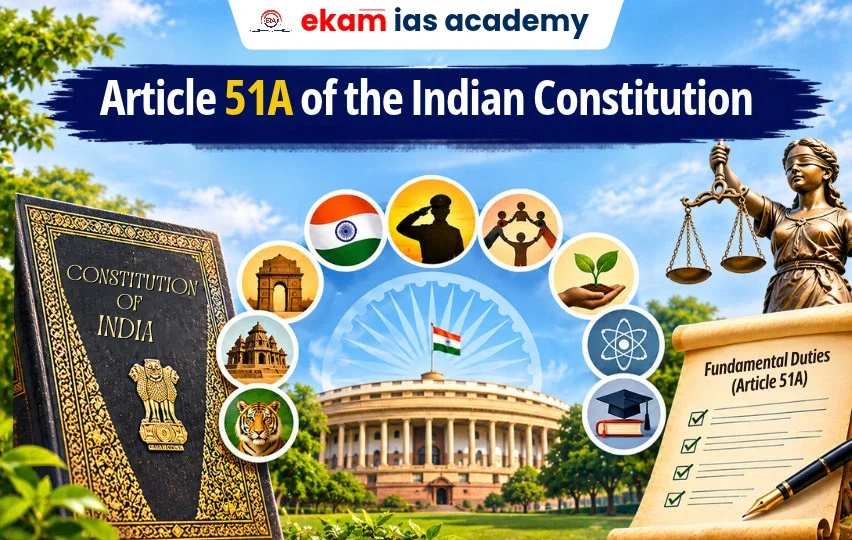
- Clauses (a) through (e) focus on constitutional and national allegiance: abiding by the Constitution and respecting national symbols/anthem, cherishing freedom struggle ideals, upholding sovereignty, unity, and integrity, defending the country and rendering national service when called upon, and promoting harmony and brotherhood while renouncing practices derogatory to women.
- Clauses (f) through (i) emphasize cultural, scientific, ecological, and public-order stewardship: valuing composite heritage, protecting and improving the natural environment and compassion for living creatures under Article 51A(g) Environmental Protection, developing scientific temper, humanism, and inquiry/reform, and safeguarding public property while abjuring violence.
- Clauses (j) and (k) complete the Fundamental Duties List: striving for excellence in individual and collective spheres so the nation rises higher, and the duty of a parent or guardian to provide educational opportunities to a child or ward aged six to fourteen years (added by the 86th Constitutional Amendment Act 2002).
Features of Fundamental Duties
- Fundamental Duties in India apply exclusively to citizens of India, whereas several Fundamental Rights extend to persons or non-citizens as well.
- They combine moral/civic ideals (such as cherishing freedom ideals or striving for excellence) with principles mirrored in ordinary statutes (such as wildlife/forest conservation or respect for national symbols).
- They reflect aspects of India’s cultural ethos and kartavya (duty) tradition, encouraging voluntary compliance rather than purely punitive obedience.
Importance of Fundamental Duties
- Article 51A UPSC serves as a constant reminder that rights carry corresponding obligations toward national unity, public order, and fellow citizens.
- They help courts evaluate the reasonableness of laws—especially restrictions invoked under Article 19—when legislation advances environmental protection, public peace, or national integrity.
- Provisions like Article 51A(g) Environmental Protection and clause (i) support civic awareness against ecological harm, vandalism, and violence.
Fundamental Duties vs DPSPs
← Swipe left or right to view the full comparison →
| Comparison Feature | Directive Principles of State Policy | Fundamental Duties |
|---|---|---|
| Constitutional Location | Part IV of the Indian Constitution. | Part IVA, Article 51A of the Indian Constitution. |
| Addressed To | The State in policy-making, legislation and governance. | Indian citizens, through 11 Fundamental Duties. |
| Legal Enforceability | Non-justiciable, but fundamental in governance. | Non-justiciable by themselves. Legislation may give effect to particular duties. |
| Primary Purpose | Guide legislation and governance towards a welfare state. | Promote civic responsibility and responsible conduct in society. |

Legal Enforceability
- Article 51A of the Indian Constitution is non-justiciable: courts cannot issue a direct writ solely to compel performance of a duty under Part IVA of Indian Constitution.
- However, Parliament and state legislatures can enact specific laws—such as the Prevention of Insults to National Honour Act, 1971, Wildlife (Protection) Act, 1972, or Environment (Protection) Act, 1986—that penalize conduct aligned with these duties.
- As of 2026, there is no single omnibus statute enforcing all 11 Fundamental Duties automatically, so legal liability arises through specific statutory offenses.
Important Supreme Court Judgments
- In AIIMS Students’ Union v. AIIMS (2001), the Supreme Court observed that Fundamental Duties in India are as important as Fundamental Rights, even though they are not directly enforceable like Part III rights.
- In MC Mehta v. Kamal Nath and environmental jurisprudence, courts have linked ecological conservation with Article 51A(g) Environmental Protection and constitutional environmental norms.
- In Ranganath Mishra v. Union of India (2003), Javed v. State of Haryana (2003), and In Re Ramlila Maidan Incident (2012), the Supreme Court underscored public awareness of the Verma Committee’s insights, the harmony between rights and duties, and citizens’ duty to cooperate in maintaining public order.
Way Forward
- Expanding civic and constitutional education in schools, colleges, and public outreach can make Duties of Indian Citizens an everyday habit rather than a textbook checklist.
- Pairing public awareness with fair, lawful enforcement of existing environmental, anti-vandalism, and public-order laws strengthens Fundamental Rights and Fundamental Duties together.
- Encouraging responsible participation across communities supports Article 51A(g) Environmental Protection, scientific temper, and excellence in public life.
Conclusion
- Article 51A of the Indian Constitution anchors Fundamental Duties in India within Part IVA of Indian Constitution, completing the balance between citizen rights and national responsibility.
- Shaped by the 42nd Constitutional Amendment Act 1976 and 86th Constitutional Amendment Act 2002, the 11 Fundamental Duties reinforce constitutional morality, ecological care, and social cohesion.
- Thorough command of Article 51A UPSC, Article 51A Explained, and Constitutional Provisions UPSC prepares aspirants to tackle both Prelims and Mains questions in Indian Polity UPSC.
UPSC Prelims: PYQs & Practice Questions
Previous Year Questions (Prelims)
Q: Consider the following pairs:
Provision in the Constitution of India — State under
I. Separation of Judiciary from the Executive in the Public services of the State
— The Directive Principles of the State Policy
II. Valuing and preserving of the rich Heritage of our composite culture
— The Fundamental Duties
III. Prohibition of employment of children below the age of 14 years in factories
— The Fundamental Rights
How many of the above pairs are correctly matched?
(a) Only one
(b) Only two
(c) All the three
(d) None
Answer: (c) All the three
Explanation:
Pair I is correctly matched because Article 50 under the
Directive Principles of State Policy (Part IV) directs the State
to separate the judiciary from the executive in the public services of the State.
Pair II is correctly matched because Article 51A(f) under
Fundamental Duties (Part IVA) requires citizens to value and
preserve the rich heritage of India's composite culture. Pair III is correctly
matched because Article 24 under Fundamental Rights
(Part III) prohibits the employment of children below the age of 14 years
in factories, mines, or hazardous employment.
Q: Which of the following statements regarding Fundamental Duties in the Constitution of India is/are correct?
1. Fundamental Duties were inserted into Part IVA by the
42nd Constitutional Amendment Act, 1976 on the recommendations
of the Swaran Singh Committee.
2. Unlike Fundamental Rights, Fundamental Duties are non-justiciable and apply
exclusively to citizens of India.
Select the correct answer using the code given below:
(a) 1 only
(b) 2 only
(c) Both 1 and 2
(d) Neither 1 nor 2
Answer: (c) Both 1 and 2
Explanation:
Both statements are correct. Part IVA and
Article 51A were added by the
42nd Constitutional Amendment Act, 1976 based on the
Swaran Singh Committee recommendations. Initially, there were
10 Fundamental Duties, which were later expanded to 11 by the
86th Constitutional Amendment Act, 2002. Fundamental Duties
apply only to citizens of India and are
non-justiciable, though Parliament can enact laws to enforce
specific obligations.
Practice Questions
Q: With reference to Article 51A of the Indian Constitution, consider the following statements:
1. The Swaran Singh Committee recommended making the duty to pay taxes a
Fundamental Duty, which was incorporated into Article 51A.
2. The 11th Fundamental Duty under Article 51A(k) was added by the
86th Constitutional Amendment Act, 2002.
3. Courts can issue a writ directly against a citizen solely to compel performance
of a non-statutory moral duty under Article 51A.
Which of the statements given above is/are correct?
(a) 1 and 2 only
(b) 2 only
(c) 1 and 3 only
(d) 1, 2 and 3
Answer: (b) 2 only
Explanation:
Statement 1 is incorrect: Although the
Swaran Singh Committee recommended including the duty to pay taxes
and allowing penalties for non-compliance, Parliament did not include tax payment
in Article 51A and did not make breach of Article 51A directly
penal by itself.
Statement 2 is correct: The
86th Constitutional Amendment Act, 2002 added
Article 51A(k), requiring a parent or guardian to provide
educational opportunities to a child or ward between 6 and 14 years of age.
Statement 3 is incorrect: Fundamental Duties are
non-justiciable, meaning they are not directly enforceable by
courts through writs.
Q: Which of the following pairs of Fundamental Duty clauses under Article 51A and their core subject matter is/are correctly matched?
1. Article 51A(g): Protecting and improving the natural environment
and having compassion for living creatures
2. Article 51A(h): Developing scientific temper, humanism, and
the spirit of inquiry and reform
3. Article 51A(i): Safeguarding public property and abjuring violence
Select the correct answer using the code given below:
(a) 1 and 2 only
(b) 2 and 3 only
(c) 1 and 3 only
(d) 1, 2 and 3
Answer: (d) 1, 2 and 3
Explanation:
All three clauses are accurately matched under
Article 51A. Clause (g) covers natural environment
protection, including forests, lakes, rivers and wildlife, along with compassion
for living creatures. Clause (h) covers scientific temper,
humanism, and the spirit of inquiry and reform. Clause (i) covers
safeguarding public property and abjuring violence.
UPSC Mains – Previous Year & Practice Questions
Mains Previous Year Questions
Question: Fundamental duties are not made enforceable by a writ of court like the fundamental rights, but they are fundamental to the well being of society and individuals. Examine. (Mains 2020)
Question: The Indian Constitution has provisions for holding a just society by harmonizing Fundamental Rights and Directive Principles of State Policy. Discuss how rights, duties, and state obligations interact in constitutional governance. (Mains – GS Paper II)
Question: Judicial activism and constitutional/statutory interpretation have expanded the horizons of Article 21 in India. Examine how courts draw upon constitutional values—including environmental and civic duties—while interpreting rights and laws. (Mains – GS Paper II)
Question: Role of civil society and citizen participation in strengthening democratic accountability and social harmony. (Mains – GS Paper II)
Question: Despite constitutional guarantees, challenges persist in translating ideals of fraternity, gender dignity, and ecological stewardship into everyday social practice. Discuss. (Mains – GS Paper II)
Mains Practice Questions
[10 Marks | 150 Words]
Question: Examine the constitutional origin and evolution of Article 51A from the 42nd Constitutional Amendment Act, 1976 to the 86th Constitutional Amendment Act, 2002. Why did Parliament not accept every recommendation of the Swaran Singh Committee?
[15 Marks | 250 Words]
Question: Analyze the relationship between Fundamental Rights, Directive Principles of State Policy, and Fundamental Duties. How do courts use Article 51A while interpreting statutes and assessing reasonable restrictions?
[10 Marks | 150 Words]
Question: Why are Fundamental Duties non-justiciable under the Constitution, and how do specific statutes—such as environmental, wildlife, and anti-insult laws—give operational effect to clauses of Article 51A?


Article 51A of the Indian Constitution-FAQs
What is Article 51A of the Indian Constitution?
Article 51A contains the 11 Fundamental Duties of Indian citizens and forms Part IVA of the Constitution. They promote constitutional values, national unity, environmental protection and responsible citizenship.
When were Fundamental Duties added to the Constitution?
Fundamental Duties were introduced through the 42nd Constitutional Amendment Act, 1976, based on the recommendations of the Swaran Singh Committee. The 86th Amendment later added the 11th duty under Article 51A(k).
Are Fundamental Duties legally enforceable?
Article 51A itself is non-justiciable, meaning courts cannot directly compel citizens to perform these duties. However, specific laws can impose penalties for conduct related to particular duties.
Who is bound by Fundamental Duties?
Fundamental Duties apply only to citizens of India, unlike several Fundamental Rights that are available to both citizens and non-citizens.
What is the importance of Article 51A(g)?
Article 51A(g) requires citizens to protect and improve the natural environment and show compassion towards living creatures, making it particularly important for environmental governance and UPSC preparation.