Table of Contents
ToggleArticle 52 of the Indian Constitution
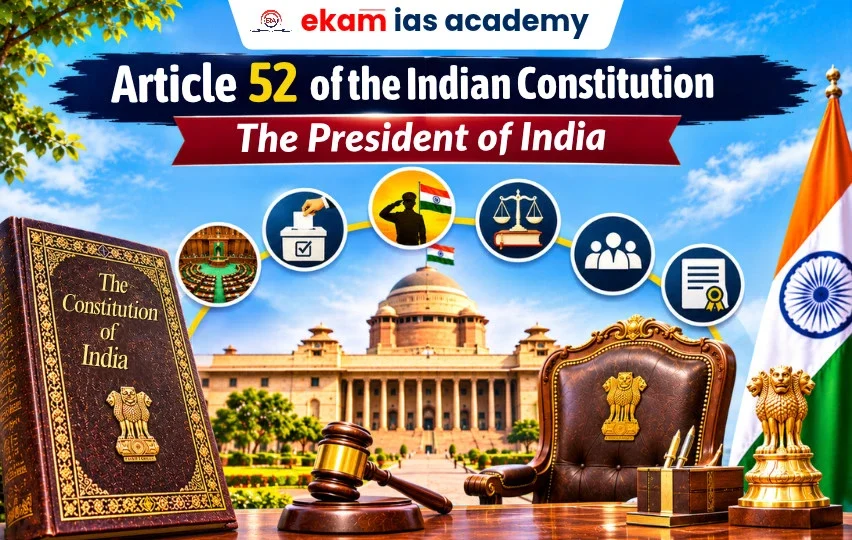
- Article 52 of the Indian Constitution declares that there shall be a President of India, establishing the Head of the Indian State and first citizen of the republic.
- Positioned at the start of Part V of Indian Constitution (The Union), Article 52 Explained centers on the Office of the President of India within the Union Executive in India.
- For Indian Polity UPSC and Indian Constitution Articles UPSC preparation, mastering Article 52 UPSC clarifies how constitutional authority, parliamentary democracy, and national unity are anchored.
Constitutional Background
- Article 52 Constitution of India opens Chapter I (The Executive) of Part V of Indian Constitution, working alongside Article 53 (vesting executive power of the Union) and Article 52 to 62 Indian Constitution governing the presidency.
- As part of Constitutional Provisions for President, the office symbolizes the continuity and sovereignty of the Indian state while executive actions are formally expressed in the President’s name.
- Unlike presidential systems where the head of state is also head of government, the Indian President Constitutional Position operates within a cabinet-led parliamentary framework.
Historical Background
- During the Constituent Assembly debates in December 1948, Article 52 of the Indian Constitution originated as Draft Article 41, simply stating that India shall have a President.
- Proposals to add descriptive labels such as “Chief Executive and Head of State” were not pressed, with clarity that Hindi terminology like Rashtrapati would reflect the office’s national stature.
- Framers chose a parliamentary executive with an indirectly elected President of India so the Head of the Indian State represents federal balance across states and Parliament without rivaling popular mandate of the legislature.
Election of the President
- Under Article 54 and Article 55, the President of India is elected indirectly by an electoral college of elected MPs of both Houses of Parliament and elected MLAs of states (including eligible Union Territory assemblies like Delhi and Puducherry), excluding nominated members and state legislative councils.
- Voting follows proportional representation by means of the single transferable vote through secret ballot, ensuring parity between states and the Union and between states themselves.
- Election disputes are decided exclusively by the Supreme Court of India, and any vacancy caused by death, resignation, or removal must be filled within six months while the Vice-President acts as President in the interim.
Qualifications and Conditions
- Constitutional Provisions for President under Article 58 require a candidate to be an Indian citizen, at least 35 years old, qualified for Lok Sabha election, and free from disqualifying offices of profit (with exceptions for sitting President, Vice-President, Governors, and Union/State ministers).
- Under Article 59, the President cannot be a member of Parliament or any state legislature, cannot hold any other office of profit, uses official residence rent-free, and receives Parliament-determined emoluments that cannot be reduced to their disadvantage during the term.
- Before assuming office under Article 60, the President of India takes an oath before the Chief Justice of India (or senior-most available Supreme Court Judge) to preserve, protect, and defend the Constitution and the law.
Term, Resignation and Removal
- Under Article 56, the President of India holds office for five years from entering upon office and continues until a successor enters office, with eligibility for re-election under Article 57.
- The President may resign in writing addressed to the Vice-President (who communicates it promptly to the Lok Sabha Speaker) or be removed by impeachment under Article 61 solely for “violation of the Constitution.”
- Impeachment requires a special majority resolution in either House of Parliament after notice and investigation by the other House, with the President having the right to appear and be represented.
Powers and Functions of the President
- Within the Union Executive in India, the Office of the President of India carries executive and appointment functions (such as appointing the Prime Minister, Union Ministers, Supreme Court and High Court judges, and State Governors) alongside serving as Supreme Commander of the Defence Forces.
- Legislative, financial, and judicial powers include summoning/proroguing/dissolving the Lok Sabha, assenting to bills or returning non-money bills once, promulgating ordinances under Article 123, giving prior recommendation for money bills, and granting pardons/remissions under Article 72.
- The President also exercises emergency proclamations (Articles 352, 356, and 360) and may seek the Supreme Court’s advisory opinion on questions of law or public importance under Article 143.

Constitutional Position and Discretionary Powers
- Under President of India UPSC frameworks, the Indian President Constitutional Position is largely ceremonial/titular, exercising executive functions on the aid and advice of the Council of Ministers headed by the Prime Minister.
- Following Article 74 and constitutional amendments, ministerial advice is binding on the President, though the President can once ask the Council of Ministers to reconsider its advice.
- Situational or constitutional discretion can arise in rare contingencies—such as appointing a Prime Minister when no party has a clear majority, dissolving the Lok Sabha if a ministry loses confidence, or seeking clarity on constitutional duties.
Important Constitutional Provisions
- Article 52 to 62 Indian Constitution forms the core cluster on the President of India: Article 52 (office), Article 53 (executive power), Articles 54–55 (election and manner), Articles 56–57 (term and re-election), Articles 58–60 (qualifications, conditions, oath), Article 61 (impeachment), and Article 62 (timely election/vacancy).
- Allied provisions include Article 74 (Council of Ministers to aid and advise), Article 75 (appointment of PM and ministers), Article 72 (pardoning power), Article 123 (ordinances), and Article 143 (advisory jurisdiction).
- Together, these Constitutional Provisions for President define checks, balances, and institutional accountability across Part V of Indian Constitution.
Important Supreme Court Judgments
- In Ram Jawaya Kapur v. State of Punjab (1955) and U.N.R. Rao v. Indira Gandhi (1971), the Supreme Court affirmed that India follows a cabinet system where real executive authority rests with the Council of Ministers while the President of India acts as constitutional head even when the Lok Sabha is dissolved.
- In Shamsher Singh v. State of Punjab (1974), a seven-judge Bench clarified that the Head of the Indian State ordinarily acts on ministerial aid and advice save in exceptional situations, reinforcing the Indian President Constitutional Position.
- In S.R. Bommai v. Union of India (1994) and Rameshwar Prasad v. Union of India (2006), the Court held that constitutional powers like Article 356 or legislative dissolution are subject to judicial review and constitutional norms.
Conclusion
- Article 52 of the Indian Constitution establishes the President of India as the unifying Head of the Indian State at the apex of Part V of Indian Constitution.
- Anchored by Article 52 to 62 Indian Constitution, Article 74, and judicial precedents, Article 52 Explained balances titular dignity with democratic accountability.
- Sound mastery of Article 52 UPSC, President of India UPSC, and Indian Polity UPSC equips aspirants to analyze executive governance with precision.
UPSC Prelims: PYQs & Practice Questions
Previous Year Questions (Prelims)
Q: Which of the following statements regarding the President of India is/are correct?
1. Article 52 provides that there shall be a President of India, and under
Article 56, the President holds office for a term of five years from the
date of entering upon office.
2. Under Article 59, the emoluments and allowances of the President can be
diminished during the President's term of office if Parliament passes a
simple resolution.
Select the correct answer using the code given below:
(a) 1 only
(b) 2 only
(c) Both 1 and 2
(d) Neither 1 nor 2
Answer: (a) 1 only
Explanation:
Statement 1 is correct: Article 52
establishes the office of the President of India and
Article 56 prescribes a five-year term from entering
upon office, continuing until a successor enters office.
Statement 2 is incorrect: Article 59
explicitly provides that the emoluments and allowances of the President
shall not be diminished during the term of office.
Q: Consider the following constitutional provisions relating to the President of India:
1. Article 54: Composition of the electoral college
for electing the President
2. Article 60: Oath or affirmation by the President
before the Chief Justice of India (or senior-most available Supreme
Court Judge)
3. Article 61: Procedure for impeachment of the
President for violation of the Constitution
Which of the pairs given above is/are correctly matched?
(a) 1 and 2 only
(b) 2 and 3 only
(c) 1 and 3 only
(d) 1, 2 and 3
Answer: (d) 1, 2 and 3
Explanation:
All three articles are accurately matched.
Article 54 covers the electoral college,
Article 60 covers the oath or affirmation of the
President, and Article 61 sets out the impeachment
procedure for violation of the Constitution.
Practice Questions
Q: With reference to the election and office of the President of India under Articles 52–62, consider the following statements:
1. Nominated members of the Rajya Sabha and Lok Sabha participate in the
electoral college for electing the President.
2. A resignation by the President is addressed in writing to the
Vice-President, who communicates it forthwith to the Speaker of the
Lok Sabha.
3. Under Article 58, a person must have completed 35 years of age and be
qualified for election as a member of the Lok Sabha to be eligible as
President.
Which of the statements given above is/are correct?
(a) 1 and 2 only
(b) 2 and 3 only
(c) 1 and 3 only
(d) 1, 2 and 3
Answer: (b) 2 and 3 only
Explanation:
Statement 1 is incorrect: Only
elected members of both Houses of Parliament and
elected members of State Legislative Assemblies
(and eligible Union Territories) form the electoral college under
Article 54. Nominated members do not participate in
the Presidential election.
Statement 2 is correct: Under
Article 56, the President's resignation is addressed
in writing to the Vice-President, who communicates it forthwith to the
Speaker of the Lok Sabha.
Statement 3 is correct: Under
Article 58, a person must have completed
35 years of age and be qualified for election as a
member of the Lok Sabha to be eligible for election as President.
Q: Consider the following statements regarding the constitutional position of the President of India:
1. The President is the head of state and first citizen of India, while
real executive authority in a parliamentary system rests with the
Council of Ministers headed by the Prime Minister.
2. Under Article 72, the President has pardoning powers, and under
Article 143, the President may seek the Supreme Court's opinion on a
question of law or fact of public importance.
Which of the statements given above is/are correct?
(a) 1 only
(b) 2 only
(c) Both 1 and 2
(d) Neither 1 nor 2
Answer: (c) Both 1 and 2
Explanation:
Statement 1 is correct: While
Article 52 establishes the office of the President as
the head of the Union executive, India's parliamentary system vests
effective governance in the Council of Ministers
headed by the Prime Minister.
Statement 2 is correct: Article 72 grants pardoning powers to the President,
while Article 143 provides for Presidential references
to the Supreme Court on questions of law or fact of public importance.
UPSC Mains – Previous Year & Practice Questions
Mains Previous Year Questions
Question: Compare and contrast the President's power to pardon in India and in the USA. Are there any limits to it in both the countries? What are 'preemptive pardons'? (Mains – GS-II)
Question: Instances of the President's delay in commuting death sentences have come under public debate as a denial of justice. (Mains – GS-II)
Question: The size of the cabinet should be as big as governmental work justifies and as big as the Prime Minister can manage as a team. (Mains – GS-II)
Question: Under what circumstances can the Financial Emergency be proclaimed by the President of India? What consequences follow when such a declaration remains in force? (Mains – GS-II)
Question: To what extent, in your view, is the Parliament able to ensure accountability of the executive in India? (Mains – GS-II)
Mains Practice Questions
[10 Marks | 150 Words]
Question: Explain the constitutional significance of Article 52 in India's parliamentary democracy. How does the President serve both as a symbol of national unity and as a constitutional check within the Union Executive?
[15 Marks | 250 Words]
Question: Trace the constitutional provisions governing the election, term, qualifications, and impeachment of the President of India (Articles 54–61). Why did the framers opt for an indirect election rather than a direct popular vote?
[10 Marks | 150 Words]
Question: Examine the constitutional position of the President of India in relation to the Council of Ministers. In what situations can situational or constitutional discretion arise for the Head of State?


Article 52 of the Indian Constitution-FAQs
What does Article 52 of the Indian Constitution provide?
Article 52 states that “There shall be a President of India.” It establishes the office of the President as the constitutional Head of the Indian State.
How is the President of India elected?
The President is elected indirectly by an electoral college consisting of elected MPs and elected MLAs of the states and eligible Union Territories. The election uses proportional representation through the single transferable vote.
What is the term of the President of India?
Under Article 56, the President holds office for five years and continues until the successor assumes office. The President is eligible for re-election under Article 57.
Can the President be removed from office?
Yes. Under Article 61, the President can be removed through impeachment by Parliament for violation of the Constitution.
What is the constitutional position of the President?
The President is the constitutional head of the Union Executive and ordinarily exercises powers on the aid and advice of the Council of Ministers headed by the Prime Minister.