REFORMING CRIMINAL JUSTICE SYSTEM
TOPIC: (GS2) INDIAN POLITY: THE HINDU
The recent custodial death in Tamil Nadu, has raised serious concerns over police brutality and the need for urgent criminal justice reforms. This case is one among several such incidents in Tamil Nadu in recent years, pointing to systemic issues in policing.
Custodial Deaths – A Growing Concern
- Ajith Kumar’s Case (2025): Died in Sivaganga, with autopsy revealing 44 injuries, burn marks, and drug exposure.
- Other Incidents:
- Vignesh (2022): Died in Chennai soon after arrest; post-mortem showed multiple wounds.
- Raja (2024): A Dalit man died in Villupuram police custody; his family awaits justice.
- Tiruchi Case (2023): An autorickshaw driver died under suspicious circumstances.
- These cases are not isolated but part of a disturbing pattern of custodial abuse.
Root of the Problem: Normalising Force
- Use of physical violence during detention is seen as routine, not exceptional.
- Focus remains on control and enforcement rather than fairness and human rights.
- Lack of emotional and mental health support for police contributes to aggressive behaviour.
Need for Police Reform
- Misplaced Priorities: Huge budgets are allocated for surveillance tools and vehicles. Minimal spending on training, officer welfare, and mental health.
- Emotional Health Ignored: Policemen face daily exposure to violent and emotionally draining situations. Without counselling or psychological support, stress often turns into violence.
Steps Needed for Reform
- Mental Health Support: Allocate at least 5% of police budget for setting up mental health units. Introduce mandatory counselling and periodic mental wellness check-ups.
- Upgrading Police Training: Include ethics, human rights laws, trauma care, and community engagement in training. Move away from outdated colonial-era policing practices.
- Accountability Mechanisms: Enact a strict anti-custodial violence law. Time-bound investigations and video recording of interrogations should be made mandatory.
- Use of Technology for Transparency: CCTV cameras in all custodial areas must be working, secure, and regularly audited. Data should be monitored in real-time to prevent cover-ups.
Reimagining Law Enforcement
- The police force must be seen as a service-oriented institution.
- Uniforms should reflect empathy, discipline, and public responsibility—not fear or unchecked power.
- Deaths like Ajith’s are not just personal tragedies but reflect a failure of the justice system.
RECOMMENDATIONS ON PREVENTING POLICE CUSTODIAL DEATHS
Law Commission of India (152nd Report)
- Recommended mandatory video recording of police interrogations to ensure transparency and prevent torture.
- Suggested amending laws to hold police officers criminally liable for custodial violence and deaths.
National Human Rights Commission (NHRC) Guidelines
- Directed that every custodial death must be reported within 24 hours to the NHRC.
- Called for magisterial inquiry, post-mortem by two doctors, and videography of autopsy to ensure accountability.
Second Administrative Reforms Commission (ARC) – 5th Report “Public Order”
- Recommended independent Police Complaints Authorities at the State and district levels to investigate complaints of police misconduct.
- Emphasised the need for police training in human rights, ethics, and stress management to reduce violent behavior.
Conclusion
India needs to shift from reaction to reform. Preventing custodial deaths requires immediate structural, emotional, and legal changes in policing. Justice must begin with policy—not after another life is lost.
INDIA–BRAZIL BILATERAL TALKS (2025)
TOPIC: (GS2) INTERNATIONAL RELATIONS: THE HINDU
Prime Minister Narendra Modi met the Brazilian President in Brasilia after the 2025 BRICS Summit. Both countries signed six key agreements and unveiled a 10-year roadmap to boost bilateral cooperation.
Highlights of the Bilateral Talks
Agreements Signed
- 6 MoUs/Agreements were signed in the areas of: Security & counter-terrorism, Digital technology sharing, Renewable energy collaboration, Agricultural development, Intellectual property rights
- A mechanism at the ministerial level was set up to track trade and investment progress.
Strategic 10-Year Roadmap
- Cooperation will focus on five key pillars: Defence and security, Food and nutritional security, Energy transition and climate action, Digital transformation, Industrial cooperation in strategic sectors
Trade and Economic Engagement
- Target set to double bilateral trade to $20 billion in 5 years.
- In 2024–25, trade stood at $12.2 billion, with Indian exports worth $6.77 billion.
- A Trade Monitoring Mechanism is in place to resolve trade barriers.
Defence and Security Ties
- Defence cooperation began with a 2003 agreement.
- Joint Defence Committee (JDC) meetings held regularly.
- Strategic Dialogue (since 2006) covers regional and global concerns.
- Agreements on extradition, legal assistance, and transfer of sentenced persons exist.
Space and Science Partnership
- Agreement for peaceful space use signed in 2004.
- Joint activities include data sharing and satellite tracking.
Multilateral and Global Cooperation
- Close coordination in forums like BRICS, G-20, IBSA, BASIC, ISA, WTO, and UN.
- Both push for UN Security Council reforms, representing Global South interests.
Climate & Food Security Leadership
- Joint action under the Global Biofuels Alliance and COP30.
- Collaborate in Global Alliance Against Hunger and Poverty.
- India supports Brazil’s Tropical Forests Forever Fund (TFFF) initiative.
Challenges in Bilateral Relations
- Geopolitical rivalry in global forums like the UN.
- Trade barriers and regulatory issues persist.
- Weak infrastructure and limited connectivity hinder deeper cooperation.
- Different regional priorities—India in Indo-Pacific, Brazil in Latin America.
Way Forward
- Boost people-to-people ties, tourism, and cultural exchange.
- Follow through on agreements with timely implementation.
- Expand cooperation in science, health, and innovation.
- Enhance maritime and air connectivity for trade facilitation.
- Strengthen South-South cooperation for a balanced global order.
Recognition
- PM Modi received Brazil’s highest civilian award – Grand Collar of the National Order of the Southern Cross.
Conclusion:
India–Brazil relations are evolving into a strategic South–South partnership with huge untapped potential. Effective cooperation and political will can convert agreements into action for mutual benefit.
DELHI’S FUEL REFUELLING BAN POLICY – A STEP TOWARDS CLEAN AIR
TOPIC: (GS3) ENVIRONMENT: THE HINDU
On July 1, 2025, Delhi introduced a policy banning refuelling of petrol vehicles older than 15 years and diesel vehicles older than 10 years to fight growing air pollution. The step aims to reduce emissions, but has faced issues in implementation and impact measurement.
Refuelling Ban
- Older vehicles are banned from refuelling in Delhi to cut pollution.
- Over 500 petrol pumps installed with Automatic Number Plate Recognition (ANPR) to detect restricted vehicles.
- The rule applies only inside Delhi; vehicles can refuel just outside city limits.
Challenges in Implementation
- Technology Limitations: ANPR systems often fail to read high-security registration plates. No shared database for blacklisted vehicles across agencies.
- Lack of Staff Training: Fuel station workers are not properly trained to implement the policy.
- Evasion of Ban: Vehicle owners refuel in nearby cities like Noida or Gurugram, bypassing restrictions.
Limitations of the Policy
- Age as a Weak Indicator: Vehicle age does not always show actual pollution levels. No data on fitness, emission tests, or daily usage of banned vehicles.
- Data Gaps: No clear public data on how many of the banned vehicles are still on the road.
Pollution Reduction Impact
- Only 8% of Delhi’s fleet (~7.5 lakh vehicles) fall under the ban.
- If fully followed, the policy could cut PM2.5 emissions by 8% from the transport sector.
Way Forward
Learning from Other Cities:
- Beijing: Diesel truck bans + scrappage support.
- Tokyo: Strict emission norms + upgrade subsidies.
- Paris: Low-emission zones + public transport expansion.
Suggestions for Delhi:
- Organize vehicle exchange fairs, offer scrappage incentives.
- Annual tax renewals linked to pollution norms.
- Launch awareness campaigns and phased rollout (12–18 months).
- Create a grievance redressal system.
VEHICLE SCRAPPAGE POLICY:
Targets pollution reduction by phasing out old, inefficient vehicles—private vehicles older than 20 years, commercial vehicles older than 15 years must undergo fitness tests; automatic deregistration on failure
- Aims to enhance road safety, improve fuel efficiency, and stimulate the automotive and recycling sectors
Fitness Testing & Deregistration
- Establishes Automated Testing Stations (ATS) across the country via PPP, reducing manual interference in fitness tests.
- Vehicles that fail fitness or emission tests are de-registered and classified as End-of-Life Vehicles (EOLV)
Incentives for Vehicle Owners
- Owners get scrap value (≈ 4–6 % of new vehicle ex-showroom price) and a scrappage certificate
- Incentives include 5 % manufacturer discount, road tax rebate (up to 25 % for personal, 15 % for commercial vehicles), and waived registration fees on new vehicle purchases
- A “green tax” of 10–25 % on older vehicles add disincentive to retain them post 8–15 years
Conclusion
Delhi’s refuelling ban is a timely move but needs better planning, public support, and regional coordination to achieve lasting improvements in air quality.
REFORMING THE UNFCCC PROCESS
TOPIC: (GS3) ENVIRONMENT: THE HINDU
The UNFCCC process is under review as it struggles to deliver strong climate action despite growing climate-related crises. At the Bonn Climate Conference 2025, reforms were proposed to improve its functioning and accountability.
What is the UNFCCC?
- The United Nations Framework Convention on Climate Change (UNFCCC) is the main global platform for climate negotiations.
- Adopted at the 1992 Rio Earth Summit, it forms the legal foundation for major climate agreements like:
- Kyoto Protocol (1997) – legally binding emission targets for developed countries
- Paris Agreement (2015) – aims to limit global warming to below 2°C, preferably 1.5°C
Institutional Structure
- COP (Conference of the Parties): Annual decision-making meeting of member states.
- SBSTA & SBI: Support science-based advice and implementation.
- Secretariat: Coordinates negotiations, manages data, and ensures transparency.
INDIA’S ROLE AND CONTRIBUTIONS
NDCs (2022 Update):
- Cut emissions intensity of GDP by 45% by 2030 (compared to 2005 levels).
- Target 50% power capacity from non-fossil sources by 2030.
- Net-zero emissions target by 2070.
Key Initiatives:
- Mission LiFE – lifestyle-based environment movement.
- LT-LEDS Strategy – focuses on clean energy, CO₂ removal, and low-carbon transport.
COP28 (Dubai):
- Reported 33% drop in emissions intensity (2005–2019).
- 40% renewable power capacity reached nine years early.
- Launched: Green Credit Programme, Global Biofuel Alliance, LeadIT 2.0.
Why Reform Is Needed
- Slow Progress: Emissions are still rising; climate finance goals are unmet.
- Consensus Problem: Every country has veto power — leading to weak or delayed decisions.
- Climate Finance Gaps:
- $100 billion/year goal unmet.
- New pledge of $300 billion/year (from 2035) still below the actual need (~$1.3 trillion).
- Trust Deficit: Past withdrawals by countries (e.g., U.S.) have damaged faith in the process.
Proposed Reforms
Reforms at Bonn Summit (2025)
- Simplify Agenda: Remove overlapping negotiation items.
- Limit Delegation Size: For efficient discussions.
- Time Management: Set limits for country statements to save negotiation time.
Brazil’s Leadership for COP30
- Released a 30-point reform agenda.
- Pushed for climate integration across UN agencies and global financial institutions.
- BRICS supported Brazil’s stand for: Equitable climate finance. Greater support for adaptation in developing countries.
Conclusion
The UNFCCC remains central to global climate governance, but it needs bold reforms in decision-making, finance, and transparency to address the accelerating climate emergency.
CATASTROPHE BONDS (CAT BONDS) AND INDIA’S ROLE
TOPIC: (GS3) DISASTER MANAGEMENT: THE HINDU
As climate disasters rise in India and South Asia, the idea of using Catastrophe Bonds (Cat Bonds) is being discussed to strengthen financial protection and support post-disaster recovery. India is being seen as a potential lead sponsor for a regional South Asian cat bond.
What are Cat Bonds?
- Catastrophe Bonds are financial instruments that transfer disaster risk from a government or insurer to global financial markets.
- They act as a mix of insurance and debt, offering funds quickly after disasters.
How Do Cat Bonds Work?
- Sponsors: Usually national governments or large institutions pay a premium to back the bond.
- Issuers: Agencies like the World Bank, ADB, or reinsurers issue the bond.
- Investors: Get higher interest returns, but lose their principal if a major disaster occurs. Funds raised are used for post-disaster relief and reconstruction.
Why Are They Attractive to Investors?
- Cat bonds offer portfolio diversification as disaster risks are not linked to stock markets.
- Pension funds and institutional investors prefer these for risk balancing.
- Around $180 billion worth of cat bonds have been issued globally to date.
Does India Need Cat Bonds?
- India faces frequent climate-related disasters: floods, cyclones, earthquakes.
- Traditional insurance is not widely used for individual assets.
- A cat bond can protect public finances and ensure faster disaster response.
- India already allocates $1.8 billion annually for disaster risk reduction, supporting cat bond readiness.
Proposal for a South Asian Cat Bond
- India could lead a regional cat bond, covering risks in Nepal, Bhutan, Bangladesh, Sri Lanka, Myanmar.
- Pooling risks could lower premium costs and improve regional disaster resilience.
Challenges
- Poorly designed bonds may not pay out, even after major damage.
- High cost without disaster may raise concerns.
- Transparent planning and risk-based pricing are essential for success.
FUND-BASED TOOLS FOR DISASTER MANAGEMENT IN INDIA
Contingency Fund of India
- Established under Article 267(1) of the Constitution.
- Used for urgent and unforeseen expenditure, including disaster situations.
- Operated by the President of India; amount presently fixed at ₹30,000 crore (as per latest updates).
- Expenditure is later approved by Parliament and added to the Consolidated Fund of India.
National Disaster Response Fund (NDRF)
- Created under Section 46 of the Disaster Management Act, 2005.
- Used to meet emergency relief needs after notified disasters (earthquakes, floods, cyclones, etc.).
- Financed through budgetary support and grants-in-aid from the Union government.
- Managed by the Union Ministry of Home Affairs (MHA).
State Disaster Response Fund (SDRF)
- Established under Section 48 of the DM Act, 2005 for every state.
- First line of funding for relief operations in case of notified disasters.
- Funded by both Centre and States:
- Centre contributes 75% (90% for Himalayan and NE states),
- States contribute the rest.
- Used for relief (not reconstruction) like food, shelter, medicines, rescue operations.
Conclusion
Cat bonds offer India and South Asia a chance to shift from reactive disaster spending to proactive financial planning. With proper design, they can strengthen resilience to climate shocks.
NO DECISION ON UPDATING NPR WITH CENSUS 2027
TOPIC: (GS2) GOVERNANCE: THE HINDU
The government has not yet decided whether to update the National Population Register (NPR) along with the 2027 Census. This is important because the NPR is linked to the creation of the National Register of Citizens (NRC) under the Citizenship Rules, 2003.
What is a Census?
- Census is the official, systematic enumeration of a country’s population including details like age, sex, occupation, literacy, religion, language, and housing.
- It provides crucial demographic, social, and economic data for planning, policymaking, and administration.
- In India, it is conducted by the Office of the Registrar General and Census Commissioner, under the Ministry of Home Affairs.
India’s First Census
- First Complete Census: Conducted in 1881 during British rule.
- It was the first synchronous, nationwide Census covering the entire Indian subcontinent (then under British administration).
What is the National Population Register (NPR)?
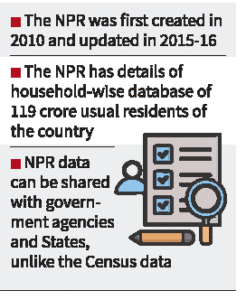
- NPR is a list of usual residents of India, meaning those who have lived in an area for at least 6 months or plan to stay for 6 months or more.
- First prepared in 2010, using data from the 2011 Census’s house listing phase.
- Updated again in 2015-16.
Details about NPR Database
- Contains household-level data of around 119 crore residents.
Upcoming Census 2027
- Enumerators will be trained starting July 2025.
- This will be India’s first digital Census, using mobile apps to collect data.
- A pre-test (trial run) will happen in August-September 2025 to test the system and process.
Past NPR Pre-Test (2019)
- Pre-test covered over 26 lakh people across India.
- NPR questions included:
- Date/place of birth of parents
- Last place of residence
- Aadhaar, voter ID, phone number (optional)
- Mother tongue and driving license number
Difference Between NPR and NRC (Simple Points)
Feature | NPR | NRC |
Purpose | List of usual residents of India | List of legal Indian citizens |
Basis | Residency (6 months or more) | Citizenship proof required |
Data Collected | Demographic and personal info | Documents to prove citizenship |
Legal Link | Under Citizenship Rules, 2003 | Also under Citizenship Rules, 2003 |
Next Step | NPR can lead to NRC | NRC identifies illegal immigrants |
Conclusion
While NPR helps in improving policy targeting and welfare schemes, linking it with NRC has led to debates on privacy and citizenship rights. A clear decision on updating NPR alongside the 2027 Census is yet to be made.
HIMACHAL PRADESH’S RISE IN NATIONAL ACHIEVEMENT SURVEY (NAS) 2025
TOPIC: (GS2) INDIAN POLITY: THE HINDU
On July 2, 2025, the National Achievement Survey (NAS) results were released, where Himachal Pradesh jumped from 21st place (2021) to top five in rankings. This sudden improvement caught national attention and sparked discussion on reforms in the State’s education system.
What is NAS?
- A nationwide assessment by the Ministry of Education, held every three years.
- Tests learning outcomes of students in Classes 3, 5, 8, and 10 in subjects like language, mathematics, and science.
- Covers only government and government-aided schools.
- Helpful for understanding basic learning levels but does not assess critical thinking or emotional development.
Reasons Behind Himachal’s Improved Performance
- Reforms under Sukhu Government:
- Over 1,000 under-enrolled schools were merged, helping better use of teachers and infrastructure.
- Introduced a unified education directorate from pre-primary to Class 12 for better monitoring.
- Encouraged school-level autonomy and student participation.
- Exposure and Innovation:
- Teachers and top students sent on national/international exposure visits.
- Cluster model adopted for shared learning and local involvement.
Limitations of NAS
- NAS does not measure teaching quality, mental well-being, or community role in schooling.
- High NAS rank is a positive signal, but should not be the only measure of education quality.
What More Needs to Be Done
- Regularize teacher hiring to ensure stability.
- Focus on equity and rural outreach.
- Promote holistic assessments that go beyond test scores.
Conclusion
Himachal’s turnaround reflects renewed trust in public education. The State must now build on these gains through inclusive and long-term reforms.
JAL JEEVAN MISSION
TOPIC: (GS2) INDIAN POLITY: THE HINDU
A House Committee in Jammu & Kashmir is investigating complaints of irregularities under the Jal Jeevan Mission (JJM). Issues raised include corruption, poor quality materials, and incomplete water supply projects.
About Jal Jeevan Mission (JJM)
- Launched: 2019 by the Prime Minister.
- Nodal Ministry: Ministry of Jal Shakti.
- Objective: To ensure tap water connections to all rural households (around 16 crore) by 2028 (extended from original 2024 target).
- Coverage: Focus on functional household tap connections (FHTCs) with 55 litres per capita per day (lpcd) as service level.
Key Features
- Components Include:
- Water source sustainability
- Greywater reuse
- Rainwater harvesting
- Retrofitting existing water schemes
- Community-Based Approach: Emphasis on Information, Education, and Communication (IEC). Promotes a jan andolan (people’s movement) for water awareness and conservation.
- Women Empowerment: Reduces time spent by women collecting water. Improves health, education, and social opportunities for rural women.
Governance Challenges
- Lack of Transparency: Weak audit mechanisms and oversight. Poor coordination between local bodies and implementing agencies.
- Administrative Gaps: Shortage of trained engineers and workers in rural and remote areas. Inadequate systems for post-installation maintenance of infrastructure.
- Political Interference: Politically-connected contractors often bypass rules. Quality control compromised in favor of lower costs.
Way Forward
- Independent Social Audits: Involve NGOs, civil society, and citizens for on-ground verification.
- Digital Monitoring Tools: Use real-time dashboards to track progress at panchayat/block level.
- Strengthen Local Institutions: Train and support Gram Panchayats in managing water supply systems.
- Water Testing: Set up affordable local labs to detect contamination early.
Conclusion
The Jal Jeevan Mission is a transformative step toward rural water access. However, success depends on ensuring transparency, local ownership, and accountability to avoid leakages—both of water and public money.