
Daily Current Affairs 11-October-2025

Share this Post

THE REAL NEED FOR A HOLISTIC DEMOGRAPHIC MISSION

TOPIC: (GS2) INDIAN POLITY: THE HINDU

On August 15, 2025, the government announced a demographic mission focusing on undocumented immigration from Bangladesh.

Background and Context

  • India, now the world’s most populous nation, has a large youth population that presents both opportunities and challenges.
  • Past demographic policies mainly focused on population control, ignoring broader aspects like migration, ageing, education, and skill development.
  • A holistic demographic mission is essential to ensure balanced growth and equitable human development across regions.

Need for a Broader Demographic Vision

  • The new mission should go beyond monitoring population numbers or immigration.
  • It must assess demographic changes over the past two decades, focusing on:
    • Fertility and mortality patterns
    • Migration flows within and outside India
    • Age-sex distribution and regional disparities
  • The mission should also study how education, health, and livelihoods are shaping India’s human capital.

Unequal Human Capability Development

  • Education and skill infrastructure are unevenly distributed across regions.
  • The gap between affluent and less privileged groups in accessing quality education and employment is widening.
  • Without equitable human capability development, India’s dream of becoming a global skill hub may remain unfulfilled.

Migration: The Balancing Factor

  • Migration has become a key factor balancing population and workforce distribution among States.
  • However, migrant identity and rights remain politically sensitive issues.
  • Migrants often face dual disenfranchisement — they lose voting rights both in their home and host States due to unclear residency rules.
  • The demographic mission should focus on restoring migrants’ rights, ensuring equality and recognition for internal migrants.

Ageing and Social Security Challenges

  • With increasing life expectancy, India needs to redefine the concept of productive years.
  • Both the young and elderly can contribute productively if supported by healthcare and active ageing policies.
  • Social security systems must evolve — employers and individuals should share responsibility with the State for post-retirement financial stability.

Integrating Demographics into Policy

  • Every policy and development plan should be demography-sensitive.
  • Planning should consider population composition, not just per capita averages.
  • Demographic data should guide resource allocation, policy design, and evaluation to ensure inclusion and sustainability.

Way Forward

  • Launch a National Demographic Mission with multidisciplinary focus — linking population trends to education, employment, and migration policies.
  • Strengthen data systems for real-time demographic monitoring.
  • Promote awareness and research on demographic changes and their impact on governance.
  • Foster cooperative federalism to address regional demographic imbalances.

Conclusion

India’s demographic mission must shift from a narrow focus on population control to a broad, human-centered approach. Recognising shifts in fertility, ageing, and migration — and investing in education, health, and social protection — will help India transform its vast population into a true demographic dividend for sustainable growth.

This article has been updated and published in detail on our new platform. Please visit the link below for the latest version:

👉 Read the full article on ekamiasacademy.in

CRIME PATTERNS IN INDIA – NCRB REPORT 2023

TOPIC: (GS2) INDIAN POLITY: THE HINDU

The NCRB (National Crime Records Bureau) 2023 Report highlights a sharp rise in cybercrimes and crimes against Scheduled Tribes (STs) across India, even as murder cases declined. The findings underline emerging challenges in digital safety and protection of vulnerable groups.

Background and Context

  • The NCRB report 2023, released after a delay, provides data on crimes recorded across India.
  • Crime statistics often depend on reporting and registration, so inter-State comparisons must be made carefully.
  • However, national trends and year-on-year changes indicate serious policy challenges requiring attention.

Major National Trends (2023)

  • Murder cases: Decreased by 2.8% compared to 2022, offering some relief to law enforcement agencies.
  • Crimes against Scheduled Tribes (STs): Surged by 28.8%, showing worsening safety for tribal communities.
  • Cybercrimes: Jumped by 31.2%, indicating rapid growth in digital offences with expanding internet use.

Crimes Against Tribals

  • The spike in Manipur accounts for most of the increase — from just 1 case in 2022 to 3,399 in 2023 — due to severe ethnic violence.
  • Other States such as Madhya Pradesh and Rajasthan also show high rates of offences against STs.
  • This reflects the continued vulnerability of tribal groups in central and northeastern India.
  • Experts suggest weak governance and delayed intervention worsened these incidents.

Rising Cybercrime

  • With greater digital connectivity, cybercrimes — especially financial frauds and online sexual exploitation — have increased sharply.
  • Growing dependence on digital payments and online investments adds to risks.
  • Although police have set up cybercrime cells, they often lack advanced technical expertise.
  • Tackling cyber threats requires better training, technology, and inter-State coordination.

Crimes Against Children

  • Crimes against children rose by 9.2% (1,77,335 cases).
  • In 96% of incidents, the offender was known to the victim, highlighting the role of trust and domestic environments.
  • Authorities must focus on child awareness programs and school-level sensitisation.
  • Some cases involve POCSO Act misuse in consensual teenage relationships — requiring sensitive handling by police and courts.

Crimes Against Women

  • Overall women-related crimes increased by 0.4%, but dowry-related offences rose by 14.9%, showing deep-rooted social issues.
  • The data reveals that traditional crimes like dowry harassment persist despite legal safeguards.

Way Forward

  • Strengthen tribal protection mechanisms and ensure quick response during ethnic unrest.
  • Improve cybersecurity infrastructure and police training.
  • Launch public awareness campaigns on digital safety and gender sensitisation.
  • Reform the criminal justice system to ensure faster trials and victim support.

Conclusion

The NCRB 2023 data exposes new-age challenges — cyber threats and social violence — alongside persistent gender and caste injustices. India needs modern policing, digital literacy, and inclusive social reforms to ensure safety for all, especially vulnerable communities and youth.

This article has been updated and published in detail on our new platform. Please visit the link below for the latest version:

👉 Read the full article on ekamiasacademy.in

SUPREME COURT ON RETROSPECTIVE APPLICATION OF THE SURROGACY (REGULATION) ACT, 2021

TOPIC: (GS2) INDIAN POLITY: THE HINDU

The Supreme Court of India ruled that the age limits under the Surrogacy (Regulation) Act, 2021) cannot be applied retrospectively to couples who had already initiated the surrogacy process or preserved embryos before the law came into effect. The decision upholds reproductive rights and legal fairness under Article 21.

Background of the Case

  • The petition involved couples who had frozen embryos before the Surrogacy Act, 2021, came into force.
  • Authorities later denied permission for surrogacy, citing new age restrictions introduced by the Act.
  • The couples approached the Supreme Court, arguing that applying the new law to their earlier actions was unfair and unconstitutional.

Supreme Court’s Key Observations

Doctrine of Fairness

  • The Court held that laws cannot operate retrospectively if they take away vested rights or impose new burdens.
  • Retrospective application in this case violated fairness and legal certainty, fundamental principles of the rule of law.

Right to Privacy and Reproductive Autonomy

  • Reaffirming the K.S. Puttaswamy (2017) judgment, the Court stated that reproductive decisions fall within personal liberty and privacy protected by Article 21.
  • Individuals have the freedom to make reproductive choices, including using frozen embryos for surrogacy.

Gender and Equality Perspective

  • The Court noted that restrictive interpretations of reproductive laws disproportionately impact women, who already face biological and social barriers in family planning.
  • It emphasized the need to interpret such laws through a gender-sensitive and rights-based lens.

Significance of the Judgment

  • Protects vested reproductive rights of couples who started the process before 2021.
  • Reinforces the constitutional balance between regulation and personal autonomy.
  • Ensures gender justice by preventing unfair restrictions on women’s reproductive choices.
  • Sets a precedent for fair and humane interpretation of reproductive health laws.

SURROGACY (REGULATION) ACT, 2021

Objective: To regulate surrogacy practices and ban commercial surrogacy in India. Allows only altruistic surrogacy, where no monetary compensation (beyond medical expenses) is involved.

Eligibility Criteria

  • Intending Couple:
    • Must be Indian citizens, married for at least 5 years.
    • Woman: 23–50 years; Man: 26–55 years.
    • Must prove medical infertility.
  • Surrogate Mother:
    • Must be a married woman aged 25–35 years with at least one biological child of her own.

Penalties: Engaging in commercial surrogacy or sale of gametes/embryos attracts up to 10 years’ imprisonment and fines up to ₹10 lakh.

Conclusion

The Supreme Court’s ruling underscores that while regulation is essential, personal liberty, fairness, and reproductive autonomy must remain central to India’s legal framework.

This article has been updated and published in detail on our new platform. Please visit the link below for the latest version:

👉 Read the full article on ekamiasacademy.in

SOLAR DIMMING IN INDIA

TOPIC: (GS1) GEOGRAPHY: THE HINDU

Recent research published in Nature’s Scientific Reports has revealed that India is witnessing a continuous decline in sunlight hours due to rising pollution levels and increased cloud formation.

About Solar Dimming

  • Solar dimming refers to the gradual reduction in the amount of sunlight (solar radiation) reaching the Earth’s surface over time.
  • Primary Causes:
    • High levels of aerosols from industries, vehicles, and biomass burning block and scatter sunlight.
    • Cloud buildup and urban haze reduce solar penetration.
    • Humidity and smog further trap sunlight, lowering visibility and brightness.

Key Findings of the Study

  • Reduced Sunshine Duration: The northern plains of India have lost around 13.1 hours of sunshine per year on average over the past 30 years.
  • Twomey Effect: Due to human-made aerosols, clouds contain more but smaller droplets, making them thicker and longer-lasting, which further blocks sunlight.
  • Main Drivers: Industrial smoke, vehicle emissions, stubble burning, and dust pollution are the main contributors to this dimming trend.

Implications

  • Renewable Energy: Declining sunlight could lead to up to a 7% fall in solar power output, threatening India’s 2030 renewable energy goals.
  • Agriculture: Crops like rice and wheat may experience reduced yields due to lower light availability for photosynthesis.
  • Climate and Environment: Dimming affects the Himalayan cryosphere, as altered sunlight patterns can disturb melting rates, rainfall, and regional water cycles.

Incoming Solar Radiation (Insolation)

Insolation is the solar energy received by the Earth’s surface in the form of shortwave radiation. It drives weather, temperature, and climate systems.
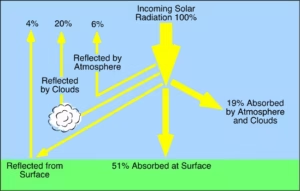
Incoming Solar Radiation (Insolation)

  • Key Facts:
    • Earth receives about 1.94 calories/cm²/minute at the top of the atmosphere.
    • Varies with Earth’s position:
      • Perihelion (closest to Sun): Early January
      • Aphelion (farthest): Early July
  • Influencing Factors:
    • Earth’s rotation and tilt,
    • Day length,
    • Cloud cover and atmospheric clarity,
    • Land–sea contrast and topography.

Conclusion

Solar dimming poses a growing challenge for India’s clean energy transition and food security. Addressing air pollution and improving atmospheric monitoring are essential to preserve sunlight availability and maintain environmental balance.

This article has been updated and published in detail on our new platform. Please visit the link below for the latest version:

👉 Read the full article on ekamiasacademy.in

PUNJAB FLOODS THREATEN SOIL HEALTH

TOPIC: (GS3) ENVIRONMENT: THE HINDU

Punjab recently witnessed one of its most severe floods in recent years, affecting all 23 districts and submerging nearly two lakh hectares of farmland.

Impact of Floods on Punjab’s Soil

Soil Erosion: Loss of Fertile Top Layer

  • Floodwaters wash away the nutrient-rich topsoil, which contains vital elements like nitrogen, phosphorus, and organic carbon.
  • Loss of this top layer weakens soil fertility, reducing crop output and increasing rehabilitation costs.
  • Erosion also makes the soil structure unstable and prone to crusting and compaction.

Silt Deposition: Double-Edged Effect

  • Floods bring silt, especially to river-adjacent and low-lying areas.
  • Fine silt can improve soil texture and add minerals, acting as a natural fertiliser.
  • However, excessive deposits can harden the soil, restrict root penetration, and disrupt microbial balance.
  • Experts suggest mixing shallow silt layers (2–3 inches) with local soil through normal tilling for fertility restoration.

Findings from Soil Tests

  • Punjab Agricultural University (PAU), Ludhiana, conducted soil assessments in flood-hit regions.
  • Tests revealed:
    • Leaching of nutrients, especially nitrogen.
    • Temporary imbalance in pH due to waterlogging.
    • Drop in organic matter where topsoil was lost.
  • Scientists believe that fertility can be restored through deep ploughing, organic manure, and fertiliser application based on soil test results.

Recovery and Management Strategies

  • The recovery plan depends on soil type and depth of silt:
    • For 2–3 inch silt layers: simple ploughing is sufficient.
    • For deep or compacted deposits: mechanical removal or deep chiselling is advised.
    • Adding compost or green manure improves soil aeration and microbial activity.
  • Farmers are advised to control weed growth, a common post-flood problem.
  • The state’s policy, “Jisda Khet, Usdi Ret” (the sand belongs to the landowner), allows farmers to sell deposited sand/silt without special clearances, helping both soil recovery and income support.

Prospects for the Rabi Season

  • Agricultural experts believe most farmers can resume wheat cultivation on schedule if early field management is done.
  • In moderately affected areas, residual flood moisture may help germination without pre-irrigation.
  • For low-lying zones, bed planting of wheat, gobhi, or mustard is suggested.
  • Short-term crops like toria, potato, or maize can be cultivated before wheat in some regions.

Conclusion

While Punjab’s floods caused serious damage, the state’s soils remain recoverable with prompt scientific management. Through soil testing, organic amendments, and community-level interventions, Punjab can restore soil health and sustain its agricultural resilience in the coming rabi season.

This article has been updated and published in detail on our new platform. Please visit the link below for the latest version:

👉 Read the full article on ekamiasacademy.in

ASSAM–MEGHALAYA BORDER CLASH

TOPIC: (GS2) INDIAN POLITY: THE HINDU

A violent clash recently broke out along the Assam–Meghalaya border, leading to the death of a resident from Assam’s West Karbi Anglong district. The incident occurred in a disputed stretch where both states claim ownership, highlighting the continuing tensions despite earlier efforts to settle the boundary conflict through a 2022 MoU.

Background of the Dispute

  • The Assam–Meghalaya border dispute traces back to the British colonial period, when Assam included present-day Meghalaya, Nagaland, Mizoram, and Arunachal Pradesh.
  • After Meghalaya became a full-fledged state in 1972, boundary differences arose.
  • The Assam Reorganisation (Meghalaya) Act, 1969 formalized boundaries, but Meghalaya did not accept the demarcation.

Why Meghalaya Rejected the 1969 Act

  • The Act followed the 1951 committee’s recommendations that transferred some territories of today’s Meghalaya (like parts of Ri-Bhoi and Jaintia Hills) to Assam.
  • Meghalaya argued that these lands traditionally belonged to tribal chiefs (Himas) under customary governance.
  • The state maintained that ancestral and tribal ownership should be recognized over administrative demarcations.

Assam’s Position

  • Assam insists the 1969 boundary is legally valid and supported by historical documents.
  • It argues that Meghalaya has insufficient archival evidence to back its territorial claims.

Extent and Areas of Conflict

  • By 2011, the dispute was narrowed to 12 contested sectors across the districts of West Khasi Hills, Ri-Bhoi, and Jaintia Hills (Meghalaya) and adjoining Kamrup and Karbi Anglong (Assam).
  • These regions often witness tensions, clashes, and cross-border encroachments.

Major Efforts to Resolve the Dispute

  • Joint Official Committee (1983): Suggested a Survey of India re-demarcation, but no consensus was reached.
  • Chandrachud Commission (1985): Meghalaya rejected the report, citing disagreement with its conclusions.
  • Survey of India (1991): Demarcated about 100 km of boundary — Meghalaya refused to accept it.
  • Centre’s Role (2011): Meghalaya sought central intervention and a boundary commission; both states appointed nodal officers.
  • Renewed Talks (2021–2022):
    • Three regional committees from each state reviewed disputed sites.
    • In March 2022, a historic MoU was signed resolving 6 of 12 conflict zones (36.79 sq km).
    • Assam got 18.51 sq km, while Meghalaya received 18.28 sq km, making 70% of the boundary dispute-free.

Current Status and Challenges

  • The remaining six areas, including Langpih, Borduar, and Block I & II, remain unresolved and are considered sensitive.
  • Periodic clashes continue over agricultural and land rights, as seen in the latest incident, reflecting the need for clear ground demarcation and stronger local coordination.

Conclusion

The Assam–Meghalaya border issue is rooted in historical ambiguity and tribal land traditions. A peaceful resolution requires community-level engagement, clear demarcation, and sustained political dialogue to prevent further violence and promote stability in the Northeast.

This article has been updated and published in detail on our new platform. Please visit the link below for the latest version:

👉 Read the full article on ekamiasacademy.in

INTERNATIONAL SOLAR ALLIANCE (ISA)

TOPIC: (GS2) INTERNATIONAL RELATIONS: THE HINDU

The International Solar Alliance (ISA), chaired by India, will hold its upcoming Assembly meeting to review global progress in expanding affordable solar energy and to discuss challenges in scaling up renewable energy deployment worldwide.

About the International Solar Alliance

  • The ISA is a treaty-based intergovernmental organization launched jointly by India and France during the COP21 Climate Conference (Paris, 2015).
  • It aims to promote solar power as a sustainable and affordable energy source to combat climate change and improve energy access.
  • Headquarters: National Institute of Solar Energy (NISE), Gurugram, India — the first international organization headquartered in India.
International Solar Alliance (ISA)

Objectives and Vision

  • Promote global cooperation in solar energy deployment and innovation.
  • Reduce the cost of solar power generation through joint financing, research, and technology sharing.
  • Facilitate capacity building and knowledge exchange among member nations.

‘Towards 1000’ Strategy (by 2030)

  • Mobilize USD 1000 billion for solar projects.
  • Provide clean energy access to 1 billion people.
  • Achieve 1000 GW of installed solar capacity globally.
  • Reduce 1 billion tonnes of CO₂ emissions annually.

Membership

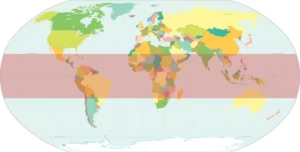
  • Open to all solar-rich countries located between the Tropics of Cancer and Capricorn that are UN members.
  • Countries outside this region can join as partner members.
  • Over 100 countries have signed the ISA Framework Agreement, and 90+ have ratified it.

ISA Assembly

  • The Assembly is the apex decision-making body of the ISA.
  • It includes representatives from all member countries.
  • The Assembly decides key matters like the appointment of the Director-General, budget approval, and institutional functioning.
  • The first ISA Assembly was held in October 2018 in Greater Noida, India.

Conclusion

Through the ISA, India is leading global efforts to make solar energy affordable, accessible, and sustainable, strengthening its role as a champion of climate action and clean energy transition.

This article has been updated and published in detail on our new platform. Please visit the link below for the latest version:

👉 Read the full article on ekamiasacademy.in

AIM-120 AMRAAM MISSILE

TOPIC: (GS3) SEQURITY: THE HINDU

The United States is reportedly preparing to supply AIM-120 Advanced Medium-Range Air-to-Air Missiles (AMRAAM) to Pakistan, following their recent cooperation in a rare earths deal. This move has drawn attention due to its potential impact on South Asian security dynamics.

AIM-120 Advanced Medium-Range Air-to-Air Missiles (AMRAAM)

About AIM-120 AMRAAM

  • The AIM-120 AMRAAM (Advanced Medium-Range Air-to-Air Missile) is a radar-guided, beyond-visual-range (BVR) air combat missile developed by the United States.
  • Designed in the late 1970s and 1980s, it entered operational service in 1991 with the U.S. Air Force, replacing older missile systems like the AIM-7 Sparrow.
  • It is one of the most widely used BVR missiles globally, with over 35 countries employing it.
  • Major users include the U.S., U.K., Japan, Australia, and NATO allies.

Platform Compatibility

  • The missile is integrated with several fighter aircraft, including:
    • American jets: F-15, F-16, F/A-18, and F-35.
    • European aircraft: Typhoon, Gripen, and others.

Key Features

  • Speed: Can reach over Mach 4 (approximately 3,000 mph).
  • Range: Effective up to 160 km, depending on launch altitude and speed.
  • Guidance: Uses active radar homing, allowing “fire-and-forget” capability — the pilot can disengage after launch.
  • Data Link: Features a two-way data link that enables mid-course guidance updates for higher accuracy.
  • All-Weather Operation: Capable of functioning in day or night, all-weather conditions.
  • Combat Advantage: Its onboard radar enables the missile to track and destroy maneuvering targets independently.

Strategic Importance

  • The AIM-120 AMRAAM provides air superiority by allowing engagement of enemy aircraft from long distances.
  • Its potential supply to Pakistan raises regional security concerns and could influence air combat balance in South Asia.

Conclusion

The AIM-120 AMRAAM remains a cornerstone of modern aerial warfare, enhancing the combat capabilities of air forces worldwide. Its advanced radar guidance and long-range performance make it a key deterrent and strategic asset in contemporary air defense systems.


This article has been updated and published in detail on our new platform. Please visit the link below for the latest version:

👉 Read the full article on ekamiasacademy.in

Write a Review

Your email address will not be published. Required fields are marked *